Author Archive: Ed Driscoll

THE CORBYNIZATION OF THE DEMOCRATIC PARTY CONTINUES APACE: Provocative Lake Oswego theater’s marquee message about Jews provokes criticism, worry.

A Lake Oswego [Oregon] movie theater known for provocative marquee messages drew rebukes from members of the Jewish community this week after its latest sign compared Jewish history to “The Odyssey,” the ancient Greek epic that inspired Christopher Nolan’s newest movie.

The marquee for the Lake Theater & Cafe in downtown Lake Oswego read, “Before there were the Jews, there was The Odyssey,” ahead of the film’s highly anticipated release Friday.

The message was removed from one side of the marquee on Thursday but remains on the other side, according to local residents who saw it Friday.

The foremost criticisms of the marquee missive included that the statement was incorrect – and that it might spark antisemitic acts, such as the death threat scrawled on Northwest Portland’s Congregation Beth Israel building in 2022.

“It’s historically inaccurate. That’s the first piece,” said Rabbi Eve Posen of Congregation Neveh Shalom in Southwest Portland. “It’s a movie that doesn’t need much to get people to come see it, so why the theater would make this decision knowing that it’s historically inaccurate makes no sense.”

Historians generally date “The Odyssey” to the eighth or seventh century B.C.E., while the Jewish people predate that period by centuries.

Posen said she began receiving complaints Wednesday morning from congregants who were offended by the message. Others in the community also were outraged by the theater’s message.

In an email to the theater, West Linn resident Abby Farber wrote: “I think your marquee advertising ‘The Odyssey’ contains an inappropriate reference to Jews. If it’s an attempt at humor, it falls flat. Moreover, in this era of rising antisemitism, I think it’s also highly distasteful to everyone who is a fair-minded person.”

Farber continued: “What do Jews have to do with this piece of fictional art? Why bring up a religion? Definitely not funny.”

Wait until the owners of the theater discover who invented the idea of longform motion pictures adapted from an important novel or story as well, long before Christopher Nolan’s version of The Odyssey.

 

WE’VE DESCENDED INTO SOME SORT OF BIZARRE HELL-WORLD IN WHICH VAN JONES IS A VOICE OF SANITY:

BABYLON BERLIN, THE NEXT GENERATION: Transgender neo-Nazi assigned to women’s prison, despite wearing a mustache and being biologically male.

“A neo-Nazi who claims to be transgender has been sent to a women’s prison in Germany despite being suspected of mocking gender self-identification laws,” reports The Telegraph. It is Sven Liebich, a biological male who still has a mustache:

Marla-Svenja Liebich – who was born a man and named “Sven” before registering as a woman – was extradited on Wednesday from the Czech Republic to a prison in Chemnitz, Saxony.

The German far-Right provocateur, who has been photographed at rallies in a Nazi-style uniform, disappeared last August.

He had failed to attend a different women’s prison to serve a one-and-a-half-year jail sentence imposed in 2023…

The following year, while appealing against the sentence, the 55-year-old registered as a woman, exploiting a reform that made it easier to change legal gender.

His “transition” was widely seen as intended to mock the self-determination act…The reforms introduced by [Germany’s] centrist coalition simplified the process of changing a person’s name and gender on official documents.

Liebich, who now appears in public wearing women’s clothing and a moustache, claimed the gender change and request to serve the sentence in a female prison were in order to avoid “discrimination” from male inmates.

A male neo-Nazi was sent to a woman’s prison in Germany? Kamerad, you have no idea were a Nazi-curious politician almost went in America:

OLD AND BUSTED: “Kids in Cages.”

The New Hotness? Meat in Cages! California Walmart locks up pricey meat to fight shoplifting.

First it was spray paint. Then eye drops. Now, even ground beef is under lock and key.

A San Jose Walmart has reportedly taken anti-theft measures to a new level, placing pricey cuts of beef and even packages of ground meat inside metal security cages to keep would-be shoplifters at bay.

Influencer Tony Bartleson — better known online as “Meatdad” — posted a video from inside the California store showing rib-eye steaks and ground beef wrapped in wire security devices.

Holding up a cowboy rib-eye priced at nearly $16 a pound, Bartleson quipped: “Welcome to California.”

The video also showed a three-pound package of ground beef locked inside its own metal cage. The clip has racked up more than 3.8 million views.

Bartleson said he was stunned by the response.

“Seeing basic food items locked behind cages is sad,” Bartleson said in a statement to The Sun.

“My hope is that we can get to a point where measures like this aren’t necessary anymore—where people don’t have to steal just to eat, stores don’t have to lock up food, and everyone has reliable access to the necessities they need.”

“I think most of us want to live in a world where people can put food on the table with dignity, and I hope we continue moving in that direction,” he added.

It’s not so much the wire around the meat, as the anti-theft tag attached to it, which trigger the store’s alarm if someone tries to tamper with it, or shoplift it.

Mr. “Meatdad” was quoted above saying, “I think most of us want to live in a world where people can put food on the table with dignity, and I hope we continue moving in that direction.” No, thanks to leftists in Sacramento, California is moving away from that direction. In December of 2022, Virginia Postrel wrote in the Wall Street Journal: What Shopping Did for American Equality.

The urban palaces of early department stores, the climate-controlled corridors of suburban malls, the endlessly scrolling pages of Etsy, the utilitarian aisles of Walmart and the chatty reveals of haul videos aren’t merely sites of envy or exchange. They’re places where Americans—both buyers and sellers—work out who we are and who we want to be. Since the mid-19th century, modern retailing has tested the practical meaning of equality and freedom.

When A.T. Stewart opened his multistory dry goods store in 1846, the Manhattan merchant introduced two revolutionary practices that we now take for granted. He let anyone come and browse freely, whether or not intending to buy, and he charged every customer the same price. Both policies changed the everyday meaning of social equality.

At Stewart’s, wrote a journalist in 1871, “you may gaze upon a million dollars’ worth of goods, and no man will interrupt either your meditation or your admiration.” The store and its many emulators established a new social norm. Any well-behaved patron, regardless of class or ethnicity, could freely examine the merchandise without being pestered or pressured to leave.

Unfortunately, there are less and less “well-behaved patrons” and more and more looking to fleece businesses – sometimes on an industrial scale – and thus more and more goods enclosed in cases and security tags.

NIXON’S THE ONE, NOW MORE THAN EVER! Young conservatives have an unlikely new icon: Richard Nixon. ‘Nixonmaxxing’ swag and TikTok videos have helped trigger a rethinking of the former president’s legacy among some conservatives.

The reason Nixon is important for the right,” said Christopher Rufo, a conservative culture warrior who has advised Trump on dismantling the modern administrative state, “is that America has been essentially stuck in the year 1968.”

The progressive ideas that animated Nixon’s enemies now motivate the opposition to Trump, Rufo said, setting the stage for what he described as “a counter revolution.”
The first step in that rebellion for the right, he said, was for conservatives to recapture the memory of their own heroes: “It is a way for conservatives to regain their self-confidence, and to reject delegating their self-perception to the left.”
The White House welcomes the comparison between the two presidents.
“President Nixon exposed the treachery of the Deep State and Fake News media,” White House spokesman Kush Desai said.
“Decades later, President Trump has consistently, and successfully, fought against these same entrenched interests for the American people and put our country first every single day.”
Nick Solheim, 29, began to notice an uptick in discussions about Nixon during the Biden administration.
“I see this argument among young people going through our programs all the time about whether Nixon was all great or all bad,” said the CEO of American Moment, a conservative organisation dedicated to training right-of-centre policy staffers.
“I’d say the consensus is a little bit of both.”
Peyton Mikolayek, 19, regularly shows off her large collection of pins, posters, and other Nixon memorabilia to her nearly 500,000 followers on TikTok.
“I get a lot of strange old men in my DMs,” said the rising junior at Johns Hopkins University, who said she leans liberal.
“Maybe it’s just because I’m Gen Z, but there’s this certain emotional distance from his presidency,” Mikolayek said in explaining her interest in Nixon.
Asking her about Watergate, she said, “is almost like asking someone what they think of the Teapot Dome scandal.”
Mikolayek said she prefers a more complete picture of Nixon that includes the lows of Watergate, but also the highs of his accomplishments such as changing the voting age and Title IX.
At the Nixon Library, Vance compared Nixon’s 1972 win to Trump’s latest victory, arguing that the coalitions that returned both Trump and Nixon to the White House were broadbased and more durable than the one that made Ronald Reagan president.

“Reagan could not have won his landslide in 2024,” Vance said because of national demographic change, before adding “Richard Nixon maybe could have.”

Both the right impeaching Bill Clinton in 1998 and the left impeaching Trump twice during his first term (and they’ll catch another case of impeachment fever if they win one or both houses of Congress in November), have made Watergate look far less tectonic than when it was sold to the American public by the DNC-MSM in the 1970s. As Glenn has written, “Recent Events Have Made Me Doubt the Entire Watergate Story:” Nixon’s Revenge.

GOODER AND HARDER, LA:

The latter, as Adam Carolla noted last year:

In one of the books I wrote, I outlined a scenario.

I used to come here via Forest Lawn Drive, which is a long stretch of road that runs along the cemetery. It’s kind of long—you guys may know it—and it doesn’t have cross streets or anything like that. So people tend to speed on Forest Lawn Drive because it’s just long, and there’s rarely any traffic on it. People in L.A., when there’s no traffic, think, “All right, let’s make up a little of this time.”

So the scenario is this: I would drive down Forest Lawn Drive and see, on one side of the road, a motorcycle cop who would back his bike up a driveway in a shaded, wooded area near the Jewish cemetery next to Forest Lawn. He’d be back there with his radar gun out, waiting for citizens to speed. I’d see him pull over soccer moms in minivans because, inevitably, they’re going 57 in a 45, and they get pulled over. Okay, fine.

On the other side of Forest Lawn Drive were many illegal immigrants selling flowers that they’d bought downtown to resell without a business license or any other form of regulation—just cash and carry. On the other side of the street, a bunch of people were selling flowers to those visiting their dead nana in a mausoleum.

The City of Los Angeles—and, in general, California—is this way: it has no interest in the illegal activity happening on one side of the street. That’s people engaging in illegal behavior.

Now, there’s a florist up the street, and that person has to carry all kinds of insurance, pay all kinds of taxes, worry about being sued by an employee for wrongful termination, deal with OSHA, and so on. There will be very vigorous compliance enforcement for the taxpayer, and it’ll be very vigorous for the soccer mom. But for the illegal vendor? No problemo.

If you go to SoFi Stadium, you can buy shots of tequila outside the stadium while illegal vendors sell you Tecate beer and “ghetto dogs” right next to cops who are doing security.

The city has declared a war on taxpayers and regulated them to death. But if you’d like to sell food illegally, you can pop up on any corner and do whatever you want. They walk right past those people. They never shut them down, and they never send them a summons.

The city council agrees with this. They agree that you should be regulated out of business and taxed out of business. But if you want to create a street black market where you sell food, you can do it.

By the way, every time you send a health inspector over to my business, you’re doing it under the guise of safety. Except you don’t seem to have a problem with people cooking whatever food they want on a sidewalk and selling it to people. No thoughts.

Once cities like San Francisco and Los Angeles do this—once you essentially look the other way for the homeless, junkies, illegal immigrants, criminals, or whoever it is, while shining a spotlight on taxpayers with overregulation, over-permitting, and trying to manage every grain of their lives, versus saying to illegal immigrants, “Go do whatever you want,” or to the homeless, “Go shoot up wherever you want or sleep wherever you want”—then you’ve lost it.

L.A.’s there. San Francisco’s there.

Look, if you’re not a taxpayer and you don’t have a checking account, whatever city you’re in, they’re not going to be nearly as interested in you as they are in the people who have a checking account, pay taxes, and can be compliant.

Basically, the compliant people are paying them. So it’s like, okay, who do you make money on? When you’re running a city and you need to keep the lights on, who do you go to?

Well, I’d go to Mark Geragos or Adam Carolla because those guys have businesses. We can charge them for permits. We can charge them taxes—land taxes, business taxes, whatever.

Okay, what about the homeless guy with a load of shit in his pants over there? Well, that guy costs us money. He doesn’t have anything. He costs us money because we’d have to take him somewhere, incarcerate him, process him, put him in housing, or something like that.

So that guy costs us money. These guys make us money.

Then they go, “Well, why don’t we focus full-time on these guys because they make us money, whereas the illegal immigrants, the homeless, and the junkies cost us money?”

You go, “Okay, well, that sounds like a plan.”

But you focus too hard on these guys. Those other groups start flourishing in terms of numbers, and then these guys say, “Fuck it. I’m moving to Nashville because I’m tired of you being up my ass if you’re not going to do anything about these guys. I’m running a business, these guys are camping in front of my business, and you want me to pay taxes on my business, but you won’t do anything about them.”

And when that starts, that’s the beginning of the end of a society.

The Brits call it “managed decline,” but for L.A., it’s a rapid descent into anarchy.

HMMM:

I would think ideology plays a far greater role than gender. In his 2001 book, Volume One of The Age of Reagan, Steve Hayward wrote that by the early to mid-1960s:

The deterioration in criminal justice was not limited merely to catching criminals; punishment also began to slip. Even as crime was rising sharply, the number of criminals in prison was falling, and average time-served was declining. Punishment was out; “rehabilitation” was in. The public went along with this—for a while. In July 1966, a Gallup Poll found for the first time a larger number of Americans opposed the death penalty, by a 47 to 42 percent margin. This did not last long, however, and as crime rose, support for the death penalty soared back to 67 percent by 1976, peaking at 79 percent in September 1988.

In the face of this obvious deterioration in the criminal justice system, liberals decided to blame—society. Johnson had appointed a President’s Commission on Law Enforcement and the Administration of Justice, which reported to the American people in February 1967 that neither law enforcement nor the administration of justice could do very much by themselves to stem rising crime. “The underlying problems are ones that the criminal justice system can do little about,” the Commission said. “Unless society does take concerted action to change the general conditions and attitudes that are associated with crime, no improvement in law enforcement and administration of justice, the subjects this Commission was specifically asked to study, will be of much avail.”

The Commission’s report became a collateral endorsement for enlarging the Great Society: “Warring on poverty, inadequate housing and unemployment, is warring on crime. A civil rights law is a law against crime. Money for schools is money against crime. Medical, psychiatric, and family-counseling services are services against crime.” The Commission endorsed, among other progressive measures, giving convicts furloughs to work in the community during daytime hours. The only measures the Commission didn’t endorse were the ones the public most strongly desired: money for police protection and more prisons. To the contrary, the Commission endorsed lenience toward criminals: “Above all, the Commission’s inquiries have convinced it that it is undesirable that offenders travel any further along the full course from arrest to charge to sentence to detention than is absolutely necessary for society’s protection and the offenders’ own welfare.”

Liberalism would be a generation recovering from this kind of thinking. Many poor urban neighborhoods have yet to recover, for it was precisely the poor, and largely black, populations of central cities who suffered most from this negligent criminology—the very constituency liberals thought they were advancing. Blacks were two and a half times more likely than whites to be victims of crime in 1966, and this gap would widen over the next decade as black victimization in the inner city soared. Charles Murray noted that “it was much more dangerous to be black in 1972 than it was in 1965, whereas it was not much more dangerous to be white.” By 1970, social scientists at the Massachusetts Institute of Technology concluded, a person living in a central city faced a higher risk of being murdered than a World War II soldier did of dying in combat. But when Richard Nixon and conservatives called for a return to “law and order,” the phrase was attacked as “a code phrase for racism.”

Whatever their gender, why should we expect Europe’s pandering leftist judges to be any softer on crime than ours historically have been?

UPDATE:

ROGER KIMBALL: ‘Art’ and the Pathology of our Age.

And then there was the student at the Ontario College of Art and Design who, in 1996, pushed his own boundaries with an “artwork” that consisted of him vomiting on paintings by others, a Piet Mondrian in New York and a Raoul Dufy at a museum in Ontario.

The truth is that, rhetoric to the contrary notwithstanding, there is nothing new or “challenging” about the “artists” who populate the trendy precincts of contemporary art. All their “shocking” moves were long ago pioneered by Marcel Duchamp and his fellow Dadaists. Indeed, Marcel Duchamp mapped out both large domains of the pseudo-avant-garde. When Duchamp took objects from everyday life — a bottle rack, a snow shovel—and impishly exhibited them as works of art, he pioneered the entire genre of art-as-banality. When he exhibited a urinal as a sculpture, he twitted the more delicate sensibilities of an earlier age with exactly the same sort of naughty schoolboy outrage that (to take but one example) Tracey Emin’s sordid exhibitionism recycled, lo, these many years later. (Pardon, that’s Dame Tracey Emin to you. Yes, really.)

What our latter-day Dadaists have accomplished is simply the domestication and routinization of the avant-garde. They preserve the gestures but lack the spirit. They pretend to be “challenging” or “transgressing” conventional boundaries, but all such boundaries were long ago erased. Far from guying conventional taste, today’s self-styled avant-garde are today’s conventional taste. The only thing these “artists” challenge is our patience. It is a melancholy, not to say tiresome, spectacle. What it says about our culture is partly depressing, partly anger-inducing. The really breathtaking feature of the thing is that these “artists” actually seem to believe they are brave aesthetic and existential pioneers. It’s contemptible, yes, but also quite sad. Curiously, this is something that Duchamp himself recognized when his impish gestures became celebrated by the art world. “I threw the bottle rack and the urinal into their faces as a challenge,” Duchamp noted contemptuously, “and now they admire them for their aesthetic beauty.”

Assuming the BBC didn’t go full Michael Moore and staged this scene, you knew the war in Afghanistan was doomed when our betters thought that Duchamp’s style of modernism was something vitally important to teach to young women there: Money Down The Toilet In Afghanistan, that time when progressive US colonialists tried to enlighten Afghans by teaching them about the glories of Dadaist art.

Cockburn dredges up something so horrible and hilarious that it’s straight out of a Monty Python sketch. In it, the American occupiers attempt to enlighten a group of Afghan women by showing them Marcel Duchamp’s famous urinal-as-museum-piece, and telling them that it’s important art. Cockburn says watch to the 31-second point and see the moment when America failed in Afghanistan:

https://youtu.be/wdrvpSfJM1w?si=bsn2Ie6tsshKp89c

As original Saturday Night Live writer Anne Beatts famously said, “You can only be avant-garde for so long until you become garde.”

57 YEARS AGO TODAY:

Obligatory: “If she had lived, Mary Jo Kopechne would be 62 years old. Through his tireless work as a legislator, Edward Kennedy would have brought comfort to her in her old age.”

—Charles Pierce, the Boston Globe, January 5, 2003.

HORSESHOE THEORY:

And why not? The biggest difference between International and National Socialism? Better tailoring:

CHICKS DIG BAD BOYS: Why Hot Girls Are Obsessed With Richard Nixon. “The Richard Nixon trend happening right now across social media platforms is a way to show you’re standing up to the status quo, that you’re not content with the mainstream media narratives. For years, people were taught to believe that Nixon was a ‘bad’ President because of how the media attacked him. But in the social media age, Gen Z can sympathize with the plight of Nixon. They feel like they’ve been attacked, ignored, and overlooked as well in many ways. They feel like they’re fighting against a massive political system that wants to keep them quiet. His resurgence in popularity is an attempt to use social media to tell the truth about a political figure who was defamed for decades. He has become relevant because he feels authentic in an age where the internet and rise of AI slop makes everything feel fake.”

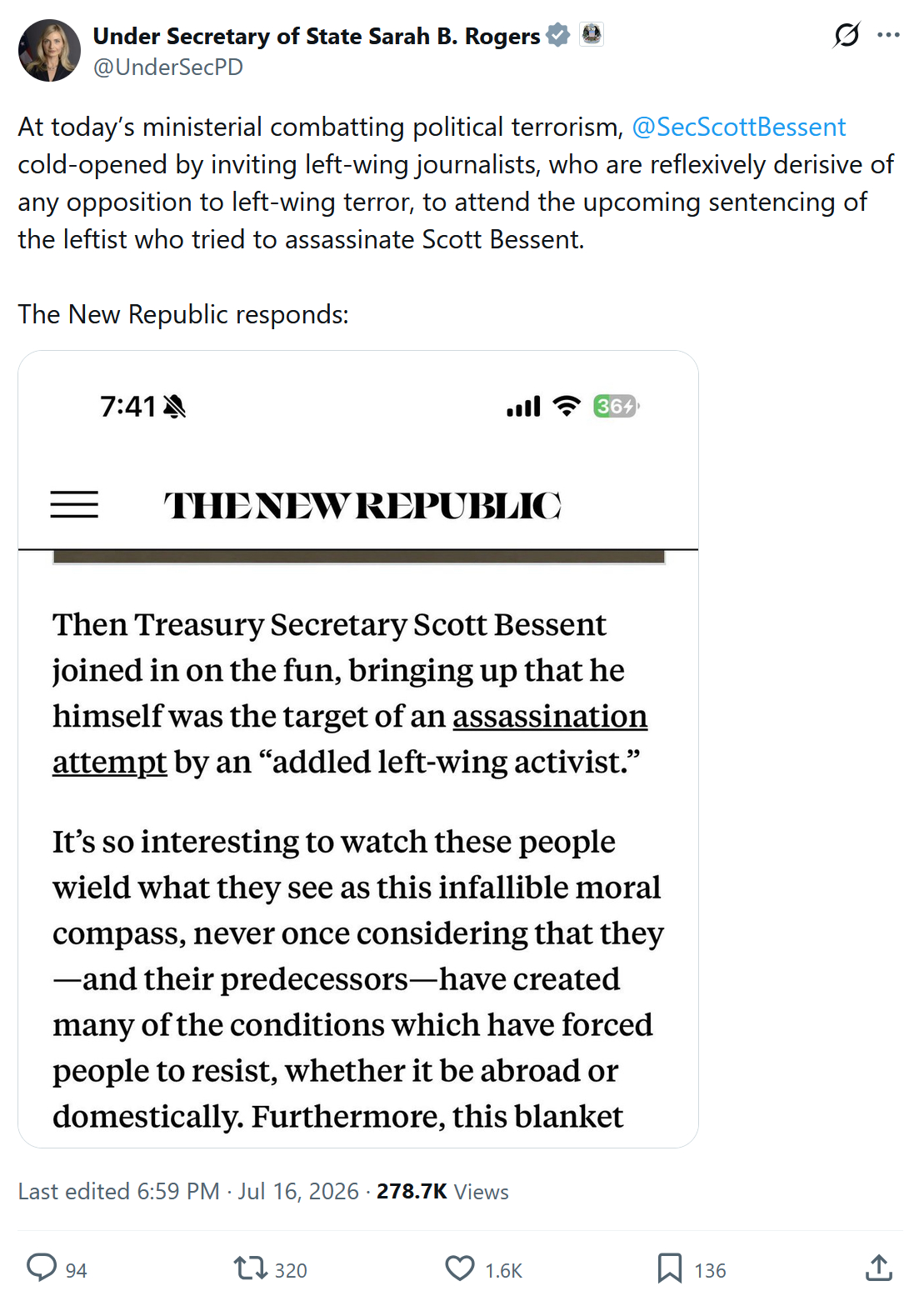
THE NEW REPUBLIC DEESCALATES: Scott Bessent: A Deranged Leftist Attempted to Assassinate Me Shortly After I Became Secretary of the Treasury. The New Republic: Don’t You Understand You’re Forcing Us Lefties to Murder You?

I’m not at all happy to see TNR writing that a Trump official had his assassination attempt coming to him, but it is a step down for the far left publication, which in 2013, suggested that Obama shell the entire GOP congress:

When Russia faced a constitutional crisis in 1993, President Boris Yeltsin did what any good dictator would do — he had the military surround the White House and had tanks shell the upper floors as a demonstration of force, announcing to the press that “Fascist-communist armed rebellion in Moscow shall be suppressed within the shortest period.”

It’s an efficient way to show who’s boss, and the folks at The New Republic seem like they’re warming up to the idea.

Back then, Jim Geraghty tweeted, “The New Republic: Your first choice for violent, authoritarian, eliminationist rhetoric!” Little has changed at the post-Marty Peretz TNR.

Related: Rubio Confronts an Epidemic of Left-Wing Violence and Extortion.

THE MOLOTOV–RIBBENTROP PACT IS BACK, JACK! DSA member says she has no problem supporting ‘secret Nazis’ under one condition:

Far-left podcaster Emma Vigeland raised eyebrows this month with her reaction to Maine oysterman Graham Platner’s political collapse.

Vigeland, a former Young Turks correspondent who now co-hosts The Majority Report With Sam Seder podcast, said on a separate Vox podcast that she doesn’t care if a progressive or socialist candidate has “Nazi” skeletons in their closet.

“I am wary of over-focusing on an individual’s personal character over their platform. You know, I’ve said this before. I don’t really care if say like Bernie Sanders or AOC go home and they’re a secret Nazi, but they go out and they vote for the right things. Like we’re talking about politicians…” the Democratic Socialists of America member said during the podcast, which published earlier in July.

I’m so old, I can remember when “punch a nazi” was an endlessly recurring phrase on the far left during Trump’s first term.

SUCKING IN THE SEVENTIES: Burnham sets out 1970s vision for Britain.

Andy Burnham has revealed a 1970s-style vision for Britain, saying his appointment as Labour leader was “the most significant change” in politics in the past 40 years.

In a speech on Friday, Mr Burnham said the country had taken “a series of wrong turns in the 1980s”, adding that he wanted “more power to reindustrialise”, and the public ownership of utilities and council houses.

* * * * * * * *

Mr Burnham promised to end the post-Thatcher consensus on privatisation and central government control, arguing that while politicians had called for the public to “take back control… they were the ones who gave it away in the first place”.

He said: “We must recognise that this generation of politicians – myself included – have failed to challenge a political culture and an economic model that simply doesn’t work well enough for ordinary people.

“Four decades of the neoliberalism that began in the 1980s have not been kind to the places that built our party, nor to the communities across the UK in rural and coastal areas. So we pledge today to them to be better.”

Drawing on his experience defending Hillsborough disaster victims, he said political power had been used “viciously against them to protect vested interests”, while “economic power [was] cruelly stripped with the deindustrialisation of the 1980s”.

His pitch was also an implicit rejection of the New Labour years, when Mr Burnham made his early political career in the Cabinets of Sir Tony Blair and Gordon Brown.

What could go wrong?

The past may be, as L. P. Hartley wrote, another country, but it’s rarely as foreign as Britain in the 1970s. Viewed from the United Kingdom of 2005, the day before yesterday is a banana republic without the weather. Inflation was up over 25 percent, marginal tax rates were up over 90 percent, and the only thing heading in the other direction was the pound, which nosedived so suddenly in 1976 that the chancellor of the exchequer, en route to an International Monetary Fund meeting, was summoned back from the departure lounge at Heathrow to try to talk his currency back up to sub-basement level. Her Majesty’s government had itself applied for a $4 billion loan from the IMF. Were the Britain of thirty years ago to re-emerge Brigadoon-like from the mists, it would be one of those basket cases that Bono hectors Bush about debt forgiveness for.

Such great Britons as the era could muster—Roger Moore, Michael Caine—had decamped to Switzerland and Beverly Hills. As if to underline the national decline, every flailing industry flew the moth-eaten flag: British Steel, British Coal, British Leyland. They were all owned by the state—even the last, which was the national automobile manufacturer. The government had taken all the famous British car marques—Austin, Morris, Rover, Jaguar, Triumph—and merged them into one. That’s right: the government made your car. Or, rather, a man called Red Robbo did, when he was in the mood, which wasn’t terribly often. He was the local union man at the Leyland plant in Birmingham, though he seemed to spend more time outside the gate, picketing. In Britain union leaders were household names, mainly because they were responsible for everything your household lacked. In the seventies if you opened The Times (when the print unions weren’t on strike) or watched the BBC news (when the miners weren’t on strike and the government hadn’t ordered the TV to close down mid-evening to conserve electricity), it was a parade of eminences from strange, unlovely acronyms such as ASLEF and SOGAT and NATSOPA and NACODS being received by the prime minister as if they were heads of state, which in a sense they were. Britain’s system of government in the seventies was summed up in the phrase “beer and sandwiches at Number Ten”—which meant the union leaders showing up at Downing Street to discuss what it would take to persuade them not to go on strike, and being plied with the aforementioned refreshments by a prime minister reduced to the proprietor of a seedy pub, with the cabinet as his barmaids. The beer and sandwiches went only so far, and would usually be followed a day or two later by chaotic scenes on the evening news of big, burly blokes striking for their right to continue enjoying the soft, pampering workweek of the more effete Ottoman sultans.

The man who presided over the death throes of this ramshackle realm was James Callaghan, prime minister from 1976 to 1979, and an instructive study for all those obituarists of President Ronald Reagan who were so anxious last June to attribute his success to a genial disposition, sense of humor, charming smile, tilt of the head, etc. If you want to know what Reaganesque affability without political will or philosophy boils down to, look at Callaghan. He was famously avuncular; he was known as Sunny Jim. But by the time he and his Labour government left office, the sunniness had decayed into torpid complacency. His most famous words were “Crisis? What crisis?”—which he never actually said, but were put in his mouth by an enterprising headline writer from Rupert Murdoch’s The Sun. And they fit so well that they stuck.

— “The Chap on Duty: James Callaghan (1912-2005).” Mark Steyn in – a very different and much more lively iteration of – the Atlantic, June 1st 2005.

VDH: The World Made Anew.

The Middle East is now suddenly a different place. Whatever the final denouement with Iran, Tehran has lost a half-century and half-trillion-dollar investment in its military and nuclear industrial complex. The once-feared bully of the Muslim Middle East has been humiliated and exposed as a paper tiger, with its economy, and perhaps its very existence, now dependent on the disposition of the Trump administration. It leaves Israel alone because it knows the Jewish state can target any of its unhinged leaders whenever hostilities resume.

In a development that would once have seemed surreal, Israel is providing intelligence and missile defense to the Muslim Gulf states, which are effectively fighting alongside the United States and Israel against a fellow Muslim nation.

Hamas has been crushed. Hezbollah’s once-feared missile arsenal and many of its crazy leaders have been largely eliminated. The Houthis, lacking any credible air defenses, know that every missile they launch at Israel or into the Red Sea could cost them another port facility or power station. Lebanon is reawakening from its 50-year coma.

Russia lost its last client in the Middle East with the fall of the Assad regime. Neither China nor Russia can supply Iran by land, sea, or air, nor can either purchase its sanctioned oil. America’s allies are growing stronger, while the China–Russia axis grows weaker.

Soon the Strait of Hormuz—Iran’s supposed trump card—will be nearly as irrelevant to global energy markets as it is already to the United States. Existing pipelines that bypass the Gulf are being expanded, while new ones are planned or already under construction to the Red Sea, the Mediterranean, and the Gulf of Oman beyond the Strait. The United States is the largest producer of oil and gas in history and does not need Middle Eastern oil or gas—or, for that matter, much of anything else besides.

Exit quote: “Add it all up, and the picture is almost surreal: at the very moment the Left insists that the United States has grown weak and isolated, America and its allies occupy a position of global preeminence not seen since the end of World War II.”

It’s VDH, so read the whole thing.

BIAS THROUGH OMISSION:

The DNC-MSM refought 2016 and January 6 endlessly, but are “unexpectedly” not very curious about what happened to the entire world in March of 2020.’

UPDATE:

IRAN MORPHED INTO MAMDANI’S NEW YORK SO QUICKLY, I HARDLY EVEN NOTICED: Iran issues grim new order to citizens after US strikes ‘hit power plants’ as conflict spirals.

Iran has told its citizens to turn off their air conditioning during peak hours as the country’s power grid came under strain amid US strikes.

Tehran’s energy ministry said that the power restrictions were necessary ‘to help ensure a stable electricity supply in the southern provinces, which are currently facing extreme heat and attacks on electricity supply facilities.’

Temperatures in the capital were expected to hit triple digits Friday, with highs of 102F on Saturday and Sunday.

Donald Trump ordered the US military to hit Iranian bridges throughout coastal cities along the Strait of Hormuz. A report from Iranian state media claims an American missile struck in the vicinity of Qeshm, while other reports said locations around the island were hit by projectiles. The US also fired on a ship accused of trying to break the naval blockade.

Trump has threatened to broaden the campaign to Iran‘s power plants and bridges unless Tehran returns to talks, warning in a Fox News interview that attacks would intensify next week.

Related: “‘We are in an essential and existential war with America,’ [Iran’s] Qalibaf said. Who pulled a switcheroo on them? After decades of ‘Death to America’ ain’t that a surprise.”

Exit question from Lee Smith at Tablet: Is Trump Ready to Win Yet? “The reason America doesn’t win wars is not that it wants to turn tribal confederations into liberal democracies or teach surrealism to veiled schoolgirls or sow corruption abroad and reap the profits. Those are all effects of the fundamental problem, which is deciding, for whatever reasons, not to win. For Trump, the choices are stark: either preside over another American war without resolve and go down in history as the American president who forfeited America’s postwar birthright and lost the strait, or decide to win.”

PENTAGON REFUSES TO PUNISH PILOT FOR LOW BEACH FLYOVER.

Yes, and?

BLUESKY GAVE UP ON COMPETING WITH X: “Bluesky really did grow for a while and lots of people on the left started trying to move not just their own accounts but many of their followers over to the new platform. These days the site has 45 million registered users. And yet, 18 months later it’s fair to say that Bluesky is nowhere near being a competitor to X. Exact numbers are hard to source but X currently has about 250 million daily users whereas Bluesky is hovering somewhere between 1.5 million daily users and fewer than half that.”

It’s not exactly the friendliest, most welcome place to hang out: