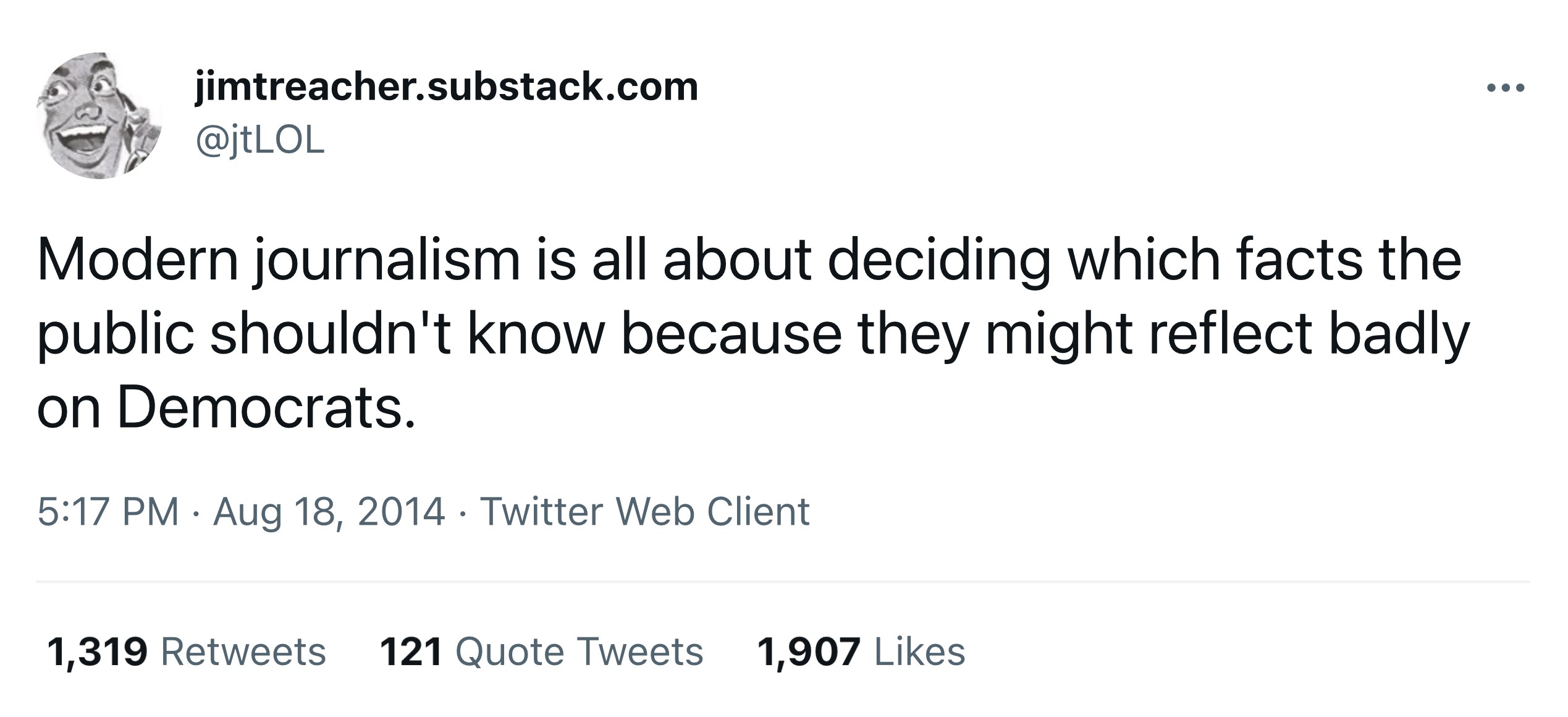
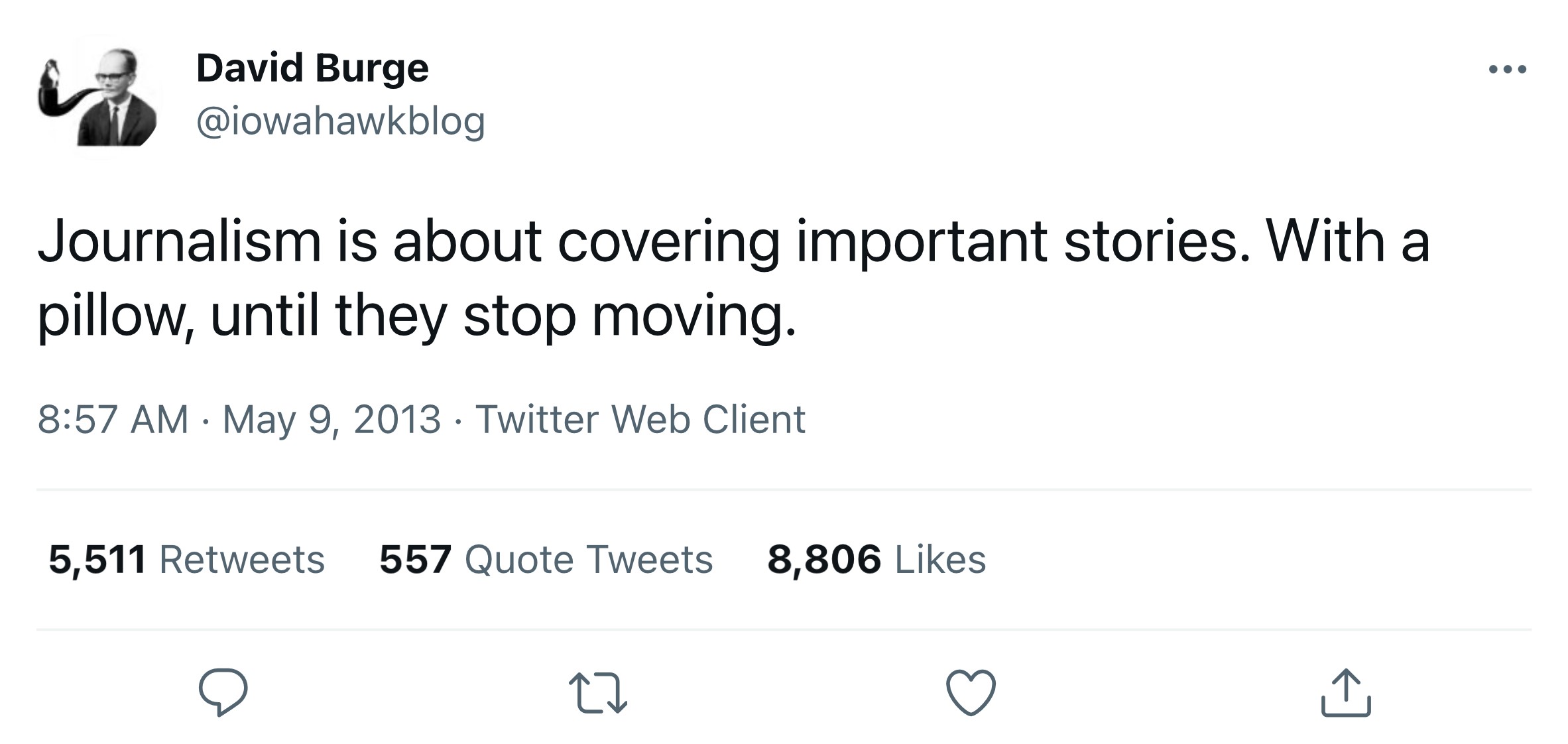
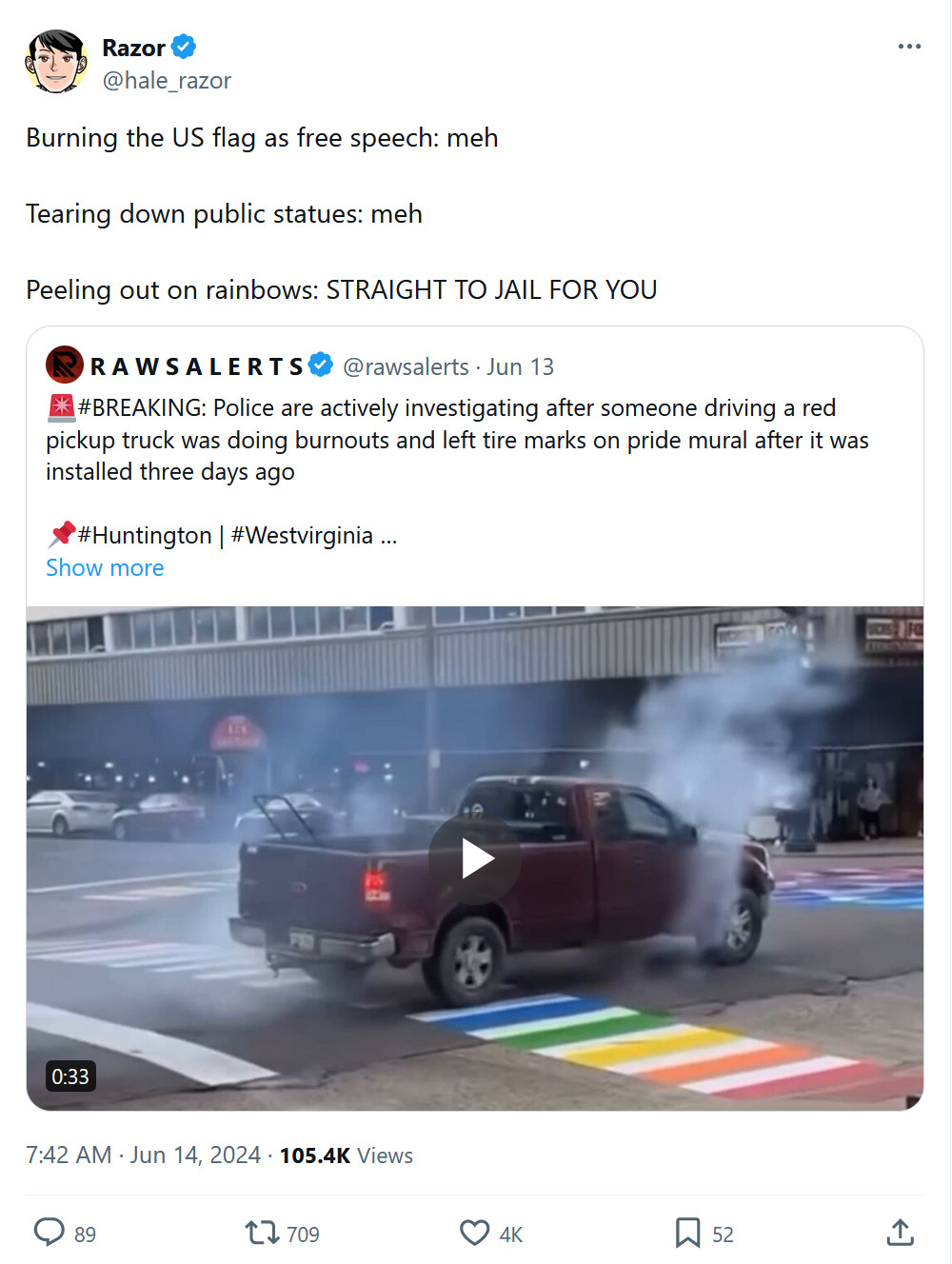
So let’s see if I have this straight. The New York Times will review a bad book I wrote in 1997, offer it some faint praise, then have that faint praise butchered by a reporter — who is walking arsenic — for the Los Angeles Times. The New York Times (and Los Angeles Times and Washington Post) will then all refuse to touch The Devil’s Triangle, a 2022 book that has important historical and cultural meaning and answers every question the Stasi media bombarded me with in 2018. Then, in the copy of a different book entirely that attacks me, New York Times reviewer Alexandra Jacobs expresses longing for me. She is the same reviewer who refuses to download my book and read it.
Adhering to leftist orthodoxy can sure get confusing.
Confusing for the Democratic party stenographer, but usually pretty simple for the reader:
Can a bot powered by artificial intelligence run a city? Wyoming resident Victor Miller thinks so.
Miller, 42, filed paperwork for him and his customized ChatGPT bot, named Virtual Integrated Citizen or “Vic,” to run for mayor in Cheyenne, Wyoming. Miller — who filled out the candidate paperwork with his own information under the name Vic, which is also his nickname — said he planned to serve as a “meat avatar” for the bot. He’ll do the ribbon-cutting while the bot will handle the decision-making — if he advances out of the crowded nonpartisan mayoral primary in August and wins the November election.
But Miller’s bid has run into a speed bump: Wyoming Secretary of State Chuck Gray said it is not legal.
“Wyoming law is very clear that AI is not eligible as a candidate for any office,” Gray, a Republican, said in a radio interview last week, noting that only eligible voters can run for office. “An AI bot is not a qualified elector.”
Sunol California’s former mayor, Bosco the Dog, is looking better all the time.
An artificial intelligence candidate is on the ballot for the United Kingdom’s general election next month.
“AI Steve,” represented by Sussex businessman Steve Endacott, will appear on the ballot alongside non-AI candidates running to represent constituents in the Brighton Pavilion area of Brighton and Hove, a city on England’s southern coast.
“AI Steve is the AI co-pilot,” Endacott said in an interview. “I’m the real politician going into Parliament, but I’m controlled by my co-pilot.”
When writers at The Atlantic, where [Anne] Applebaum is a contributor, talk about “The Democrats’ Last Chance to Save Democracy,” they aren’t lamenting Biden’s unprecedented executive abuse, but the “democratic deficits in the Senate and the Electoral College” — as if these institutions weren’t specifically instituted to diffuse centralized control. They know the difference.
Democrats who want to “expand” the Supreme Court for failing to follow democratic trends, don’t care about the “republic.” After all, many of the high court’s most historic decisions, including Dred Scott and Plessy, cut the legs out from under “democracy.”
Or take the so-called moderate Democrats who want to get rid of the filibuster or use the slimmest of fleeting majorities to shove through massive, generational federal “reforms” without any national consensus — Obamacare or The Deficit Reduction Act [sic]. They’re aware that “reforms” will overturn hundreds of state and local laws. They want local minorities subordinate to the whims and vagaries of national majorities.
Then again, the more “democracy” we have, the more demagoguery thrives. Of course they’re fans.
As it turns out, according to CNN a number of Trump supporters also understand the distinction even if they are unable to articulate it in poli-scientific terms.
At Outkick the Coverage, David Hookstead adds, “It’s great to see the internet come together to win one for the good guys. Chuck Schumer is one of the most powerful people in the country and has been for a long time. Yet, it didn’t save him from being bullied into deleting a grilling photo. The internet can truly be an incredible place at times. How is it possible that Chuck Schumer doesn’t know how to grill a simple burger patty? Cheese on raw meat? What was he thinking? A child could have done it better, and yet, a powerful Democrat Senator couldn’t.”
RIOTS FOR THEE, BUT NOT FOR ME: On Friday, the Atlantic breathlessly announced publication of the following story:
At which point, readers may wonder how Ms [Xochitl] Gonzalez, a novelist, manages to write her books amid the fashionably vibrant racket that she recommends to others. All that shouting and shrieking and “ceaseless music” that she finds so liberating and authentic. Wouldn’t those extended and rather complicated trains of thought be disrupted, and likely made impossible, by all the shouting and laughing, all the whumping and thumping, all those jolly sirens?
Happily, an answer is provided in the pages of Elle Décor, in which Ms Gonzalez opined some two months earlier:
Writing novels is intrinsically solitary. Which is no small part of why I switched professions in the first place. Despite wearing the coat of an extrovert, I am pure Greta Garbo. I want to be alone.
This point is expanded upon:
The early pandemic found me without a permanent residence and on a deadline. In March, while getting my MFA in Iowa, I’d come home to New York City for a quick visit to celebrate having just sold my first novel. Three months and one case of COVID-19 later, I was quarantining with my best friend, her husband, and their toddler in their Brooklyn apartment. Before long, the close quarters and endless sounds of sirens made revising my novel there untenable. I decided to head upstate.
And so, our silence-needing novelist sought out “a gorgeous historic house in downtown Kingston, New York.” Ah, yes. An “upstate vacation rental.”
Perhaps Ms Gonzalez was hoping that readers of her Atlantic article – the one about noise being so vibrant and racially affirming – would not stumble across her Elle Décor piece, published weeks earlier, which rather calls into question her own later claims. And which, it has to be said, suggests a certain pretence, a certain hypocrisy.
In short, then, your desire for peace and quiet is terribly problematic, and probably racist. While hers, not so much. Which is enormously convenient. If not entirely convincing.
Disney’s new Star Wars series, “The Acolyte” is further evidence that Kathleen Kennedy and her acolytes (for life imitates art), are not just creating entertainment but are actively engaged in the cultural revolution.
Kennedy has recently become a meme for this movement, thanks to her on-the-nose lampooning by “South Park.” The predictable corporate response has been canned articles with titles like, “Star Wars Boss Kathleen Kennedy Is Not a ‘Woke Warrior’ at Disney (Report)” which, as anyone who’s paying attention knows, is like printing, “COVID was absolutely NOT the result of a lab leak!” in March of 2020. For “Acolyte,” Kennedy brought in Leslye Headland, a woke lesbian with an axe to grind against her religious upbringing who admits that she rooted for the evil witch Ursula in “The Little Mermaid” and spent four years as Harvey Winstein’s assistant.
The transformation of iconic characters and narratives from the original saga into vessels for neo-Marxist propaganda underscores this strategic shift. In the original saga, Luke Skywalker and Han Solo epitomized the hero’s journey, representing the values of traditional culture. One as the farm boy with the secret lineage who heeds the call to adventure to avenge his dead father and reclaim his role in the world, the other as the redeemable bad boy or the beast to be tamed by the princess. Obi-Wan served as the sage archetype or Jungian wise old man common in such retellings of the eternal story, while Leia was both damsel in distress and leadership material. But that must be forgotten, as the world was obviously an oppressive patriarchy until five minutes ago, 1979’s Ellen Ripley be damned.
You can make the case that the original Star Wars was “Maoist Hackery” as well – Lucas wanted to write a parable about the Vietnam War, with Palpatine as Nixon and eventually, the Ewoks as the Vietcong. (No, really.), but was smart enough to bury that theme deep into its subtext. And he knew how to tell a story, blending and borrowing disparate elements from Flash Gordon and Buck Rogers serials to Dune to Akira Kurosawa’s samurai movies to Joseph Campbell’s The Hero with a Thousand Face. Lucas had a vision and a goal that transcended his cookie-cutter Bay Area far left politics:
There was no shortage of sci-fi in Hollywood at the time. But most were dark, dystopian tales like Rollerball, Logan’s Run, or THX 1138 (Lucas’s 1971 feature-film debut). Lucas was determined to make a different kind of sci-fi movie—something fun that was aimed at 14- and 15-year-olds.
“The reason I’m making Star Wars is that I want to give young people some sort of faraway exotic environment for their imaginations to run around in,” he said in an interview. “I have a strong feeling about interesting kids in space exploration. I want them to want it. I want them to get beyond the basic stupidities of the moment and think about colonizing Venus and Mars. And the only way it’s going to happen is to have some dumb kid fantasize about it — to get his ray gun, jump in his ship and run off with this wookie into outer space. It’s our only hope in a way.”
And despite all of the “Force is Female” boosterism of Kathleen Kennedy et al, Lucas was saved in the editing bay, way back in 1977, by his then-wife: Five Ways Marcia Lucas Gave Star Wars Its Heart.
UPDATE: I much prefer the Critical Drinker’s solo rants than his online chats with fellow pop culture critics, but in the most recent example of the latter format, he brings up another negative aspect to the Acolyte, which might be dubbed Michael Burnham Syndrome:
There’s a pattern here, right? Whether it’s Doctor Who, whether it’s Star Trek, whether it’s Star Wars, of taking something that used to be a unique to one specific male character, whether it’s Captain Kirk, he was the first character that we had that was venturing out into space. Or [Doctor Who,] the very first one, was played by William Hartnell, a white guy. To going back, reconning the history of these franchise, so that actually a Strong Diverse Woman actually did it before them, and we just didn’t know about it at the time. Star Trek’s done it with Michael Burnham. Doctor Who’s done it with the Timeless Children. And now we’ve got it here with Star Wars with with episode three of the Acolyte. I just think it’s such a consistent pattern, there has got to be intent behind this. They think they’re so smart by doing it, but like I don’t know, man, like I’m starting to notice this pattern occurring.
Later in the chat, the Drinker adds:
I could draw a lot of parallels between where Star Wars is at now, and where Doctor Who is at as a franchise. It’s that feeling of the game is almost up, we’re running out of time, running out of money, and it’s just like, we’re into pure “f*** you mode” now. We know you don’t like what we’re making, and we just say f*** you, we’re just going to put everything in that we want to put in: All the sociopolitical messaging, all of our own personal hang-ups, all of our own personal politics, all of it. It’s just going to get rammed down your throat, because we know we’re in The Last Chance Saloon right now, so why not? Why not just throw all the s*** up a wall and see what sticks, and Doctor Who’s exactly the same way.
I’m sure the producers and writers think that their work on the Acolyte and similar product from Kathleen Kennedy is simply their first or latest step in what they hope is a lengthy career in Hollywood, but based on “Streaming and Screaming,” Rob Long’s latest column at Commentary, they might want to think twice:
The limitations that kept the television business small and nasty and profitable—only so many hours in a day, only so many networks in business—began to loosen as basic cable stations emerged and produced original programming of their own. But it wasn’t until the introduction of streaming services that the business broke loose. With unlimited bandwidth to deliver hours and hours of content, unlimited storewidth to amass an endless library, and unlimited money coming in from Wall Street, the streaming services could make as many TV shows as they wanted. They hired writers and produced TV shows with money-drunk abandon, and the greatest thing about those go-go years was, you didn’t need to wait for someone else’s show to get cancelled. Nobody had to die and get out of the way. They just kept adding shows. How many shows? Put it this way: In 2019, the Writers Guild of America had about 11,000 members. Today, five years later, it has around 20,000.
Five years from now, unfortunately, it will probably have a lot less. Show business is going through a painful contraction. In 2023, American television production declined by 15 percent. In the first quarter of 2024, it’s down another 7 percent. Studio space, for the first time in 10 years, is operating at 70 percent capacity. It doesn’t matter how many shows you make, it turns out, if there are still the same number of hours in the day to watch them. So some of those 20,000 members of the WGA are not going to last long enough in the business to get old and in the way. Some of them are going to have to find another line of work now, while they’re still young.
“I’m outta here,” a former writer colleague of mine posted on a group text we share. “Heading to Missouri. Done with this crap.” He has spent the past two years writing and rewriting a project for a big streaming service, weathering the budget cutbacks and two major strikes, only to be told last month that his project is dead. Without the prospect of a show in production, and facing another year or two of unemployment, he and his wife had a complicated and fraught conversation about money (the most complicated and fraught topic there is), and they decided it was better to sell their house and move than stick around and struggle and, eventually, have him shuffle around the Brentwood Country Mart shouting at young people.
I’ve heard the same calculation from writers, directors, even people in talent management: cutbacks, tight belts, more people fighting over fewer opportunities, all signals to get out of the business while there’s still some money in the bank to start over, in some other place, in some other business.
Matthew Weiner should be a cautionary tale for those who produce streaming entertainment — ten to 15 years ago, at the height of Mad Men’s popularity among hyper-online critics, he was the subject of glowing interview after interview, and his name was mentioned in most of the cover stories and profiles of the show’s cast. The amount of ink and pixels spilled over the show was in direct proportion to its actual popularity among television viewers (hey, remember them?), as TV critic Richard Rushfield wrote in 2011:
Mad Men at its height was watched by 2.9 million viewers. In contrast, CBS’ military police procedural drama NCIS last week was seen by 19.7 million viewers. As far as I can tell, NCIS has never been featured on the cover of any major American magazine apart from TV Guide and one issue of Inland Empire, the magazine of California’s suburban Riverside and San Bernadino counties.
Then came #MeToo in 2017, and Weiner’s Hollywood career seems effectively over. One way or another, Kathleen Kennedy’s acolytes (pun intended) will have people gunning for their jobs as well, particularly if streaming viewership continues to contract.
In the spring of 1979, a few weeks after the partial meltdown of a nuclear reactor at Three Mile Island in Pennsylvania, more than 65,000 people marched on the United States Capitol chanting “No Nukes, No Nukes.” As a young reporter at the Washington Star assigned to cover this new movement, I interviewed march organizers and noticed that all of them had previously organized protests against the Vietnam War. This struck me as curious: How had they suddenly become so passionate and knowledgeable about nuclear power?
I later learned that a term exists for this phenomenon—the March of Dimes syndrome—and that the tendency affects many other movements, too. Why, last year, did the Human Rights Campaign declare a “national state of emergency” for LGBT people? Why was the election of the first black American president followed by the Black Lives Matter movement? Why have reports of “hate groups” risen during the same decades that racial prejudice has been plummeting? Why, during a long and steep decline in the incidence of sexual violence in America, did academics, federal officials, and the #MeToo movement discover a new “epidemic of sexual assault”?
These supposed crises are all examples of the March of Dimes syndrome, named after the organization founded in the 1930s to combat polio. The March helped fund the vaccines that eventually ended the polio epidemics—but not the organization, which, after polio’s eradication, changed its mission to preventing birth defects. Its leaders kept their group going by finding a new cause, just as antiwar activists did after achieving their goal of ending the Vietnam War. The Three Mile Island accident offered new fund-raising opportunities and a new platform for veterans of the antiwar movement such as Jane Fonda and her husband Tom Hayden, who both addressed the crowd at that first antinuke rally.
For career activists, success is a threat. They can never declare mission accomplished.
* * * * * * * * *
The March of Dimes syndrome is an ancient social affliction that is especially virulent today and destined to get even worse. Kings, generals, and high priests have always tried to maintain power by declaring new crusades—new enemies to conquer, new sins to extirpate. But it has gotten steadily easier for leaders to rally the public because of another phenomenon, known as Spencer’s Law, named after the Victorian sociologist Herbert Spencer, who observed a paradox in the reform movements of his day to combat poverty, hunger, child labor, illiteracy, and alcoholism.
These problems were widespread in Britain at the end of the eighteenth century. Then, as the Industrial Revolution lifted incomes during the nineteenth century, the working classes saw a dramatic improvement in their diets and living conditions. By mid-century, most Britons were literate because children were going to school instead of being put to work. Alcohol consumption fell dramatically. But it was only late in the nineteenth century, after so much progress had already occurred, that reformers captured the public’s attention with campaigns to help the needy, mandate universal education, and pass temperance laws. “The more things improve,” Spencer wrote in 1891, “the louder become the exclamations about their badness.”
Other astronomers, meanwhile, have proposed that the putative Dyson spheres might just be interference from nearby, hot, dust-obscured galaxies (or Hot DOGs), which are “surrounded by enormous, thick clouds of dust” and are “very good at emitting infrared radiation.”
The scientists who discovered the potential spheres are more than willing to admit that they might not in fact be what they appear to be. They’re going to do what every good scientist does in these situations: Seek more data, particularly via the James Webb Space Telescope, which can make direct observations of the stars.
Also, look for an elderly former chief engineer preserved within a transporter loop inside a starship atop the Dyson sphere:
Modern New York City is a crucible of progressivism. From 2014 to 2022, progressive mayor Bill de Blasio held the reins at City Hall, and until early 2023, progressives held a majority in the city council. Since the 2018 Democratic state legislature victory, progressive policies have reshaped New York, introducing major criminal-justice reforms, higher income taxes, legalized marijuana, and widespread e-bike availability. With weak, moderate Democratic leaders in New York State and City—Governor Kathy Hochul and Mayor Eric Adams—and with both levels of government until recently flush with cash, progressives have freely pursued their agendas in the legislature, council, and high-profile district attorney offices.
Under this regime, though, New York City is regressing. On any life-safety metric, from homicides to fire deaths, and on any measure of prosperity or well-being, from population to job growth, Gotham is stagnant or sliding backward. A walk around town reveals no enlightened, well-funded urban oasis but something more like a twenty-first-century version of Frank Capra’s dystopian Pottersville, with neon cannabis-for-sale signs blinking on storefronts, addicts nodding off on sidewalks, and street vendors selling stolen toiletries, even as drugstores lock up merchandise to deter shoplifters.
When I was down in Florida just before he passed away, Dad was fighting dementia. He was desperately trying to hold on to his memory, continually reviewing everyone’s names, his kid’s names, the names of his children’s kids, the layout of our homes, etc. Incredibly, through that desperate struggle, my father kept talking and singing happily because that was my Dad.
I have two adult children, who bring me joy all the time. But celebrating Father’s Day together on Sunday can’t be as joyous as it was five years ago because my Dad won’t be there.
Biden spokesmen objected that the clip was taken “out of context.” The president, you see, was merely registering the presence of another parachutist who landed just out of the picture’s frame. My own view is that more context makes Biden’s performance seem even worse. As one naughty commentator put, if you look at the longer clip, Biden’s behavior is “even more horrifying,” more geriatric, more porous, “A dull head among windy spaces,” as T.S. Eliot put it in “Gerontion.“
Speaking of Eliot, Joe Biden is the perfect “objective correlative” for the G7 and kindred pustules of globalist exhibitionism. The pop singer Michael Jackson popularized a dance move known as the Moonwalk. Joe Biden gave the group its signature move: an alarming rictus, hoisted upon a vacant stare by a wizened, trembling hand, propelled uncertainly forward with halting steps and slow. Ladies and Gentlemen, it’s the Joe Biden Shuffle. It will not, I am confident, be widely imitated — outside the parlors of late-night comedy, anyway — but it is certain to be long remembered.
He’s fine, absolutely fine:
Everyone freaking out about that Biden clip at G7.
I found the full video. The longer clip, in context, is even more horrifying. pic.twitter.com/obFINP7RNE
Besides, Barry assures me his former veep is fine as well:
Obama has to grab his hand to signal it’s time to move and then has his hand on his back the entire time to guide him off stage. Biden is not okay. They’ll all tell you not to believe your eyes, but my gosh is this obvious. https://t.co/3CJ72PYhA0
Jews have been terrified; one Jewish parent at Columbia, withdrawing his freshman daughter in April, analogized his experience to evacuating a refugee from a war zone.
Perhaps colleges and city centers will see a brief respite, as would-be revolutionaries jet off for summertime gigs at tony investment banks or do-goody nonprofits.
Such a respite would be nice.
But one would still be forgiven for asking the obvious question — which I’ve pondered often as a former law clerk on the US Court of Appeals and a frequent law school speaker: Why are none of these “protesters” in jail?
Nearly every American city afflicted by mass protesting and rioting in 2020 ended up settling and paying out millions in taxpayer money to radical protesters who were allegedly subjected to force by law enforcement.
Denver settled to pay $1.6 million to just seven people.
Austin settled to pay $17.3 million.
The cities, led by Democrats, don’t even bother to fight the cases, preferring to write a check.
The settlement cash doesn’t just end up rewarding the protesters, awarded inflated attorney fees are used to reinvest in the legal groups to grow the operation for the next cause. Additionally, law enforcement morale declines as they are punished for doing their jobs.
But lawsuit settlements aren’t the only way that militant protesters and riot suspects get paid.
I assume there’s a similar dynamic going on today: Welcome to protest season, where the cause changes but the tactics stay the same. “One year, statues are toppled and the next, Jews are bullied, but it’s amazing how the far-left treats such wildly diverse issues with the same small toolbox. It has ever been thus. As one radical wrote for a Students for a Democratic Society publication in the 1960s, ‘The issue is never the issue. The issue is always the revolution.’”
Besides, the authorities have invented much more severe crimes to prosecute these days:
What [Alvin] Bragg did was to turn a misdemeanor — whose statute of limitations had expired — into a felony under a New York statute that requires an accompanying crime without ever explaining what that secondary crime was.
We are bequeathing our children and grandchildren a completely different country than the one our parents, grandparents and Founders bequeathed to us.
Read the whole thing. Joe’s boss did promise “fundamental transformation,” so he can least boast that he delivered just that.
For the first time in recent memory, conservatives have triumphed over the left’s control of mainstream thought. It’s a testament to their collective strength that hardly a person in America would deny the influence of pharmaceuticals on Biden’s behavior. While progressives may dominate the media and social media, conservatives have consistently proven their ability to reshape the narrative.
* * * * * * * * *
This narrative has gained traction because it’s not a far stretch of the imagination to believe that Biden’s doctors have a drug cocktail they administer before he’s set to go out in public. His speeches often start with a high energy level, with him practically yelling at the crowd. As the speech progresses, he gradually lowers his voice, culminating in his signature smile and whisper routine before exiting the stage in the wrong direction.
Before the debate on June 27th, Biden’s handlers may want to dial things back a bit from whatever was in the adrenochrome cocktail they gave him before his State of the Union speech.
Or as Jim Geraghty wrote afterwards in March, “President Steroids Shouts His Way through the State of the Union:” “Taken as a whole, Biden’s speech started to sound like Howard Beale’s monologue from Network. But keep in mind, the number of Americans who watched the whole speech, beginning to end, is considerably smaller than the number who will see brief excerpts on the television news, or YouTube, or other social media. By shouting through almost the entire speech, Biden maximized the odds that any clip or segment that went viral would have him looking fired up and impassioned rather than like the sleepy, whispery, mumbling octogenarian that Americans have soured on so thoroughly.”
The Biden and Trump campaigns have put the finishing touches on their debate on June 27th. We already knew that Jake Tapper and Dana Bash would moderate. Now the two sides have agreed to several ground rules.
There will be two commercial breaks instead of one. No interaction with campaign staff will be allowed. Will they allow a bathroom break?
Mics will be muted when it’s not the candidate’s turn.
“Both candidates agreed to appear at a uniform podium, and their podium positions will be determined by a coin flip,” according to CNN.
No audience will be present.
No opening statements.
The moderators “will use all tools at their disposal to enforce timing and ensure a civilized discussion,” according to the network. That means no talking over the other guy.
As Rick Moran writes, “With the inability to interrupt the other, there probably won’t be a lot of fireworks. But given how much they hate each other, you have to wonder if they’re even going to shake hands before the debate. Other than that, I’m going to be watching the expressions on both their faces. Daggers and arrows, man. Daggers and arrows.”
Last month, the president’s public approval reached its lowest point in nearly two years. Biden’s approval rating among young Americans is particularly low.
His administration’s inability to connect with this crucial demographic spells trouble for the Democrats. The youth vote could prove to be a decisive factor in November.
Enter “Won’t PAC Down,” a new super PAC with a star-studded Hollywood lineup. The group’s mission? Rejuvenate Biden’s appeal among young voters.
Imagine writers and comedians from “Saturday Night Live” and “Parks and Recreation” joining forces with political strategists to inject some much-needed energy into Biden’s image.
Well, imagine no more.
Hollywood vets and Biden alums launch super PAC to shore up his youth vote problem https://t.co/JMvn7ZOKgi
Their primary goal is to make Biden appear humorous (no easy feat). They intend to achieve this by using a potent mix of comedy and insight designed specifically for Millennials and Gen Zers. Instead of banking on tired celebrity endorsements, they’re enlisting young writers, directors and producers to craft stories that resonate with youth culture.
But is the goal to actually get Biden to the finish line, or simply keep some positive media attention on him in the interim? As Charles Cooke writes:
In life, as in science, it can be useful to extrapolate, and here, in the summer of 2024, it comes time to do just that. It is by now near-universally acknowledged that Joe Biden is too old to perform his duties. It is less universally acknowledged that this has serious implications — the chief among which is that, for all the rococo pageantry that attends his reelection campaign, Joe Biden is not, in fact, running to be president of the United States.
I do not offer this observation in a conspiratorial tone. Joe Biden won the 2020 election legitimately; he is currently serving as the rightful occupant of his office; and he remains eligible to run again, to win again, to take office again, and to exercise all the levers of power that the Constitution would grant his office during a second term. Instead, I mean that Biden is operating as a stand-in, a widget, or a MacGuffin, whose primary purpose is to make it to November 5 of this year without expiring. Most candidates have plans for their coveted four years; Biden has none. He does not expect to be there, and the public agrees with his hunch.
Exit quote: “Biden is little more than a political instrument, to be played for the benefit of his team. Presently, Biden’s utility lies in his staying in the race. Twenty-three seconds after he has won, this will change. And, when it does, the reversal will be astonishing in both speed and scope.”
UPDATE: Finally, a Hollywood superstar emerges, who will do wonders to jump-start Biden’s image among centrist pro-military voters, and those who think his handlers have pushed him far to the left on environmental issues…: Jane Fonda to join Jill Biden at Reno appearance to engage senior voters.
Periodic reminder the Gaza Pier is a stunt designed to buy votes in Michigan and to undermine Israel by boosting the narrative of a humanitarian crisis. It’s costing hundreds of millions of American taxpayer dollars and endangering the lives of US servicemembers. There’s not even a coherent defense of it. On the merits the Pier is unnecessary for getting aid into Gaza, because more than enough comes in through land, and would be ineffective even if it was necessary, because it’s a dumb way to move aid. The whole thing is just brazenly an electoral and geopolitical performance act.
Breitbart News got a hold of a video from the pier itself moving in the “rough seas.”
This week President Joe Biden’s pier in Gaza washed away, and along with it, $320 million in U.S. taxpayer dollars.
That a temporary pier built in the open ocean broke up in a storm should not shock anyone who has ever looked at the sea or watched the Weather Channel. Sailors since the days of the Phoenician trireme have used the expression, “any port in a storm.” For that reason, most piers are built in ports, anchorages and harbors.
President Biden’s pier disaster is not unlike President Jimmy Carter’s “Operation Eagle Claw,” the botched attempt to rescue the Iranian hostages in the final months of his presidency. I would say let’s hope this latest military bungle is Biden’s final Jimmy Carter moment, but that’s unfair to the president from Plains, Georgia. President Carter deservedly had higher approval ratings than Biden at this point in his presidency.
Or as America’s Newspaper of Record suggested at the time:
Let us also not forget that you supported the Occupy takeovers of yester-decade. You supported the state rotunda takeovers by unionized thugs. You supported the BLM riots. You supported the CHAZ in Seattle and similar secessionist movements in other cities. You supported the attacks on churches and pregnancy centers after the Dobbs ruling. You supported the Stalinist show trial against Brett Kavanaugh, as well as the mob that tried to storm the Supreme Court to prevent his swearing-in.
You supported the attack by James Hodgkinson against Republican congressmen playing baseball. You supported the attack on Rand Paul by his neighbor. You supported the campus attacks against conservative speakers and activists. You supported every random street attack against anyone wearing a MAGA hat.
You supported every act of violence, censorship, social coercion, government repression, and outright insurrection so long as it was seen as beneficial to advancing your agenda and, more importantly, as long as it never affected you personally. These shock troops are disciples of the secular religion that you — yes, you, traditional liberals — have propagated for decades. With your winks and nods, you have taught them that trampling other people’s rights in pursuit of your cause du jour is both permissible and preferable.
And the entire time, you told us that “this is what democracy looks like.”
You are who Lenin accurately referred to as “useful idiots.” But I’m not so sure that you still support what democracy “looks like,” now that it “looks like” it has reached your front yard. When they scream that they want to burn the entire country to the ground, they mean exactly that. The monster that you constructed, animated, fed, riled up, and let roam free to dispatch your political enemies is now peering through your bay window, staring at you with a ravenous look in its eyes that evinces neither “solidary” nor “inclusion” with you.
Frankenstein’s monster always comes home to his castle.
Why does Democratic Party governance seem less effective on the West Coast than on the East Coast?
Sometimes I wonder if the West is less serious about policy than the East and less focused on relying on the most rigorous evidence. There’s some evidence for that. But I’m not sure, for it’s also true that West Coast states have managed to innovate exceptionally well in some domains. Oregon pioneered “death with dignity” through physician-assisted suicide and led the way to vote by mail, an important step for democracy. California has some of the smartest gun safety laws in America, championed by Gov. Gavin Newsom. As a result, California has a firearms death rate 40 percent below the national average.
So my take is that the West Coast’s central problem is not so much that it’s unserious as that it’s infected with an ideological purity that is focused more on intentions than on oversight and outcomes.
I ran for governor in Oregon two years ago (I was ousted from the ballot by Oregon’s then-secretary of state, who said I didn’t meet the residency requirement). While running, I’d meet groups of liberal donors in Portland, as the city’s problems cast a shadow over all of us; we’d all be wondering nervously if our catalytic converters were in the process of being stolen. The undercurrent in such a liberal gathering would be the failures of Republicans — but Portland was one mess we couldn’t blame on Republicans, because there simply aren’t many Republicans in Portland. This was our liberal mess.
Politics always is part theater, but out West too often we settle for being performative rather than substantive.
For example, as a gesture to support trans kids, Oregon took money from the tight education budget to put tampons in boys’ restrooms in elementary schools — including boys’ restrooms in kindergartens.
“The inability of progressives, particularly in the Portland metro area, to deal with the nitty-gritty of governing and to get something done is just staggering,” Representative Earl Blumenauer, a Democrat who has been representing and championing Portland for more than half a century, told me. “People are much more interested in ideology than in actual results.”
Politicians in Washington have very short memories, so they repeat the same mistakes over and over.
It was only 17 years ago that the “subprime” mortgage crisis torpedoed the economy and sent the financial markets into the biggest tailspin since the Great Depression. Millions of Americans lost their jobs. One of the matches that lit that bonfire was Freddie Mac and its cousin, Fannie Mae, offering generous, taxpayer-guaranteed mortgage insurance to risky borrowers on loans with low down payments.
It all blew up in the faces of the taxpayers even though the Washington experts said the chances of these mortgages going bust and taxpayers taking a loss was less than one in a thousand.
The biggest taxpayer bailouts went not to the Wall Street banks and investment companies but to Fannie and Freddie.
Here we go again. The latest scheme by the Biden administration is to encourage families to borrow more money by using the equity in their home as collateral. Home equity loans are often very risky. If prices fall, home equity can become negative. There is nearly $18 trillion in home equity, and it’s one of the largest sources of savings and ownership for American families.
Now the Biden administration wants to encourage Americans to borrow even more at a time when credit card and auto debts are at an all-time high. If homes fall in value, families could slip underwater and default — just like during the subprime crisis.
As The Wall Street Journal points out, the other “likely losers” from this scam “would be taxpayers.” The evidence is indisputable from 2008 that the mortgages that ended in default were low-down-payment and low-equity loans.
Of course, if Biden times it right, it blows up early after his re-election, and the press will do their best to bury the result (and/or break out their FDR metaphors and “Depression Lust”). Or it blows up during the second Trump administration, and the press will assign him the blame.
It is now little more than a “developing country”. Its stock market is a “junk shop” selling old tat. And its reputation as a place to do business has “never been so bad’. In the middle of the UK’s dismal election campaign, it would be easy to imagine that Britain was the country under discussion.
But Theodor Weimer, the head of the once mighty Deutsche Börse, was describing his native Germany. And he was absolutely right. After a series of catastrophic policy mistakes by centrist leaders, there is no way back for Germany – and its decline is only going to accelerate from here.
In a speech to Bavarian business leaders delivered back in April, but only made public when it was posted on YouTube this week, Weimer certainly didn’t mince his words. A country that prided itself on its efficiency, that saw itself as the engine of Europe and boasted of its formidable export machine was, as he put it, slipping to third world status.
The coalition government led by Chancellor Olaf Scholz was, he argued, a “catastrophe”, Germany was “economically on the way to becoming a developing country” and “one thing is clear: our reputation in the world has never been so bad”.
No, it was much worse before — as Glenn has insta-quipped, “We have the worst political class in our history. The Germans, at least, can say that’s not true for them. . . .”
Speaking of which, as seen in the Power Line Week in Pictures:
(Via Small Dead Animals, under the well-deserved headline, “Schadenfreude.”)
ANALYSIS: ABSOLUTELY TRUE. America Thrives at the Interstate Exit. Buc-ee’s is about as pure a distillation of American capitalism as there has ever been.
Every manner of commercial snack known to man is sold at Buc-ee’s, from Funyuns to Snickers bars. But that isn’t significant.
What is significant is the Beaver Nuggets, perhaps the world’s best caramel corn sold in embarrassingly large bags. Or the more than 20 different flavors of beef jerky, available in delicatessen-style displays along the back wall (the Mesquite Peppered jerky and the Cherry Maple jerky were the two I fell in love with).
But the Buc-ee’s brisket tacos might just be the greatest convenience-store food ever invented.
All of the employees smile, hustle, and joke with the customers. There’s a Black Friday rush atmosphere to the place, and yet there is no line at the checkout counters, every single one of which is manned by a cashier who works efficiently and enthusiastically — and for a reason: Buc-ee’s pays their employees exceptionally well. A sign at the gas pumps advertises $18-an-hour wages for the lowest positions, up to $200,000 per year or more for a store manager.
It’s a capitalistic shangri-la. No better shrine to productive, happy prosperity has ever graced our beautiful planet. It’s a place that utterly trumps, somewhat hilariously so, all of the grifting and griping of the American Left.
There are no social problems at Buc-ee’s. Beef jerky knows no race, and brisket tacos know no gender. Beaver nuggets and fried pecans have no politics. And if you believe any of this harms the planet, we laugh at your derangement.
Greta Thunberg might just be fed to the beaver if she were ever to complain about a Buc-ee’s.
It might sound stupid to say it: this is about as close to heaven as roadside commerce can get.
Flashback: Episode Five of the Babylon Bee’s series from 2022, on a California couple moving to Texas, where Steve and Timpani discover that you can immanentize the eschaton:
I do have a theory, however. Imposters have taken over Star Wars (and lots of other popular genre properties, from The Witcher to True Detective). Maybe they’re fans, maybe they’re not but they’re certainly masquerading as good storytellers. And they think they know best, making whatever changes they see fit to “make it their own”.
Everywhere you look, there are more screenwriters and producers eager to take great stories and “make them their own.” It does not seem to matter whether the source material was written by Stan Lee, Charles Dickens, Ian Fleming, Roald Dahl, Ursula K. Le Guin, J.R.R. Tolkien, Mark Twain, Raymond Chandler, Jane Austen, or… well, anyone. No matter how major a writer it is, no matter how great the book, there always seems to be someone on hand who thinks he can do better, eager to take the story and “improve” on it. “The book is the book, the film is the film,” they will tell you, as if they were saying something profound. Then they make the story their own.
They never make it better, though. Nine hundred ninety-nine times out of a thousand, they make it worse.
Amen, brother.
I’d say that Star Wars deserves better stewards, but George Lucas didn’t do a very good job of that himself in the later years. In fact, The Acolyte keeps reminding me of the prequel trilogy in all the worst ways.
The Critical Drinker adds that with episode three, “I’m Done And So Is Star Wars:”
The Acolyte represents their ultimate vision for this franchise. It’s the perfect distillation of everything Disney and the so-called creatives that Lucasfilm want to inject into George Lucas’s vision and they’re not going to stop. Kathleen Kennedy recently bemoaned all the criticism that she and women like Leslye Headland have taken for their creative decisions, because the predominantly male fan base just can’t seem to recognize their genius.
Well, congratulations Kathy! Because that seems to be a problem that you’ve gradually solved with every new show and movie that you’ve produced: If there’s no fans left at all, then there’s no toxic male fans left either, genius! So in that respect at least I guess you’ve kind of won by default. Congratulations — Star Wars is all yours now, and this here is your prize: an empire of dust, a franchise in ruins, and really I hope it was all worth it. I hope it was worth the billions of dollars you’ve blown on failed projects over the years. I hope it was worth provoking the contempt, and finally the apathy of millions of Star Wars fans that have just chosen to walk away. I hope it was worth it to have a legacy of absolute failure.
Near the end of Julie Salamon’s brilliant 1991 book, The Devil’s Candy, Brian DePalma and others involved in the stillborn movie adaptation of Tom Wolfe’s epochal 1987 novel, The Bonfire of the Vanities, begin to realize that they’ve produced a dog, and no amount PR hype or post-production massaging in the editing bay is going to save them once the film is released to the general public:
It was common practice for Hollywood studios to hold a special preview just for “the community” shortly before a movie opened. These “industry screenings” were frequently followed by a party and had the appearance of a gala. A giant searchlight outside the theater sent flashes into the sky, and paparazzi would wait outside in hopes of spotting a major celebrity, or a minor one. How well the evening would pay off for the paparazzi depended on the buzz preceding a picture – the early word-of-mouth. If the word was good, there would be plenty of high-level studio executives, major dealmakers, and stars to choose from. However, when the buzz was bad, the “industry” was suddenly populated by secretaries, junior agents, and minor actors – people who’d been handed invitations by their bosses, and people who were happy to be invited anywhere at all.
* * * * * * * *
Two days before the party it had hit De Palma for the first time: he might have directed a disaster.
Exit question: Do those who assembled The Acolyte have similar feelings, or as the quote above from George R.R. Martin implies, do they blame the public for not understanding the breadth of their sheer genius and talent?
InstaPundit is a participant in the Amazon Services LLC Associates Program, an affiliate advertising program designed to provide a
means for sites to earn advertising fees by advertising and linking to Amazon.com.