Author Archive: Ed Driscoll

JEFF DUNETZ: After SCOTUS Abortion Decision, CNN’s Ana Navarro Pushes Eugenics.

Ana Navarro, a pseudo “GOP strategist” and a CNN commentator shocked the news channel’s audiences on Friday when she said that she supports abortion to kill off autistic and mentally challenged people like her own family. In other words, she supports eugenics.

Navarro’s words sounded like those of Margaret Sanger, the founder of Planned Parenthood. Sanger created the organization to practice eugenics–a sick belief that the human “gene pool” would be improved through selective breeding and sterilization. In Sanger’s case, improving the gene pool meant keeping African-Americans, morons, those with a family background with a history of illnesses, mental disease (like Ana?)  serious physical defects, and other undesirables from reproducing.

Perhaps she should used the original German phrase, “Lebensunwertes Leben.”

THE GODFATHER AT 50: Skip The Offer, Take The Cannoli.

My latest over at Ed Driscoll.com, comparing The Offer, Paramount+’s bloated and highly fictitious Mad Men-esque 10 episode making of series with Mark Seal’s brilliant recent book, Take the Gun, Leave the Cannoli.

TOP GUN: MAVERICK CATAPULTS PAST $1B AT WORLDWIDE BOX OFFICE:

Paramount/Skydance’s Top Gun: Maverick has raced past the $1B mark worldwide, becoming only the second movie of the pandemic era to reach such rarefied air — and Tom Cruise’s first time to the milestone in a career that has spanned 40 years. It took just 31 days for the aviators to get to $1B with the total through Sunday at an estimated $1.006B worldwide, including domestic’s estimated $521.7M and $484.7M from the international box office.

Cruise’s flying ace had already raced across $900M last Monday, and a few days prior had topped $800M to become Cruise’s biggest movie ever globally.

The overseas holds on this 36-years-later sequel directed by Joseph Kosinski have been nothing short of stellar. Last weekend was off just 21%, and the current frame, at $44.5M in 65 markets, is down only 26% — simply phenomenal.

Earlier: Top Gun: Maverick: Tom Cruise Delivers the Goods.

VIRGINIA POSTREL: Stakeholder Capitalism Isn’t Working As Planned.

The great value of the Friedman doctrine is that it establishes a coherent standard for making tradeoffs. Maximizing economic value tells you to “spend an additional dollar on any constituency provided the long-term value added to the firm from such expenditure is a dollar or more,” as Harvard Business School economist Michael Jensen put it in a 2010 article.

Stakeholder theory, by contrast, tells you nothing. It assumes you just make everybody happy. And, as Jensen wrote, “Without the clarity of mission provided by a single-valued objective function, companies embracing stakeholder theory will experience managerial confusion, conflict, inefficiency, and perhaps even competitive failure.” Jensen’s article is the best articulation of why what he calls “enlightened value maximization” is indispensable.

But neither he nor Friedman fully imagined the chaos that could ensue without it.

Look at the backlash when Walt Disney Co. tried to placate vocal employees by opposing Florida legislation to ban discussing sexual orientation with younger children in schools. The political pushback — like the original protests — reflected a sense of betrayal by a beloved company whose fans see their dreams and values reflected in its characters and stories.

Appeasing one group of stakeholders alienated others. It wasn’t hard for conservatives to find opposing voices within the company. Disney has nearly 200,000 employees and countless customers. All are stakeholders, and they represent every conceivable viewpoint.

By focusing on business goals, by contrast, Netflix, despite other challenges, has more successfully weathered its own controversies, from conservative uproar over the French film “Cuties” to more recent protests about Dave Chappelle’s jokes about trans women. To make expectations clear, the company revised its cultural guidelines for employees to explicitly say, “As employees we support the principle that Netflix offers a diversity of stories, even if we find some titles counter to our own personal values.”

Stakeholder capitalism implicitly assumes a cultural consensus identical to whatever its advocates believe. It harks back to the mid-20th century, when big US companies enjoyed little competition, mass media marginalized all but a narrow range of political, religious and social views, and hierarchy and security dominated worker expectations. It pretends social media, Slack channels and “bringing your whole self to work” don’t exist.

It’s really not working out well for Disney: Disney’s Stock Price Has Lost 50% Of Its Value After Year Of Leftwing Political Electioneering And Badly-Received Woke Programming.

‘I LOST FRIENDS:’ Former Rolling Stone Journalist Talks Reaction To Him Reviewing What Is A Woman.

“[T]he movie shows academic after academic and activist after activist seething at the mere implication that they should have to explain themselves,” he wrote. “Their attitude is positively medieval: ‘We keep the Bible in Latin for a reason!’”

In the same review, Taibbi applauded the humor in “What is a Woman?”, something the journalist told Shapiro had been completely lost on the Left.

“It’s done with a sense of humor and satirical bend that’s taboo on our side of the aisle now, which I find really strange, because that shift happened almost overnight and imperceptibly,” he said.

Well, not quite overnight; we’ve been exploring how the left lost its edge on comedy for almost 20 years now.

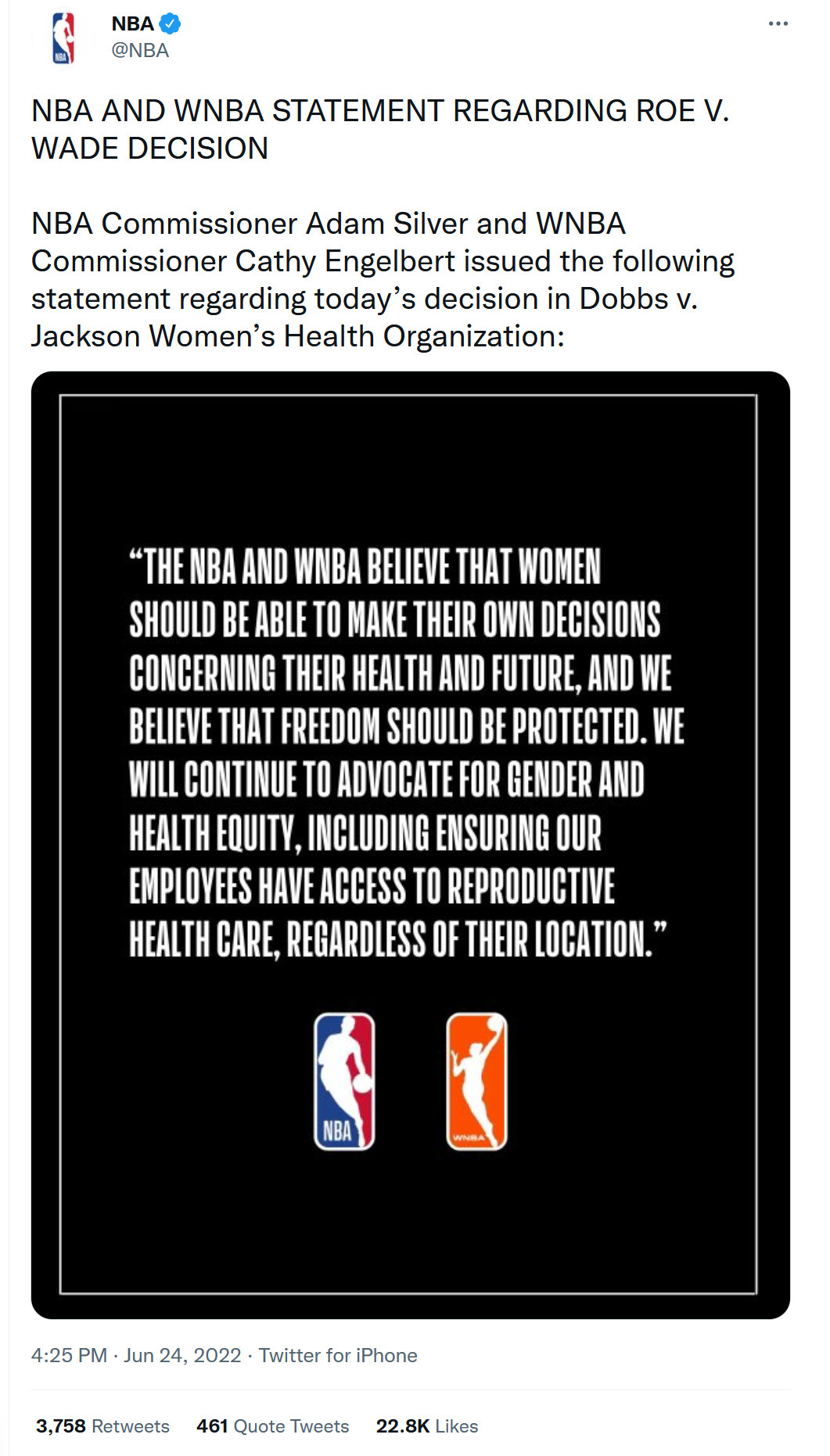
NBA AND WNBA ISSUE STATEMENT REGARDING ROE V. WADE DECISION:

Offer void in China.

THE HILL IS SUDDENLY COOL WITH NATIONALIZING SOCIALISM: Why we must nationalize Big Oil.

In one scenario, the federal government could buy a controlling interest in the three most dominant oil companies, ExxonMobil, Chevron and Conoco. The cost would be around $350 billion, a trivial amount compared with unmitigated climate change or the $5 trillion the government spent on COVID-19 relief, the nation’s defense budget this year ($778 billion), or fossil fuels’ $630.5 billion annual damages to public health and the environment.

The federal government typically nationalizes companies to save them. In this case, it must nationalize Big Oil to save us all from a future we don’t want.

Why has The Hill started working Salon.com’s side of the far left aisle?

“Let’s nationalize Fox News: Imagining a very different media…Excerpted from ‘Imagine: Living in a Socialist USA.’

—Salon.com, January 18, 2014.

● Like [the late communist Pete] Seeger and the FDR cargo cult, Salon also harbors turn-the-clock-back fantasies of their own: Last month, the publication called for the nationalization of the news media because it was uncomfortable with the glut of right-leaning news and opinion led by — you guessed it! — Fox News. (Hmmm — I wonder if someone in the FCC read that article?) Now the Website wishes to turn the clock back on the film industry because of a perceived glut of independent films.

Easy Riders, Raging Stasists, Ed Driscoll.com, February 22, 2014.

“Let’s nationalize Amazon and Google: Publicly funded technology built Big Tech. They’re huge and ruthless and define our lives. They’re close to monopolies. Let’s make them public utilities.”

Salon.com, July 8, 2014.

In any case, as Charles Cooke asked in 2016, “Herewith, an under-asked question for our friends on the progressive left: ‘Has Donald Trump’s remarkable rise done anything to change your mind as to the ideal strength of the State?’”

BRUCE BAWER: Wokesters Take On Classic Movies.

And in the end? They got it. They loved it. “What a great film!” cheered Mia Tiffany, the smart, charismatic young black woman at “Movies with Mia.” And they all zeroed in on what mattered: Rick’s moral choice and the message it sends. “He loves her enough to let her go,” said one of the blonde sisters with admiration. “He’s a good guy. He’s selfless.” “Beautiful. What a great man, Rick,” growled the Portuguese guy. “I love this finale. Incredible…. What a great, great movie.” “This guy is pure man!” exulted George. “I’m overwhelmed.… There is no way this kind of movie will ever be made again…. I’ve still got chills.” “What’s not to love here?” asked Shaneel (who’s apparently Indian) of “Shan Watches Movies.” “No jealousy. No pettiness,” pronounced the young Dan Bongino type at “Flix Talk,” who’d never seen a movie from the 1940s. “I loved everything about this film. I fell in love with the passion of it, the message behind it.” “I love the last half hour of this movie,” said the Canadian boy, calling it “a movie with magic in it,” pondering what it must have been like to watch it in 1942, when the war’s outcome was uncertain, and, reacting to Rick’s statement that “the lives of three little people don’t amount to a hill of beans in this crazy world,” commented intelligently that the whole point of the movie is that three people can make a very big difference indeed.

Of course, this isn’t a scientific sample. Far from it. These are young people who love film and who founded their YouTube channels precisely because they’re open to checking out a wide variety of movies. If anybody of their generation is going to give something like Casablanca a chance, it’s going to be them. Nonetheless, these YouTubers are children of their time. Like everyone else their age, they’ve been brought up in a society and a culture with values far removed in a number of ways from the values that inform a movie like Casablanca. And yet, watching it, they’re wrapped up in the intrigue, amused by the humor, affected by the music, touched by the love story, and, above all, stirred and deeply impressed by the selfless and noble courage of Victor Laszlo and, in that final scene at the airport, of Rick and Ilsa.

Hard as it is to believe in 2022, but maybe the fundamental things really do apply, as time goes by.


K-12 IMPLOSION UPDATE: Marin County Day School Kicks 5 and 8 Year Old Students Out After Their Parents Question Gender-Affirming Care.

On May 25, Paul and Rebeka Sinclair pulled their minivan over to the side of the road, just north of Lake Tahoe, and logged onto a Zoom with Katherine Dinh, the head of the Marin Country Day School.

“Today was the last day of school for your children, Charlotte and Carter,” Dinh informed the couple. The Sinclairs—she’s 37; he’s 51—had been driving home from a vacation to celebrate their anniversary. Dinh appeared to be reading a script. Two MCDS board members joined her on the call but stayed quiet. “Please do not contact any other school employees, particularly Charlotte and Carter’s teachers, as your reaching out to them will cause them further stress,” Dinh continued. “The two of you are not to be on campus again.”

It was the closing act of a year-long drama between the Sinclairs and MCDS, which charges $40,000 per student per year and had been teaching first and second graders about “deconstructing the gender binary”—the idea that there’s no such thing as girls or boys, just a spectrum of relative girlness and boyness.

The Sinclairs weren’t the only parents who had protested the new gender-identity curriculum—most families in their daughter’s class were upset and had been talking about it among themselves. But the Sinclairs had been unwilling to stay quiet. As a result, administrators had suggested that they were homophobic and accused them of tarnishing MCDS’s reputation. (An MCDS attorney had accused the Sinclairs of “defamation” for accusing MCDS of “predatory ‘grooming’ of children.” The Sinclairs never made that accusation.) Friends had stopped replying to their texts. Teachers said they felt unsafe around them. When word got out about why Charlotte, 8, and Carter, 5, had been kicked out, the Sinclairs had to decide whether they could stay in the Bay Area.

“I had no problem being a pariah in Marin,” Beka said. “We were worried about raising our kids long term in an area that was embracing these destructive ideologies.”

Read the whole thing.