Author Archive: Ed Driscoll

CHANGE: Biden Fires Architect of the Capitol Amid Unethical-Behavior Allegations.

[Brett] Blanton’s firing comes after an Office of Inspector General report released in October found that he regularly commandeered government vehicles from the federal agency for personal use, costing taxpayers almost $14,000. Blanton used the cars for trips as far away as Florida and South Carolina, according to the report.

On another occasion, Blanton told Fairfax County police officers that he was a member of law enforcement while trying to pursue a suspect in a hit-and-run crash that took place near his house, according to the report.

Biden has faced mounting pressure to fire Blanton in recent weeks from both sides of the political aisle. “The architect of the Capitol, Brett Blanton, no longer has my confidence to continue in his job. He should resign or President Biden should remove him immediately,” Speaker of the House Kevin McCarthy (R., Calif.) tweeted on Monday.

“The Inspector General’s report was highly concerning, which is, in part, why our first hearing was dedicated to providing oversight over the AOC. His refusal to be transparent and truthful has made clear that he can no longer lead the organization and must resign immediately,” House Administration Committee chairman, Bryan Steil (R., Wis.), said in a statement on Monday.

Fellow committee member Joseph Morelle (D., N.Y.) called for Blanton’s resignation last week after hearings during which Blanton adamantly denied any wrongdoing.

More details from AP: “At a House hearing last week, Blanton also came under fire when he testified that he was not at the Capitol during the Jan. 6 attack because it was a ‘telework’ day under COVID-19 protocols. He also faced fierce questions about Capitol tours he allowed and sometimes conducted despite pandemic restrictions.”
THE BALLOON REALLY WAS A ‘SPUTNIK MOMENT:’

We don’t know enough about any of the post-February 4 objects to render a judgment about the threat they pose or who, precisely, is doing the threatening. But the West’s reaction to that balloon is instructive. America’s defense posture shifted almost overnight toward enhanced scrutiny of its airspace. Pivoting from the paralytic reaction to the balloon that started it all, the U.S. apparently has no compunction about neutralizing unknown objects before they’ve had the chance to execute their missions, whatever they may be. These events take place against the backdrop of a genuine, sober, and bipartisan assumption among U.S. lawmakers that China’s rise presents a potentially existential threat to the American-led geopolitical order.

The Cold War began long before the Soviets achieved escape velocity. The threat posed by the Communist Bloc was apparent to all who were willing to see it at least a decade earlier. It did, however, focus American minds. The competition with the USSR wouldn’t be limited to distant theaters where only clandestine operatives and proxy armies would fight. The threat was to the American homeland. Likewise, the threat to America’s core strategic interests posed by resurgent great powers should have been undeniable by 2014, after Russia invaded and annexed sovereign European territory for the first time since 1945. But the naïve could place their hopes in the notion that far-off conflicts would remain far-off. As the wreckage of foreign surveillance devices rains down over the American continent, the hopeful should by now be disabused of their optimism.

One big difference between today’s “Sputnik Moment” and the original is the man in charge at the time. As the late Paul Johnson wrote of Ike in Modern Times:

His first biographer claimed that the ‘unanimous consensus’ of ‘journalists and academics, pundits and prophets, the national community of intellectuals and critics’ had been that Eisenhower’s conduct of the presidency had been ‘unskilful and his definition of it inaccurate …. [he] elected to leave his nation to fly on automatic pilot.’ He was seen as well-meaning, intellectually limited, ignorant, inarticulate, often weak and always lazy.

The reality was quite different. ‘Complex and devious’, was the summing-up of his Vice-President, Richard Nixon (no mean judge of such things); ‘he always applied two, three or four lines of reasoning to a single problem and he usually preferred the indirect approach’. In the late 1970s, the opening up of the secret files kept by his personal secretary, Ann Whitman, phone logs, diaries and other personal documents, revealed that Eisenhower worked very much harder than anyone, including close colleagues, supposed.

Flash-forward to today: Sen. Ron Johnson: Biden Is ‘Detached from Reality — He’s Delusional.’

And our enemies know it.

CHOOSE YOUR NFL ADVENTURE:

Shot:

USA Today was once an influential news organization. While never the New York Times or Washington Post, USAT practiced journalism in its most pressing form.

The paper is now a shell of its former self. Cliches and authors unaware of active voice now fill its newsroom.

Its sports section is perhaps the most humiliating.

A character named Mike Freeman now covers the NFL for the outlet. Freeman’s résumé includes lying about his education on an application for The Indianapolis Star.

He’s a hack, a one-trick pony. Baselessly accusing white individuals of the NFL of racism is the extent of his abilities.

Still, USA Today tasked Freeman to cover the Super Bowl. He responded in glee, not with the assignment but with the “blackness” of it all.

“Super Bowl 57 is the blackest, most woke Super Bowl ever. Sorry haters!” the headline read.

—“USA Today Celebrates Super Bowl For Being ‘Woke’ And Lacking White People,” Bobby Burack, Outkick.com, today.

Chaser:

The whole thing was obviously light-hearted — about getting your arm stuck in an empty Pringles container. But goodness, an image is powerful. And so are the words stating the relationship. This is a baby, not a clump of cells. And while I assume any pro-life message was unintentional, maybe the grandson saying that an unborn baby with a Pringles container in the womb “doesn’t even make sense” also poked a little fun at the fact that we pretend that a baby isn’t a baby in other contexts — such as when a dead baby is the goal in an abortion.

And then, there was the Rihanna baby bump. Yes, I know parts of the performance were raunchy. Yes, I know you probably didn’t want your children watching it. I even frequently use her song “Rude Boy” as an example of the poison young people drink in in our culture — leading them all too often to unintended pregnancies and abortion. But, at the same time, we cannot dismiss the power of images. Here is a near-household name who is pregnant — with a nine-month-old at home — and still doing a Super Bowl half-time show.

Rihanna said at a pre-Super Bowl press conference last week that: “When you become a mom, there’s something that just happens where you feel like you could take on the world. You can do anything.”

—“The 2023 Pro-Life Super Bowl,” Kathryn Jean Lopez, NRO today.

Hangover:

“Something tells me Jesus would *not* spend millions of dollars on Super Bowl ads to make fascism look benign,” Ocasio-Cortez tweeted. Telling people to love one another is now “fascism” to the left.

—“AOC and the Left Flip Out Over Christian Group’s Ads at Super Bowl,” Nick Arama, Red State, today.

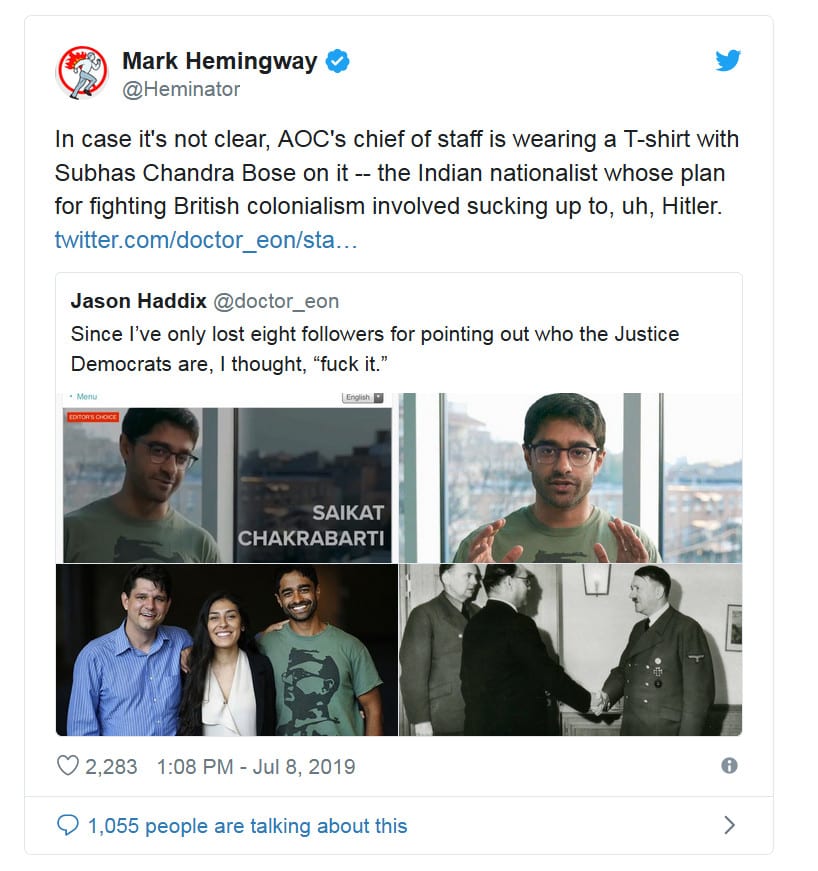
AOC complaining about somebody else making “fascism look benign” is a hoot considering her whirlwind “New Socialist ‘It Girl'” first year in Congress, when she wanted to ban and/or regulate everything in the name of the Green Nude Eel: “We set a goal to get to net-zero, rather than zero emissions, in 10 years because we aren’t sure that we’ll be able to fully get rid of farting cows and airplanes that fast.”

Its author, AOC’s then-chief of staff, was criticized for wearing shirt touting Nazi collaborator:

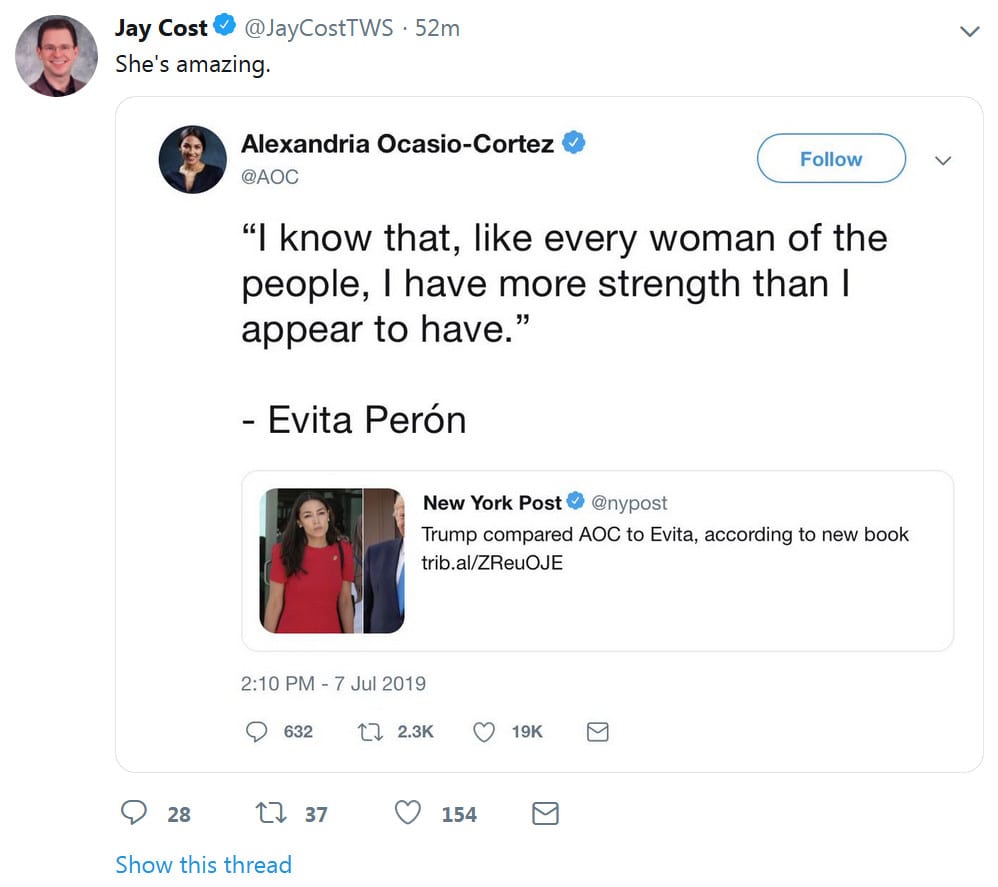
AOC herself praised Evita Peron:

As one wag joked on Twitter at the time, “Look just because she’s favorably comparing herself to the lady that Franco liked a lot who sheltered Mengele doesn’t mean… OK, I forgot where I was doing with this.”

The following year, AOC was praising another fascist group: AOC rocks Black Panthers shirt, touts group’s free food program.

CHIEFS ARE CHAMPS! Kansas City Chiefs win Super Bowl 57 thriller over Philadelphia Eagles in Arizona.

The Chiefs have taken a 38-35 lead on the Eagles with a 27-yard field goal by Harrison Butker with eight seconds left in the game.

The kick capped a 12-play 66-yard drive that took 5:07 off the clock.

On a 3rd-and-8 from the Philadelphia 15, James Bradberry was called for defensive holding after an incomplete pass from Patrick Mahomes, giving the Chiefs a new set of downs.

Or as America’s Newspaper of Record predicted: Super Bowl Refs Hold Pregame Meeting To Decide Which Team Will Win.

UPDATE: Patrick Mahomes named Super Bowl MVP after rallying Chiefs.

I’M NOT SAYING IT’S ALIENS, BUT: How Bad Is It? Biden Team Issuing ‘Private Assurances’ It’s Not Aliens.

Evergreen:

UPDATE (FROM GLENN): A friend comments: “The movies lied about all those force screens and stuff. Turns out a Sidewinder is like a magic death ray to the ETs.”

Well, you know, maybe the aliens are like the Europeans when they first visited Africa: Superior in transportation, but no more than mildly superior (and sometimes inferior) in combat, which is why they bought slaves from Africans instead of capturing them themselves.

DISPATCHES FROM THE NO FUN LEAGUE: How the NFL tried to use the Super Bowl to assault free speech.

A Phoenix city ordinance, likely lobbied for by the league, would have required local property owners to get the NFL’s approval for any advertisement they wanted to put up on properties in the downtown area. According to the Foundation for Individual Rights and Expression (FIRE), the city dubbed this nearly two square mile area a “clean zone” and would’ve required business owners to get permits to display “posters, flyers, banners, pennants, flags, window paintings and even balloons” from January 15 to February 19. As a condition of that permit, they’d need to get permission from the NFL or Arizona’s Super Bowl Host Committee.

The idea was to give the NFL the ability to more closely control advertising in the area while tourism spikes for the event. For example, they could block anyone from displaying Coke ads, since the league formally partners with Pepsi.

FIRE blasted this measure as a “dystopian rule that violates the First Amendment.” Maricopa County Judge Bradley Astrowsky evidently agrees. He just heard a case brought by a local business owner who challenged the ordinance and said, “The city of Phoenix is letting the NFL decide what I can and cannot say on my own property. That’s not right.”

After hearing the case, the judge struck down the city’s ordinance on February 2 and called it “an unconstitutional delegation of government power” to a private entity.

The NFL has been going out of its way since 2016 to make even the most ardent football fan despise it.


QUESTION ASKED: America Forgot the 1918 Flu. Will We Also Forget Covid?

The poor and immigrants—like my grandparents’ families—were hit hardest. So it stands to reason, doesn’t it, that some of my family got sick, or watched a neighbor or schoolmate get sick or die? But I don’t know for sure. Despite having spent thousands of collective hours with my grandfather and grandmother, with my uncles Gabriel and Sidney and Henry (and the other Henry), my aunts Nettie and Ruth and Ann, and numerous others—not to mention their spouses, all Philadelphians—I never heard any of them mention the Spanish flu. Not once.

That absence has me wondering how Americans will remember Covid-19 once it is finally behind us, or when it has become a manageable nuisance. Right now, it’s hard to imagine it will be regarded as anything less than a generation-defining phenomenon, like the antiwar protests of the late 1960s, the AIDS crisis of the 1980s or the attacks of 9/11. But I think it’s just as likely that it will disappear from our consciousness, as the influenza pandemic of 1918-19 did.

The Spanish flu was deadlier than Covid-19 and was more likely to kill those in the prime of life, yet it has been largely obliterated from historical memory. As Alfred W. Crosby noted in his 1989 book “America’s Forgotten Pandemic,” the Spanish flu was omitted from all the great midcentury American history textbooks, including volumes by Samuel Eliot Morison, Henry Steele Commager, Richard Hofstadter, Arthur Schlesinger Jr. and C. Vann Woodward—all men who had lived through the pandemic.

The one major textbook that Crosby could find that mentioned the pandemic, Thomas A. Bailey’s “The American Pageant” (1956), gave it one sentence and, Crosby says, “understates the total number of deaths due to it by at least one half.” Today, a U.S. history student is still unlikely to learn about the 1918-19 pandemic. The latest, 17th edition of “The American Pageant,” by David M. Kennedy and Lizabeth Cohen, mentions the pandemic on two pages.

Popular culture did at least as poor a job in commemorating it. The Spanish flu killed perhaps 50 million people worldwide, the equivalent, as a percentage of the population, of 200 million people today. Yet there is no great film about the Spanish flu pandemic, and the literature is sparse. Katherine Ann Porter’s novel “Pale Horse, Pale Rider” (1939) and William Maxwell’s novel “They Came Like Swallows” (1937) offer the principal treatments by major writers. Then there is John O’Hara’s short story “The Doctor’s Son,” which ran in The New Yorker in 1935, and Willa Cather’s minor 1922 novel, “One of Ours.”

At the time, people remarked upon this gap in the literature. “Novels, one would have thought, would have been devoted to influenza; epic poems to typhoid; odes to pneumonia,” Virginia Woolf wrote in her 1926 essay “On Being Ill.” But she was lamenting the general inattention to illness in literature, which she attributes to the fact that fiction writers concern themselves with affairs of the mind rather than the ordeals of the body. The flu pandemic was less than a decade in the past, yet it did not seem to loom larger in her mind than typhoid or any other malady.

Nobody seems to have a good answer for why the extraordinary, worldwide die-off of 1918-19 imprinted so little on our collective imagination. “The whole issue of how quickly it was forgotten is one that historians have not really grappled with,” said Naomi Rogers, who teaches the history of science at Yale. John Barry concurred: “No satisfactory explanation,” he wrote to me in an email, when I asked about this forgetfulness. “No research that I know of” on its causes, he added.

It seems less likely we’ll forget Covid, given our current obsession with social media, and ubiquitous smart phones documenting everything. Including this classic flip/flop from America’s healthcare professionals in the spring of 2020, which began the next phase of that annus horribilis, the summer of “fiery but mostly peaceful” riots and looting. But given the left’s vaunted ability to pivot on dime on any topic, who knows?

UPDATE: A vintage post from Neo on the tsunami and the forgetting.

(Updated and bumped.)

THE BEST SUPER BOWL COMMERCIALS OF ALL TIME:

Super Bowl 57 will be broadcast to the world on Sunday, February 12, offering hours of high-impact sports, and perhaps more importantly, hours of multi-million dollar commercials. It’s been like this for a long time, and often what products are successful during the Super Bowl carries over into what are successful in the real world.

Super Bowl commercials are there in part to attract the non-football-loving crowd, which is why they have to be engaging in the first place. It’s also why we remember so many advertisements, even the ones we weren’t around to witness. Most ads are time capsules for a specific moment in pop culture history.

Flashback to 2002: The Rebel Sell.

What American Beauty illustrates, with extraordinary clarity, is that rebelling against mass society is not the same thing as rebelling against consumer society. Through his rebellion, Lester goes from being right-angle square to dead cool. This is reflected in his consumption choices. Apart from the new car, he develops a taste for very expensive marijuana—$2,000 an ounce, we are told, and very good. “This is all I ever smoke,” his teenaged dealer assures him. Welcome to the club, where admission is restricted to clients with the most discriminating taste. How is this any different from Frasier and Niles at their wine club?

What we need to see is that consumption is not about conformity, it’s about distinction. People consume in order to set themselves apart from others. To show that they are cooler (Nike shoes), better connected (the latest nightclub), better informed (single-malt Scotch), morally superior (Guatemalan handcrafts), or just plain richer (bmws).

The problem is that all of these comparative preferences generate competitive consumption. “Keeping up with the Joneses,” in today’s world, does not always mean buying a tract home in the suburbs. It means buying a loft downtown, eating at the right restaurants, listening to obscure bands, having a pile of Mountain Equipment Co-op gear and vacationing in Thailand. It doesn’t matter how much people spend on these things, what matters is the competitive structure of the consumption. Once too many people get on the bandwagon, it forces the early adopters to get off, in order to preserve their distinction. This is what generates the cycles of obsolescence and waste that we condemn as “consumerism.”

But last week, Virginia Postrel republished a speech from 2012 noting that we need to take shopping seriously: “The good news is that there is a significant group of scholars who do understand that shopping has something to do with freedom. They are feminists. Not all feminist scholars take this view, of course. Plenty subscribe to Marxian or Freudian or status explanations. But nearly all the scholars who write about consumer culture in a way that appreciates its relation to freedom are feminists. What they teach us is that the growth of what is sometimes called the ‘consumer society’ was good for women. Poor girls could become shop clerks instead of servants. They could go shopping themselves and forge careers as buyers and even store detectives. Middle-class ladies could get out of the house into a new and respectable public sphere. They could meet friends for conversation in department-store tea rooms. Magazines supported by ads for cosmetics and fashion could argue in favor of women’s rights and give readers new images of female achievement. Businesses that wanted to sell things to women had to pay attention to what they wanted. That meant goods and services, but it also meant the environments, institutions, and behaviors that surrounded those things. The consumer society made women public and independent in new and powerful ways—not through politics, at least not at first, but through the marketplace.”

TOP BIDEN LEGAL ADVISER SAYS ELECTION WAS STOLEN:

Leading Democrats and their supporters in academia, journalism, and entertainment have an exceptionally long track record of peddling stolen-election theories and denying the legitimacy of American elections, as I’ve most recently summarized here and here regarding House Minority Leader Hakeem Jeffries and his contention that the 2016 presidential election was stolen. They’re at it again. Here is Harvard Law professor emeritus Laurence Tribe on Wednesday:

It certainly looks like Putin, with the help of Manifort [sic] and Trump, stole the 2016 election from Hillary Clinton but, more importantly, from the 65.8 million people who voted against the Thief in Chief, Donald Trump, who, btw, won just 62.9 million votes despite Putin’s efforts.

Is Tribe simply some random Twitter crackpot? A Twitter crackpot, yes, but not a random one. He has 1.3 million followers. He wrote what is still treated as the leading constitutional law treatise (disclosure: I worked as one of his army of research assistants on one edition of it). He is still regularly treated as a serious commentator on MSNBC and in other media outlets.

Here are numerous other leading Democrats denying elections:

RON KLAIN AND THE DEMISE OF MODERATE DEMOCRATS:

But the main conclusion to draw from Klain’s time as chief of staff is that his decisions and actions demonstrate the way the Democratic Party establishment has undergone a fundamental shift since the 1980s and 1990s. Someone with Klain’s background might have been expected to despise his party’s radicals and their ideological obsessions with climate change, open borders, and intersectional myths about race. But as chief of staff, he wound up leaving little daylight between the White House and the rhetoric of the congressional “Squad” and other hardcore progressives.

Rather than being the expression of the normalcy and moderation of the Democratic Party that had governed successfully during the Clinton presidency, Biden and Klain’s White House signaled the death of that wing of their party. After BLM and Jan. 6, there was no resisting the “resistance” even if they had wished to do so. Klain’s successor, Jeff Zients, another veteran establishmentarian, is unlikely to think differently. If this was his last government job, Klain’s career may have epitomized the career path of a Democratic insider, but it also demonstrated that the era of Democratic moderates is over. Instead of cooling down political rhetoric, Klain fueled the continuing decline of public discourse into bitter vituperation. Rather than healing the country’s post-Trump and post-pandemic wounds, the Biden administration’s hard-left turn that he helped oversee has made clear that bipartisanship is dead and the era of partisan culture wars is just beginning.

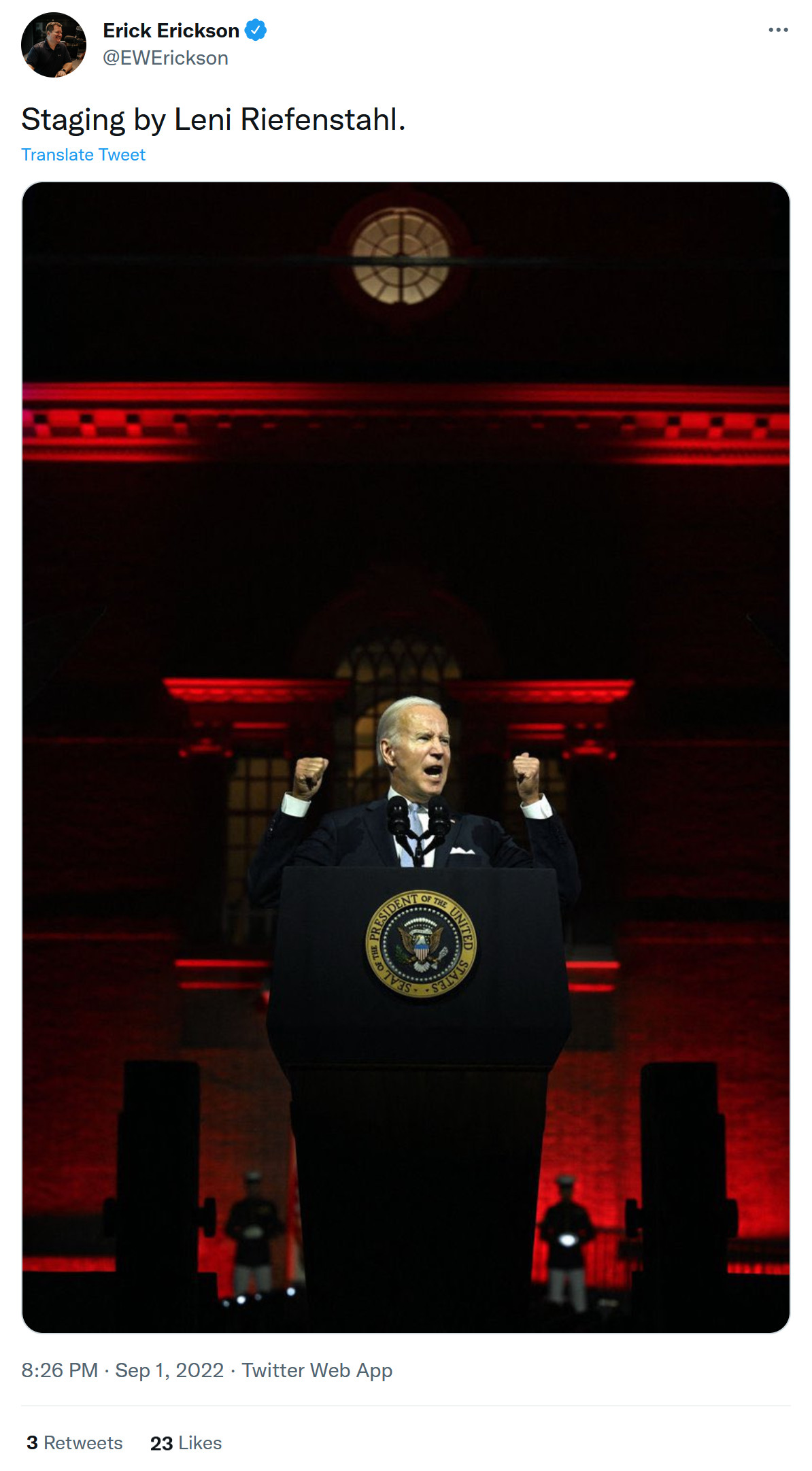
Still though, we’ll always have these show-stopping moments to look back on during President Klain’s time in office:

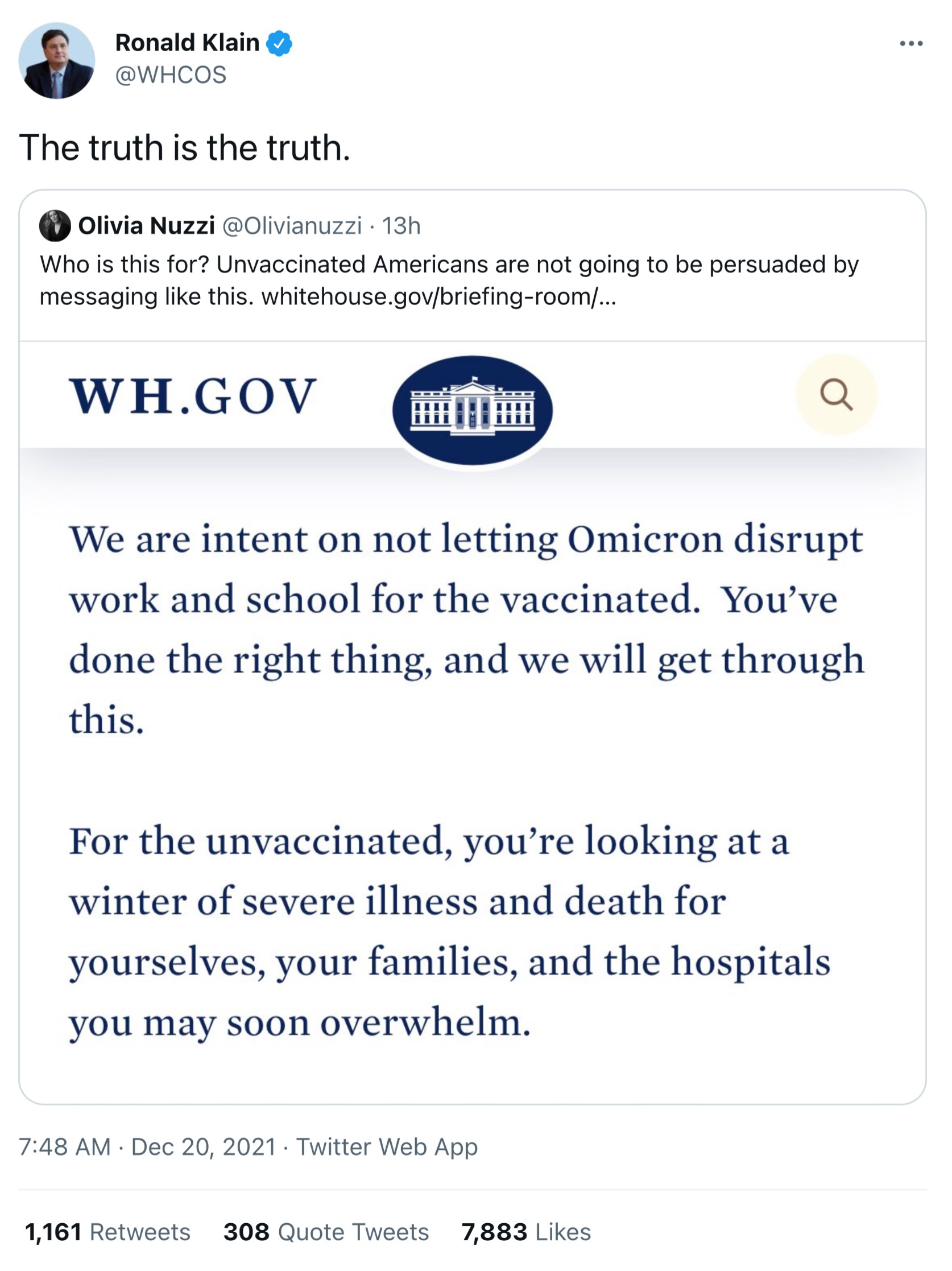
And from the previous year: White House Christmas message to unvaccinated: You’re looking at a winter of death for yourselves and your families:

From earlier in December of 2021: Biden’s Chief of Staff Can’t Stop Embarrassing Himself On Twitter:

The president’s chief of staff is arguably the most demanding job inside any White House. President Joe Biden’s top staffer, Ron Klain, isn’t making things easier for himself lately with the absurd things he’s posting on Twitter.

Klain is what we can only call a Very Online person. He is constantly tweeting and sharing other people’s posts to his half-million followers in an incessant effort to cheerlead for his boss and the Democratic Party more broadly. While this is the role of any outward-facing political staffer, Klain is taking his shilling so far that he’s now just making embarrassing public statements on the regular.

For example, Klain recently tweeted that “America is back at work” alongside this graph, which shows the opposite.

The Biden staffer boosted the graph hoping to show that the labor force participation rate, the percentage of people working or seeking work, is back to normal after the pandemic. Yet it actually shows that it’s still significantly below pre-pandemic levels, even a year and nine months later. Anyone with eyes can clearly see this.

In actuality, we are 8.2 million jobs below the pre-pandemic trend, according to economist Aaron Sojourner. So much for America being “back at work.”

From August of 2021: White House chief of staff Ron Klain retweets Paul Begala saying Biden’s handling of Afghanistan has been ‘Trumanesque.’

And from July of 2021: The Mark of Klain. “[A]ll in all, things have worked out pretty darn well for Ron Klain. For America? Not so much.”

WE DO NOT KNEEL: A Letter to My Newborn Son.

You see, son, the world is full of people who mistake passion for extremism, confidence for arrogance and drive for selfishness and ambition. No matter who you are or what you do, you will encounter this over and over again.

It is not their fault. Most people, me included, have been trained to fit in. The very genes we carry have shaped us to fear stepping outside the group. As your grandmother used to say to me when I was a little boy:

“If you spit society in the face, society will wipe it off and carry on. If society spits you in the face, you’ll drown”.

And your grandmother was right — if you want to live a comfortable life this is good advice. Fit in, don’t ask too many questions and keep your head down.

But son, if there’s one thing I’ve learned it’s that comfort is overrated. You did not come into this world to consume as much food, pleasure and entertainment as you can. A fulfilling life is one of purpose and the meaning of your life is to identify that purpose and pursue it with every fibre of your being.

Most people never get there. They don’t even try. Don’t blame them – no one ever told them that giving up on their dreams was a recipe for misery. As little kids, they were trained to do what they were told, to think how others told them to think and to avoid standing out at all costs.

Read the whole thing.

OUT ON A LIMB: Tyre Nichols’ Death Doesn’t Prove White Supremacy, It Proves A Need To Inflame Fear Of White Supremacy.

CNN analyst Van Jones penned an op-ed arguing “racism” likely “drove” the officers to beat the man. The New York Times attributed a “system” that “fosters racism and violence” against black people to the death.

Struggling author Jemele Hill told a group of young black Vanderbilt students Nichols’ killing demonstrated how the police force is “designed” not to protect black Americans. The Boston Globe cited systemic racism as the cause of the death.

MSNBC, Al Sharpton, the Washington Post, and the increasingly large group of usual suspects echoed the same sentiment: that Tyre Nichols is evidence that the blue turns even black officers into vile white supremacists.

One might wonder what evidence exists to support that narrative. After all, outlets continue to say what happened in Memphis was racially motivated but don’t provide any proof the officers exercised brutality based on race.

That’s because there isn’t any proof. The portrayal of the incident is a diversion, a means to stoke racial hostility.

Tyre Nichols’ death does not demonstrate white supremacy. Rather, Tyre Nichols’ death demonstrates a need to inflame the fear of white supremacy.

That’s because the demand for white supremacy in today’s america vastly exceeds the supply, to coin an Insta-phrase.

FORMER SOCIALIST “IT GIRL” CONTINUES TO PAY DIVIDENDS:

AMITY SHLAES: Shaming Americans. Ken Burns’s The U.S. and the Holocaust distorts the historical record in service of a political message.

By 1925, a reality inconvenient to the narrative thrust of The U.S. and the Holocaust intruded. Americans of all backgrounds, including blacks, saw their lives improve, with electric appliances and automobiles changing even working-class life. The Harding-Coolidge wager that growth would reduce extremism was succeeding. Mid-decade, the Ku Klux Klan commenced a precipitous decline. Lynchings likewise dropped. Coolidge traveled to Omaha to challenge thousands of members of the mighty American Legion to reconsider any prejudices they might harbor: “We must all realize,” Coolidge told the crowd, “that there are true Americans who did not happen to be born in our section of the country, who do not attend our place of religious worship, who are not of our racial stock, or who are not proficient in our language.” In America, concluded Coolidge, “we are all now in the same boat.”

But it is Herbert Hoover whom the film wrongs most. Hoover had first won national popularity for the kind of grand humanitarian heroism that the filmmakers admire, getting past enemy lines in World War I to feed the starving citizens of German-occupied Belgium. Years later, Hoover had the bad luck to become president during the first year of the Great Depression. The scarcity of jobs—one in four Americans was unemployed by 1932—made many want to shut out foreign competitors. In the West, state and local governments began pressuring Mexicans, whether citizens or not, to return to Mexico. Many left voluntarily; others were forced out. At times, federal immigration officials were involved. In the Los Angeles raids, for example, federal authorities arrested 389 aliens, 269 of them Mexican. Other times, the drive to remove or send away legal immigrants was led by towns, counties, and states, and scant records of these events exist. Estimates of the number of Mexicans who left or were driven out range widely, from 200,000 to more than 1 million. Repatriation and deportation are not equivalent, as scholars Brian Gratton and Emily Merchant noted in 2013 in International Migration Review, and the evidence suggests that many Mexican-Americans left of their own accord. The departures went on for years, including at least some that occurred well into the mid- or later 1930s, when Franklin Roosevelt, not Hoover, was in the Oval Office.

Rather than offer all this detail, the film weaponizes history to clobber Hoover: “Under the slogan ‘American jobs for real Americans,’ Hoover’s Labor Department approved raids by sheriffs, marshals, and vigilantes that rounded up some 1.8 million people of Mexican descent and deported them.” That “1.8 million,” outside the bounds of serious scholarship to date, is particularly ominous in a film about the 6 million—leaving an opening for authors of urban legend to present Hoover as operating in the big-number league of the Nazis. Adding insult to injury, the film chides Hoover for what it treats as an exceptional cruelty: enforcing a regulation already on the books requiring immigrants to demonstrate that they could care for themselves. Yet such measures were an American tradition dating back to a period that the documentary presents as Edenic: the 1882 Immigration Act empowered authorities to deny entry to “any person unable to take care of himself or herself without becoming a public charge.” This is not much different from what our own bureaucracies do when they check with employer sponsors in evaluating green-card applications.

It is in the second episode that the filmmakers turn to Franklin Roosevelt, the only president forced to contend with the Third Reich while in office. Roosevelt himself was capable of bigotry. During his first election campaign, Roosevelt allowed himself a kind of casual but nasty xenophobia, as in a San Francisco speech in which he assailed the Chicago electricity magnate Samuel Insull, who was taking his employees down with him as his firm failed. Roosevelt spoke against “the Ishmael or Insull, whose hand is against every man’s,” a line so creepy one can only ask, “What does that mean?” In his March 1933 inaugural address, just weeks before Hitler opened his first concentration camp, Roosevelt channeled Henry Ford on international capital, claiming that “the rulers of the exchange of mankind’s goods have failed” and that “practices of the unscrupulous money changers”—code for Jewish Wall Street—“stand indicted.” Burns covers none of this.

Earlier: New Documents Reveal FDR’s Eugenic Project to ‘Resettle’ Jews During World War II. As the Holocaust raged, the American president secretly asked his government to study the possible resettlement of remaining European refugees in Africa and South America. His goal: for Jews to be ‘spread thin all over the world.’