Author Archive: Ed Driscoll

ANNALS OF LEFTIST AUTOPHAGY: The Odyssey Translator Emily Wilson Slams Christoper Nolan’s ‘Abysmal’ Screenplay: ‘I Would Be Ashamed to Have Written Any Part of This Script.’

Christopher Nolan cited Emily Wilson’s 2017 translation of “The Odyssey” as an influence on his own interpretation of Homer’s epic poem while on the press tour for his latest blockbuster. Wilson is not returning the favor. In a negative review of Nolan’s “The Odyssey” for the London Review of Books (via The Guardian), Wilson criticized Nolan’s adaptation for lacking “psychological, emotional, political and ethical depth.” The author, who is also a professor of classical studies at the University of Pennsylvania, added that Nolan’s “The Odyssey” has “nothing convincing to say.”

“I had hoped that Nolan’s affinity with these Homeric themes might push him to new creative heights, and enable him to conjure more believable characters. But ‘The Odyssey’ features his usual combination of grandiosity and superficiality … the film’s vision is too confused, its characters too underdeveloped, to deliver what it half-promises in terms of big ideas – although it is very good at conveying big bangs and big giants,” Wilson’s scathing review reads.

She adds: “Nolan’s ‘Odyssey’ lacks many of the elements that make the poem great. It has nothing convincing to say about time, memory, history, war, or about the relationship between one warrior’s glorious return and the lives of his family, adversaries, comrades, friends and neighbors. It lacks psychological, emotional, political and ethical depth. Its narrative structure is gimmicky. The writing is abysmal. None of the characters has convincing motivation for their actions or words. There are no sex scenes, and all the food looks horrible.”

Exit questions:

TWO FAUCIS IN ONE, PART DEUX:

TWO FAUCIS IN ONE! Fauci, CNN Condemned ‘Small Household Gatherings’ Week Before Fauci-Tapper Dinner.

Related:

Tweet concludes, “While he was going on TV saying the opposite to terrify the public into shutting down the economy. It was all a lie designed to take out Trump’s most formidable weapon for reelection: his booming economy.”

HEH: Bring Back the Hollywood Asshole!

And that is the ultimate lesson here. We do not need a new Coppola. We need a new Robert Evans. We need a studio head constructed out of parties and vice, with infinite taste and style. Someone artists feared and loved, who may not have had a soul, but had the genius to find the people who did.

So this is what we need you to do with your elite MBAs and high SAT scores: Get back to being a meritocracy. Drop the affectations. Best, most profitable idea wins. Hire crews and staff based on excellence, not what your favorite Harvard admissions counselor would love. Build movie stars. Learn what the poors want — people in flyover states who make less than $300,000 a year. Make sure those movie stars do not offend those poors by insulting Jesus or Tom Brady.

You are part of a great legacy. The Movies. You know: the great American cultural export created by Jewish Eastern European garment tradesmen. Honor them by wearing expensive clothes, making expensive movies, entertaining as many people as possible and selling millions of electric Hulk toothbrushes.

The executive’s job is to be the brilliant, greedy, tasteful money animal who funds the dream, and pretending otherwise is what broke the business. The business forgot it is supposed to be a hit-driven, star-driven, spectacle-driven machine, not a lifestyle brand for coastal creatives.

They have been calling you a suit like it is an insult.

It isn’t.

It’s the job.

Wear the suit. Be a suit.

Beginning in 2010, Hollywood rejected lucrative DVD and Blu-Ray sales for streaming, ending the ability for movies that didn’t make at the box office to earn a second chance in home distribution. From 2017 to 2019, powerful Hollywood execs were routinely #metoo-ed into oblivion. In 2020, Hollywood shutdown the movie business to curry favor with Fauci and Birx. In 2022, L.A.’s Academy Museum of Motion Pictures tossed the Jewish founders of Hollywood right down the memory hole.  Then in 2023, the Writers Guild went on strike. The product became increasingly weird and woke. Going to movies went from being a near-weekly experience to something families did once or twice year to see event movies such as Top Gun: Maverick, “Barbenheimer,” and The Odyssey. No matter how big of a schmuck he is, the Hollywood asshole has his work cut out for him to turn the industry around.

UPDATE: The movie industry is broken. “Last year, just three studios – Warner Bros. Discovery, Disney and Universal – accounted for nearly 70 percent of domestic box office takings. Hollywood’s share of what Americans actually watch is around 95 percent plus in theaters (by revenue) and 85 to 95 percent in streaming viewing time. They own your butt and your eyeballs and that’s not changing anytime soon. But behind the rosy headlines and inside the plush boardrooms in Beverly Hills and Century City and Burbank, the hope of 2026 looks more like cope. A lot is going wrong all at once, and a huge transition is not-so-quietly under way. The agent did not mince words. ‘Streaming has ruined the business. It’s the reason Shari Redstone sold Paramount for peanuts. It’s why Warner Bros. was forced to sell. It’s why Comcast is looking to exit streaming.’”

FAUCI’S NEWLY RELEASED COVID DIARIES REVEAL BIZARRE FIXATION ON FAME AS PANDEMIC DEATHS MOUNTED:

Newly released diary entries reveal that as COVID-19 deaths mounted around the world, former White House COVID advisor Dr. Anthony Fauci became increasingly fixated on his newfound celebrity.

Released by Senate Homeland Security Committee Chairman Rand Paul, R-Ky., the journals chronicle Fauci’s day-to-day role during the COVID-19 crisis through conversations with President Donald Trump, governors and world leaders, media appearances, and his personal observations as the pandemic unfolded.

Paul, a longtime Fauci critic who frequently clashed with Fauci over the federal response and the origins of the virus, made the diaries public as part of the committee’s ongoing oversight investigation. The release comes days before Fauci is scheduled to testify before the Senate Homeland Security and Governmental Affairs Committee after being subpoenaed by Paul.

A surprising recurring theme throughout the diaries is Fauci’s growing awareness of his own public profile during the most intense months of the pandemic, which ultimately claimed more than 7 million officially reported lives worldwide, including roughly 1.2 million in the United States.

On April 7, 2020, after recording the latest pandemic developments, Fauci wrote: “Press still hot and heavy about me. Multiple stories per day directly or indirectly involving me.”

On April 23rd, Fauci wrote:

That was only three days after Trump berated Georgia’s Governor Brian Kemp for reopening his state:

In April 2020, businesses in Georgia were shuttered by government decree as in most of the rest of the country. Mr. Kemp was hearing from desperate entrepreneurs: “ ‘Look man, we’re losing everything we’ve got. We can’t keep doing this.’ And I really felt like there was a lot of people fixin’ to revolt against the government.”

The Trump administration “had that damn graph or matrix or whatever that you had to fit into to be able to do certain things,” Mr. Kemp recalls. “Your cases had to be going down and whatever. Well, we felt like we met the matrix, and so I decided to move forward and open up.” He alerted Vice President Mike Pence, who headed the White House’s coronavirus task force, before publicly announcing his intentions on April 20.

That afternoon Mr. Trump called Mr. Kemp, “and he was furious.” Mr. Kemp recounts the conversation as follows:

“Look, the national media’s all over me about letting you do this,” Mr. Trump said. “And they’re saying you don’t meet whatever.”

Mr. Kemp replied: “Well, Mr. President, we sent your team everything, and they knew what we were doing. You’ve been saying the whole pandemic you trust the governors because we’re closest to the people. Just tell them you may not like what I’m doing, but you’re trusting me because I’m the governor of Georgia and leave it at that. I’ll take the heat.”

“Well, see what you can do,” the president said. “Hair salons aren’t essential and bowling alleys, tattoo parlors aren’t essential.”

“With all due respect, those are our people,” Mr. Kemp said. “They’re the people that elected us. They’re the people that are wondering who’s fighting for them. We’re fixin’ to lose them over this, because they’re about to lose everything. They are not going to sit in their basement and lose everything they got over a virus.”

Mr. Trump publicly attacked Mr. Kemp: “He went on the news at 5 o’clock and just absolutely trashed me. . . . Then the local media’s all over me—it was brutal.” The president was still holding daily press briefings on Covid. “After running over me with the bus on Monday, he backed over me on Tuesday,” Mr. Kemp says. “I could either back down and look weak and lose all respect with the legislators and get hammered in the media, or I could just say, ‘You know what? Screw it, we’re holding the line. We’re going to do what’s right.’ ” He chose the latter course. “Then on Wednesday, him and [Anthony] Fauci did it again, but at that point it didn’t really matter. The damage had already been done there, for me anyway.”

The damage healed quickly once businesses began reopening on Friday, April 24. Mr. Kemp quotes a state lawmaker who said in a phone call: “I went and got my hair cut, and the lady that cuts my hair wanted me to tell you—and she started crying when she told me this story—she said, ‘You tell the governor I appreciate him reopening, to allow me to make a choice, because . . . if I’d have stayed closed, I had a 95% chance of losing everything I’ve ever worked for. But if I open, I only had a 5% chance of getting Covid. And so I decided to open, and the governor gave me that choice.’”

At that point, Florida was still shut down. Mr. DeSantis issued his first reopening order on April 29, nine days after Mr. Kemp’s. On April 28, the Florida governor had visited the White House, where, as CNN reported, “he made sure to compliment the President and his handling of the crisis, praise Trump returned in spades.”

Also on April 29th, this response to Kemp opening up Georgia from Amanda Mull of the Atlantic:
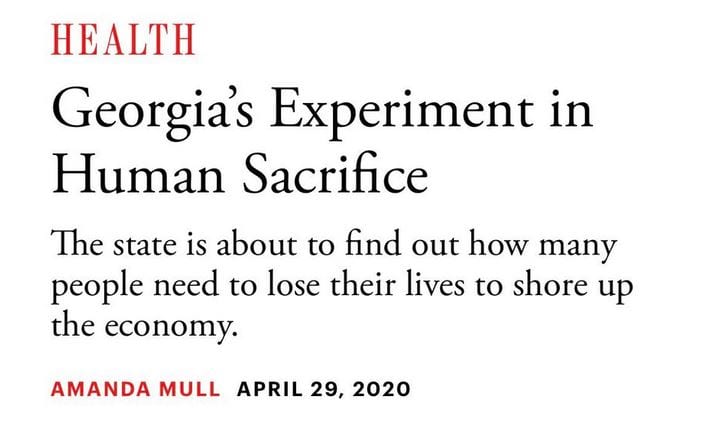
That’s an “unexpected” headline from a magazine that was concurrently depicting Fauci as a totally cool and dreamy “heartthrob:”

RAND PAUL RELEASES DOCUMENTS ON INTERCEPTED COVID RESEARCH MATERIALS:

Sen. Rand Paul, R-Ky., has released another batch of documents related to the COVID-19 pandemic.

The latest records show that U.S. officials intercepted undeclared biological materials tied to a U.S.–China coronavirus research network as early as 2018, likely in an attempt to avoid international tensions and regulatory scrutiny, Paul said.

The documents, which include a Department of Homeland Security intelligence report, primarily focus on a network centered around University of Minnesota virologist Fang Li.

The released documents also include pages from “Tony’s Diary:”

As Jim Geraghty writes, “For the entirety of 2020 and long after, the ‘it started in a wet market’ view was the respectable one. Believing that somebody at the Wuhan Institute of Virology hadn’t been careful one day and had gotten accidentally infected with a virus that had gained a function or two during its time in the lab made you a crazy conspiracy theorist. In fact, the lab leak theory was evidence of your racism. And now — in July 2026! — we learn that Fauci himself had dismissed the wet market as a potential source at the end of January 2020.”

Then there’s an incredible juxtaposition by Fauci of new deaths and new WaPo profiles:

Alyssa Farah, now an employee of ABC News, makes an appearance in “Tony’s Diary:”


AND AGAIN: Terror Attack in Berlin.  “Fifteen people were injured, with one having died so far. German police are investigating whether the attack was terror-related, but I am not sure what there is to investigate. The perpetrator drove a car into a gay crowd at a high rate of speed, and then attacked people with a knife. There’s your investigation. I assume the terrorist was a Muslim, but it is possible he was some other kind of extremist. We will find out soon.”

UPDATE: Its origin and purpose, still a total mystery.

MORE: Suspect in Berlin Pride attack identified as ‘Islamist.’ “‘Based on the investigators’ initial findings, we have already identified a suspected perpetrator,’ Florian Nath, a spokesman for Berlin police, said, adding that the force’s search for the suspect was ‘proceeding at full speed’. ‘He is known to us as a member of Islamic circles here in Berlin … we still have no information whatsoever regarding his specific motives, the exact sequence of events, or his role in the crime itself.’”

UPDATE (11:14 am): Abdul Ballout: Berlin Pride suspect tried to join Islamic State. Around 2,000 police officers searching for 21-year-old German citizen who is of Lebanese descent.

UPDATE (12:44 pm): Ballout “was convicted and sentenced for terrorism offences in May 2026 but released on time served. By July 2026 he was back on the streets. German authorities told him to attend de-radicalisation counselling sessions. He responded by carrying out a jihadist terrorist attack on a pride parade.”

UPDATE (1:50 PM): Suspect in deadly Berlin Pride attack is killed in a confrontation with police.

ROGER KIMBALL: Odysseus Visits the Smithsonian.

I said that the best entertainment I enjoyed last week was the cross-examination—not to say the thorough exposure and humiliation—of Anthea Hartig. And the best of the best, I thought, was the brilliant surgical evisceration conducted by freshman representative Brandon Gill (R-TX). In under 5 minutes, he performed an elegant posterior sagittal anorectoplasty on Hartig’s long tenure at the National Museum of American History. And he did it by the simple, revelatory expedient of confronting her with the Smithsonian’s own public educational materials. “Are you a white supremacist?” he asked. “Oh no, no,” replied Hartig, smiling weakly. “Do you think we all have implicit biases?” asked Gill. “If so, what are yours?” Oh dear. “Do you think it is important to be polite?” Gill wondered. “Oh yes,” quoth Hartig, perhaps thinking that if she said she approved of politeness, Gill would be polite to her. No such luck.

Politeness, you see, is one of the many bourgeois virtues that literature distributed by the Smithsonian has identified as a symptom of white supremacy. Other behaviors and attitudes that raise the alarm about lurking white supremacist tendencies are hard work, rational thinking, respect for private property, delayed gratification, and rugged individualism.

You think that I am making this up, but I am not. It’s all there in an official NMAH brochure called “Aspects and Assumptions of Whiteness and White Culture in the United States.” File it under “Things are always worse than you think.” Here’s a thought experiment: What if these habits and behaviors really were signs of “whiteness” or “white supremacy”? What then? Or to put it another way, how much of a racist would you have to be to promulgate a brochure like “Aspects and Assumptions of Whiteness and White Culture in the United States”? (It would be interesting to know whether most of the authors of that odious document were themselves white. I’d wager most of them were liberal white women.)

Thanks to Proposition 65, Sacramento requires labels on just about everything warning about a possible cancer risk. (Or as Consumer Reports quips, “Why California Thinks Your Couch Will Give You Cancer.”) Should the Smithsonian have warning labels about its ideological capture?

Incidentally, here’s the excerpt from the page at the Smithsonian that sorta kinda insinuates that Franklin’s research assistants for his electrical experiments may have been “an indentured servant or an enslaved person, although he never mentioned them in reports of his work:”

THE MERGER ISN’T KILLING HOLLYWOOD. HOLLYWOOD ALREADY DID THAT:

Far from “thriving,” theaters sold roughly 770 million tickets last year — down 37% from 2019 and less than half the 1.57 billion sold at the 2002 peak. The share of adults who see a movie at least monthly has fallen by more than half. Receipts hold up only because the average ticket now runs north of $13. Charging ever more to ever fewer people is not a thriving business; it is a shrinking one, repriced. And moviegoers will tell you why they stopped coming: nearly 2 in 5 adults who attend less often say there is simply not a good enough variety of new films worth the trip.

Much of the rest of the case comes down to jobs. The Teamsters call the deal a “direct threat to film and television workers nationwide”; one producer predicted 10,000 job losses, without any data behind the figure. Yet the merger’s own critics have noted that Los Angeles County lost more than 42,000 motion picture jobs between 2022 and 2024 — years before this deal existed. Entertainment employment has fallen roughly 30% in four years, Los Angeles on-location filming is down more than 40% since 2022, and production employment sits at a 30-year low. Hollywood is not losing its audience to consolidation. It is losing its audience to itself.

Nor would blocking the deal freeze some healthy status quo in place. Warner Bros. Discovery was for sale because its trajectory was unsustainable. Its revenues slid from $41.3 billion in 2023 to $37.3 billion last year, after a $9.1 billion write-down in 2024 — the company’s own reappraisal of its worth. Stopping the deal does not change the market.

Opponents of the merger fail to consider the impact the deal could have on long-term employment across the wider creative economy, where the meaningful driver is production volume. Film and television support 2.01 million American jobs, pay $202 billion in wages, and sustain more than 162,000 businesses, 93% of which employ fewer than 10 people. A single-location shoot injects roughly $1.3 million a day into a local economy. The only question that matters is whether this merger means more movies or fewer.

The answer is on paper. Paramount has committed to maintaining both studios, releasing at least 30 theatrical films a year, and guaranteeing a 45-day theatrical window before video-on-demand. And since Skydance took over last August, Paramount has nearly doubled its slate from eight films to 15. These commitments mean more production days, more crews, more stages booked, more location spending — precisely what the unions say they want protected, and the only real medicine for what ails Hollywood: too few movies worth leaving the house for.

The success of Christopher Nolan’s Odyssey might be a pyrrhic victory for Hollywood, cementing audiences’ post-Covid habit to go to the movies a couple of times a year to see the blockbuster that has the most hype, rather than going nearly every weekend:

TRIGGERNOMETRY INTERVIEWS PETER HITCHENS: “We Live in the Age of Delusions.”

At the conclusion of the clip, Hitchens tells his interviewers:

Intelligence chiefs keep coming out and saying we have to prepare for war. Russia is a great threat.

Well, you can believe that if you want, though I find it a struggle.

I always remember going to Moscow—I think it was in 2008. It was the first big parade of the new Russian Army. They had decided they were going to restart the Red Square parades. I’d watched the last one back in November 1990.

My office said, “Why don’t you go out and watch it?” So I watched it with my old friend Igor, whose father had been a Soviet nuclear submarine commander who really knew his military stuff. We stood on the balcony of th hotel, watching it from as close as we could get.

I enjoyed the parade as much as the rest. But at the end of it, Igor turned to me and said, “What did you think of our great display of strategic scrap metal?” [laughter]

And he was quite right! The big new weapons—they probably only had two or three. Most of the stuff they were able able to put on display was probably old, much of it dating back to the Soviet era.

We knew—and we still know—that the Russian military is fantastically corrupt and incompetent, and the training of its soldiers is a disgrace. It’s a terrible army. After four years, they still haven’t managed to take Kharkiv, 20 miles from the border.

So to turn this into a great bogeyman which is supposedly about to arrive at Dunkirk with its tanks pointed at the British coast just doesn’t seem to me to be realistic.

But the intelligence people, retired generals, ex-defense ministers, and NATO chiefs are constantly trying to prepare us for war. The last thing I noticed was some suggestion that we should all start hoarding food and medicines in case there was a war.

There is a real attempt to get the British people to become war-minded, and I think that can only end sadly.

Obsessing over the Russians “about to arrive at Dunkirk” is a great way to ignore who is crossing the Channel: Iran smuggling agents into UK as Channel migrants.

ATLAS SHRUGS:

ROGER SIMON: The Jews Should Leave New York.

It’s hard to admit this, but we are now at a similar juncture. Jews are not safe around the world, but particularly in New York, a city to which they made huge, one could almost say unparalleled, contributions in finance, architecture, city planning, medicine, education, theater, music, radio and television, museums and art, and virtually every field of science and culture you can think of.

That’s indisputable.

But, ironically, it is time for the Jews to go.

They must leave New York not only to save it but also to save themselves.

Not all will do so. Some are too frightened or too embedded in fusty left-wing politics that has repeatedly failed.

But those who do go, not just titans of Wall Street but regular middle-class folks, will take with them such a significant portion of the city’s tax base that Mamdani’s not-so-Democratic Socialist goals will be more unattainable than they already are.

New York will no longer be the country’s economic capital. Miami and/or Dallas will be, if they are not already.

Lessons might even be learned. Meanwhile, they can go be antisemites by themselves.

New York morphed into London so quickly that everyone noticed:

TROLL LEVEL: POTUS DJT.

Also, consider the media environment that Trump is trolling:

THIS POST IS BROUGHT TO YOU BY THE OXFORD COMMA:

As one wag joked on Facebook, “Wow, how did she have time to write?!”

BEWARE THE FLAMBOYANT CANDIDATES WITH NO EXPERIENCE:

The city also has to be on the alert for Legionella impacting nursing homes this summer. Late Monday, dangerous levels of Legionella were found in the water system at a long-term care facility in Rochester, New York, forcing the facility to shift to bottled water and stop all bathing.

Let the deaths in New York this week be a red flag that being mayor is a serious management job. It’s not about wildly speculating on the popularity of arresting Israeli Prime Minister Benjamin Netanyahu, a preposterous and illegal act. Or cycling around the city, grinning for the cameras.

The investor class is seeing the warning signs of management inexperience. Yields are suddenly jumping upward on municipal bonds, a sign that debt holders are jittery watching the boy mayor demand ever-higher taxes to fund his socialist ideas and allow record dependence on cash welfare to continue.

Voters across the nation should watch this unfold and learn from it as they’re wooed by other candidates offering Mamdani-like theatrical appeal and utopian visions but no experience governing. In many of these races, people’s lives and money could depend on wisely choosing a leader with a track record.

Why would voters start now?

PAST PERFORMANCE IS NO GUARANTEE OF FUTURE RESULTS: Adventures in the Patriarchy™: Disgraced Former CNN Host Discovers Perverted New Shtick.

Via Unraveling With Brooke Baldwin (emphasis added):

If you’ve been reading me for a while, you know I signed up for my very first dating app a few months ago and lasted approximately three minutes before deleting it… Very recently, I gave it another shot.

Why? Maybe I wanted a distraction. Maybe I like to kiss. Maybe I’m a grown-ass woman who can do whatever the hell she wants.

This time I made it… five whole days.

Part of my bio read:

Integrity. Brains. Respect. Big career. Deeply spiritual. Serial monogamist… but taking a break from that for the first time in my life. Rare window.

Rare window.

It’s true. I know myself. I love love. I love partnership. This chapter won’t last forever.

But here’s what’s fascinating. Over the last month or so, I’ve had the opportunity to sleep with four different men. This is not a humblebrag. Nor have I suddenly become Samantha Jones. (Though if that’s your lane… Do you, boo.)

What’s interesting isn’t them. It’s me.

We’ll get to that but first — they’re all amazing.

One literally flew in just to take me to dinner and spends his days trying to save our democracy one congressional district at a time.

One used to run a country.

One is just… hot.

That’s all you’re getting for now.

(Also, this is officially awkward because I know at least a couple of these gentlemen subscribe to this Substack now. Hi, fellas. 👋)

Now that she’s effectively doing a safe-for-work Substack version of OnlyFans, I’d like to bring to your attention my personal favorite Baldwin moment from her storied CNN career, when she performatively feigned outrage after Clay Travis said on the air, preposterously and hilariously, that the only two things he really believes in are the First Amendment and boobs.

Newsreaders invariably get incensed by the notion they can easily be replaced with actors, and yet Baldwin certainly gave an Oscar-winning performance back in 2017:

QUESTION ASKED AND ANSWERED: What Broke Black America? A Review of Howard Husock’s The Projects:

Speaking of painting, the genesis of the American movement to reconfigure big city housing—and soon enough small town and rural housing too, and heck, the entire enchilada of urban design—came in 1934 at, of all places, the Museum of Modern Art in New York City, which in the Depression’s depths hosted a “Modern Housing Exhibition.”

The Picassos and Cubism and Dadas were on another floor. This unusual museum exhibition, writes Husock, had little to do with art, but a lot to do with “modern.” It “was the spearhead of a crusade; it made the economic, political, and even visual case that the federal government should finance the construction of housing for working families of modest means—not as an emergency measure but as part of the ongoing responsibilities of government.”

Why? A book accompanying the exhibition proved an exemplar of an empowered and eager progressivism, describing itself as:

a statement of the far reaching and varied social, financial, technological, administrative, legislative and political factors which have led to the present situation. It discusses the radical changes which must be made in our social philosophy and public policy in order to improve the housing condition of the masses of the American people.

But was it housing—or was it something else—that tempted the progressive social engineer? Something else gets the nod: The mission, writes Husock, was not truly “the mere provision of utilitarian housing.” Instead, the aspiration was “about building a new type of urban landscape, a city of tomorrow . . . organized by government and designed by architects.”

Actually, a motivating spirit for the exhibition and the forces it would unleash was a 1927 book, The City of Tomorrow, by Charles- Édouard Jeanneret, a Swiss-French architect known as “Le Corbusier,” whose vision—which detested streets—was the creation of “superblocks,” long now a reality for many American cities. Superblocks

were set projects with no cross streets for stores, cars, or small homes. Le Corbusier had already designed such a city in his 1922 plan for the Ville Contemporaine, which was to comprise sixty-story apartment buildings, all identical, surrounded by a zigzag of smaller buildings and a park. Le Corbusier asserted that whole urban scene “is one of wasted opportunities and inefficiency.” He proposes an alternative course, “which is a bold and drastic reconstruction of the entire machine.” Central to his vision was that of “skyscrapers set at immense distances from one another and surrounded by large open spaces or parks.”

Where to build this new city? The canvases for Le Corbusier and his acolytes were to be empty sites—or, sites that were to be emptied because they were decreed slums. Harvard professor James Ford was one of the moment’s leading, persuasive apostles of slum eradication, and Husock quotes him amply: “Wrote Ford, ‘The slum is a menace which cannot be overcome by piece meal modernization loans or random demolitions with the owner’s consent. . . . No solution will be found short of a comprehensive and intelligent policy actuated by one or more units of government, apply financed, which makes the neighborhood rather than the buildings the basis of operations.’”

What was to be the collateral damage of implementing utopia? “As for the shops,” writes Husock, “the churches and synagogues, the small businesses, street life, and so much more which slums were replete, Ford was silent.”

Within three years of the Depression-era exhibition, its patrons and the forces of “slum elimination” it effectively unleashed had successfully lobbied Congress to pass the National Housing Act and create the United States Housing Authority, tools embraced by big city mayors and in particular First Lady Eleanor Roosevelt, who was a major champion of slum clearance.

Corbusier, who would later align himself with Vichy France, only saw two buildings bearing his imprimatur completed in the US. He was part of the architectural committee which designed the UN building in New York in 1948, and he designed the Carpenter Center for the Visual Arts building at Yale in 1962.  However, Corbusier’’s urban planning concepts were enormously influential on American urban renewal in the 1950s and ‘’60s, with invariably disastrous results. Jane Jacobs’’ influential book 1961 book The Death and Life of Great American Cities is essentially a real-world rebuttal to his architectural and urban planning fantasies.

JEFFREY BLEHAR: The Most Irresponsibly Stupid Column of the Year.

Because in [Nancy Armour of USA Today’s] moral world, the real threat here is not to Caitlin Clark’s right quadricep but rather to the dignity and safety of the black women who play against her. As Armour describes it, if Clark “flops” during a game . . . she’s apparently encouraging her white fans to take justice into their own hands and lynch the hated blacks. I’m not kidding about this, though I wish I were:

It shouldn’t need reminding this country has an awful history of Black people being harmed, even killed, in the name of “defending” white women. The irony of the WNBA’s All-Star Game is that it’s happening this weekend in Chicago, the hometown of Emmett Till, who became an icon of the civil rights movement after his tragic murder. The local art gallery is currently hosting an exhibit imagining his life if he hadn’t been lynched. While it’s incumbent on the WNBA to do more to protect its players, there also should be an expectation on Clark to recognize the broader implications of her actions being weaponized.

First off, marvel at that rhetorical stretch. Emmett Till was killed in Mississippi by Jim Crow racists in the Fifties, which is just like Caitlin Clark complaining after being fouled at next week’s All-Star Game . . . and it’s all connected because Chicago. (This one fact alone meant I had to write this. Somehow it’s always MAGA country’s fault.) Then step back further and gaze with disbelief upon the neo-Stalinist moral logic: because others might react badly to her public disapproval at being abused, she must remain silent (and take more abuse). It is howlingly, outrageously wrong — a complete inversion of all accepted principle.

Related: We’ve descended into some sort of bizarre hell-world in which Barack Obama is a voice of sanity:

I INVENTED* NIXONMAXXING:

Instead of the Watergate legend raising the moral standing of the media, today deep distrust of the media has cast Watergate in a new light. So has the revelation that Bob Woodward’s and Carl Bernstein’s key insider source, “Deep Throat,” was a man who aspired to the power once wielded byJ. Edgar Hoover and brought down the president who refused to make him director of the FBI.

Hoover was a man above the Constitution, thanks to his ability to intimidate and blackmail members of the elected government – Congress was afraid to touch him. Mark Felt believed he was entitled to what Hoover enjoyed, and when Nixon defied him, Felt, through Woodward and Bernstein, showed the president who really had the power to destroy whom.

An unelected government within the government ought to be the subject, not the sponsor, of media investigations. The relationship between the media and those parts of government in agreement with the liberal-leaning news industry’s own biases is a scandal unto itself. Nixon’s reputational recovery is the flipside of the media’s dwindling authority. Rising esteem for Nixon is reciprocal with the plummeting of newspaper circulations.

“If Watergate happened tomorrow, it would be like a 12-hour news story. The idea that it would have taken down a presidency is crazy,” Vance told an audience at the Nixon Library in Yorba Linda, California, in June. Yet the Nixon saga isn’t ancient history: “If you look at the story of how the Deep State took down Richard Nixon, it’s not all that different from what the same groups of people, the same institutions tried to do to Donald Trump in the first Trump administration,” the Vice President argued.

Nixon was a tragic figure – almost an American Macbeth. His story is human in a way that moves the young right, who have been subjected all their lives to stories that are mere ideological morality tales. It’s not Nixon’s ideology they admire; they admire him for not being easily reduced to inhuman “principles.”

* Family Ties producer Gary David Goldberg, and/or the NBC executives who likely told him that it might be a bit off-putting to ‘80s TV viewers if Alex P. Keaton was seen worshipping Ronald Reagan on a weekly basis might like a word here:

TRUMP FINALLY GETS HIS WHITE HOUSE CORRESPONDENTS’ DINNER SPEECH: “Is this supposed to be fun? Am I supposed to be serious? Am I supposed to be a comedian?”

And here’s the joke I thought was the best: “Under my administration, a once-feared and powerful regime that relentlessly attacked America has finally been toppled. Their former leaders have been removed and they’re now being run by a gay dictator facing internal divisions. But I for one wish Bari Weiss all the best at CBS News. She’s a wonderful woman.”

Heh, indeed.

Meanwhile, at America’s Newspaper of Record:

SETH MANDEL: AOC’s Latest Dual-Loyalty Hoax Is a Doozy.

“This amendment is an existential threat to American sovereignty and democracy,” declared Ocasio-Cortez.

How did we get here? The lie seemed to get off the ground in late May thanks to folks at the Quincy Institute, the isolationist activist forum, though it didn’t at first use the term “merge” but rather “integrate.” That word is important, because it also appeared in one of the sentences in the defense bill. Of course, the bill doesn’t say the militaries will be integrated, but conspiracy theorists decided it was one of the few straws they had in reach, so they’re grasping it.

A second conspiracy theory around the bill, pushed by the folks at Dropsite, the podcasters who were last seen trying to bully Ro Khanna into approving of October 7, is that a letter sent by Benjamin Netanyahu claims the bill was his idea.

In fact, Netanyahu sent a letter to a congressman who had written up a resolution that just said the two countries would move toward cooperation instead of the old aid model and called for a new Memorandum of Understanding. Netanyahu has been pushing this change for years, and he wrote that he was happy the two allies would now move in that direction.

So when you combine the two lies, you have: Israel is dictating U.S. laws, and the council of the Elders of Zion—Sorry, the Jewish state—now runs our military. Oh, and everyone who supported the U.S. defense bill is a traitor.

Tucker goes full Judgement at Nuremberg about that last idea:

Why would Tucker be in favor of the Nuremberg Trials Mark II, when he thinks the Germans were the good guys in WWII, and the millions of people they murdered were a tragic accident instead of a deliberately planned slaughter? As Steve asked in September of 2024: Seriously, What the Hell Is Wrong With Tucker Carlson?

Carlson’s interview on Tuesday with alleged historian Darryl Cooper — like his interview in April with Reverend Munther Isaac, referenced in today’s flashbacks — was so much worse than merely glib or incurious.

Carlson chose to interview Cooper, whom he endorsed as “the best and most honest popular historian in the United States” to learn exactly how World War II didn’t happen. According to Cooper — and Carlson nodded along the entire time — Winston Churchill was perhaps “the chief villain of the Second World War” and “primarily responsible for that war becoming what it did.”

It’s true that Hitler did not want or expect Britain to fight. He wanted Britain to acquiesce to German dominance of Europe from the Urals to Gibraltar and subsume the UK to Nazi interests. This is all a matter of historical record. Britain could fight or submit — that was Hitler’s choice, not Churchill’s.

FLASHBACK: Carlson chose to interview Isaac to find out how the Jewish State of Israel treats Christians. Isaac is a priest who neither lives nor works in Israel and who uses the loaded phrase “Occupied Palestine” as his location on his Twitter/X profile. He is a Palestinian Christian from Palestinian-controlled Bethlehem, where Christian ministers serve at the mercy of the Palestinian Authority.

As for the Holocaust — brace yourself — Hitler was just being merciful, according to Cooper. “We can’t feed these people, we don’t have the food to feed these people,” Cooper imagined the Germans thinking after fighting on the Eastern Front accidentally created more prisoners and refugees than Germany could cope with. “And one of them actually says, ‘Rather than wait for them all to slowly starve this winter, wouldn’t it be more humane to just finish them off quickly now?’”

Vance really needs to have his Sister Souljah moment with Tucker, sooner, rather than later:

Flashback: The Last Temptation of JD Vance.

STRENGTH THROUGH JOY: Why Democrats Can’t Do Better Than Kamala Harris in 2028.

There are only two lanes to the Democratic presidential nomination two years from now, and one of them is already blocked—by Kamala Harris.

Get ready for the Kamala comeback, followed, in all likelihood, by a replay of her crushing defeat by the Republican nominee. Believe it or not, the ex-VP occupies what counts as the “center lane” within the party, and for most of the last three decades that’s the one that’s led to the nomination.

Republicans used to be the party of orderly succession, even if the candidate whose turn had come looked like a certain loser: think Bob Dole in ’96. But recently, it’s been Democrats who’ve tended to pick a party elder as their nominee: Al Gore, as a sitting VP, might not have been remarkable in 2000, but in ’04 it was John Kerry, in ’16 Hillary Clinton and in 2020 Joe Biden—with only Barack Obama butting ahead of the line in 2008.

Democrats like a known quantity, a reliable liberal who isn’t too overtly radical; the radicalism can wait until after Election Day. So they’re leaning to running Harris again, even if donors aren’t happy about it: They blew nearly $2 billion on her campaign and aligned PAC’s in 2024, only for Harris to lose every battleground state to Trump.

Given her weak performance in 2020 and 2024, I strongly suspect someone else will also be “butting ahead of the line” on the left’s road to 2028.