Author Archive: Gail Heriot

MAKING PROGRESS:  A few months ago, Pete Kirsanow and I sent a letter to Members of Congress asking for college accreditation reform.  Now Senator Jim Banks has responded!  We got a bill going!  (Now all we have to do is get it introduced in the House, get it passed in both houses, and signed into law by the President.  Stay tuned …)

THE CALIFORNIA LEGISLATURE DOESN’T LOVE STAND-YOUR-GROUND LAWS:  I missed this when it came out:  California is apparently considering an anti-Stand-Your-Ground law.

The Commission on Civil Rights undertook a study of the racial impact of Stand-Your-Ground laws a little while ago.  When the research indicated that Florida’s SYG law didn’t have the anti-black effect that my progressive colleagues thought, they threw out the research.  I had fun writing about it.

HOUSTON, WE’VE HAD A PROBLEM:  Ed Smylie, a hero of the Apollo 13 mission, died three weeks ago at the age of 95.  He headed the team of engineers that came up with a way to save the lives of astronauts Jim Lovell, Jack Swigert, and Fred Haise.  The news has only made it into the major media in the last day or two.

Here’s what happened (in case you don’t remember the event and didn’t see the 1995 movie):  An oxygen tank exploded, forcing the astronauts to retreat from the command module to the lunar module.  But air in the lunar module was designed to handle only two men, not three.  NASA estimated that, after two days, the build-up of carbon dioxide would render the air poisonous.  Something had to be done fast.

Both the lunar and the command modules were equipped with canisters of lithium hydroxide to cleanse the air of excess carbon dioxide.  If the astronauts could just use the canisters from the command module to supplement the lunar module’s canisters the problem would be solved.  But … not so fast.  The canisters in the two modules were different from each other.   “You can’t put a square peg in a round hole, and that’s what we had,” said Smylie.   Before the canisters could be used, the engineers had to design an adaptor out of the materials available onboard.   They were able to do so, using cardboard, plastic bags, a hose from a space suit, and duct tape.   Duct tape!!!  (As Smylie later put it, “If you’re a Southern boy, if it moves and it’s not supposed to, you use duct tape.”)

Mission accomplished.  The astronauts returned safely to Earth.  God bless Ed Smylie and his engineers.

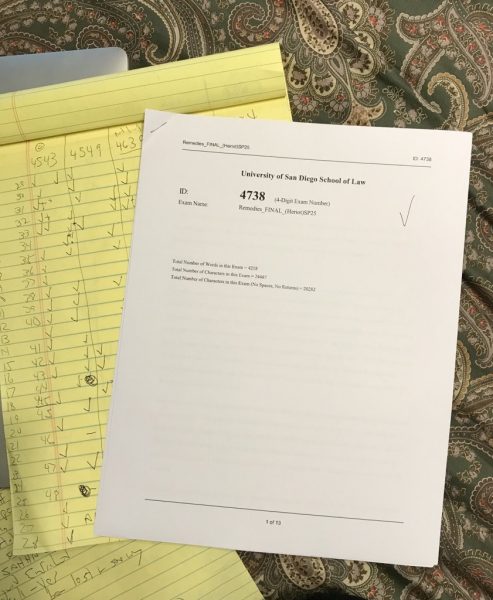
THE UNIVERSITY OF SAN DIEGO IN THE REAR VIEW MIRROR:  Behold the last exam that I will ever have to grade (as well as the last of the insanely meticulous charts I make when grading exams).   I figure I’ve done several thousands of these over the last 35 years.  By the end of today, I should have this one scored, all the exams tallied, and the grades recorded.

All five of the more conservative law professors who signed up for “phased retirement” are now finished at USD.  For the past several years, USD hasn’t exactly been the world’s most hospitable place.  On the other hand, for many years, this was the best job in the world, so I guess it all evens out.

Once I’m done with the book I’ve been working on, I plan to get a job with a think tank.  I also plan to stay on as a Commissioner at the U.S. Commission on Civil Rights (assuming it continues to exist).  Oh … and since I haven’t had a full day off (Christmas included) since 2019, I think I’ll take Memorial Day off to clean out my closets.  Maybe.

ARE THE CIVIL RIGHTS DIVISION LAWYERS WHO ARE LEAVING THE CIVIL RIGHTS DIVISION APOLITICAL TECHNOCRATS?:  WaPo implies that the 100 or so lawyers who are leaving the Civil Rights Division en masse are somehow apolitical technocrats who are outraged that the Trump Administration is politicizing their division.  But as Alison Somin writes on X, that’s ridiculous.  The Civil Rights Division has been home to hyper-partisan wokesters for quite some time.  If that’s who’s leaving (and it almost certain to be), there is no good reason to miss them.

More than a decade ago, I got a taste of the Civil Rights Division’s special brand of leftism when the U.S. Commission on Civil Rights investigated of the Civil Rights Division’s handling of the New Black Panther Party case.  The dominant view there was that civil rights laws do not protect white males.   If anything, it’s gotten worse since then.

Changing the culture there will be a labor on par with cleaning the Augean stables.  But Harmeet Dhillon might turn out to be just the right person to do it.  Godspeed to her.

UNCONSTITUTIONAL:  “Prosecutors to Consider Race in Pleas Deals under New Policy Written by Hennepin County Attorney Mary Moriarty.”  The policy was deliberately written in an effort to disguise its unconstitutionality.  It says both to consider the accused’s race and not to consider the accused’s race in offering plea deals.  But, despite the efforts to conceal it, the unconstitutionality of such a policy should be throbbingly obvious.

When someone tries to tell you that a particular instance of considering race is a cool idea, the best thing to do is “flip it.”  If prosecutors considered an accused’s whiteness in his or her favor as “part of the overall analysis,” but not necessarily as “controlling,” we would rightly be outraged.  It should be no different here.

Can’t this Soros-backed prosecutor be recalled?

JOHN O. McGINNIS:  “The Road to Campus Serfdom.”  “Federal control over education has grown so powerful because progressives empowered the government for their own ideological goals.”  And the road to that serfdom runs through a little Christian college in southeastern Pennsylvania called Grove City College.

There have been a lot of complaints from progressives that it is unfair to cut off Harvard and Columbia from all their federal funding when their sins, if any, were isolated.  Well … own it, guys.  You’re the ones who made the law that way. (Typo fixed.)

CRAZY DAY IN SACRAMENTO:  Today, the California Legislature plans to hold several hearings on so-called “reparations” bills.

*Assembly Bill 7 would allow state colleges and universities to give preferential treatment in admissions to the descendants of American slavery.

*Assembly Bill 57 would make possible “home purchase assistance” for the descendants of American slaves (if at some point a Bureau for the Descendants of American Slavery is established (see Senate Bill 518), which will identify who is and who isn’t a descendant of American slavery).

*Senate Bill 437 would provide funding for California State University to further research slavery reparations and especially to figure out how to determine who is descended from American slaves and who isn’t.

*Assembly Bill 742 would provide preferential treatment in licensing for descendants of slaves (if at some point a Bureau for the Descendants of American Slavery is established (see Senate Bill 518), which will identify who is and who isn’t a descendant of American slavery).

And there are more such bills.

Note that California was not even a slave state.

Oh … and there’s a new effort to repeal (partially) Proposition 209.  It never ends.  We whipped their butts when they tried to repeal Proposition 209 back in 2020, despite being outspent by MORE than 14 to 1.  We managed to derail last year’s effort to repeal it by trickery through Assembly Constitutional Amendment 7 (ACA7) (which passed the Assembly, and which looked like it would pass in the Senate, but mercifully did not).  That effort would have allowed the governor to make virtually unlimited exceptions to Proposition 209.

This year’s effort is also called ACA7, but I believe that is just a coincidence.  The new ACA7 exempts education from Proposition 209’s prohibition of preferential treatment based on race, sex, color, ethnicity or national origin.  For K-12, the exemption would be total.  For higher education, the exemption would exclude admissions (since that is already prohibited by the Supreme Court’s decision in Students for Fair Admissions v. President & Fellows of Harvard College (2023)).  But discrimination in financial aid and everything else would no longer be prohibited by Prop 209.

None of these bills has passed either the Assembly or the Senate and with luck they never will.  It’s hard to tell at this point whether they should be taken seriously.  I can’t imagine that Governor Gavin Newsom, who is desperately trying to position himself as a “Not Crazy” Presidential candidate, would be happy to have to take a stand on them.  Still, we at the American Civil Rights Project don’t like to take chances.  We’ve filed opposition letters to several of the bills.

But with all the problems California has—fires, crime, water shortages, transportation messes, homeless encampments, drug abuse, immigration—it’s incredible the Legislature thinks it has time for this.

By the way, there are so many bills they can’t handle them all in one day.  Tomorrow, Assembly Bill 1071, a criminal procedure bill to combat white supremacy and systemic racism, will be heard.

I LOVE A HERO:  And so does the Carnegie Hero Fund.  The Fund, founded by Andrew Carnegie, “awards the Carnegie Medal to individuals in the United States and Canada who risk death or serious physical injury to an extraordinary degree saving or attempting to save the lives of others.”

Thank you, Andrew Carnegie for helping to foster a culture where heroism is valued.  But most of all, thank you to those individuals (yes, they are mostly men, but there was woman among this group and a boy) who instinctively came to the rescue of their fellow human being.  God bless you (and, to the men among you, God bless your toxic masculinity).