Author Archive: Ed Driscoll

DISPATCHES FROM THE INTERSECTION OF WEIMAR AMERICA AND TRUNALIMUNUMAPRZURE: It Looked Like Biden Froze During Early Juneteenth Celebration at the White House.

Biden looked to be having a frozen episode. He looked a lot like Mitch McConnell did when he froze during a press conference. At the time, McConnell’s people said it was likely a part of the process as his brain recovered from a bad fall he took. He hit his head when he fell and was hospitalized.

When McConnell froze, he stood motionless with a blank stare on his face. Biden had the same look on his face. McConnell had a second frozen moment during an event in Kentucky. After the second episode, McConnell announced he was stepping down as Senate minority leader and would not seek re-election. He was 81, the same age as Biden.

Where was Jilly from Philly? Kamala’s husband was there with her. They were clapping and swaying to the music next to Biden on the front row.

This comes at an awkward time. Last week the Wall Street Journal ran a tough piece about Biden’s loss of mental acuity. 45 people were interviewed, both Democrats and Republicans. Most of the Democrats spoke anonymously. It was notable, though, that they were speaking about Biden’s condition at all. Most are silent or defensive when asked about Biden’s ability to do the job, given his advanced age and obvious decline.

More here: Video of Joe Biden Appearing to Freeze at Juneteenth Event Raises Questions.

Many questions:

CHARLES COOKE: Did I Miss the ‘Vandalism Is Fine Now’ Memo?

Many of the protesters wore masks and keffiyehs to cover their faces, in apparent violation of a D.C. law that prohibits demonstrations “while wearing any mask, hood, or device whereby any portion of the face is hidden, concealed, or covered as to conceal the identity of the wearer.”

No arrests were made during the day, even as protesters vandalized property and clashed with police, according to law enforcement officials.

Can someone please explain to me, in words that your average ten-year-old could understand, what the argument in favor of this abdication is supposed to be? Suppose, arguendo, that I do not share the worldview of the vandals. What case could be made for their liberation that would persuade me? I can’t see one.

As a rule, I am very much interested in what other people think about politics. In my estimation, you cannot be useful as a citizen if you do not comprehend what your ideological opponents believe, and you cannot be effective as a writer if you do not understand why you don’t share those views. But here? Here, I’m stumped. Vandalism is a crime, and a malum in se crime at that. It is a crime at the federal level. It is a crime at the state level. It is a crime at the local level. Morally, it is considered a crime even where there is no law. I was taught as a child that vandalism was wrong; I have taught my own children that vandalism is wrong; and, even if I hadn’t done that, I suspect they’d grasp it instinctively. There is no ethical framework I can intuit in which defacing public monuments is acceptable, and no prosecutorial theory I can detect in which it ought to be ignored. Opposition to vandalism is obvious, widely understood, and value neutral. All in all, there cannot be more than 5 percent of Americans who believe that spraying graffiti on statues is okay.

Right around this time in  2020, it became widely accepted on the left that toppling statues of bad people was perfectly acceptable. These were historic figures who committed doubleplus ungood crimethink, and thus desperately needed to become unpersons, the sooner the better. Historians and even mainstream publications such as Popular Mechanics(!) dispensed advice on how to topple said statues without getting injured in the process. So what’s some graffiti in comparison.

It’s not like it’s skidmarks on a pride flag-painted crosswalk, after all. Speaking of which, as America’s Newspaper of Record reports:

JIM TREACHER: They Were Just Minding Their Own Business, Guarding Their Hostages…

Have you ever had one of those days?

You’re just sitting at home minding your own business, guarding the Israeli hostages your Hamas buddies kidnapped after their bloody rampage on October 7. Then, all of a sudden, for no reason whatsoever, a bunch of Zionists bust in and kill you. A lot of you. Hundreds of you, if your terrorist comrades are to be believed.

And for what? Why did so many people need to die just for four Jews? Aren’t your lives important too?

* * * * * * * * *

But wait, there’s more. Guess who was holding Kozlov and two of the three other hostages? A reporter for something called the Palestine Chronicle.

Terrorist, journalist, whatever.

The only difference between this guy and his counterparts in the west is that at least he had skin in the game. He didn’t just talk the talk. He actually got in there and participated in the terrorism he endorsed.

And now he’s dead, which is really great. He wanted martyrdom, and now he’s got it. I hope he enjoys his 72 virgins, or 72 raisins, or whatever these psychopaths believe.

Exit quote:

CHRISTIAN TOTO: It’s Official: Audiences Have Forgiven Will ‘The Slap’ Smith.

The “King Richard” star slapped Oscar presenter Chris Rock in front of a global audience two years ago. The actor took issue with Rock’s reference to his wife Jada Pinkett Smith’s bald head. The incident, swiftly dubbed “The Slap,” stained Smith’s career in ways no one could have predicted.

Would audiences embrace the affable Smith again? Could he return to the action comedies that once rocked the box office?

We got our answer over the weekend.

Will Smith and the Box Office: It’s Not Complicated

“Bad Boys: Ride or Die,” Smith’s first populist film since “The Slap,” scored big at the U.S. box office. The movie’s $56 million haul not only gave Hollywood a sigh of relief given recent blockbuster fails it showed Americans are willing to forgive (if not forget) Smith’s transgressions.

The film teams Smith with Martin Lawrence again as Miami cops whose bond helps them survive crisis after crisis. It’s precisely the kind of mainstream blockbuster Smith delivered for decades.

Would the sequel land differently given the post-“Slap” era? Apparently not.

Need more?

The new film indirectly references the slap in a clever way that feels organic to the story.

John Nolte adds, “I think Bad Boys: Ride or Die overperformed for the same reasons Top Gun: Maverick, Spider-Man: No Way Home, Sound of Freedom, and Oppenheimer overperformed—because after five-plus years of the Woke Terror removing fun and humanity from the movies, Normal People are dying to go to the movies. Normal People miss going to the movies. And Bad Boys: Ride or Die looks like a non-woke, non-gay, appealing, good-time-movie made for Normal People.”

DISPATCHES FROM THE RELIGIOUS LEFT: Our Society Is Reverent, After All.

It is good to know that even in today’s anything-goes age, some things are inviolate. Like the “Pride” flag. (If anyone ever explains why being “queer”–their word, not one that I would ever use–is something to be proud of, let me know.) Thus we have kids being arrested for riding their scooters across a Pride flag that was…painted on a street:

A sane person would say, if you don’t want people driving on your religious symbol, don’t put it on a street. But sanity is in short supply these days.

And let’s not forget that religious symbols other than the Pride flag are routinely desecrated, not because they were on a public thoroughfare but because a liberal gratuitously wanted to insult them.

But in today’s world, it is dangerous to cross the “Pride” contingent.

Which leads us to this astonishing headline: Lime Scooters Will Now Shut Down If Driven Over Pride Flag Crosswalk In Spokane, WA.

Lime has now implemented a “no-go zone” over the crosswalk, meaning scooters driven over the mural will be remotely shut down. According to the company’s website, entering a “no-go zone” will cause a Lime vehicle to “gradually come to a stop,” forcing a rider to walk their scooter until it is outside the zone.

The incident in Spokane is not the first time an individual has been arrested or investigated for “defacing” a pride mural painted on the street.

In February, a 19-year-old from Clearwater, Florida, was arrested after being caught on video doing “burnouts” with his truck on a pride crosswalk in Delray Beach. Dylan Brewer turned himself into the Delray Beach Police Department after the video began to circulate online. He was charged with felony criminal mischief over $1000 and reckless driving.

I’m pretty sure Mike Judge didn’t intend for Idiocracy to be a how-to guide for life in the 21st century. But then, as John Hinderaker wrote above, “A sane person would say, if you don’t want people driving on your religious symbol, don’t put it on a street. But sanity is in short supply these days.”

In any case, as a wise woman once wrote, “There’s no way to rule innocent men. The only power any government has is the power to crack down on criminals. Well, when there aren’t enough criminals one makes them.”

CAN BLUE STATES AND CITIES RECOVER?

Blue states and cities are usually unconcerned about the throwaway culture when it comes to people, anyway. They’re usually “solving the climate crisis” or perhaps solving the Middle East, tasks that are not within their job description or their competency. Meanwhile, their actual tasks of providing safety and public order are often left in the dust.

Minneapolis, which makes its twin across the Mississippi look relatively sane, is in a world of hurt. Center for the American Experiment president John Hinderaker wrote on the fourth anniversary of the George Floyd arrest about the “world of hurt” that is a city he came to in 1974 because of its “easy commutes, low crime, pleasant neighborhoods, cultural amenities and relatively good schools.” Now, if commutes are still ok, that’s only because the city is a hollowed-out shell of itself with a high percentage of vacancies and very little foot traffic. One local at the conference told me he met someone for lunch in Minneapolis for the first time in years. He described it as many do—a “ghost town.” At the very nice restaurant he went to, there were only about five tables with customers. He shook his head and muttered, “This can’t go on.”

Another old friend who works in Minneapolis described his own company’s downsizing of their office space due to an inability to get workers to come into town. He is six feet, four inches tall and about 240, but he’s afraid of becoming a crime statistic, too. As Hinderaker observes, the declines in crime over the last year or so still haven’t brought the city back to pre-2020 levels. Even before I left in 2021, a colleague told me that police wouldn’t respond to his daughter’s mugging because she wasn’t hurt. Indeed, the recent ambush and murder of Minneapolis Policeman Jamal Mitchell happened in part because the hero was working without a partner on a mandatory overtime shift due to the staffing problems.

As James Lileks told Jon Gabriel last year when Gabriel asked if Minneapolis was going to the proverbial dogs:

Big question, and so many different ways to answer it. Is there hope? Yes of course there is. Are we going to the dogs? No. Are things worse than they were? Yes.

People believe somehow that downtown is in a state like San Francisco, where it’s just hordes of drug addicted zombies and the mentally ill staggering about accosting people. And that’s not the case. I mean I work downtown, and I never felt unsafe downtown walking around anywhere. It’s not particularly populated; it’s emptied out in a horrible fashion because of the pandemic, and everybody who went to work from home didn’t want to go back, because they hate to commute, and they like their jammies and their dog and the rest of it, So why go downtown? Well, you know the knockoff effects on that have been catastrophic to the local economic ecosystem.

We have all of the buildings downtown here connected on the second floor by skyways, which is great when it’s 20 below — really great when it’s 20 below. But unfortunately, the loss of something we used to call customers means that all the little shops that had the things to buy; the stores, the drugstores, the shoeshine places, the restaurants, have been just hammered.

So, what was a vibrant (and I hate to use that word because it’s always overused) and bustling — another cliche — but what was vibrant and bustling is now 20, 30 percent of what it used to be. And it’s hard because you walk around, and you see empty storefront after empty storefront. And you recall what was and you think, well, that’s not coming back is it, for an awful long time?

Now the solutions that are being put in place are the usual usual, usual. Nobody ever says, hey tell you what, we get a bad thing going on here let’s drop rents, let’s drop our tax rates, let’s cut regulations, let’s make it really easy for somebody to start up a business. Noooo. No, we have plans to, well, if we move the buses from this street to this street , we can create a vibrant and bustling Entertainment District in the night. And liberalize the liquor laws a little bit so people can walk around without fear of getting tagged if they’ve got a mango margarita. Maybe that’ll do it!

No, that’s not going to do it.

What’s going to do it is to have a sense of safety. And what we have, unfortunately, is a sense that there are feral elements at the margins, and nobody really seems to know what to do about that. I mean, you might say, okay your light rail system is a moving homeless shelter, with people just nodding off and doing meth and people feel really unsafe there. You might go back to your old Dragnet-era prescriptions and say okay well then, we should send people in there to remove them. But now you can’t really do that, because homelessness is a problem; economic inequality and the rest of it, and until we solve these problems, we’re just moving them around from one place to the other. So, we can’t do anything about the immediate disorder, because we haven’t solved the structural problems that created it in the first place.

Okay how about crime? Well we can’t really put people in jail. I mean, incarceration is a sign that we as a society have failed these people. So we can’t do that. And policing is good but if we let the police pull people over for what used to be the usual (now regarded as specious) reasons: You got a taillight out; you’ve got an equipment violation; you don’t have your tags on you; you’ve got no license plate. And if you pull them over, well, if there’s a disparate impact, with that then it shows that structural racism is the impetus again behind our law and order campaign. So we really can’t do that until we eliminate the problems with structural racism et cetera. So everybody knows what can be done; I mean, it’s not hard to have basic civil order in a society. But the will to do it is hampered by a little sort of squick factor that  it’s not right to do these things. We did these before and  what happened? We generally had a clean, well-ordered society with a social compact and high social trust and all the rest of it you know, but we don’t have that much anymore. Yeah that’s all really unfortunate. But like I say I don’t feel unsafe, I don’t.

But at the same time, my wife was almost held up at gunpoint about two blocks from our house…

More from Lileks and Gabriel here:

EUROPE MOVES TO THE RIGHT: “The results are coming in for today’s elections for the European Parliament, and so far it appears right-leaning populist parties are routing the establishment centrist and left parties. Green Parties are taking a disproportionate share of the losses…Is this an omen for our election in November, just as the Brexit vote in 2016 foreshadowed the outcome? I know one center-left thinker who says Yes.”

THAT’S GOOD, BECAUSE THE CURRENT PRODUCT STINKS: The Brits Invade US Newsrooms With a ‘Killer Instinct’ and Fleet Street Ethics.

The crisis in American news media has led to an unexpected result in a very short time: The invasion of executive news suites by British editors, who experts say bring a “killer instinct” to news gathering, while notably downgrading the diversity quotient* in news leadership.

Most recently with the appointment of Will Lewis as the publisher and CEO of the Washington Post — and his latest restructuring plan, featuring the appointment of Fleet Street-bred editor Robert Winnett as executive editor after the election — British players are gaining a significant foothold in the U.S. media industry.

These latest U.K. natives arrive just months after a growing list of others — CNN’s CEO Mark Thompson, The Wall Street Journal Editor-in-Chief Emma Tucker, Bloomberg News Editor-in-Chief John Micklethwait, The Daily Beast’s content chief Joanna Coles and the outlet’s new executive editor Hugh Dougherty.

“In media, everybody is floundering. As legacy media takes continual hits, everybody is looking for the magic ticket that appeals to consumers and advertisers,” said Mark Borkowski, a London-based British publicity, image and crisis consultant, told TheWrap. “It is about the perception of who is successful, and therefore doing something similar is going to lead to similar success.”

But, as UK media execs are being handed some of the biggest jobs in U.S. journalism, some question whether the choices are what America’s democracy needs. “Everybody’s screaming about how we have a crisis in local news,” said Jeff Jarvis, a journalism professor at CUNY. “I say we have a crisis in national news too, at this time when fascism is at the door.

But their coverage of 2016 and 2017 and 2020 is a big part of why they’re so despised now. And their hatred of the Bad Orange Man (see also Jarvis’s f-bomb above) means there will be no apologies for going all-in on conspiracies. After the elections of 2004 and 2008, the media at least paid lip service to what they got wrong and vowed not to do it again – and of course promptly forgot those mea culpas. None are forthcoming this time around.

* Howell Raines, then of the New York Times, who said in a classic Kinsley Gaffe from 2001, their hiring campaign that brought in serial plagiarist Jayson Blair, “has made our staff better and, more importantly, more diverse,” could not be reached for comment.

UPDATE: John Nolte: Crybaby Washington Post Staffers Melt Down over Changes.

[T]he Post has lost its credibility and customers, and the parasites killing this host remain in charge.

I love it. I don’t want the Post to turn things around. Not only that, but I want to watch the Post and all of its reprehensible staffers get what they deserve: a slow, agonizing, and humiliating death.

Plus a (partial?) list of the many hoaxes the Post and other DNC-MSM outlets have run since 2016.

Back in 2003 Virginia Postrel explored “Press Pathologies:”

Each national press corps seems to have its own pathology. For the American press, it’s the giant campaign swing, as applicable in military campaigns as in electoral contests. First the front-runner can’t lose. Then he’s a total disaster. Ditto the U.S. military in Iraq. The audience, reporters seem to believe, will reward drama.

The British press corps serves its market, in turn, by passing on every rumor someone tells a reporter in a bar. The result are lots of juicy stories, some of them true. As a former U.S. news editor told her editors after 9/11, when asked why her paper wasn’t getting the great stories in the British press, “They’re great stories. But they aren’t true.”

The American media certainly arrived there by 2016! No wonder the Brits are making such headway in American newsrooms these days.

JOEL MILLER INTERVIEWS VIRGINIA POSTREL: Technology, Culture, and Power—What Connects Them All. Journalist Virginia Postrel on Spotting Trends, AI, Her Simple Advice for Young Writers, More.

In The Future and Its Enemies, which came out in 1998, I argue that many political and cultural issues are better understood not as conflicts between traditional left and right but as conflicts between advocates of dynamism and advocates of stasis.

The central value of dynamism is learning. Progress occurs not as marching toward a known goal but as a decentralized process of trial and error with feedback provided through competition and criticism. We neither start from scratch nor seek to freeze what is (or was). We build on the past by identifying flaws—“form follows failure”—and seeking to correct them. Progress is a bottom-up, incremental process. Contrary to what some people assumed because of my Reason job, dynamism isn’t synonymous with libertarianism—it’s compatible with some forms of redistribution, for instance—but it does require less regulation and more tolerance than we’re often accustomed to.

Today when I give talks on the subject, I often define dynamism as a variety of liberalism that foregrounds learning, whereas other versions foreground other values, such as justice, equality, or autonomy. Liberalism in real life, as opposed to liberalism in philosophy articles, values all these things but also constantly makes tradeoffs among them. Liberals argue among themselves about which should take precedence in a given situation.

The drive for stasis takes two basic forms. The first I call “reactionaries.” Their central value is stability. They idealize a steady-state society where things don’t change. The irony is that pursuing this ideal implies a revolutionary turn from our current liberal order, usually toward an idealized past. When I wrote the book, the best examples were often green ideologues, who have since morphed into degrowthers. Today, they’ve been joined by integralist theocrats like Patrick Deneen. Consciously or not, reactionaries oppose the open society. They are illiberal or anti-liberal.

The other stasist camp, which I call “technocrats,” emphasizes control. Technocrats often praises the idea of progress but define it as moving toward a single, known goal. When the book was new, I used to talk about Bill Clinton’s “bridge to the future” as an example of technocratic thinking. The phrase sounds inspiring, but it assumes a single route from Point A to Point B. Deviate from that predetermined path and you fall into the abyss. Technocrats may or may not have liberal allegiances. Bill Clinton does. Xi Jinping does not.

Read the whole thing.

RICHARD FERNANDEZ: The Unexpected Hostage Rescue.

Part of me wants to know how the assault force achieved the surprise needed to forestall hostage execution in two separate locations. They had to make entry practically simultaneously at a mutually optimal moment. Since I can’t know I will guess. The rescue operation elements may have seemed to be part of the random environment until the rescue moment. The key disadvantage of holding hostages in populated areas is that Hamas cannot entirely prevent random and ambient access by the public to places nearby, access the IDF can exploit by continuously flowing assets through the vicinity. The presence of civilians cuts both ways. It provides human shielding against an assault force, but it can also conceal those same elements.

Related: Did Gazan who held Israeli hostages work for Al Jazeera and US-based charity?

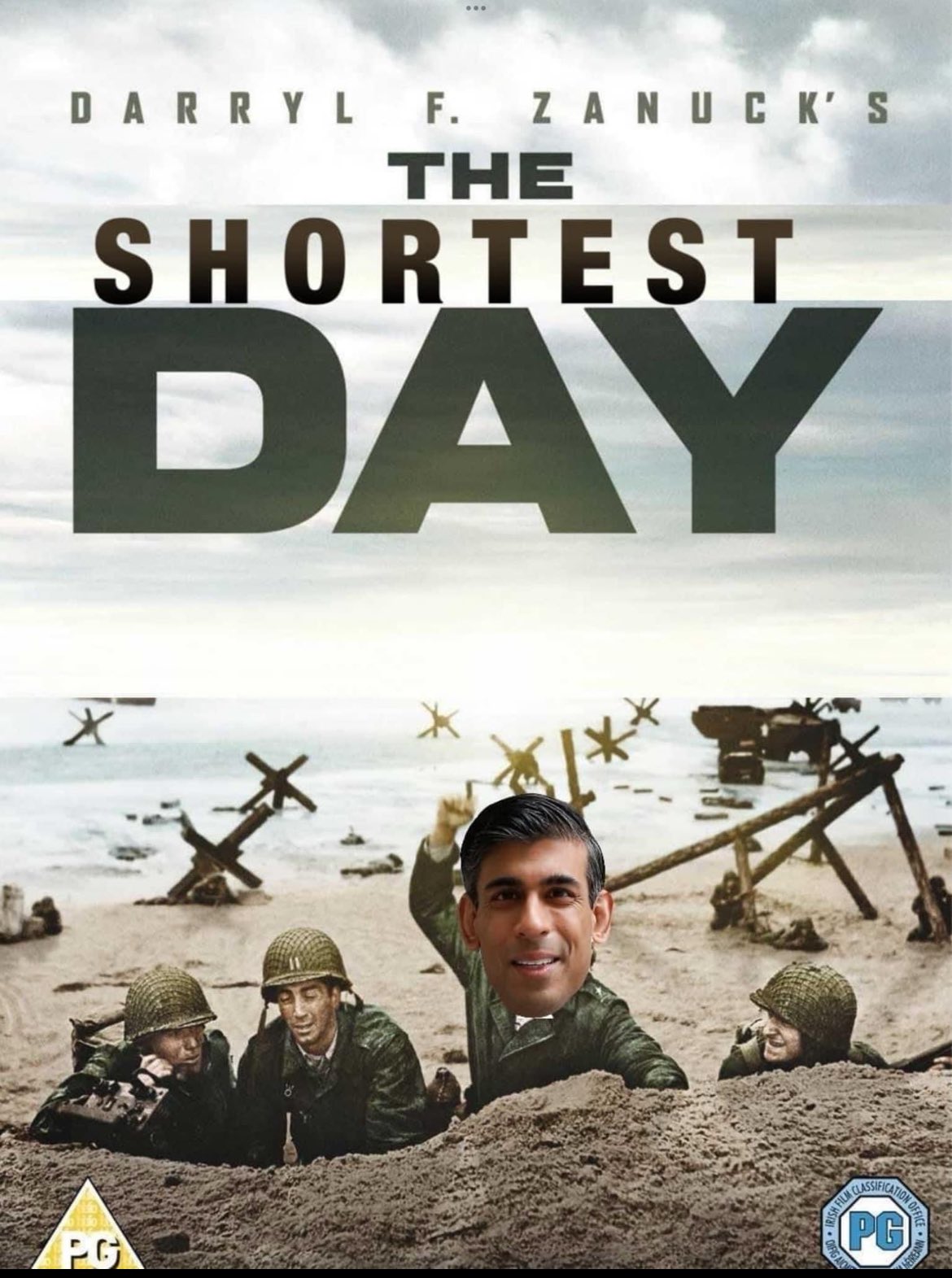
QUESTION ASKED: “Is Rishi Sunak trying to lose the General Election?” Sunak’s D-Day snub has exposed his staggering aloofness:

Today, Rishi Sunak apologised for leaving Thursday’s D-Day events early. He attended a memorial event for the 80th anniversary of the landings at Ver-sur-Mer in northern France in the morning, before hopping back over to Blighty to film an interview with ITV. This meant he missed the later ceremony on Omaha beach. And so UK foreign secretary David Cameron, not prime minister Sunak, was pictured alongside US president Joe Biden, French president Emmanuel Macron and German chancellor Olaf Schoz. This was an all-too-visible snub.

Sunak has also been forced to deny claims that he was planning to skip even the morning ceremony to stay in the UK campaigning.

I can’t believe I need to say it, but it seems that Sunak and his coterie of advisers still need to hear it: D-Day matters to the British people – a hell of a lot. It was critical to the Allied defeat of the Nazis in the Second World War. It’s about democracy’s triumph over fascism and the sacrifices that were made to achieve this. This stuff is the very basis of the modern British national identity. If Sunak himself did not realise this – damning enough in itself – you would like to think that one of his band of handsomely remunerated aides might have twigged it.

Seen on Facebook:

PRO-PALESTINIAN PROTESTERS SURROUND WHITE HOUSE, CLASH WITH POLICE:

Police clashed with Gaza protesters on Saturday morning as the demonstrators attempted to surround the White House in Washington DC.

As the protest ensued, officers were in the process of making an arrest of a woman and the other demonstrators around them started to follow, chanting, “Let her go!” A mob surrounded the officers in an attempt to make the arrest and could be seen pushing the policeman.

Demonstrators attempted to pull the arrested woman away from the police officers and were eventually successful in helping her to escape. During the clash with police, mace was also used by the officers to quell the mob, according to reporter Jordan Fischer.

Other protesters cheered after they set the suspect free from the police as she was being arrested.

At one point during the protest, a man wearing a Hamas headband lifted up a mask of Joe Biden with blood stains after others had defaced a monument.

One protester was seen at the demonstration holding a sign that said, “F*ck Israel. Stand with Hamas.” The man with the sign explained to an interviewer, “I support by any means necessary what Hamas can do to resist the genocide that Israel and the Jews who do it.”

Smoke bombs were also reportedly being set off in front of the White House during the protest.

This all sounds pretty insurrection-y to me. Hey, you know what that means!

UPDATE: Charles Cooke writes, “It gets boring to play these ‘what if?’ games, but that they are boring does not mean that they aren’t necessary or true. What if the people who did this had been right-wingers? What if they’d been wearing MAGA hats?”

We all know the answers to these questions. There would have been mass arrests — and mass hysteria to go along with it. We’d have had wall-to-wall coverage in the press, an endless supply of furrowed opinion pieces in the newspapers, and the delivery of hundreds of new “expert” theories confirming the intrinsic link between right-of-center views and murderous hyperbole. As it is, I’ve had to search quite hard to find out what happened yesterday, and most of the photographs and videos I’ve seen were taken not by TV stations or newspapers but by amateurs on Twitter. There is a reason that I’ve used NBC’s report twice in this post: I couldn’t find an equivalent on the homepages of CNN, the BBC, the New York Times, or the supposedly D.C.-oriented Washington Post.

We all know why this is. And, until it changes, the Democrats’ rhetoric will continue to fall flat — even in such cases as it’s demonstrably correct.

Indeed.

MICHAEL GOODWIN: Joe Biden’s D-Day speech was a bitter mockery of Ronald Reagan.

Joe Biden’s trip to France proved two big things: He’s no Ronald Reagan, and he forgot to pack his patriotism.

Along the way, he also managed to cheapen historic heroes by trying to score partisan political points with attacks on Donald Trump and House Republicans.

Whatever happened to the tradition that partisanship stops at the water’s edge?

Other than that, heckuva job, Mr. President.

Biden’s visit to Normandy for the 80th anniversary of the D-Day invasion was overshadowed from the start by Reagan’s exceptional speech at the same spot 40 years earlier.

Although the contrast must have eaten at Biden, who bitterly opposed almost everything Reagan did and stood for, White House aides used the Gipper’s speech as a guide for Biden’s.

Joe Biden’s trip to France proved two big things: He’s no Ronald Reagan, and he forgot to pack his patriotism.

Along the way, he also managed to cheapen historic heroes by trying to score partisan political points with attacks on Donald Trump and House Republicans.

To crib so shamelessly from Reagan’s 1984 speech, there has to be some sadistic element of the “anything you put on that teleprompter, Ron Burgundy will read” mindset to Biden’s speechwriters. They had to know that doing so would simultaneously cause reminders of Joe’s long history of plagiarism, and illustrate Biden’s increasingly diminishing state:

NOT ANTI-WAR, JUST ON THE OTHER SIDE: The Press Reactions to Israel Rescuing the Hostages Will Make Your Blood Boil.

There are three things certain in life: Death, taxes, and the mainstream press being the worst people on earth. The sheer ability of the journalistic class to take any issue and come down on the wrong side of it is legendary. That dynamic didn’t change after Israel rescued four hostages on Saturday morning.

As RedState reported, a joint operation between the IDF, ISA, and police forces entered the city of Nuseirat, a supposed “refugee camp,” after discovering their location. The hostages were being held in “civilian” homes, with Hamas fighters responding to an all-call to attack the area after the rescue attempt was discovered. That led to a tense firefight in the streets, with a helicopter eventually providing evac from the nearby beach.

Now, you’d think the press would be very interested to know why hostages were being held in “civilian” homes in the middle of a “refugee camp.” That would seem the most prudent question when discussing casualties as a result of the rescue operation. Instead, they simply went to bat for Hamas.

Here’s a primer from The Washington Post before we get to one of the more unbelievable examples.

Everything about that headline is carefully crafted to mislead. For one, the claim that “more than 200 Palestinians killed” is completely unverified. Those numbers come directly from the Hamas-controlled “Gaza Ministry of Health.” Also absent in them is any admission of how many of the dead were combatants, either because they were members of Hamas or chose to fire on the Israeli forces.

If only the Post had warned us about unverified casualty numbers from the “Gaza Ministry of Health.” Or as the kids say these days, life comes at you fast: Women and children of Gaza are killed less frequently as war’s toll rises, AP data analysis finds.

—AP article appearing in the Washington Post, on Friday.

(Yes, the one and the same AP: Israel Shared Intelligence to Us Showing Hamas Operated Inside Building Where AP, Al-Jazeera Had Offices.)

UPDATE: The Biggest Media Scandal of the Era Has Arrived. “In a normal media ecosystem, there would be extensive internal reviews at the New York Times, Washington Post, BBC and others, concluding with a clear plan for reforming the newsgathering process at these places and holding accountable those responsible for setting the world aflame with obvious lies. I won’t hold my breath. But the AP report, while late, is the first sign of a waking conscience among the press. May there be others.”

TRUNALIMUNUMAPRZURE: Jill Biden, Edith Wilson, and the Changing American State.

Biden’s unusually intense reliance on his wife as a cognitive enhancement and an image protector is as inarguable as it is provocative. According to an NBC News profile, she is known in the White House as “the Decider,” and she wields “unparalleled influence.” “She is,” the profile continues, “her husband’s foremost defender. She guards his interests and dignity….Her input is essential in some of the weightiest political and personnel decisions the 46th president confronts.” She is to Biden what the left used to claim Dick Cheney was to George W. Bush, i.e., the power behind the throne.

All of this has drawn comparisons between Jill Biden and another uniquely powerful First Lady, Edith Wilson.

Some historians consider Edith Wilson the nation’s “first woman president”—and not without cause. When her husband, the execrable Woodrow Wilson, suffered a debilitating stroke on October 2, 1919, Mrs. Wilson essentially took over running the White House and, by extension, the entire executive branch. She screened all government business brought to the Oval Office. She handled all serious matters. Because he was left unable to write his name, she forged his signature on official documents. Most notably, Edith Wilson guarded her husband’s “interests and dignity” by keeping his infirmity secret from the public. As William Hazelgrove noted in his 2016 biography of her, Madam President: The Secret Presidency of Edith Wilson, “her Oval Office authority was acknowledged in Washington circles at the time—one senator called her “the presidentress who had fulfilled the dream of suffragettes by changing her title from First Lady to Acting First Man.”

The biggest difference between Edith Wilson and Jill Biden is that Wilson got away with it. While Jill Biden is front-and-center in her husband’s public life at all times, earning the admiration of his supporters and drawing the ire of his opponents, Edith Wilson worked effectively and quietly behind the scenes. Through quiet diligence and discretion, she was able to convince those outside of Washington that all was well in the White House and that her husband was still in charge. His stroke occurred more than 17 months before Warren G. Harding was inaugurated on March 4, 1921. That’s more than 35% of his second term and nearly one-fifth of his entire presidency.

Edith Wilson was able to keep this secret and succeed where Jill Biden has failed, not because she was especially crafty or exceptionally dishonest (although she was both) but because the president was not, at the time, the most important person in the world. The government was small enough and the presidency unimportant enough that no one missed Woodrow Wilson in the slightest. No one outside of Washington noticed or cared that he wasn’t around. No one needed him to fix their problems, right their wrongs or deliver retribution upon their enemies. No one needed him to be the cause of all economic activity or the source of the nation’s self-image. He wasn’t the “empathizer in chief” or a powerful father-like figure. He was a just a guy, albeit a guy with an important job, but not one that was so important that it completely preoccupied everyone’s waking hours. Celebrities didn’t obsess about the man or deliver foul-mouthed press conferences declaring that the world’s fate depended on his reelection. No one cared—and nor should they have.

I’m not sure about that last part, given Wilson’s role in creating the modern American state:

As Robert Curry noted at the American Thinker, 1913 was the Turning Point.

In 1913, Woodrow Wilson was the newly elected president. Wilson and his fellow progressives scorned the Constitution and the Declaration. They moved swiftly to replace the Founders’ republic with a new regime.

There is widespread agreement that Wilson did not always show good judgment – for example, in his blunders in international relations – but in the project of overturning the Founding, he and the movement he led selected their targets shrewdly. By the time he left office, the American republic was, as they say, history. The fundamentals of the new regime were in place, and the expansion of government under FDR, LBJ, and Obama was made easy, perhaps even inevitable.

Nineteen-thirteen gave us the 16th and 17th Amendments to the Constitution. That year also saw the creation of the Federal Reserve. This burst of changes marks the effective beginning of the Progressive Era in American politics, the era in which we now live. Wilson was to do much more that would once have been considered out of bounds, but these three changes were enough to change everything. In 1913, the fundamental agreement the Founders made with the American people about the relation of the states and the federal government was broken.

What followed was a tumultuous — and not coincidentally, largely forgotten — decade in America: You want a more ‘progressive’ America? Careful what you wish for.

I’m thinking of an American president who demonized ethnic groups as enemies of the state, censored the press, imprisoned dissidents, bullied political opponents, spewed propaganda, often expressed contempt for the Constitution, approved warrantless searches and eavesdropping, and pursued his policies with a blind, religious certainty.

Oh, and I’m not thinking of George W. Bush, but another “W” – actually “WW”: Woodrow Wilson, the Democrat who served from 1913 to 1921.

President Wilson is mostly remembered today as the first modern liberal president, the first (and only) POTUS with a PhD, and the only political scientist to occupy the Oval Office. He was the champion of “self determination” and the author of the idealistic but doomed “Fourteen Points” – his vision of peace for Europe and his hope for a League of Nations. But the nature of his presidency has largely been forgotten.

That’s a shame, because Wilson’s two terms in office provide the clearest historical window into the soul of progressivism. Wilson’s racism, his ideological rigidity, and his antipathy toward the Constitution were all products of the progressive worldview.

As with the moral revolution of 2020, the hangover that followed was enormous for the American left.  In his 2014 book, The Revolt Against the Masses: How Liberalism Has Undermined the Middle Class, Fred Siegel wrote that in order to put a fresh PR spin on their ideology after the horrors of the Wilson administration, the self-described “Progressives” of the 20th century’s early years began to call themselves “liberals” instead — a huge stolen base, considering that there’s a vast difference between the traditional laissez-faire meaning of classical liberalism and the racism, eugenics, and “moral equivalent of war” obsessions of “Progressivism.”

ACE: The Hollywood Reporter Wonders If This Time, Hollywood Really Is In Trouble.

You can’t survive long on costly failure after costly failure.

The Summer Box Office Crisis: Is the Sky Really Falling This Time?With fewer big movies out as a result of the strikes, theatrical revenue is plummeting every week as fans grow accustomed to staying at-home.

ComicsGate had a good point about the word fans: Don’t call them “fans.”

Call them what they are: Customers, or potential customers.

“Fans” suggests that people love you so much they will show up for whatever crap you churn out. t “Customers” suggests you have to woo them and provide them with good value for money.

Hollywood would do well to correct its mindset. No one needs what they’re selling. It’s not fuel or food. It’s a diversion.

They need to stop thinking they’re stars and “creators” and start thinking that they work in a customer-service industry.

And when the customer isn’t being served, there are ultimately repercussions: Alamo Drafthouse Cinemas franchisee closes theaters in North Texas, Minnesota.

JONATHAN TURLEY: Can democracy survive the ‘defenders of democracy?’

In 2024, the greatest test for our Constitution may be whether it can survive the “Defenders of Democracy.”

Ronald Reagan often said, “The nine most terrifying words in the English language are: I’m from the government and I’m here to help.” Today, Reagan’s line cannot compare with the line that sends many of us into a fetal position: “I’m a Democrat and I am here to save democracy.”

The jump scare claim is that unless citizens vote for us, the end of democracy will begin shortly. In 2022, House Majority Whip Rep. James Clyburn (D-S.C.) told “Fox News Sunday” that “democracy will be ending” if Democrats lost the midterms.

The rhetoric has continued to ramp up with the upcoming election.

From President Joe Biden to a host of progressive politicians and pundits, the 2024 election is all about saving democracy. The public has been told that if the Democrats lose power, citizens will be living in a tyrannical hellscape. Vice President Kamala Harris stated in one interview that 2024 “genuinely could be” the last democratic election in America’s history. Dozens of Democrats have said that democracy will end if Biden is not reelected.

The Washington Post even ran an op-ed titled, “A Trump dictatorship is increasingly inevitable. We should stop pretending.”

Many Americans have tuned out the overheated rhetoric, as shown by Donald Trump’s continuing lead in many polls even after his conviction in Manhattan. The warnings also ignore that our system has checks and balances that protected democracy for centuries as the world’s oldest and most successful constitutional system. These dire predictions would require all three branches to fail in an unprecedented fashion.

While these figures cite the Capitol riot on Jan 6., 2021 as evidence of the pending collapse of democracy, the system worked as designed on that day. Congress refused to be deterred by the riot and virtually every court (including many presided over by Trump-appointed judges) rejected challenges to the election.

The most obvious threats today to the democratic system are coming from the left, not the right.

Read the whole thing.

SOMEBODY’S GOT A LOT OF ROGER WATERS’ ALBUMS ON HER PLAYLIST: Pelosi “Sad” That Netanyahu Was Invited to Speak. “She added that the invitation would absolutely not have been made if she were still the Speaker. So we at least know where she stands on the matter.”

SPRINGTIME FOR NETFLIX: Netflix’s new WWII series is New York Times* approved: Hitler and the Nazis Review: Building a Case for Alarm. Joe Berlinger’s six-part documentary for Netflix asks whether we should see our future in Germany’s past.

Hitler’s project: “Making Germany great again.” The Nazis’ characterization of criticism from the media: “Fake news.” Hitler’s mountain retreat in Berchtesgaden: “It’s sort of like Hitler’s Mar-a-Lago, if you will.”

Donald Trump’s name is not mentioned in the six episodes of “Hitler and the Nazis: Evil on Trial,” a new historical documentary series on Netflix. But it dances just beneath the surface, and occasionally, as in the examples above, the production’s cadre of scholars, popular historians and biographers can barely stop themselves from giving the game away.

As the conclusion of this series of quotes on the Weimar Republic from early in the series’ second of six episodes demonstrates:

BENJAMIN CARTER HETT, Author, The Death of Democracy:

Hitler comes out of prison into a Germany which is really politically much less favorable terrain for him than it had been in the crisis year of 1923. Hitler was really a crisis politician; he needed a crisis to be able to get oxygen. By late 1924, when he comes out, things have stabilized: The economy is doing better. The political system is sort of settling down.

ANNE BERG, Professor, University of Pennsylvania:

Between 1924 and 1929, this period is kind of often described as the golden age of the Weimar Republic. The good life slips into view, even if it isn’t quite reachable for the majority of people.

CHRISTIAN GOESCHEL, Author, Mussolini and Hitler:

The Weimar Republic was a progressive liberal democracy.

BERG:

We have relative political stability. We also have a thriving cultural sphere; filmmakers, [and] cabaret.

LISA PINE, Author, Hitler’s ‘National Community:’

We think about abstract and expressionist artists, the Bauhaus architectural movement. Germany was becoming more accepted in the international arena, so she wasn’t a pariah anymore. And so there’s this kind of quite liberating and modernizing aspect to the 1920s. Women were able to vote for the first time.

TIFFANY N. FLORVIL, Professor, University of New Mexico:

There were sex reform movements with individuals like Magnus Hirschfeld, who did studies about homosexuality and was conducting some of the first transgender surgeries in the Weimar Republic. And so you see all of this dynamism emerging. But on the other hand, the Nazi Party, Hitler in particular, recognizes that there are so many German citizens that are distrustful of this fledgling democracy that is supposed to be this new beacon of hope, but it rather is a beacon of disillusionment for many.

HETT:

Outside of Berlin, large numbers of Germans are living in small communities, rural communities where the artistic experimentation, the innovation, the sexual experimentation of Weimar Berlin is utterly foreign to them. And indeed, they are somewhat hostile to it.

BERG:

It’s a group of people who feel shunned. So, if we want to make a contemporary analogy, we can see the sort of forgotten people in America, there is a sense that the system has dealt them a bad hand, and Hitler kind of taps into a fundamental disillusionment with the Weimar Republic. And this is the concept that he will return to repeatedly, even after he is in power.

Hey, if we’re going to go full Godwin, what about these recent headlines?

Or as Tom Wolfe has written:

The Great Depression of the 1930s gave our version of this new breed, the intellectual, plenty of material to get wholesomely indignant about. For a change, America did look dreadful. But even then things weren’t as blissfully vile as they were in Europe, the birthplace of the intellectual. Europe, after all, now had the Depression plus fascism. The solution was what became the specialty of our colonial intellectuals: the adjectival catch-up. Europe had real fascism? Well, we had “social fascism.” And what was that? That was the name Left intellectuals gave to Roosevelt’s New Deal. Roosevelt’s “reforms” merely masked the fascism whose dark night would soon descend upon America.

“Fascism” was, in fact, a Marxist coinage. Marxists borrowed the name of Mussolini’s Italian party, the Fascisti, and applied it to Hitler’s Nazis, adroitly papering over the fact that the Nazis, like Marxism’s standard-bearers, the Soviet Communists, were revolutionary socialists. In fact, “Nazi” was (most annoyingly) shorthand for the National Socialist German Workers’ Party. European Marxists successfully put over the idea that Nazism was the brutal, decadent last gasp of “capitalism.”

* If only the New York Times had gotten Hitler right when he was actually in power. Or as Ann Althouse wrote in October: In 1922, The New York Times published its first article about Adolf Hitler. The reporter, Cyril Brown, was aware of his subject’s anti-Jewish animus but he wasn’t buying it.

‘Several reliable, well-informed sources confirmed the idea that Hitler’s anti-Semitism was not so genuine or violent as it sounded,’ Brown wrote, ‘and that he was merely using anti-Semitic propaganda as a bait to catch masses of followers.’ Two years later, the Times published another news item on the future architect of the Holocaust: ‘Hitler Tamed by Prison.’ The Austrian activist, the piece said, ‘looked a much sadder and wiser man,’ and ‘his behavior during his imprisonment convinced the authorities that [he] was no longer to be feared.’

If only the Gray Lady was still heeding that alarm. Also from October: Why has the New York Times hired a Hitler sympathizer?

Adolf Hitler is back in vogue at the New York Times. I never thought I’d live to see the day.

Until now, the very nice liberals who run the newspaper were probably quite relieved that the world had mostly forgotten about that time in the 1930s, when it had a Nazi-loving Berlin bureau chief called Guido Enderis. Among his many failings, Enderis wrote a puff piece about chief Nazi propagandist Joseph Goebbels, calling him ‘an outstanding go-getter’. But the New York Times leadership kept him on, despite complaints from colleagues, because they considered his high-ranking sources in the Nazi Party too good to lose.

Of course, this is not to say the New York Times editors and the family that owns it are now or ever have been Nazi supporters. Rather, it shows that despite all the protestations of moral virtue and speaking truth to power – and other tired, self-aggrandising journalistic clichés – at its heart, the Gray Lady answers only to its own agenda, which has consistently been focussed on keeping proximity to power.

Today, keeping proximity to power means serving the new master in elite circles: radical woke ideology. The fact that this ideology is a petri dish for anti-Semitism, as we have seen with the outrageous support across the West for the Hamas attacks on Israel on 7 October, does not seem to matter.

This is why the news this week that the New York Times has rehired a Palestinian freelancer who has praised Hitler on social media was shocking but not surprising. In fact, anyone who is aware of what has been happening to American journalism will know that this is the inevitable, even logical, outcome of the thorough radicalisation of the once respected newspaper, and of the industry as a whole.

In the worldview the New York Times has adopted, no white person, Jews very much included, can ever be anything other than an oppressor or an ‘ally’. And no brown or black person can ever be anything other than a victim or a heroic freedom fighter. That’s it. No other details matter.

That the grown-ups who work at the world’s most famous newspaper are willing to adopt such a childish moral framework is startling, I grant you. But they have. And this Hitler episode is just the latest evidence in a long trail.

Exit quote: “Someone should call James Bennet and Donald McNeil Jr to ask how they feel about Mr [Soliman] Hijjy’s continued work for the paper.”

And if only the Gray Lady had gotten Stalin right when he was concurrently in power: How The New York Times Helped Hide Stalin’s Mass Murders in Ukraine.

Or when he had died in 1953: Stalin Rose From Czarist Oppression to Transform Russia Into Mighty Socialist State.

And don’t get them started about all of the sex in the swinging Soviet Union.

MARK JUDGE: I Can’t Let Go of My UPS Box.

The mailbox saved my life in 2018. I was swept up in a political hit when a high school friend of mine was nominated to the Supreme Court. Extortionists, psychotics, the media and Congress called for my head. The Washington Post slimed me, even if they couldn’t find me. My only known address, wrote Marc Fisher, was “a UPS box in Georgetown.” Fisher also noted that I was “a rebel” who was “outspoken, profane, sometimes boorish, but also surpassingly loyal to his friends.” Up your ass, Marc.

During the height of the fall 2018 insanity I drove by to pick up my mail. Out front was a reporter with a camera. She was casually pacing up and down the sidewalk, waiting. Waiting for me. I slowly parked in front of the store and just watched her. I was her prey, and just feet away. I silently drove away. It was several weeks before I picked up my mail. There was a stack of it, and I didn’t know what I would find—death threats? I was relieved to see it was mostly normal stuff. It lifted my soul to see several issues of The New Criterion and DownBeat. There was also a marriage proposal. Civilization might survive after all.

Read the whole thing.

PULITZER INCOMING: Spokane Reporter OUTRAGED That Kids Are Riding Their Scooters on the Street.

Still though, think of the possibilities!