Author Archive: Ed Driscoll

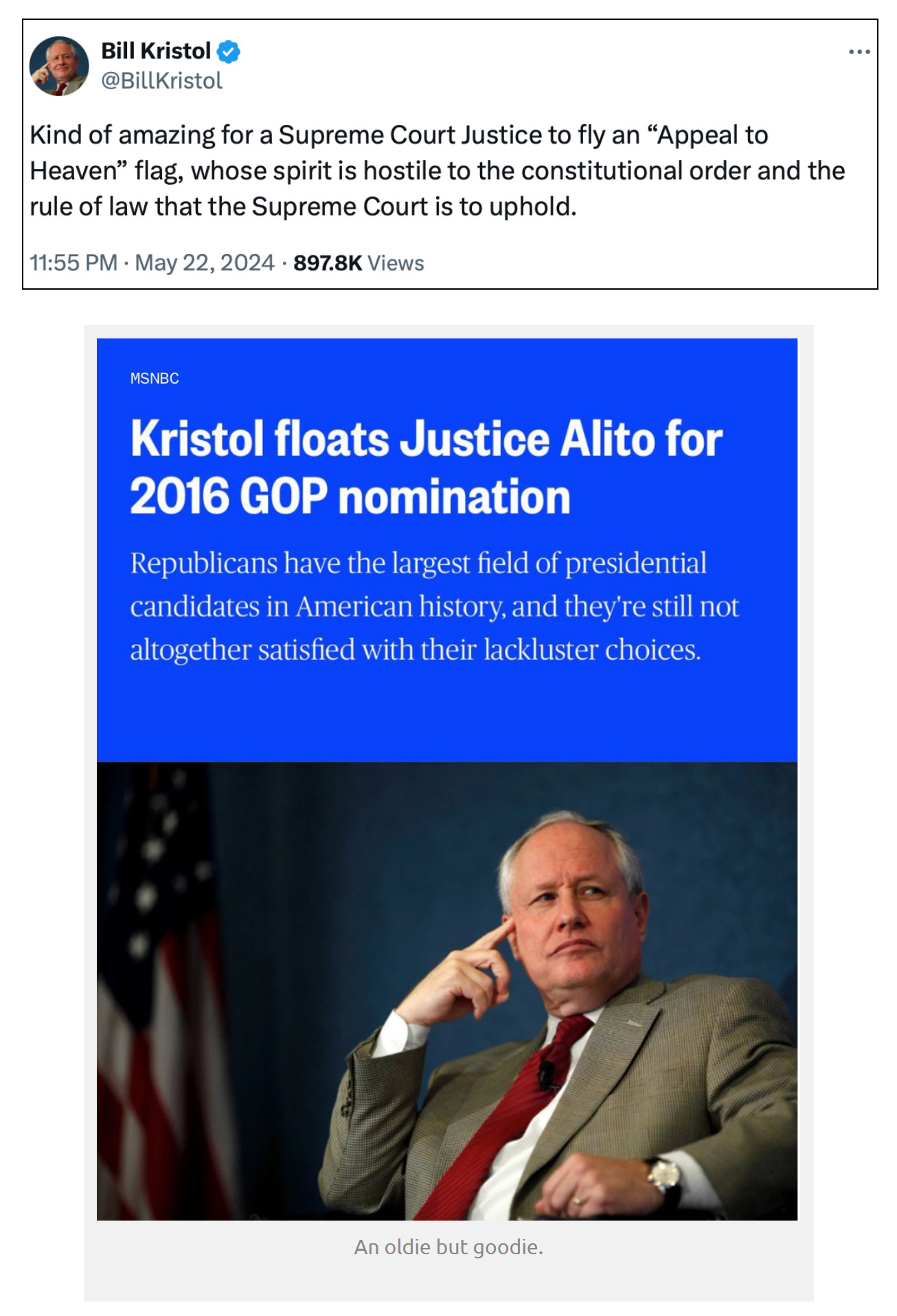
JONAH GOLDBERG: Flag-Gate and Other ‘Moral Panics.’

I’ll be honest, I don’t know what to make of the explosion of SOV sweeping through the chattering classes. In case you didn’t already know the term I just made up, that stands for Sudden Onset Vexillology. Vexillology, in case you’re not a Big Bang Theory fan, is the study of flags.

I don’t want to spend a lot of time on the flag issue, per se, but a little context and scorekeeping seems necessary. Justice Samuel Alito—and his wife—are caught in a crossfire between vexillologists from all directions. This all started when the New York Times reported that shortly after January 6, the American flag outside the Alitos’ home was hung upside down. The upside-down Stars-and-Stripes is a long-recognized symbol of distress. If you have pirates on your ship or a hole in your hull, you should fly your flag upside down to signal you’re in very serious trouble. Apparently, some of the January 6 rioters and other MAGA radical types have adopted this as a kind of insignia of their movement: “The country is sinking!”

(According to reports, Mrs. Alito hung the American flag upside down as a middle finger to a really awful neighbor. More on that in a moment.)

The Times and many of Alito’s harshest critics are convinced that Justice Alito knew this and was telegraphing his solidarity with such people. But given that Justice Alito says it was his wife who displayed the flag upside down without his knowledge, some will concede the possibility that it is Mrs. Alito who has gone full MAGA. The controversy seemed poised to start dying down when the Times followed up with another report: The Alitos flew a “Pine Tree Flag” outside their vacation home. Despite being a venerable banner going back to George Washington (his secretary designed it) that was, until 1971, the official maritime flag of Massachusetts, we are told it too is a symbol of the MAGA-aligned Christian nationalist right. As a result, the controversy has gone back to 11.

I think most of Alito’s defenders concede, with varying degrees of reluctance or enthusiasm, that hanging the flag upside-down was a mistake, regardless of the motivations behind the decision. As for the Pine Tree Flag, the defenders concede nothing to the detractors. This, they argue, is little more than artificially ginned up and wholly unjustified outrage. “The Flag Furor Is an Appeal to Stupidity” read the headline of a piece written by my friend and former National Review colleague Charlie Cooke.

At the American Conservative, Jude Russo writes: The Alito Flag Furor Shows the Left’s Generational Change.

Perhaps the defining generational change in leftist rhetoric is its relation to the American project. Older leftist endeavors took their stand on firmly American principles and presented themselves as a continuation of the American project. The SDS itself grew out of the ad hoc free speech movement at the University of California, Berkeley. The entire Whole Earth Catalog–adjacent counterculture was suffused with a kind of Americanism, appealing particularly to the individualism of the frontier. Organs like the PBC had no qualms about decking themselves out with the symbols of the American experience, even the bad old Gadsden Flag. The modern left—you might call it the New New Left—prefers a disruptive hermeneutic hostile to the traditional symbols of American piety.

As a partisan, I should cheer this development. The American people, whatever their other preferences, still seem to like America. If the right seems to be the only shop in town that is offering a broadly pro-American stance, well, that seems good for the right’s political prospects. The Old New Left was successful in large part because it was able to integrate itself into the American mainstream, particularly at the universities and other commanding heights of American culture. But it seems bad for the nation that one of the major political tendencies is increasingly invested in attacking the nation itself, and its historical symbols.

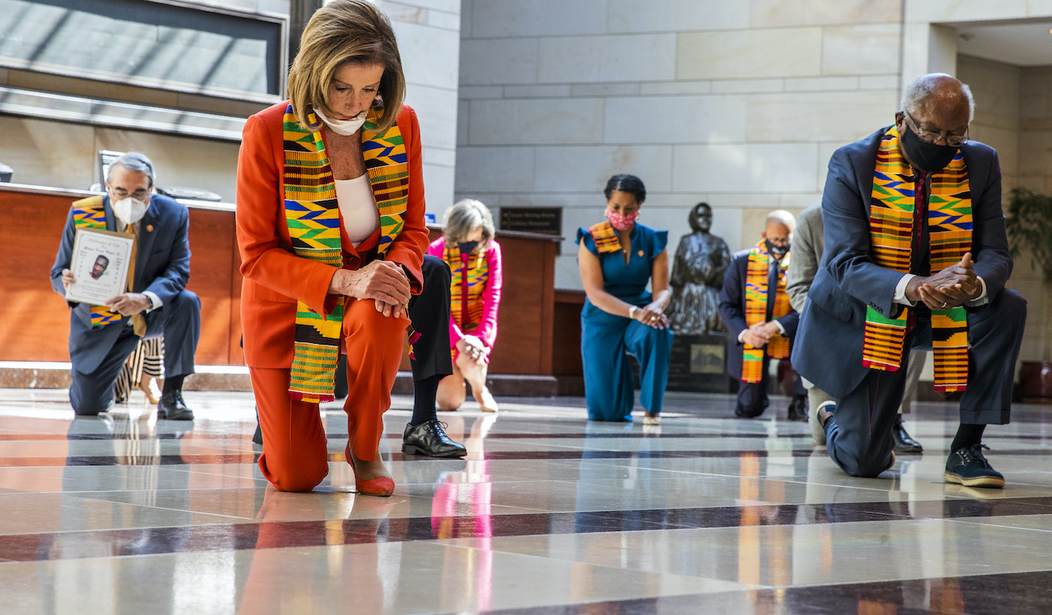
Just to reiterate where things stand based on the headlines of the past few weeks:

Related: WaPo Passed on the Highly Controversial Alito Flag Incident at the Time.

I’d insert the usual “just think of the media as being Democratic Party operatives with bylines” reminder here, but as Jeff Jacoby recently noted, the WaPo has made it official: A cynical Washington Post tells Biden: Nothing matters more than beating Trump.
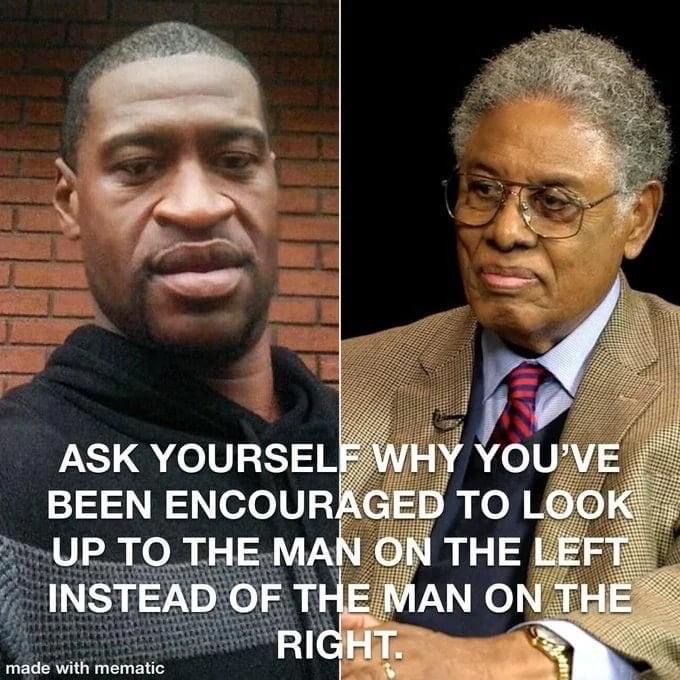

PAST PERFORMANCE IS NO GUARANTEE OF FUTURE RESULTS: ‘We mark this solemn day:’ Biden statement on anniversary of death of George Floyd.

Here is the official statement from U.S. President Joe Biden on the fourth anniversary of the death of George Floyd, Floyd died May 25, 2020 at age 46 while be detained by police in Minneapolis, His death sparked protests, calls for police and racial justice reforms and civil strife across the country.

The day before George Floyd’s funeral, his young daughter Gianna told me, “Daddy changed the world.” Four years after her father’s murder, there is no doubt that he has.

George Floyd should be alive today. His murder shook the conscience of our nation and reminded us that our country has never fully lived up to its highest ideal of fair and impartial justice for all under the law. What we witnessed as a result was one of the largest modern civil rights movements in our Nation’s history, with people from every background marching together against racism and systemic injustice.

Two years ago, alongside George Floyd’s family, civil rights leaders, and law enforcement officials, I signed an executive order to implement key aspects of the George Floyd Justice in Policing Act with respect to federal law enforcement, including: restricting chokeholds and no-knock warrants, and establishing a database for police misconduct—all measures to advance effective, transparent and accountable policing.

My Administration has made significant progress in implementing this Executive Order, and will continue our work to build public trust and strengthen public safety. But real and lasting change at the state and local level will only come when Congress acts. That’s why I will continue to urge Congress to send the George Floyd Justice in Policing Act, which ensures law enforcement accountability, to my desk.

As we mark this solemn day tomorrow, we join George Floyd’s family in remembering his life and his legacy. We are vigilant of Black and brown communities who all too often have borne the brunt of injustice; and we recommit ourselves to honoring George Floyd’s legacy by ensuring our Nation lives up to its founding ideal that we are all created equal and deserve to be treated equally throughout our lives.

Or as the Onion noted on June 10th, 2020, just as that summer’s riot season began: Biden Flattered His 1994 Crime Bill Suddenly Starting To Receive So Much Attention.

Of course, as Jon Gabriel recently wrote: Welcome to protest season, where the cause changes but the tactics stay the same.

In 2017, the Women’s March was launched in reaction to the #MeToo revelations, while in 2018, the anti-gun March for Our Lives dominated headlines. Neither attracted much violence; you could find that at anti-Trump protests.

In 2019, Greta Thunberg grimaced at the United Nations over climate change, which apparently was solved by blocking traffic and throwing tomato soup on Van Gogh paintings. This Monday was Earth Day, but it didn’t get much coverage. Environmentalism is so five years ago.

The pandemic put the kibosh on public gatherings, which made mass protests a bit hypocritical. So, the anger went online. In 2021, it was COVID masks and vaccines, while in 2022, anyone skeptical of funding Ukraine was labeled a Putin devotee.

But those annoying COVID restrictions were put on hold back in 2020, just as the virus was at its peak. Black Lives Matter protests swamped cities from coast-to-coast, often peaceful during the day but turning ugly by night.

Downtown Seattle was turned into the Capitol Hill Autonomous Zone while Portland burned for months.

Exit question:

DISPATCHES FROM THE HERMIT KINGDOM: Photographer’s Rare Images Reveal Everyday Life in North Korea.

Upon arriving in North Korea, [Tariq] Zaidi had his equipment examined and documented before entering the hermit country. Afterward, he traveled all across North Korea visiting Dandong on the Chinese border down to the Demilitarized Zone in the south.

The photographer says that people were welcoming and hospitable, although he drew mixed reactions when raising his camera.

“Children were generally OK with me taking pictures, and adults allowed me to take photos after a few minutes of politely asking, although it did depend on where we were,” he says.

“In the metro, for instance, when I pointed my camera at people, they all shyly put their heads down to avoid being photographed. I’m unsure if that was due to cultural differences, shyness, or the lack of camera culture.

Gosh, could there possibly be another reason? Flashback to 2018: As Trump Plans North Korea Summit, Defectors Tell Harrowing Stories.

JIM TREACHER: Here’s Why I Hate Media Matters.

The next day, when the [Daily] Caller reported out the story, they got that incoming number from the office switchboard and called it back. Only then did McGuinn identify himself as a federal agent. I don’t know if he admitted to being the driver then, or later.

All of which is to ask you, dear reader:

How in the hell was I supposed to know who hit me?

Telepathy? Crystal ball? Authorial omniscience?

But Media Matters didn’t care about any of that. They just saw me as an enemy, for the crime of accepting a job offer from Tucker Carlson. So they maligned me as I lay in a hospital bed after being crippled for life. They compounded my suffering, because that’s their job.

It’s the sort of thing a fella tends to remember.

All of which is to say I’m glad those MMFA idiots decided to mess with Elon Musk, because he’s suing them and they’re panicking and yesterday they laid off a bunch of people whose only job was to watch Fox News and read conservative media and try to ruin the lives of those who dare to disagree with them.

Or, y’know, libel them after they were just in a horrible accident. For kicks.

I neither like nor trust Elon Musk, but today my hat is off to him. Not since Hulk Hogan took down Gawker have I been so happy.

Read the whole thing.

As James Taranto wrote in 2004, when Media Matters first began, holding itself up as a far left clone of the right’s Accuracy in Media and the Media Research Center:

See the problem here? [David] Brock’s new shop is devoted to faulting conservative opinion journalists for expressing conservative opinions. What the Media Research Center does is entirely different; it analyzes liberal bias in the news media, which are supposed to be objective. If liberals are willing to spend $2 million funding a Web site that does nothing more than expose conservative commentators for engaging in conservative commentary, can we really afford to trust them with our tax dollars?

Of course, once Media Matters did “expose conservative commentators for engaging in conservative commentary,” it was time to unleash the social media mob on them:

However, one man is holding up an olive branch this week:

PIXAR IS LAYING OFF 14% OF ITS WORKFORCE AS DISNEY SCALES BACK CONTENT:

Long-expected layoffs are hitting Pixar Animation Studios on Tuesday.

Pixar will lay off about 175 employees, or around 14% of the studio’s workforce, a spokesperson for parent company Walt Disney told CNBC. The cuts come as CEO Bob Iger works toward his overarching mandate to focus on the quality of its content, not the quantity.

Layoffs hit other Disney businesses last year, but Pixar’s cuts were delayed because of production schedules. Initially, it was reported that 20% of the animation studio’s employees would be laid off.

Iger, who returned to the mantle of CEO in late 2022, has been working to reverse the company’s box office woes, spurred both by the company’s content decisions and pandemic shutdowns. While Disney has seen mixed box office success with several franchises, including the Marvel Cinematic Universe, the company has found it challenging to get its animated features to resonate with audiences.

Or as Ed Morrissey paraphrased this month: Iger: We’re Reducing Output Because Audiences Realized We Serve Up C***.

Fortunately, despite the sluggish economy, one veteran Pixar employee bounced back surprisingly fast:

OKAY GROOMERS, BUT IN GERMAN: Germany’s Decriminalization Of Child Porn Reminds Us Why We Need Societal Taboos.

There was an instructional news item this week that helps explain the collapse of Western civilization we see all around us these days. The German parliament voted to decriminalize the possession of child pornography, downgrading it from a felony to a misdemeanor offense and reducing minimum sentences for possession and distribution.

German lawmakers justified their action by arguing that decriminalization gave “necessary flexibility” to deal with the “large proportion of juvenile offenders,” and would also protect parents and teachers who discover child porn on the devices of young people and pass them on to the relevant authorities.

But as critics rightly noted, instead of creating exceptions in the law to deal with these kind of contingencies, German lawmakers downgraded all possession and distribution of child porn — a move that was cheered by pro-pedophile advocacy groups. The members of these groups believe anti-child porn laws, and indeed all legal prohibitions on pedophilia, are nothing more than antiquated taboos that society must discard in the name of personal autonomy and self-determination. One such group, Krumme-13 or simply K13, praised the vote but bemoaned the fact that no politician had yet “apologized to the thousands upon thousands of those affected who fell victim” to the now-defunct criminal laws prohibiting possession and distribution of child porn.

The Weimar Republic called and told Germany to dial it back a notch or ten.

CONFIRMED: Hunter Biden’s ‘Laptop From Hell’ Is Authentic and Will Be Trial Evidence, Per Special Counsel.

Federal prosecutors on Hunter Biden’s illegal gun purchase case will now be using a wealth of information taken from Hunter Biden’s abandoned laptop in the First Son’s upcoming trial – and over the objections of Hunter’s attorneys, Special Prosecutor David Weiss told Judge Maryellen Norieka that the laptop is authentic and he can prove it. Hunter Biden’s past may be — finally — about to catch up with him.

Federal prosecutors plan to deploy thousands of pages of electronic records from first son Hunter Biden’s “laptop from hell” and other technology — including a message demanding more “chore boy” to smoke crack cocaine, court papers show.

President Biden’s 54-year-old son goes on trial June 3 in the Delaware federal case accusing him of illegally owning a gun while addicted to drugs and prosecutors in special counsel David Weiss’ office have said they plan to show damning evidence taken from the laptop, a hard drive and an iCloud account linked to his iPad and iPhone XR.

In all, the feds say, they have more than 18,000 pages of Biden’s electronic records which they want to summarize in a chart for jurors.

—Ward Clark, Red State.com, yesterday.

And worse: Biden’s daughter Ashley has finally admitted her diary about ‘showers with dad’ as well as fears she was ‘molested’ is real. So, [the London Daily Mail’s] Maureen Callahan demands: What IS the truth, Joe?

THOSE FINGERS IN MY HAIR, THAT SLY COME HITHER STARE THAT STRIPS MY CONSCIENCE BARE, IT’S NICHE CRAFT: Driving stick shift has become a niche craft in America.

Shifting gears, the feel of the clutch underneath your foot. These mark the experience behind the wheel of a manual transmission car — now a rare breed in the U.S.

Though the American auto industry focuses on automatic vehicles, some car enthusiasts continue to hit the road with a stick shift. Manual transmission vehicles offer more control, with drivers maneuvering the shifter between gears.

Or, in some case, not: Automakers can’t quit manual transmissions so they’re cramming fake stuff into EVs. “Toyota is toying with an EV prototype that mimics driving a manual transmission, complete with a stick shift that doesn’t do anything and fake engine noises. What are we doing here, people?”

Decline is a choice, America:

JON GABRIEL: What Libertarianism Gets Wrong.

Remember the “New Atheists”? They were a big deal 15 or so years ago, bashing irrationality and superstition in bestselling books like “The God Delusion,” “The End of Faith” and “God Is Not Great.” Some of them ultimately ended up as believers, others turned to ayahuasca, and Richard Dawkins recently admitted to being a “cultural Christian.” He still doesn’t believe in the big J.C., but acknowledges his worldview was shaped in a Christian context.

In a similar way, I’ve always been a cultural libertarian. A son of the Mountain West, my traditional conservatism is heavily dosed with a “leave me the hell alone” contempt for Washington, Wall Street and anyone else who dares to tell me what to do. It’s more instinct than ideology. When policy wonks argue how government can best solve a problem, I’m the guy in back muttering, “Why should government be involved at all?”

That said, I’ve never described myself as a full-blown libertarian—never joined the party, haven’t even read “Atlas Shrugged.” Despite admiring the libertarian movement, I’ve always sensed a hollowness at its core that didn’t jibe with human nature.

Many politically minded people have filled out “The World’s Smallest Political Quiz” or the Political Compass. By answering a few questions, these questionnaires map your beliefs on a grid instead of a left-right continuum. The latter uses two axes: Authoritarian vs. Libertarian and Left vs. Right. You can take it here.

After taking and retaking these surveys, I always end up in the fourth quadrant: Libertarian Right. Here’s to freer markets, smaller government and individual rights. But this only covers economic and political issues while ignoring the many, many other elements of human flourishing.

Take the test and read the whole thing. (Or vice-versa.)

THE MASTERPIECE OF OUR TIME: On The Gulag Archipelago at fifty.

Western intellectuals usually supposed that Russian dissidents might suffer the sort of punishment that in their own countries is reserved for dangerous criminals. At worst, Westerners pictured conditions like those in tsarist Russia, long considered the model of an oppressive state. That is why Solzhenitsyn devotes so many passages to contrasting what passed for tyranny in nineteenth-century Russia with ordinary Soviet conditions.

Begin with numbers. Solzhenitsyn instructs: from 1876 to 1904—a period of mass strikes, peasant revolts, and terrorism claiming the lives of Tsar Alexander II and other top officials—“486 people were executed; in other words, about seventeen people per year for the whole country,” a figure that includes “ordinary, nonpolitical criminals!” During the 1905 revolution and its suppression, “executions rocketed upward, astounding Russian imaginations, calling forth tears from Tolstoy and indignation from [the writer Vladimir] Korolenko, and many, many others: from 1905 through 1908 2,200 persons were executed,” a number contemporaries described as an “epidemic of executions.”

By contrast, Soviet judicial killings—whether by shooting, forced starvation, or hard labor at forty degrees below zero—numbered in the tens of millions. Crucially, condemnation did not require individual guilt. As early as 1918, Solzhenitsyn points out, the Cheka (secret police) leader M. I. Latsis instructed revolutionary tribunals dispensing summary justice to disregard personal guilt or innocence and just ascertain the prisoner’s class origin: this “must determine the fate of the accused. That is the meaning of the Red Terror.”

On this basis, over five million peasants (classed as “kulaks,” supposedly better off than their neighbors) were forcibly exiled to completely unsettled wastelands with no food or tools, where they were left to die. The same punishment later befell whole nationalities deemed potentially disloyal (such as ethnic Germans, Chechens, and Crimean Tatars) or dangerous because of the possibility of receiving subversive support from a foreign power (as in the case of Koreans and Poles). “The liquidation of the kulaks as a class” was followed by the deliberate starvation of millions of peasants. All food for a large area of what is now Ukraine was requisitioned, and even fishing in the rivers was prohibited, so that over the next few months inhabitants starved to death. Idealistic young Bolsheviks from the capital enforced the famine. In total, Stalin’s war on the countryside claimed more than ten million lives. As Solzhenitsyn makes clear, this crime is not nearly as well known among intellectuals as the Great Purges, which claimed fewer victims, because many purge victims were themselves intellectuals.

Arrests also took place by quotas assigned to local secret-police offices, which, if they knew what was good for them, petitioned to arrest still more. After World War II, captured Russian soldiers in German slave-labor camps were promptly transferred to Russian ones, as was anyone who had seen something of the Western world. Even soldiers who had fought their way out of German encirclement were arrested as traitors, simply because they had been behind German lines. Still more shocking, the Allies—who could not imagine why people would not want to return to their homeland—forcibly repatriated, often at bayonet point, over a million fugitives, some of whom committed suicide rather than face what they knew awaited them.

In his introduction Gary Saul Morson writes:

When Aleksandr Solzhenitsyn’s The Gulag Archipelago: An Experiment in Literary Investigation appeared in 1973, its impact, the author recalled, was immediate: “Like matter enveloped by antimatter, it exploded instantaneously!” The first translations into Western languages in 1974—just fifty years ago—proved almost as sensational. No longer was it so easy to cherish a sentimental attachment to communism and the USSR. In France, where Marxism had remained fashionable, the book changed the course of intellectual life, and in America it helped counter the New Left celebration of Mao, Castro, and other disciples of Marx, Lenin, and Stalin.

Which is why the American left hated Solzhenitsyn so, Tom Wolfe wrote in his 1976 article, “The Intelligent Co-Ed’s Guide to America:”

Solzhenitsyn’s tour of the United States in 1975 was like an enormous funeral procession that no one wanted to see. The White House wanted no part of him. The New York Times sought to bury his two major’ speeches, and only the moral pressure of a lone Times writer, Hilton Kramer, brought them any appreciable coverage at all. The major tele­vision networks declined to run the Solzhenitsyn interview that created such a stir in England earlier this year (it ran on some of the educa­tional channels).

And the literary world in general ignored him completely. In the huge unseen coffin that Solzhenitsyn towed behind him were not only the souls of the zeks who died in the Archipelago. No, the heartless bastard had also chucked in one of the last great visions: the intellec­tual as the Stainless Steel Socialist glistening against the bone heap of capitalism in its final, brutal, fascist phase. There was a bone heap, all right, and it was grisly beyond belief, but socialism, had created it.

Earlier: Why Isn’t Lenin As Condemned As Hitler?

JEFF JACOBY: In Argentina, Milei’s exhilarating chainsaw revolution is underway.

As he campaigned for president of Argentina last year, Javier Milei brandished a chainsaw as a symbol of the ferocity with which he intended to slash the country’s massive public sector. Again and again he told voters that Argentina’s economy had been wrecked by corrupt and irresponsible left-wing governments and warned that there was no easy fix to the chaos caused by decades of unaffordable state spending financed by endlessly borrowing and printing money. A trained economist, Milei outlined what he called his “Chainsaw Plan” — a drastic reduction in the cost and scope of the government and a frontal assault on the power of Argentina’s entrenched political class.

The self-described “anarcho-capitalist” appalled his critics, who smeared him as a “wannabe fascist” and a “mini-Trump” whose simplistic solutions would wreak “devastation” on Argentina. But voters weren’t deterred. They elected Milei in a landslide, giving him the chance to show what he could accomplish with a chainsaw and public support but very little parliamentary or institutional backing.

You’ve got to watch out for those wannabe fascists who [checking notes] want to dramatically shrink government and leave voters alone!

DISPATCHES FROM THE EDUCATION APOCALYPSE: ‘A Failed Medical School:’ How Racial Preferences, Supposedly Outlawed in California, Have Persisted at UCLA.

Long considered one of the best medical schools in the world, the University of California, Los Angeles’s David Geffen School of Medicine receives as many as 14,000 applications a year. Of those, it accepted just 173 students in the 2023 admissions cycle, a record-low acceptance rate of 1.3 percent. The median matriculant took difficult science courses in college, earned a 3.8 GPA, and scored in the 88th percentile on the Medical College Admissions Test (MCAT).

Without those stellar stats, some doctors at the school say, students can struggle to keep pace with the demanding curriculum.

So when it came time for the admissions committee to consider one such student in November 2021—a black applicant with grades and test scores far below the UCLA average—some members of the committee felt that this particular candidate, based on the available evidence, was not the best fit for the top-tier medical school, according to two people present for the committee’s meeting.

Their reservations were not well-received.

When an admissions officer voiced concern about the candidate, the two people said, the dean of admissions, Jennifer Lucero, exploded in anger.

“Did you not know African-American women are dying at a higher rate than everybody else?” Lucero asked the admissions officer, these people said. The candidate’s scores shouldn’t matter, she continued,  because “we need people like this in the medical school.”

Even before the Supreme Court’s landmark affirmative action ban last year, public schools in California were barred by state law from considering race in admissions. The outburst from Lucero, who discussed race explicitly despite that ban, unsettled some admissions officers, one of whom reached out to other committee members in the wake of the incident. “We are not consistent in the way we apply the metrics to these applicants,” the official wrote in an email obtained by the Washington Free Beacon. “This is troubling.”

“I wondered,” the official added, “if this applicant had been [a] white male, or [an] Asian female for that matter, [whether] we would have had that much discussion.”

Since Lucero took over medical school admissions in June 2020, several of her colleagues have asked the same question. In interviews with the Free Beacon and complaints to UCLA officials, including investigators in the university’s Discrimination Prevention Office, faculty members with firsthand knowledge of the admissions process say it has prioritized diversity over merit, resulting in progressively less qualified classes that are now struggling to succeed.

Race-based admissions have turned UCLA into a “failed medical school,” said one former member of the admissions staff. “We want racial diversity so badly, we’re willing to cut corners to get it.”

In 2000, Dr. Sally Satel wrote PC, MD: How Political Correctness Is Corrupting Medicine. Unless universities can tamp down it down  dramatically, it’s negative impact risks spiraling out of control, with all too predictable catastrophic results. Or as the Victory Girls write: Never Trust A Doctor Under 30: DEI Is Going to Kill You.

WHAT NELLIE SAW:

Remember the heady days of 2020? Progressives trained by the richest universities in the land suddenly had the chance to remake America in their image, the way they had always dreamed of doing. The result was so obvious and crushing a failure that one is no longer supposed to talk about it.

Four years later, the power elite have discovered that their cosplay revolution is seen as merely ridiculous. Minority groups don’t want the new names that have been issued to them. Straight people prefer not to be called cisgender, and gay people don’t like being submerged in a tide of heterosexuals who style themselves queer. Even The New York Times, that high conclave of official euphemisms, has begun to soft-pedal chilling locutions like “gender-affirming care for minors,” instead referring honestly to puberty blockers and body-altering surgery.

Nellie Bowles’ Morning After the Revolution is a grand tour through the craziness that followed the killing of George Floyd and continues to this day, despite the majority of Americans shaking their heads in bewilderment. Bowles, a former Times reporter, started out as a progressive seeker, curious and hopeful about the new thinking, and she is still seeking solutions to racism, income inequality, and attacks on women’s rights. But she also sees the absurdity of much of what passed for progressivism, yet was actually narcissistic, neo-racialist, and aggressively inhumane.

At the Times, Bowles was hounded by an anti-disinformation editor, who was there to remind writers that the lab leak hypothesis was a conspiracy theory and also that conservatives were very bad people. The real danger was Trump, she was told, and anything questionable that the left did had to be passed over in silence, lest the enemy gain succor. When she said she wanted to go to Seattle to check out the new anarchist collective that had abolished the police, she was asked, she says, “Why do you care? No, but seriously why do you care?”

No enemies to the left, a Soviet motto that former Timesman Walter Duranty would have approved. Or as Bowles tells Salena Zito:

Washington Examiner: I don’t think acts of courage are all Joan of Arc moments. I think acts of courage are often subtle. They’re done without making a statement that you are brave because you did this. Can you talk about where that part of you came from in writing this book and in general your decision to be noncompliant with the [progressive] movement?

Bowles: There were a lot of the things that are asked of me for a long time and I want to please people for a long time. I want to stay in the good of the movement for a long time, and I manage it for a while, but eventually the movement becomes too demanding for me to accommodate and it wants too much. First, it was blunting my reporting. It was saying you can’t report on the most interesting stories of the day, which was really frustrating and crazy-making a little bit because it was like, “What do you mean we’re not supposed to cover the riots? What do you mean we’re not supposed to talk about” … you name it, hot-button issue of the day. And basically there was a media blackout for a while.

I call it now time wandering, which is all of the most interesting issues. You’re allowed to talk about it in the world of all the Substacks, the conservative media covers it, and the liberal media waits about two or three years and then they’re allowed to touch it.

So COVID origins or medical treatments for gender dysphoric kids or any of the most interesting of the day. Anyways, part of me was being frustrated in that regard, but it was really just that I couldn’t go along. At no point did I do a courageous act. It was just that I stopped being able to go along with the movement’s demands as they got too much.

So another example, when I started dating Bar [Bari Weiss], and don’t write about this in the book, but a friend of mine from college reached out and said, “You can stay in the good of the movement and you can remain friends with me, but you need to publicly disavow Bar.”

I remember just being like, “What?”

And she said, “You need to make clear where you stand apart and how you’re not going along with her and you need to do it in public.” And I was like, “First of all, I’m not even doing it in private or in public.”

Just the idea that I was supposed to do some sort of public repentance for being slightly off message in my writing or being with someone who this bizarre new movement decided was on the bad was so crazy to me.

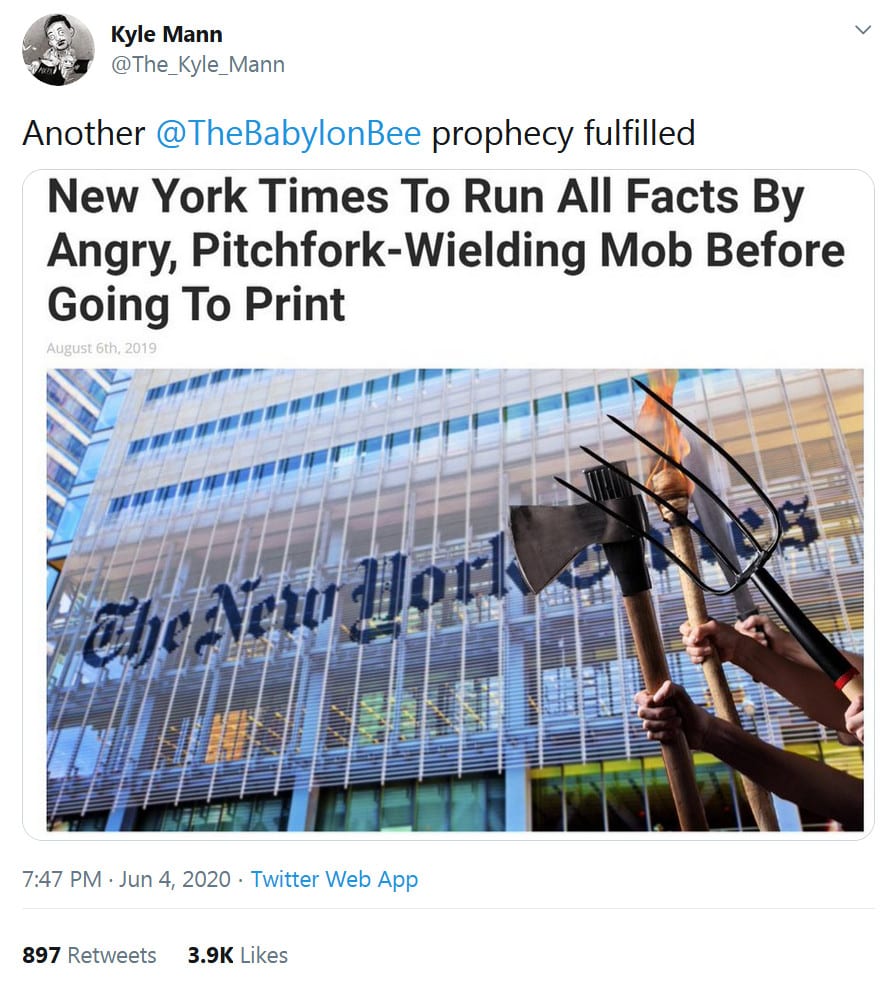
But not to the Gray Lady, which is desperate to not be flailed by its subscriber base on social media. Or as America’s Newspaper of Record reported in 2020, during the Tom Cotton-induced collective seizure of the Times’ young staffers:

Meanwhile, Nick Gillespie interviews Bowles, in both audio and video format for Reason magazine on “How the Lockdowns Drove Us Crazy.”

And finally, for my own take on her new book: Look Back in Anger: Nellie Bowles’ ‘Morning After The Revolution’ Documents the Insanity that was 2020.

PAST PERFORMANCE IS NO GUARANTEE OF FUTURE RESULTS, SOCIALIST “IT GIRL” EDITION: AOC Preps Bronx Voters for Tonight’s Trump Rally With an Amazing Gas Price Warning.

Setting aside the important and required response of “why didn’t he do this during his first term?” question which needs to be asked whenever the left has a new meltdown over the Bad Orange Man, why on earth would AOC be opposed to higher gas prices? In February of 2019, as the Federalist noted at the time, her now-infamous Green Nude Eel listed the goal of replacing “every ‘combustion-engine vehicle’ — trucks, airplanes, boats, and 99 percent of cars — within ten years. Charging stations for electric vehicles will be built ‘everywhere,’ though how power plants will provide the energy needed to charge them is a mystery.”

Higher gas prices have been openly stated as the goal of the enviro-left for over a decade and a half. Steven Chu, Obama’s then-incoming energy secretary, told the Wall Street Journal in the fall of 2008: “Somehow we have to figure out how to boost the price of gasoline to the levels in Europe.” That same year, the L.A. Times ran the headline “The joy of $8 gas,” and in lockstep, NBC, the Washington Post, and the New York Times all called for higher gas taxes. In 2023, the Washington Free Beacon noted that “Biden Taps Economist Who Bemoaned Gas Prices ‘Too Damn Low.’” The previous year, Fox News reported, “Amid high gas prices, Pete Buttigieg slammed for telling Americans to switch to electric cars.”

In 2021, then Biden-press secretary Jen Psaki told her party’s operatives with bylines, “our view is that the rise in gas prices over the long term makes an even stronger case for doubling down our investment and our focus on clean energy options so that we are not relying on the fluctuations and OPEC and their willingness to put more supply and meet the demand in the market.”

So why would AOC be complaining about Trump nudging gas prices up, when it’s something she presumably still wants?

Related: In other AOC news, Sandy’s saying the quiet part out loud: AOC: Prosecuting Trump Is Like Putting ‘An Ankle Bracelet Around Him’ Because He Can’t Campaign.

RIP: Morgan Spurlock, Super Size Me Filmmaker, Dead at 53.

Spurlock died Thursday in New York from complications of cancer, according to a statement issued Friday by his family.

“It was a sad day, as we said goodbye to my brother Morgan,” Craig Spurlock, who worked with him on several projects, in the statement. “Morgan gave so much through his art, ideas, and generosity. The world has lost a true creative genius and a special man. I am so proud to have worked together with him.”

Spurlock made a splash in 2004 with his groundbreaking “Super Size Me,” and returned in 2019 with “Super Size Me 2: Holy Chicken!” — a sober look at an industry that processes 9 billion animals a year in America.

Spurlock was a gonzo-like filmmaker who leaned into the bizarre and ridiculous. His stylistic touches included zippy graphics and amusing music, blending a Michael Moore-ish camera-in-your-face style with his own sense of humor and pathos.

The Michael Moore comparison is apt – both men debuted with documentaries that made them stars, but each of their efforts were built around spurious claims. Moore reportedly did meet with GM’s Roger Smith during filming of 1989’s Roger & Me, but couldn’t depict that onscreen, or he’d have no movie. And far as Spurlock’s effort, in 2004, Tech Central Station’s James Glassman wrote:

While the film demonizes McDonald’s and other restaurants, Spurlock’s weight gain and health decline have nothing to do with where he ate (after all, Robert DeNiro gained 60 pounds for his role in “Raging Bull” by dining at great restaurants in Italy), but rather with how much he consumed and how little he exercised (Spurlock even cut down on normal walking).

It’s no accident that Spurlock’s production company is called “The Con.” A prankster and scamster from way back, he briefly ran a program on MTV called “I Bet You Will,” where he paid people to do disgusting things.

He gave a woman $100 to eat a Madagascar hissing cockroach. A man got $25 for eating a clam out of a stranger’s armpit. Another woman shaved her head, combined the clippings with butter to form a gigantic hair ball and then ate it — for $250.

Sorry for the unappetizing detail, but it tells who this Morgan Spurlock really is. He presents himself as a socially concerned artist, but, in fact, he is up to his old tricks (among the scenes in “Super Size Me” are a rectal exam and a vivid vomiting sequence). This time, however, the person who cashes in isn’t the hairball eater; it’s Spurlock himself.

The math of weight gain is simple. Someone Spurlock’s size can eat 2,500 to 3,000 calories a day and maintain his weight. In the movie, he eats 5,000 to 5,500 calories a day. Nutritionists calculate that a man gains roughly a pound for every 3,500 extra calories, so roughly every three days, Spurlock overeats his way to an extra two pounds or more.

He could have gained that extra weight anywhere — at a health-food restaurant in Cleveland or at Taillevent in Paris. He could have burned off the extra weight if he had exercised, but he gives such a solution short shrift. He whines that it’s all Ronald McDonald’s fault, when really it’s a matter of calories in and calories burned.

According to the Daily Mail yesterday, Spurlock had another source of extra calories:

Some critics pointed out that he failed to provide logs documenting what exactly he ate and the amount of calories that he was intaking.

A documentary maker named Tom Naughton even made his own movie in response, called Fat Head, in which he too ate McDonald’s for 30 days – and he got a ‘very different’ result, ultimately losing 12 pounds.

Things only got worse in 2017, when Morgan admitted that he had been ‘consistently drinking’ since the ‘age of 13.’

‘I’ve consistently been drinking since the age of 13, something our society doesn’t shun or condemn but which only served to fill the emotional hole inside me and the daily depression I coped with,’ he wrote in a statement shared to X, formerly Twitter, while discussing the #MeToo movement.

People were certainly outraged by his revelation, since one of the major claims in the movie was that eating the fast food gave him liver problems – something that actually could have been caused by his years of heavy drinking.

In addition, if he drank during the experiment it would have meant that he lied about only consuming McDonald’s products during the 30-day period.

During a check-up with a doctor in the documentary, Morgan was asked if he had consumed any alcohol, and he stated, ‘None.’

‘I can only eat things that are for sale over the counter at McDonald’s – water included,’ he insisted.

‘Since it’s now come out that Morgan Spurlock neglected to mention his alcoholism in Supersize Me, is there any value in the documentary anymore?’ one outraged viewer scathed on Reddit afterwards.

At Reason, Billy Binion adds: Super Size Me Was Not Groundbreaking Journalism.

To his credit, Spurlock did include some balance in Super Size Me, which, at least in part, came in the form of none other than Reason‘s Jacob Sullum. Sitting in his Virginia office at the time, clad in a delightful red cardigan, Sullum expresses caution about moving toward a society where it becomes appropriate to “publicly hector fat people” as some do to smokers. Spurlock’s final product, after all, had a sense of shaming at its core, despite that it’s possible to eat fast food without gorging yourself to the point of lethargy. (Burned in my mind after having to watch the film for school is hearing Spurlock claim that his fast-food binge had made it so he could no longer have sex unless his then-girlfriend was on top.)

Ironically, on the subject of shame, compromising details about Spurlock’s life would continue to emerge for years after the documentary’s release, which included, among other things, that he was an alcoholic. That doesn’t explain every adverse impact he experienced while following his McDonald’s diet, but it does call quite a bit of it into question. It would seem irresponsible to make no mention of it, for example, when discussing damage to his liver.

And yet Spurlock will likely be remembered for years to come, his name inextricably linked to Super Size Me and what it purports to have exposed. His death is sad. But his legacy is a healthy reminder that skepticism is a necessary part of any balanced diet.

Rupert Pupkin smiles.

ALL THIS AND WORLD WAR II: Biden Spreads Misinformation About Trump Calling for a ‘Unified Reich.’

The Trump campaign disavowed the ad and deleted the Truth Social post.

But as it turns out, the assertion that Trump was tacitly endorsing some form of Nazi government is highly misleading, if not outright false. The video was made using a newspaper template that is widely available, and that template includes references to the world wars. Some have suggested the template actually refers to WWI, not WWII.

To be clear, the template is just that—a template. The point of the ad is obviously not to suggest that Trump’s policies have anything to do with the preexisting headlines.

* * * * * * * *

In his response, Biden watches the Trump ad and then says—with rising anger—”A unified Reich? That’s Hitler’s language. That’s not America’s.”

Again, this is an inaccurate summary of the video. But don’t hold your breath waiting for the media fact-checkers to spring into action and correct him. Few mainstream journalists bothered to set the record straight. (The Atlantic‘s David A. Graham and Vox‘s Zack Beauchamp did, to their credit.) An Axios writeup of Biden’s response offers zero pushback. It was the same story at NPR and Politico.

None of this is to say that Trump is free of loathsome associations. He told the Proud Boys to “stand back and stand by,” and he infamously dined with Ye (formerly known as Kanye West) and white nationalist Nick Fuentes at Mar-a-Lago. (Trump claimed he didn’t know Fuentes and had not specifically invited him.) But Biden and the media have seized upon a nothingburger here, and the media’s vast fact-checking apparatus is suddenly asleep at the wheel.

Unexpectedly! Although to be fair, given the left’s obsession with calling everyone they have even the slightest disagreement with a National Socialist and an ever-increasing hatred of Jews, I can understand them being reluctant to give up their turf.

Also unexpectedly, CNN managed to find the source of the phrase:

GOOD LUCK, I WANT YOU TO KNOW WE’RE ALL COUNTING ON YOU: ICJ orders Israel to halt Rafah operation in Gaza Strip.

The International Court of Justice in the Hague ordered Israel to halt its military operation against Hamas in Rafah, in the Gaza Strip on Friday, in a blow to Jerusalem’s diplomatic initiative and judicial system, on Friday.

But the court did not order the IDF to completely withdraw from Gaza or to restrict its military actions in other parts of the enclave.

Hamas, the Palestinian Authority and South Africa welcomed the ICJ order, while Israel objected to it.

In reading out the ruling ICJ President Nawaf Salam stated that Israel must immediately “halt its military offensive and any other action in the Rafah Governorate which may inflict on the Palestinian group in Gaza, or conditions of life that would bring about its physical dysfunction, in whole or in part.”

Fortunately, cooler heads with equal legal authority over the issue prevailed:

NOT ONLY IS THE PAST STRANGER THAN WE IMAGINE, IT IS STRANGER THAN WE CAN IMAGINE: Taylor Swift Brings Store Manager’s Dreams to Life in 2012 Macy’s Commercial.

Taylor Swift is great at making dreams come true. In an effort to promote her newest fragrance, Wonderstruck Enchanted, Swift stars in a new Macy’s commercial in which she makes a store manager’s hopes and dreams a reality… sort of.

The star-studded commercial actually advertises products made by a number of fan-favorite stars, including Justin Bieber, Diddy, Martha Stewart, Donald Trump, and Carlos Santana. A Macy’s store manager arrives at work to see all of these celebrities trying out their products, and he immediately wanders off into a dream world — because surely, this can’t be real. He can envision himself playing guitar with Santana, having Martha Stewart serve him breakfast in bed and playing wingman to the Biebs while he puts on an in-store performance.

I had no idea this serious a glitch in the Matrix even existed:

But it gets crazier, as Trump meets Edmund Gwenn’s Santa from 1947’s Miracle on 34th Street:

WHEN YOU’RE A DEMOCRAT WHO’S LOST THE PALACE GUARD AT COMEDY CENTRAL:


QUOTE OF THE DAY:

“I mean look, [Trump is] almost the same age as Biden. But Biden presents as old. Ancient. That does not look old. He does not present as old,” Maher said. “He’s like [the rock band] KISS. He puts on the wig and the face paint, and it’s 1976 all over again.”

Bill Maher talking with Greg Gutfeld, Monday.

In contrast, yesterday, Maher dropped by the View: Joy Behar Scolds Bill Maher for Not Doing Enough to Protect the ‘Cadaver-Like’ Joe Biden.

How cadaver-like? This cadaver-like:

UPDATE: Megyn Kelly Brutally Fact Checks Bill Maher’s Left Wing Talking Points to His Face.

I USED TO THINK NY SUBWAY CARS TOOK A BEATING:

ALL THIS AND WORLD WAR II WITH JAMES LILEKS:

Been on a bit of a Hitler binge lately. A nice break from the Roman binge. For this I can thank my absolutely favorite podcast, “The Rest is History,” which matches Dominick Sandbrook and Tom Holland to discuss absolutely everything. Perfect chemistry, very British, wry, droll, laugh-out-loud as well.

Eh? Laugh out loud? And Hitler? Yes, because there are absurdities and banalities that are darkly comic. They’ll do four hours on the rise of Hitler, then four more on the consolidation of power, which seems to involve an inordinate number of conferences at German spas – old-world faded charm, elderly waiters, ticking clocks in the lobby, musty smells, and it becomes a running joke referred to in passing, giving the faithful listener a recognizable callback in the next ep. All unplanned and chatty – as I said, the chemistry is great, two like-minded people who have an impressively substantial storehouse of knowledge and a sense of the breadth and scope of history, but are still continuously curious.

When I say “Binge” I mean that I’d finished the rise-to-power series and was offered up a new documentary on one of the streamers about HITLER’S MARCH TO WAR, or something — new footage! Recently uncovered documents! The hook was a countdown to WW2, and hence they had a chronological splash screen at regular intervals. MUNICH. 362 DAYS TO WAR. These words appear as if slapped on the screen, then vibrate out with a great whoosh.

Because the thing about the run-up to WW2 is this: it needs goosing to make it compelling. Jump cuts and sound effects and ADHD Ken Brown pans.

It got me thinking about the inevitable AI upscaling and enhancing of WW2 footage, particularly of Hitler. Right now he’s mostly the grainy guy shouting in newsreels, or the very grainy guy gliding in a limo as he heils the cheering throngs in Vienna. Color footage is rare. When it’s all made 4K, what sort of impact will it have?

In his 1964 book Understanding Media, Marshall McLuhan wrote:

TV is a cool medium. It rejects hot figures and hot issues and people from the hot press media…Had TV occurred on a large scale during Hitler’s reign he would have vanished quickly. Had TV come first there would have been no Hitler at all. When Khrushchev appeared on American TV he was more acceptable than Nixon, as a clown and a lovable sort of old boy.  His appearance is rendered by TV as a comic cartoon. Radio, however, is a hot medium and takes cartoon characters seriously. Mr. K. on radio would be a different proposition.

Or as Lileks concluded, “I don’t think he’ll earn many new converts. I think some might be mystified by his appeal, because his speeches are like, you know, cringe. Like dude. I don’t know, I guess you had to be there.”

And for more “I don’t know, I guess you had to be there” moments, keep reading Lileks for America veering into its own creepy fascist aesthetics as well during the 1930s, before teasing,There’s a bigger piece here, and I think I will write it for Discourse.”

Definitely looking forward to it.