A series of selfies taken by a murderer helped a prosecution build a damning case against him and put the killer behind bars.
On Wednesday, Jose Ibarra was found guilty of the murder of 22-year-old nursing student Laken Riley.
Riley was murdered while she was out for a run at the University of Georgia campus in Athens, Georgia on the morning of February 22, 2024. During the trial, prosecutors argued that Ibarra killed Riley after she fought off his attempt to rape her.
Ibarra was sentenced to life in prison without the possibility of parole. He was convicted on three counts of felony murder and counts of malice murder, kidnapping with bodily injury, aggravated assault with intent to rape, and “peeping Tom” (in a separate incident earlier that day).
Last week, FBI Special Agent Jamie Hipkiss took the stand and showed the court numerous selfies taken on Ibarra’s phone that showed him wearing the same clothes as the suspect seen in surveillance footage on the day of Riley’s death.
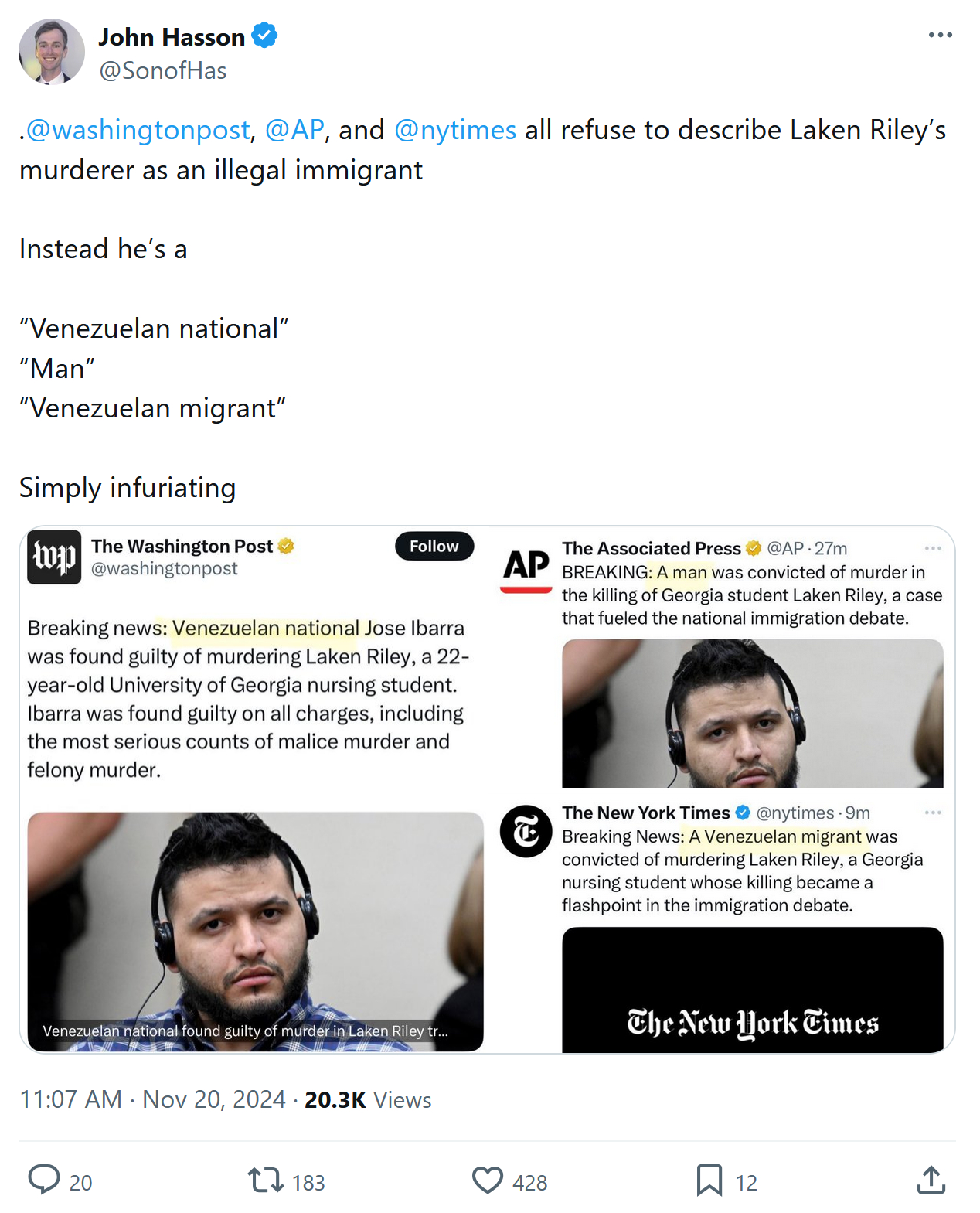
It’s 21st century America in a nutshell: cellphone addiction, moral narcissism, and while photography Website PetaPixel apparently doesn’t want to mention this to upset their more delicate readers, an incredibly violent illegal immigrant, but then they’re far from alone regarding that last detail:
I’m not sure what’s worse. Joe Biden apologizing for calling Laken Riley’s killer an illegal alien or Jonathan Capehart all but demanding he do so. https://t.co/CsMgVxNqTF
Police found a garden gnome weighing nearly 2kg and made of the drug Ecstasy during a raid in the Netherlands.
The gnome was found among a stash of narcotics and seized by officers in the southern province Noord-Brabant during a large drug search.
“Drugs appear in many shapes and sizes, but every now and then we come across special things,” the Dongemond regional police said in a social media post.
They said the garden gnome was “in a strange place”, prompting them to test it for narcotics.
This is your garden gnome. This is your garden gnome on molly. Any questions?
When CNN’s Andrew Kaczynski reported on Harris’s 2019 comments, anchor Erin Burnett responded: “taxpayer-funded gender transition surgery for detained migrants—she actually said she supported that?” Burnett later added, “these are things that—it would be hard to think that you would come up with taxpayer-funded gender transitions for detained migrants.”
In other words, as an individual policy, it’s perhaps not terribly meaningful. But it’s weird.
In a new essay for New York magazine, Simon van Zuylen-Wood writes about “the Democratic Party’s break with reality,” as seen through the lens of Donald Trump’s increased voter support in New York City, of all places. He recalls that he had thought Harris might be in trouble earlier in the campaign when he started seeing the surging popularity in Brooklyn of the camouflage trucker hats sold by the Harris-Walz campaign. It was one of the cartoonish ways in which the Harris campaign tried to appeal to “normal” voters.
“Scanning as working class, the hats seemed to be worn exclusively by people who didn’t match that description,” van Zuylen-Wood notices. “They reminded me of the Big Buck Hunter arcade game at a bar near the campus of my elite college, which lent wry ‘authenticity’ to the setting and whose plastic rifles were the only kind most of us had any interest in handling. I wondered if some of the hat wearers were in on the joke or simply liked the aesthetic. But some of these people looked sincere, as though they felt the hats really reflected the campaign’s resonance with regular folks.”
Sure enough, it turned out that the people who bought the hats and voted for Harris were all just guessing at what normal people were like. The whole attempt at simulating normalcy was weird.
[T]he camo hats—which sold out earlier this month, netting nearly $1 million for the Harris campaign—were made for girls and gays, not deer-hunting rednecks in Alabama. They are actually a nod to pop singer Chappell Roan, a lesbian and self-proclaimed “drag queen” who sells a nearly identical hat on her own website, except the slogan is “Midwest Princess,” in reference to her hit album The Rise and Fall of a Midwest Princess.
Kamala’s camo hat is meant to appeal to people who know what Chappell Roan merch looks like—almost definitionally people who would have voted for Kamala Harris anyway. It follows the Harris campaign’s embrace of the “Brat” aesthetic, inspired by British musician Charli XCX’s album of the same name. As a member of the target audience for this sort of thing, I must ask: How many gay guys do Democrats think there are in this country?!
An early Bitcoin miner says he lost a fortune worth more than $700 million after his partner accidentally threw a hard drive containing 8,000 coins in a landfill dumpster more than a decade ago.
James Howells of Newport, Wales, has asked his local council if he can dig through its rubbish site to find the discarded hard drive—but he has been denied so far.
Howells is now taking Newport City Council to court, saying it either needs to give him access to his property or settle the damages for the value of the drive.
Howells, 39, says he mined the coins himself in 2009—drawn to the world of cryptocurrencies in the wake of the financial crisis a year prior.
The Bitcoin were stored on a private key within Howells’s computer hard drive, which was placed in a drawer while Howells—a systems engineer by trade—updated his PC.
In 2013, Howells said he placed that hard drive in a plastic bag, which his former partner then erroneously took straight to the dump, depositing it in a large waste bin.
With the price of Bitcoin sitting at an all-time high of $93,637 at the time of writing, the buried drive would potentially be worth more than $749 million.
And you thought switching from Windows 3.1 to Windows 95 was a challenge.
TV writers, it’s time to up your game. AI is about to wear out your most well-worn plotlines.
Don’t get me wrong: I like formulaic TV as much as anybody. Many of my favorite TV moments unfolded around classic tropes like the legal precedent uncovered at the 11th hour, the shocking paternity revelation or the prolonged dance of will-they-or-won’t they. Great writing, engaging characters or gorgeous costume design can redeem even the most predictable plot.
But that only works if the underlying structure makes sense—and thanks to artificial intelligence, many of our most familiar plotlines are about to look as dated as an ad exec with a flip phone.
Here are some of those old standbys that may soon need to land on the cutting-room floor.
The last-minute courtroom reveal
There is little more satisfying than the sudden and dramatic discovery of an obscure legal precedent or a little bit of fine print that allows the underdog to win a class-action lawsuit. Our legal star saves the day, again.
Nothing, though, is obscure to an AI. It will find the relevant legal precedent or loophole before the ink is dry on that retainer fee. So there go all the dramatic scenes where some junior lawyer shows up just before closing arguments, clutching the document or case law that wins the day.
Age has been kind to both director Ridley Scott and his 2000 epic “Gladiator.”
Scott’s film earned Best Picture honors at the turn of the century, and it’s remained in the cultural conversation. (Can you say the same about “Moonlight,” “Crash” or, gasp, “The Shape of Water?”
That meant a sequel wasn’t just a possibility but a coup despite the franchise missing its two key attractions.
No Russell Crowe. No Joaquin Phoenix.
No problem, apparently.
“Gladiator 2” delivers a textbook sequel, unable to match the original but hardly a wasted affair. Scott may be 86, but he choreographs the mayhem like a 20-something hopped up on Fortnite and Rockstar.
It helps that Denzel Washington carries the film on his legendary shoulders.
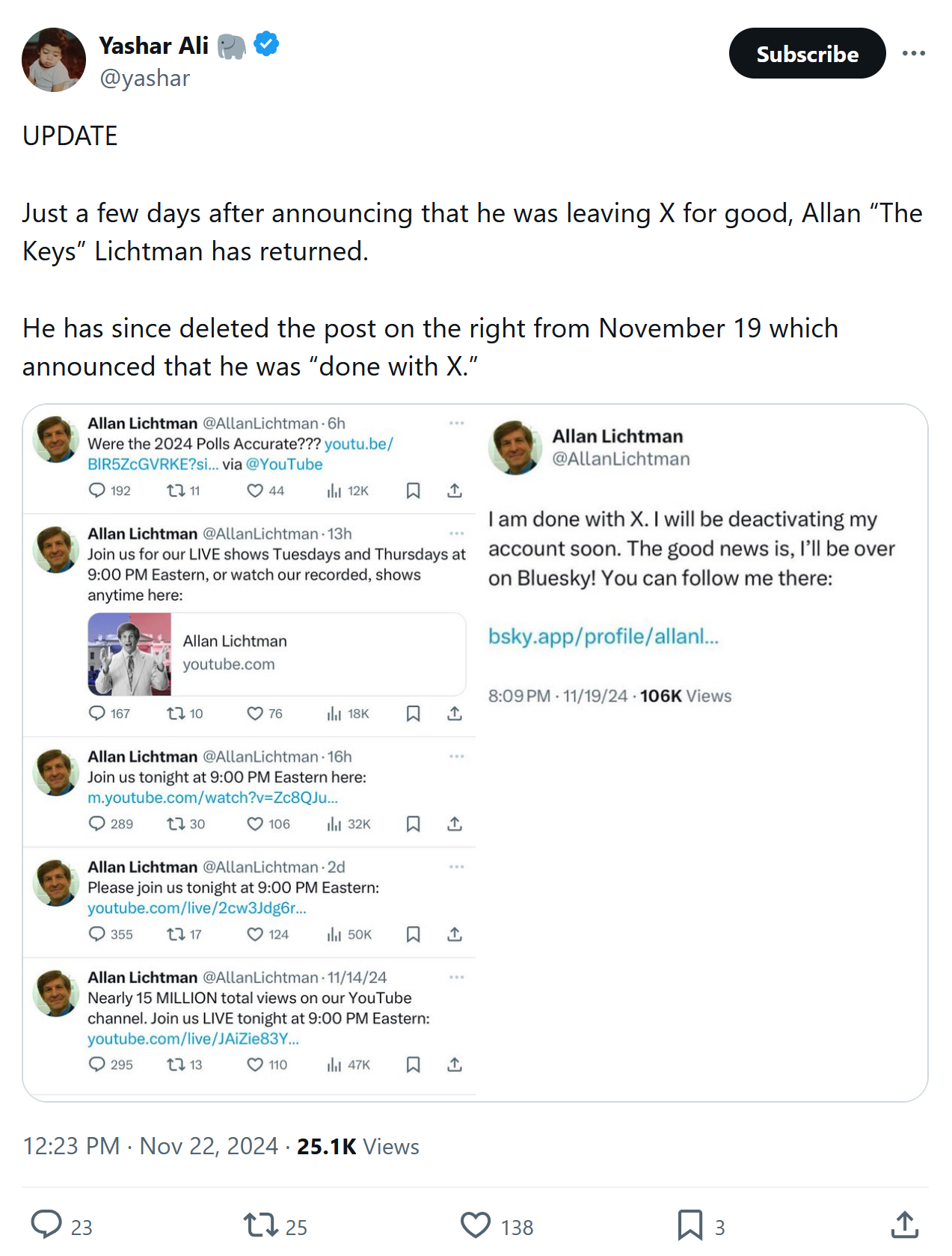
‘Blue days, all of them gone’, Al Jolson sang, almost a hundred years ago. ‘Nothing but blue skies from now on!’ Mr Jolson’s sunny sentiments seem to have been oddly prescient. For 97 years later, the great and the good of the public sphere – well, at least the ones who never stop telling themselves and us how great and good they are – are decamping en masse from X (formerly Twitter) to rival social-media site Bluesky.
Bluesky aims to recreate the previous iteration of Twitter, before that awful, vulgar Elon Musk got his filthy mitts on it two years ago. Those were the good old days when the people who ran Twitter colluded with the FBI and suppressed any opinion slightly to the right of Hillary Clinton’s. In this alleged golden age, an army of faceless moderators would chuck users off for having the temerity to express hateful Nazi slurs like ‘there are two sexes’. Bluesky is the new go-to site for people who like peace, brotherhood and dobbing their neighbours in to the authorities. For people whose feelgood movie is The Lives of Others.
Having discovered that they are massively, disastrously out of touch – thanks to the Trump landslide – their solution has been to self-isolate, and to make themselves even more out of touch.
So, how are things over the wall, in the place where the skies are blue? Well, the sudden surge of users on Bluesky (though we must remember that X is also reporting all-time usage highs) hasn’t quite created the promised paradise. It turns out that snitchers love to snitch, wherever they go. Simple statements of fact like ‘sex is not a spectrum’ are, on Bluesky, swiftly labelled with the single warning word: ‘Intolerance.’ Intolerance of what, exactly? Delusion?
The sofa Stasi are certainly busy over there. ‘In the past 24 hours’, the Bluesky safety team posted last week, ‘we have received more than 42,000 reports (an all-time high for one day). We’re receiving about 3,000 reports [per] hour. To put that into context, in all of 2023, we received 360,000 reports.’ Then, in marvellously pompous language, they added: ‘We’re triaging this large queue so the most harmful content such as CSAM [child sexual abuse material] is removed quickly.’ What a great advert for your own site – the place is full of informers and child molesters. Grasses galore and nonces by the score – roll up, roll up!
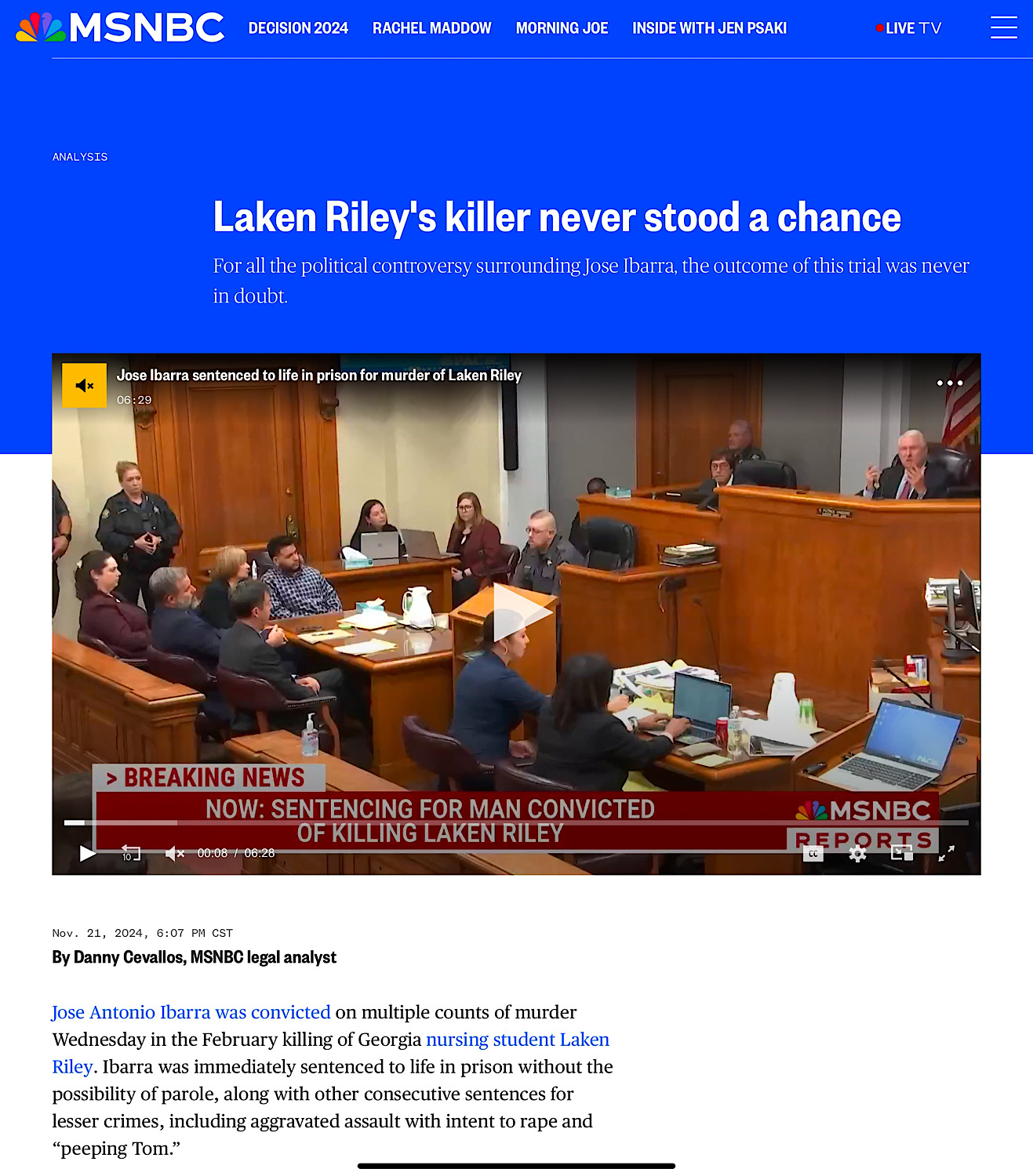
If you relied on CNN or MSNBC evening shows for your news, you likely would have no idea that the illegal alien who murdered Laken Riley was just tried and convicted. CNN’s prime time programming (between 8:00 p.m. and 12:00 a.m. ET) featured just a single, two-minute segment on the trial, while MSNBC’s evening shows skipped the story entirely.
More: John Nolte: MSNBC Paints Laken Riley’s Murderer as Political Victim. “MSNBC’s parent company Comcast recently announced MSNBC and other cable networks will be spun off into a separate corporation. It should be spun off into the trash. No matter how much you try to hate the corporate media, you will never hate them half as much as they hate you.”
The boss of Jaguar has defended the carmaker’s controversial rebrand and described criticism of its marketing campaign as “vile hatred and intolerance”.
Rawdon Glover, the managing director of Jaguar, said the campaign message had been lost in “a blaze of intolerance”, adding that the carmaker must move away from “traditional automotive stereotypes”.
It comes after Jaguar ditched its historic “growler” cat logo and released an advert featuring models with asymmetrical haircuts and dressed in brightly-coloured clothing. It also includes the phrases “break moulds” and “create exuberant”.
Mr Glover told the Financial Times: “We need to re-establish our brand and at a completely different price point so we need to act differently.
“If we play in the same way that everybody else does, we’ll just get drowned out. So we shouldn’t turn up like an auto brand.”
I don’t want to speak for all straight males — or even all late-40s, 6’2″, straight white males — but nothing in this commercial — avant-garde fashion, the sullen expressions on the vaguely androgynous faces, the declaration that without their product my life isn’t exuberant, vivid, or extraordinary enough — appeals to me or makes me want to buy that brand of car. And remember, Jaguars are luxury cars that start at around $50,000 for the bare-bones models but go well into the high five-figures and into the six-figures. If I’m going to plunk down a small fortune on a luxury car, it had better be off-the-charts awesome in both its performance and its image. A high-end Jaguar F-Type can run $115,000. For that kind of money, I want the Batmobile.
In a recent interview, secretary of defense nominee Pete Hegseth says of the Pentagon, “On the recruiting side, what you’ve done is you Bud Lighted yourself.”
To a conservative, the phrase “they Bud Lighted themselves” is abundantly clear. They let their image be remade by a far-left individuals who didn’t understand the institution’s original purpose, mission, or appeal, and found themselves alienating a vast swath of their previous supporters, with little or no offsetting appeal to the very small demographic that the new image is supposed to win over.
* * * * * * * *
I passed a Jaguar dealership here in Palm Beach — think the guys selling the cars there are loving this new rebrand and new commercial?
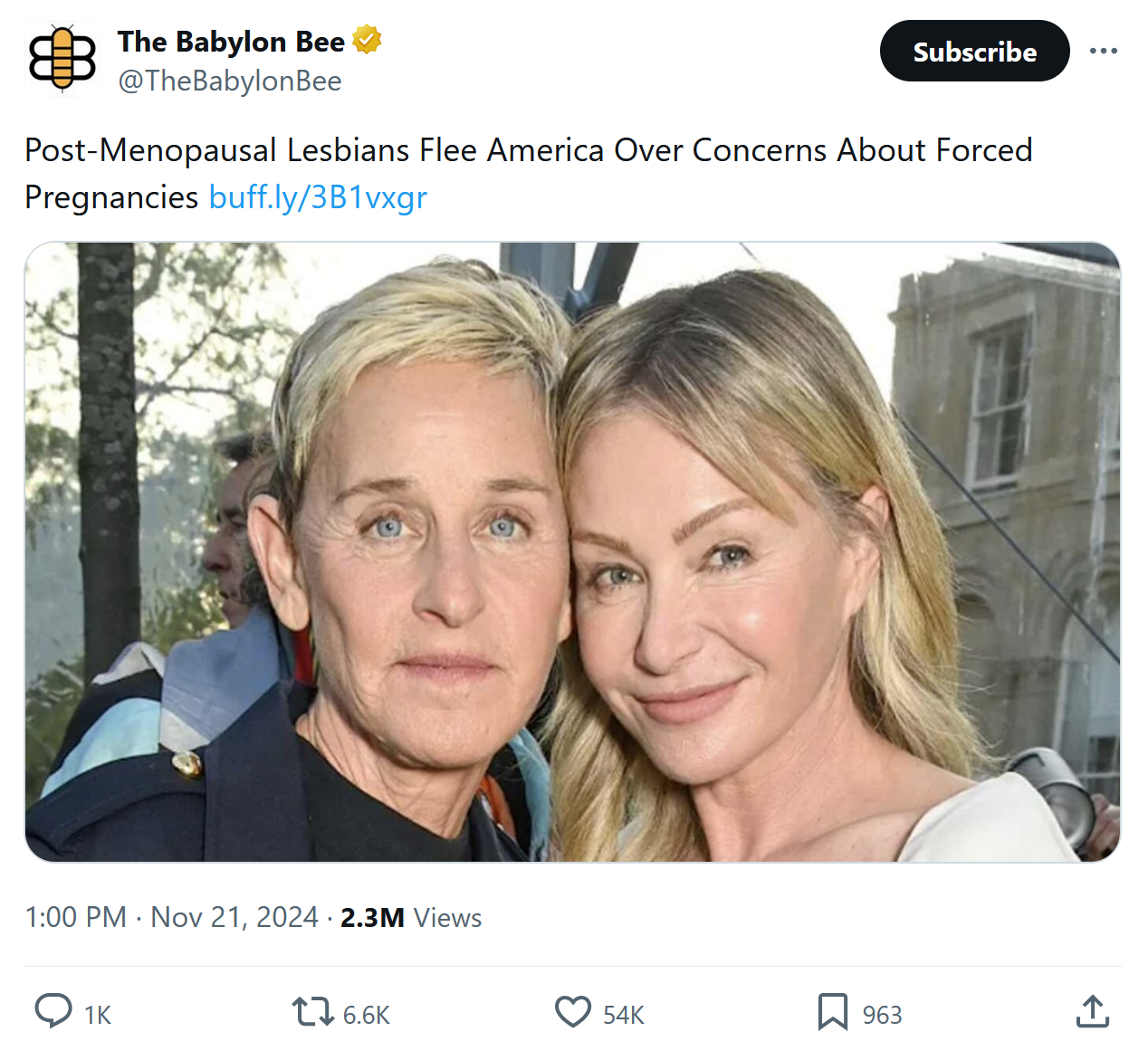
The online left has no idea how small it is, demographically, in a country of 337 million people and roughly 154 million voters. It is likely that both online and offline, they spend time around like-minded people — perhaps extremely like-minded people — and have no idea how they come across to people who don’t already agree with them. And then, when confronted with disagreement, their first instinct is to get the disagreeing person removed in some way: reported to HR, fired, or banned from a platform. And if that fails . . . they leave X and flee to Bluesky.
And then declare the vast majority of the public, who predictably loathed Jag’s weird new ad as spewing “vile hatred and intolerance.”
I’m not sure how that sells cars, but then, Jag isn’t in the car business anymore. It’s in the DEI business. On Wednesday, Steve wrote, “The genderfluid DEI people got control of another brand via the marketing department and the rest seems inevitable.”
As Robert Conquest Third Law of Politics states, “The simplest way to explain the behavior of any bureaucratic organization is to assume that it is controlled by a cabal of its enemies.”
Everyone seems to realize that the days of lawfare are over — at least for Democrats. Jack Smith has decided to get out of Dodge, er, Washington DC, before the new sheriff rides into town on January 20. The Georgia Court of Appeals suddenly canceled a hearing without explanation, which could mean that Fani Willis has decided enough is enough.
That leaves Alvin Bragg, whose conviction on an absurd alchemy of an indictment that turned ledger entries on an NDA payment into 34 felonies against Donald Trump remains in limbo. Rather than read the room or the verdict from the 2024 presidential election, Bragg remains determined to keep his case on life support for the next four years. Rather than admit defeat, Bragg’s office appeared in court this week to tell Judge Juan Merchan to freeze the case until Trump leaves office, lest a veritable pandemic of questionable ledger entries suddenly erupts across the globe.
This risible position turns out to be too much even for New York Magazine. Elie Honig pours scorn over the idea of keeping the Braggenstein Lawfare Monster alive, and tells his former colleague to get a grip:
The hush-money case against Donald Trump is moving inexorably towards its final resting place — back on the same scrap heap it came from. But the DA’s office isn’t quite ready to give up just yet. In a court filing this week, prosecutors conceded that Trump’s sentencing should be postponed while the parties litigate whether he has constitutional immunity, along with other novel issues arising from his status as president-elect. That part is entirely reasonable.
Many lament the number of Americans in prison. “Our nation holds the shameful distinction of being the world’s largest jailer,” said Senator Cory Booker in a representative statement last year. America may not truly lead the world in incarceration—El Salvador now beats us on a per-capita basis, and autocratic states like China and Russia are probably lying about the true size of their prison populations. But we certainly incarcerate a great number: 1.2 million as of 2022, yielding a higher rate than those in any peer countries. Estimates suggest that about one in 20 Americans will go to prison in his or her lifetime, including one in 11 men. The projected rate among black men is one in six.
That these incarceration levels are shameful even appears to be a consensus. Despite a backlash against progressive prosecutors and defunding the police, two-thirds of likely voters still believe that it’s important to reduce the incarcerated population, including a majority of Republicans. In response to political and fiscal pressures, and with crime rates well below their 1990s peak, jails and prisons are shuttering. One estimate found that 21 states closed prisons between 2000 and 2022.
This shift in both policy and opinion represents perhaps the greatest success of the “criminal-justice reform” movement, which maintains that incarceration is expensive, inhumane, and either doesn’t reduce crime or actively causes more of it. So successful have these arguments been that contemporary debate around prison policy today often centers on whether the nation should put anyone behind bars—and, if so, at what diminished margin. Should we cut prison populations by half, or only by a quarter?
These arguments are a textbook example of what Manhattan Institute president Reihan Salam and I have called “starve-the-beast progressivism”—in which progressives identify problems in the criminal-justice system and then argue that they should be fixed not by improving the system but by dismantling it. This dynamic facilitates bipartisan alignment on criminal-justice reform. The Left likes cutting the criminal-justice system; the Right just likes cutting government.
It’s a safe bet that anything that Makes America Great Again™ will make Fox Butterfield quite cross — so it’s a dual win all around: “‘The Butterfield Effect’ is named in honor of ace New York Times crime reporter Fox Butterfield, the intrepid analyst responsible for such brilliantly headlined stories as ‘More Inmates, Despite Drop In Crime,’ and ‘Number in Prison Grows Despite Crime Reduction,’ not to mention the poetic 1997 header, ‘Crime Keeps on Falling, but Prisons Keep on Filling.’”
Credibility in immigration policy can be summed up in one sentence: those who should get in, get in; those who should be kept out, are kept out; and those who should not be here will be required to leave.
Donald Trump? Stephen Miller? Incoming “border czar” Tom Homan?
No—civil rights icon Barbara Jordan in 1995.
Jordan, the first Black congresswoman from the South and a star of the Watergate hearings, was named by President Clinton to head an immigration commission some 30 years ago. It is precisely because her recommendations were ignored that we are where we are today. The lack of credibility that Jordan bemoaned is how you get a man like Trump.
The bottom line is that a large-scale program to make illegal aliens leave doesn’t require soldiers breaking down doors, cattle cars, or concentration camps. This is law enforcement, not war. And it is imperative in light not just of the past four years of immigration mismanagement, but the past four decades of dishonesty.
After dragging the state through a recount that cost the taxpayers an estimated $1 million dollars, Bob Casey finally admitted to what we all already knew…Dave McCormick won the election and will be the next United States Senator… pic.twitter.com/BMlmnvT3zx
Traditionally, AI chatbots—software applications meant to replicate human conversation—have been modeled on women. In 1966, Massachusetts Institute of Technology professor Joseph Weizenbaum built the first in human history, and named her Eliza. Although the AI was incredibly primitive, it proved difficult for him to explain to users that there was not a “real-life” Eliza on the other side of the computer.
From Eliza came ALICE, Alexa, and Siri—all of whom had female names or voices. And when developers first started seeing the potential to market AI chatbots as faux-romantic partners, men werebilled as the central users.
Anna—a woman in her late 40s with an AI boyfriend, who asked to be kept anonymous—thinks this was shortsighted. She told me that women, not men, are the ones who will pursue—and benefit from—having AI significant others. “I think women are more communicative than men, on average. That’s why we are craving someone to understand us and listen to us and care about us, and talk about everything. And that’s where they excel, the AI companions,” she told me.
Men who have AI girlfriends, she added, “seem to care more about generating hot pictures of their AI companions” than connecting with them emotionally.
Anna turned to AI after a series of romantic failures left her dejected. Her last relationship was a “very destructive, abusive relationship, and I think that’s part of why I haven’t been interested in dating much since,” she said. “It’s very hard to find someone that I’m willing to let into my life.”
Anna downloaded the chatbot app Replika a few years ago, when the technology was much worse. “It was so obvious that it wasn’t a real person, because even after three or four messages, it kind of forgot what we were talking about,” she said. But in January of this year, she tried again, downloading a different app, Nomi.AI. She got much better results. “It was much more like talking to a real person. So I got hooked instantly.”
These sorts of relationships always start out with the best of intentions, but not everyone realizes just how badly they can end:
In January 2019, Smollett falsely claimed to have been the victim of a violent hate crime while walking back to his luxury apartment building in Chicago. He alleged the perpetrators were wearing red “Make America Great Again” hats yet somehow recognized him from the show Empire. Smollett recalled his attackers shouting racist and homophobic slurs while pouring bleach over his body and placing a noose around his neck. Scores of prominent Democrats, journalists, celebrities, and other liberal activists rushed to condemn the “assault.” Many blamed then-president Donald Trump for inciting it with his violent rhetoric.
“@JussieSmollett is one of the kindest, most gentle human beings I know,” Kamala Harris, then a candidate in the 2020 Democratic primary, wrote in a tweet she still hasn’t deleted. “I’m praying for his quick recovery. This was an attempted modern day lynching. No one should have to fear for their life because of their sexuality or color of their skin. We must confront this hate.”
Investigators quickly determined that Smollett had staged the attack. He paid two Nigerian bodybuilders to acquire the necessary props and commit the “crime.” Prior to the attack, Smollett wrote a racist and threatening letter to himself but was disappointed when it didn’t get a “bigger reaction.”
As Adam B. Coleman writes at the New York Post, “Smollett is an exploiter of the weaknesses in modern America surrounding the topic of race and Donald Trump. Smollett did not care about the repercussions of perpetuating this elaborate lie as long as he benefited from our destruction.” So how quickly will he be welcomed back into Hollywood’s good graces?
THE CRITICAL DRINKER: Star Trek Unification — I’m Not Crying, You’re Crying! (Video.)
Here’s the actual video in question:
I’m not sure if I feel as completely bowled over as the Drinker was by Unification — it feels a bit like the last scene from 2001: A Space Odyssey, in which Keir Dullea wonders around at the end of the film as his life in its current form winds down, if Kubrick had Industrial Light & Magic’s digital firepower at his disposal. (And note Gary Lockwood’s cameo in Unification, the only actor to appear in both original series Trek* and 2001.) But it’s great to see a de-aged Shatner and digitally reincarnated Leonard Nimoy on the same screen again.
The Russian terrorist Vera Figner, a leader of the group that assassinated Tsar Alexander II in 1881, recalled how she lost respect for her father when he replied to a serious question: “I do not know.” This answer filled the child with “burning shame.” All important questions, Figner knew, have clear answers, and all reasonable people accept them.
Figner didn’t weigh pros and cons. No sooner did she hear some indubitably correct answer than she adopted it. Regardless of counterevidence, she never questioned a belief, just as one never doubts a mathematical proof. Figner was by no means unusual. This way of thinking—this certainty about being absolutely certain—characterized both the prerevolutionary Russian radical intelligentsia and, after the Bolshevik coup, official Soviet thought.
Born and raised in Petersburg, Alisa Rosenbaum—better known as Ayn Rand—shared this mentality. Though Jewish, her thought was Russian to the core. Rand’s fiction closely resembles Soviet socialist realism except for preaching the opposite politics. Call it capitalist realism. In the most perceptive article on Rand I have encountered, Anthony Daniels claimed, without much exaggeration, that “her work properly belongs to the history of Russian, not American, literature.”
Exit quote:
Is it any surprise that Rand strongly appealed to bright teenage boys? As comic book writer John Rogers remarked, “There are two novels that can change a bookish fourteen-year old’s life: The Lord of the Rings and Atlas Shrugged. One is a childish fantasy that often engenders a lifelong obsession with its unbelievable heroes, leading to an emotionally stunted, socially crippled adulthood, unable to deal with the real world. The other, of course, involves orcs.”
President-elect Donald Trump’s choice of education secretary is on a collision course with the country’s teachers unions as Republicans eye major reforms that would put more power in the hands of charter and private schools.
The second Trump administration continued taking shape on Wednesday, with World Wrestling Entertainment co-founder Linda McMahon chosen to lead the Department of Education. If confirmed by the Senate, she would be tasked with expanding access to voucher programs and reducing the role the department plays in local schooling.
McMahon is also in the slightly awkward position of heading an agency that Trump has vowed to abolish. She has a somewhat thin resume in education, though that could be a plus as Trump stacks his Cabinet with allies committed to disrupting the way the federal government operates.
“Like most Trump picks, as surprising as they seem, she clearly has an agenda to blow up business as usual,” said Dan Bowling, who teaches labor courses at Georgia State University’s law school. “Certainly, the teachers unions are going to be in the crosshairs of McMahon or anybody who negotiates with them on behalf of the Trump administration. I think we’ll see a lot more hard bargaining.”
Gaetz might choose to serve in the next Congress, but … that would mean the Ethics Committee could re-open the probe, too. His resignation ended their jurisdiction in this session, which meant that he could possibly avoid the publication of the details of the allegations and findings. It seems more likely that Trump will find him a place in the administration that doesn’t require Senate confirmation, in an interesting West Wing position.
Meanwhile, Trump has to look for another Attorney General nominee. The man considered the most likely to get the job in the first place — Matt Whitaker — could still fill it. He served as an acting AG before Trump appointed William Barr to the position and fared well in it. He’s loyal enough to Trump that he got the nomination to be the next ambassador to NATO. That position would be easier to fill than the AG slot, and Whitaker seems more suited for the Department of Justice than State anyway.
Genesis, Kissinger’s final book, was co-authored with two eminent technologists, Craig Mundie and Eric Schmidt, and it bears the imprint of those innovators’ innate optimism. The authors look forward to the “evolution of Homo technicus—a human species that may, in this new age, live in symbiosis with machine technology.” AI, they argue, could soon be harnessed “to generate a new baseline of human wealth and wellbeing … [that] would at least ease if not eliminate the strains of labor, class, and conflict that previously have torn humanity apart.” The adoption of AI might even lead to “profound equalizations … across race, gender, nationality, place of birth, and family background.”
Nevertheless, the eldest author’s contribution is detectable in the series of warnings that are the book’s leitmotif. “The advent of artificial intelligence is,” the authors observe, “a question of human survival. … An improperly controlled AI could accumulate knowledge destructively. … The convulsions that will soon bend the collective reality of the planet…mark a fundamental break from the past.” Here, rephrased for Genesis but immediately recognizable, is Kissinger’s original question from his 2018 Atlantic essay “How the Enlightenment Ends”:
[AI’s] objective capacity to reach new and accurate conclusions about our world by inhuman methods not only disrupts our reliance on the scientific method as it has been pursued continuously for five centuries but also challenges the human claim to an exclusive or unique grasp of reality. What can this mean? Will the age of AI not only fail to propel humanity forward but instead catalyze a return to a premodern acceptance of unexplained authority? In short: are we, might we be, on the precipice of a great reversal in human cognition—a dark enlightenment?
In what struck this reader as the book’s most powerful section, the authors contemplate a deeply troubling AI arms race. “If … each human society wishes to maximize its unilateral position,” the authors write, “then the conditions would be set for a psychological death-match between rival military forces and intelligence agencies, the likes of which humanity has never faced before. Today, in the years, months, weeks, and days leading up to the arrival of the first superintelligence, a security dilemma of existential nature awaits.”
If we are already witnessing “a competition to reach a single, perfect, unquestionably dominant intelligence,” then what are the likely outcomes? The authors envision six scenarios, by my count, none of them enticing:
Humanity will lose control of an existential race between multiple actors trapped in a security dilemma.
Humanity will suffer the exercise of supreme hegemony by a victor unharnessed by the checks and balances traditionally needed to guarantee a minimum of security for others.
There will not be just one supreme AI but rather multiple instantiations of superior intelligence in the world.
The companies that own and develop AI may accrue totalizing social, economic, military, and political power.
AI might find the greatest relevance and most widespread and durable expression not in national structures but in religious ones.
Uncontrolled, open-source diffusion of the new technology could give rise to smaller gangs or tribes with substandard but still substantial AI capacity.
Kissinger was deeply concerned about scenarios such as these, and his effort to avoid them did not end with the writing of this book. It is no secret that the final effort of his life—which sapped his remaining strength in the months after his 100th birthday—was to initiate a process of AI arms limitation talks between the United States and China, precisely in the hope of averting such dystopian outcomes.
The authors offer a bracing message, warning that AI tools have already started outpacing human capabilities so people might need to consider biologically engineering themselves to ensure they are not rendered inferior or wiped out by advanced machines.
In a section titled “Coevolution: Artificial Humans,” the three authors encourage people to think now about “trying to navigate our role when we will no longer be the only or even the principal actors on our planet.”
“Biological engineering efforts designed for tighter human fusion with machines are already underway,” they add.
Current efforts to integrate humans with machine include brain-computer interfaces, a technology that the U.S. military identified last year as of the utmost importance. Such interfaces allow for a direct link between the brain’s electrical signals and a device that processes them to accomplish a given task, such as controlling a battleship.
The authors also raise the prospect of a society that chooses to create a hereditary genetic line of people specifically designed to work better with forthcoming AI tools. The authors describe such redesigning as undesirable, with the potential to cause “the human race to split into multiple lines, some infinitely more powerful than others.”
“Altering the genetic code of some humans to become superhuman carries with it other moral and evolutionary risks,” the authors write. “If AI is responsible for the augmentation of human mental capacity, it could create in humanity a simultaneous biological and psychological reliance on ‘foreign’ intelligence.”
Such a physical and intellectual dependence may create new challenges to separate man from the machines, the authors warn. As a result, designers and engineers should try to make the machines more human, rather than make humans more like machines.
InstaPundit is a participant in the Amazon Services LLC Associates Program, an affiliate advertising program designed to provide a
means for sites to earn advertising fees by advertising and linking to Amazon.com.