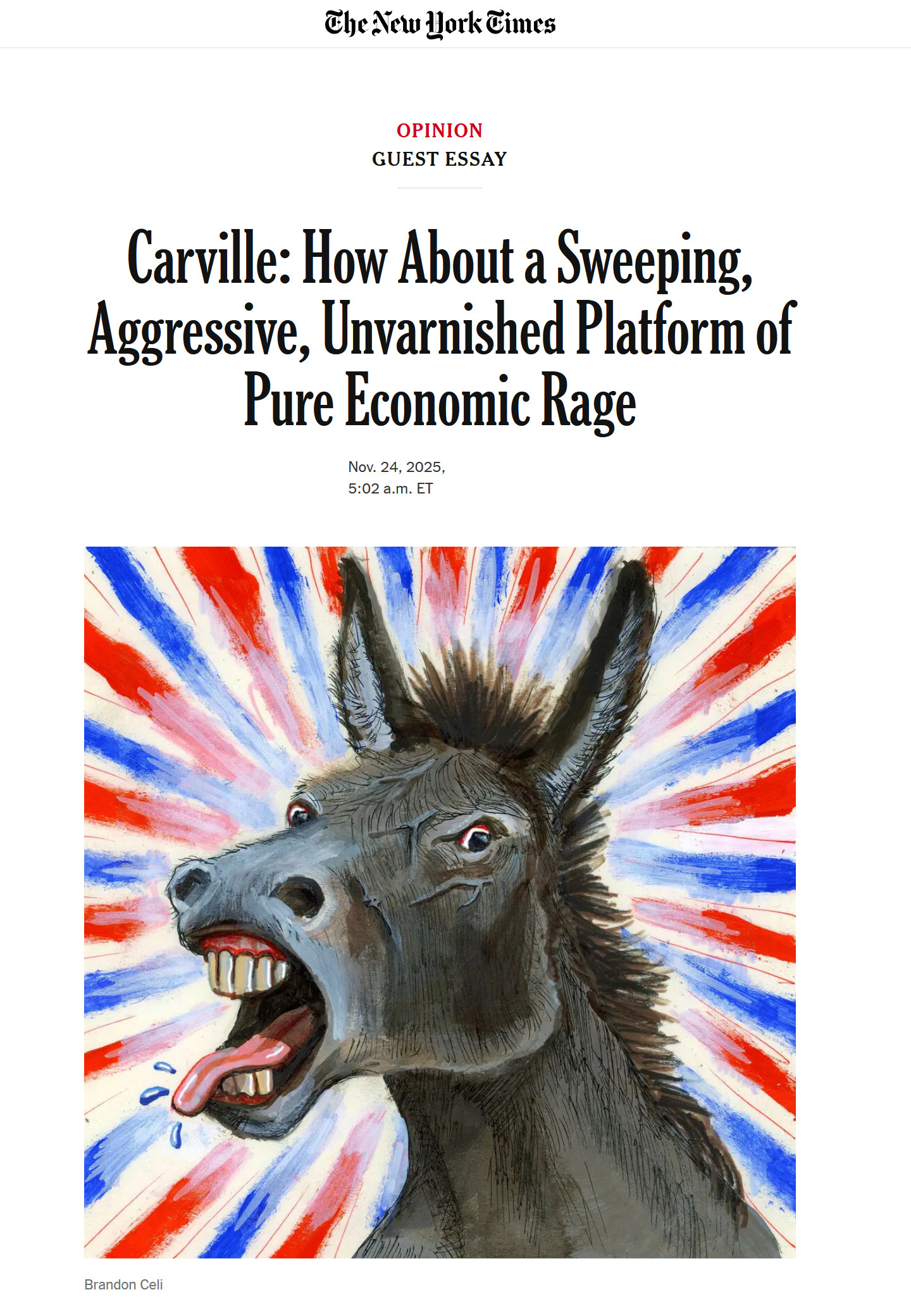
JAMES CARVILLE, TRAPPED IN 2020: Why Don’t Democrats Try Being Revolutionary Lunatics?
While utterly reckless, urging Democrats to gnash their teeth over “the system” would help the party’s candidates paper over their contributions to the very crisis against which they’re supposed to be raging. Carville lists the younger generation’s grievances: the high cost of housing (a function of limited housing stock exacerbated by municipal zoning regulations, environmental studies, and legal compliance costs), rising utility rates (due to insufficient capacity resulting, in substantial part, from environmentalist activism and policy prescriptions), and the cost of food (which was too high even before Donald Trump’s tariffs, owing to the Democratic Party’s heedless 2021-22 spending spree and its inflationary effects). If Democrats do not rage constantly and monomaniacally against these conditions, “we will continue to be viewed as part of it.”
In other words, the idiot masses can be bamboozled into forgetting the Democratic Party’s role in their malaise if the party’s messengers are sufficiently irrational about it. Coincidentally enough, Carville’s advice just happens to align with the political project in which the progressive movement’s youngish revolutionaries are already engaged. He’s got his finger on the pulse.
In 1968, Democrats embraced “Getting Clean for Gene,” shaving off their Zapata moustaches, trimming their Sgt. Pepper-length hair and donning coats and ties to appear centrist for Eugene McCarthy’s candidacy. That strategy paid off brilliantly in 1992 with Bill Clinton and in 2008 with Barack Obama. (Of course, it helps in both cases that your youthful candidates have rock star levels of charisma.) Going full Rage Against (Your Own) Machine seems like a curious strategy for Carville to embrace in his dotage.
Exit quote: “The art department at the [New York] Times did Carville no favors by gracing his effort to flatter progressive pretensions with a portrait of a feral donkey, spittle erupting from its clamorous muzzle. The image did, however, capture the spirit of the piece.”