Author Archive: Glenn Reynolds

LEGISLATION HAS LIMITS: Can Congress resurrect Roe if it’s overturned? Well, it could try.

Democrats in Congress are calling on their colleagues to “codify Roe” in federal law. The Women’s Health Protection Act (WHPA) introduced by Rep. Judy Chu (D-Calif.) in June 2021 would do just that. Here’s what you need to know. . . .

When the Civil Rights Act of 1964 came before the Supreme Court, even the liberal justices noted the awkwardness of arguing over whether hamburger meat crossing state lines meant a restaurant such as Ollie’s BBQ in Alabama had to allow Black patrons to sit at the counter, or whether an Atlanta hotel near an interstate highway had to allow Black guests because its travelers moved between states. Still, the Supreme Court unanimously upheld the Civil Rights Act, giving the green light to Congress to use its commerce power to enforce civil rights.

This time around, Congress would again define access to abortion as a case of interstate commerce. People travel across state lines to procure abortion services; medical equipment that provide abortions all moves in interstate commerce; and licensing, training and education for abortion providers all involve interstate travel and commerce. Proponents hope that by codifying Roe in this way, a new federal law guaranteeing the right to abortion would survive the Supreme Court’s inevitable review.

But the Supreme Court has narrowed Congress’s commerce power significantly since the mid-1990s. . . .

It’s possible that the Supreme Court would choose to uphold a WHPA, if passed and signed. Even with these unfavorable rulings, there is ample Supreme Court precedent to support Congress’s regulating abortion through interstate commerce, as law professor Julian Mortenson outlines.

But there is another reason that Democrats in Congress may not want to codify Roe through legislation.

If the Supreme Court rules that Congress has the power to protect abortion through legislation, Congress also would have the power to prohibit abortion through legislation. As Chief Justice John Marshall famously concluded in an 1824 Commerce Clause case, the power to regulate necessarily includes the power to prohibit.

Ultimately, any victory for abortion rights the Democrats might claim with the WHPA would be temporary, lasting only until Republicans regained control.

Congress could also try rooting a statute in the 14th Amendment under its Article 5 power to pass “appropriate legislation” to enforce its guarantees. The problem is, Congress gets to “enforce” only those rights that exist under the Constitution. As the Court held in City of Boerne v. Flores, Congress doesn’t get to define those rights, which means Congress can’t use its 14th Amendment powers to reverse the Court. So they could try.

Meanwhile, Dave Kopel and I were arguing 25 years ago that Congress’s commerce power doesn’t reach abortion.

THEY’VE NORMALIZED PHYSICAL ATTACKS ON PEOPLE FOR WHAT THEY SAY: Dave Chappelle Attacked on Stage. “After the Will Smith incident at the Oscars, there was a lot of talk about whether it would inspire other attacks on performers, whose vulnerability on stage had been so vividly exposed.”

UPDATE: From the comments: “Quite the week and it’s only Wednesday. We’ve rediscovered the existence of women, and now people are concerned about black-on-black violence.” (Bumped, because that’s funny.)

IT’S A CABAL: Revealed: George Soros, Clinton and Obama staffers and European governments are behind anti-Musk campaign to force big corporations to boycott Twitter – after Elon demanded to know ‘who funds these organizations?’ “Twenty six NGOs and advocacy groups signed a letter expressing concern about the world’s richest man’s plan. Musk himself responded to the letter asking who funded them: the answer being an assortment of ‘dark money groups’ like George Soros’s Open Society Foundation; NGOs founded by former Clinton and Obama administration staffers; wealthy Democrat donors and their family foundations; labor unions; and the governments of European nations.”

SOCIAL ENGINEERING FAILS AT STATED GOAL: Ban on sale of cheap alcohol has cost Scots £270m, new research finds.

Minimum unit pricing (MUP), introduced in Scotland in 2018 to prevent the sale of cheap alcohol, has cost consumers almost £200m more than projected, research by the Institute of Economic Affairs has found. . . .

Prior to implementation, MUP was projected to cost consumers £76 million.

But new research by the Institute of Economic Affairs has revealed that the actual cost to consumers could be closer to £270 million, the equivalent of £59.39 per adult or £71.12 per drinker.

The policy was initially justified on the basis of computer modelling from the Sheffield Alcohol Policy Model (SAPM), a team at the University of Sheffield, which projected various health-related and social improvements.

Initial modelling estimated that over the first five years of minimum unit pricing there would be 400 fewer alcohol-related deaths and 8,000 fewer hospital admissions, according to the Scottish Government’s website.

“Minimum unit pricing is designed to impact most on harmful drinkers – those who regularly drink more than the lower risk drinking guidelines. Those who drink within the lower risk guidelines should only be marginally affected because they consume a small amount of alcohol and don’t tend to buy as much of the low-cost high strength alcohol that should be most affected by a minimum unit price,” the website states.

MUP was also implemented to reduce alcohol-related crime rates. But research from Manchester Metropolitan University published late last year found no significant statistical changes in alcohol-related crime, disorder and public nuisance offences as a result of its implementation.

According to the Scottish Government website, prior to the implementation of MUP it was possible to buy 14 units of alcohol for approximately £2.50. With minimum unit pricing in place, this cannot be legally sold for less than £7.

Christopher Snowdon, co-author of the report and IEA head of lifestyle economics, said: “Our estimate suggests that minimum pricing has cost Scottish drinkers more than a quarter of a billion pounds. Now in its fifth year, minimum pricing is a reminder that politicians are often responsible for the rising cost of living.

“Although alcohol consumption has fallen slightly in Scotland, we find no evidence that this has led to an improvement in health outcomes. Consumers have simply switched from the most affordable alcohol to mid-range brands, to the benefit of alcohol producers and retailers. The policy could be dropped tomorrow without costing the government a penny.”

Will those who proposed and inflicted this policy face any consequences for its failure? Haha, I crack myself up.

NEW YORK SUN: Leak of Supreme Court Abortion Decision Threatens To Upend Coming Midterm Elections: Politicians in both parties seemed caught off-guard, and political analysts began rethinking their predictions for close races across the country if abortion becomes a central focus.

The leak of a draft Supreme Court opinion that would overturn the landmark Roe v. Wade abortion decision sent shock waves through America’s political classes Tuesday and threatened to upend the conventional wisdom about the prospects for both parties in the coming midterm elections.

If issued as a formal decision, the draft majority opinion, written by Justice Samuel Alito in February, would end the court’s protection of a woman’s right to an abortion and relegate that authority to legislators in statehouses or the U.S. Congress.

The opinion itself was not entirely unexpected, but the manner in which it became public — via a leak to Politico — was highly unusual. Politicians in both parties seemed caught off-guard, and analysts began rethinking their predictions for close races across the country if the abortion issue becomes a central focus of the fall campaign.
A formal opinion in the case, Dobbs v Jackson Women’s Health Organization, is expected in the next two months. The outcome of the case and the language of the draft opinion could still change before its release.

Republicans generally welcomed the prospect of a decision overturning Roe, but instead of celebrating spent most of the day excoriating the person or persons responsible for the leak.

In a written statement, Senator McConnell called it an “yet another escalation in the radical left’s ongoing campaign to bully and intimidate federal judges.” At a later press conference, he urged reporters to focus not on the draft itself but on the fact that it was leaked.

Democratic strategists professed to be unsure how the issue would play out at the polls. President Biden, when asked about the potential political fallout from what he called a “radical decision,” demurred, stating only that he had not thought through such things.

His office, however, wasted no time in attempting to rally its base around the cause.

I predict it will make less difference in November than people think now.

THE LEFT CHANGES WHAT MIND IT HAS ON A REGULAR BASIS:

NEWS YOU CAN USE: Don’t Leave Your Husband Because of Vibes. “This brings us to Australian life coach Amanda Trenfield, who recently shared an excerpt from her upcoming memoir in the Sydney Morning Herald under the headline “Less than a month after I met my soulmate, I ended my 14-year marriage.” What is the title of her book? Well, it’s When a Soulmate Says No, so we’re already off to a bad start.”

MARK JUDGE: The Supreme Court Leak: The Left Sows Panic to Smother the Truth.

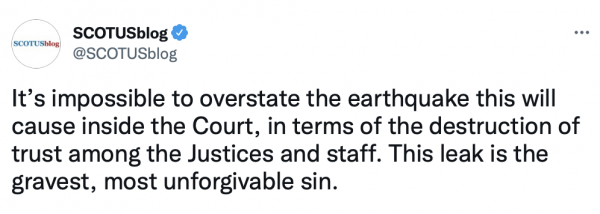
Say, where are all the condemnations of this leak from the greybeards of the Supreme Court bar? The joint statements? The loud defenses of norms and institutions? I looked on ScotusBlog, where I would expect to see that sort of reaction, and found nothing? Nothing from Chuck Cooper, the Federalist Society, Ted Olson, Michael Luttig, Miguel Estrada, Boyden Gray, John Ashcroft, the Constitution Society, various law deans, etc.

Bill Barr has suggested that the leaker might be prosecuted for obstruction of justice, and called for a special prosecutor and grand jury but we haven’t heard from very many people considering what a huge blow to the Court as an institution this leak was.

Just ask Scotusblog:

GLENN GREENWALD: The Irrational, Misguided Discourse Surrounding Supreme Court Controversies Such as Roe v. Wade. “The Court, like the U.S. Constitution, was designed to be a limit on the excesses of democracy. Roe denied, not upheld, the rights of citizens to decide democratically.”

Plus: “It was bizarre to watch liberals accuse the Court of acting ‘undemocratically’ as they denounced the ability of ‘five unelected aristocrats’ — in the words of Vox’s Ian Millhiser — to decide the question of abortion rights. Who do they think decided Roe in the first place? Indeed, Millhiser’s argument here — unelected Supreme Court Justices have no business mucking around in abortion rights — is supremely ironic given that it was unelected judges who issued Roe back in 1973, in the process striking down numerous democratically elected laws.”