
SEWN TOGETHER FROM CORPSES OF AMERICAN JURISPRUDENCE: Trump’s Judge Wants to Assemble a Frankenverdict.
Archive for 2024
May 29, 2024
DOD GOING TO THE DOGS: To do drug-testing, that is, which DOD isn’t supposed to be doing, according to the White Coat Waste Project.
DISPATCHES FROM WEIMAR AMERICA: Manhunt Underway for Driver Who Left Tire Marks on a Pride Mural.
This isn’t the first time this has happened. I’ll admit I was bummed to see “Pride” crosswalks pop up in my city. I never voted for it, never asked for it, and don’t want my tax dollars paying for it. The crosswalks do seem to trigger some people, who lay rubber on them. A manhunt is underway for a driver who left tire marks on a Pride crosswalk in St. Petersburg, Florida.
They paint their sacred symbols on the road in the hope that this will happen
As we approach American Ramadan it is important that they manufacture the ritual of victimhood, even as they force the entire empire to worship at their feet https://t.co/UBz7ocbr3v
— Auron MacIntyre (@AuronMacintyre) May 28, 2024
Meanwhile, America’s Newspaper of Record goes twenty minutes into the future:
Airline Pilot Convicted Of Hate Crime For Leaving Contrail Marks On Rainbow https://t.co/N6RAx95mLY pic.twitter.com/OXEITPmA8D
— The Babylon Bee (@TheBabylonBee) May 28, 2024
IT’S A VALUABLE LESSON, KIDS: SF Public Schools Teach ‘How to Go Broke on a Measly $3 Million a Day.’
FOLLOW THE “SCIENCE” — AND DON’T ASK QUESTIONS: Biden White House spins up ‘scientific integrity council’ to shield Government Health bureaucrats and DEI agenda from possible Trump second term: Far from a group tasked with “protecting science” from President Trump, the council is a means to protect hyper ideological government agencies from accountability.
INCENTIVES, HOW DO THEY WORK? Doubling down on illegal immigration response, Denver offers 6 months of free shelter, food, cellphones.
HOW IT STARTED: Naomi Wolf: Sarah ‘Evita’ Palin to Usher in Rovian Police State.
Please understand what you are looking at when you look at Sarah “Evita” Palin. You are looking at the designated muse of the coming American police state.
You have to understand how things work in a closing society in order to understand “Palin Power.” A gang or cabal seizes power, usually with an affable, weak figurehead at the fore. Then they will hold elections — but they will make sure that the election will be corrupted and that the next affable, weak figurehead is entirely in their control.
—Wolf in the Huffington Post, as spotted by P.J. Gladnick of NewsBusters, September 22nd, 2008.
How it’s going:
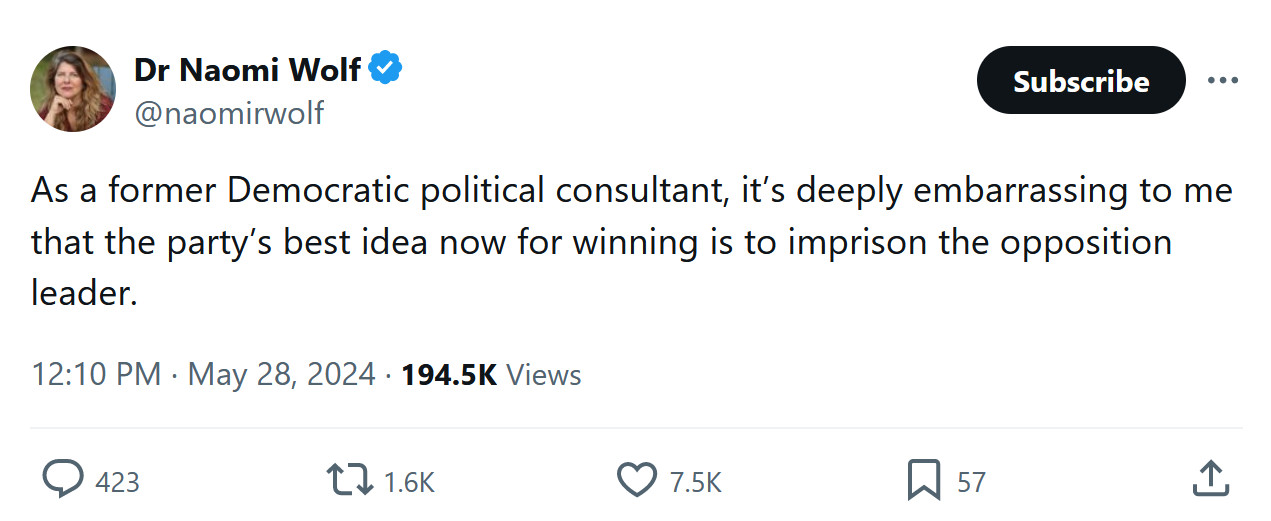
And summer is just getting started: The Democrats Are a Cornered Animal. “Democrats are not the ‘lay down and accept their fate’ type. They don’t snap their fingers, brush themselves off, and say ‘We’ll just have to do better next year.’ They don’t lose, and if they lose there are consequences. Riots, destruction, and death have been a staple of leftists not getting their way.”
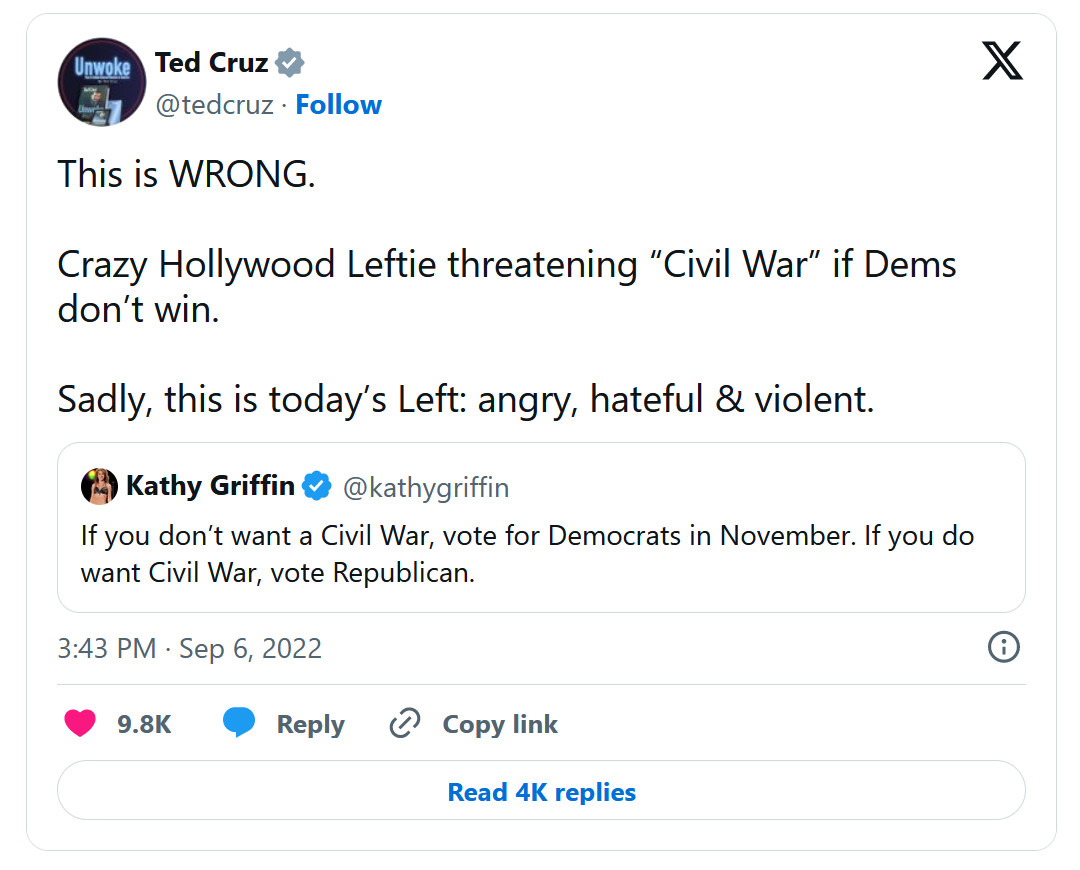
MATT MARGOLIS: Here’s What Could Happen If Trump Is Found Guilty.
HOT!: The final form of my article (with Maimon Schwarzschild) about Students for Fair Admissions v. Harvard (2023) has now been published by the Southern Methodist University Law Review. It is available here for your reading pleasure.
KANGAROO COURT:
…Merchan just delivered the coup de grace instruction. He said that there is no need to agree on what occurred. They can disagree on what the crime was among the three choices. Thus, this means that they could split 4-4-4 and he will still treat them as unanimous…
— Jonathan Turley (@JonathanTurley) May 29, 2024
Life imitates the Bee again:
Judge Instructs Jurors They Need Not Believe Trump Is Guilty To Convict Him https://t.co/QVptl3fP0J pic.twitter.com/s0TpTXNTAS
— The Babylon Bee (@TheBabylonBee) May 28, 2024
HOLLYWOOD, INTERRUPTED: Hollywood crews in ‘crisis:’ ‘Everyone’s just in panic mode’ as jobs decline.
After more than two decades in the industry, Keith Dunkerley still loves nothing more than working on a set. The 47-year-old director of photography and camera operator, who’s had consistent work since he moved to Los Angeles 23 years ago, said his is “the best job in the world.”
Since the writers’ and actors’ strikes last year and the slow restart of production, though, Dunkerley said his work opportunities look quite different than in past years: He has worked only 18 days during the first five months of 2024.
“People outside the business don’t understand this is not a factory,” Dunkerley said. “It’s not like, ‘OK, the strike’s over, go back to the factory, turn the lights on and get the machines going.’ A lot of us knew it’s going to take some time to ramp things up.”
While Dunkerley supported his family through savings and odd jobs as a handyman on TaskRabbit during the strikes, the sluggish rebound has been difficult for him. He’s recently made more than 60 calls to friends and industry contacts to look for prospects.
What Dunkerley is experiencing is a part of the massive ripple effect of the WGA and SAG-AFTRA strikes that is still affecting tens of thousands of people working in entertainment and adjacent industries. Crew members, especially, have been hit hard.
“I am currently in the worst place I’ve ever been in my entire life financially,” said Heather Fink, a boom operator and director. “The industry is in a crisis. It is not back to normal. We are in debt.”
On the plus side, a Hollywood producing fewer product is a Hollywood with a smaller carbon footprint. Which is a good thing from the industry’s point of view, right? John Nolte: ‘Experts’ Demand Even More Global Warming Alarmism in Movies.
[F]ewer than 10% of the 250 films passed [a “climate reality check” test], and climate change was mentioned in two or more scenes of fewer than 4% of the films. That’s out of touch with a moviegoing public that wants “to see their reality reflected on screen,” said Colby College English professor Matthew Schneider-Mayerson, lead researcher on the study.
“The top line is just that the vast majority of films, popular films produced over the last 10 years in the United States, are not portraying the world as it is,” Schneider-Mayerson said. “They are portraying a world that is now history or fantasy — a world in which climate change is not happening.”
Don’t laugh. This is the exact same tactic GLAAD used, which is why absolutely everything is gay now. Remember who we are dealing with. Hollywood doesn’t resent left-wing propagandists butting in like this. Nope. Hollywood loves it when left-wing propagandists give them an excuse to inject this garbage in their films. They want to be able to say, We have no choice. It’s the right thing to do.
* * * * * * * *
People continue to believe Hollywood will eventually have no choice but to stop with this woke garbage and go back to creating art and entertainment. That’s naive. History proves that once the extreme left grabs hold of an institution, it never lets go. Given the choice between ending the propaganda and going bankrupt, they choose bankruptcy.
This sort of doomsday worldview has repercussions for those who otherwise have near-unlimited power in the film industry: Be Careful What You Wish for, James Cameron.
Even in liberal Hollywood, James Cameron stands out as one of the most “woke” directors. His Avatar movies deplore how a pristine ecosystem is despoiled by “settlers” and applaud the “indigenous resistance” fighting them.
So it’s deliciously ironic that Cameron is now facing fierce local resistance to his support for a giant film studio and training center in the pastoral British countryside. It would cost nearly $1 billion and feature half a million square feet of soundstages.
Cameron has suggested the project form the base for his production company, Lightstorm3D. “The 22.5 percent of total global box office the U.K. delivered in 2023 will grow as a result,” he reportedly wrote in a pitch for the project. “But embracing that opportunity necessitates support and boldness in thinking.”
But local NIMBY activists aren’t into “boldness in thinking.” They claim that Cameron’s project “would forever destroy” the local “Greenbelt” and be “detrimental to the people living in the area, destroying their quality of life by being surrounded and trapped by the industrial-scale development.” Although the proposed site for the project is a former quarry, it is zoned as greenbelt land, an area of open land around a city in which building is restricted.
This month, a local parish poll was held in Buckinghamshire on the project, and, in a low turnout, 85 percent of those who voted opposed the film studio. The local council, which has delayed a decision on the project, appears unlikely to move forward anytime soon.
Propaganda has consequences. If you make movies that decry development, don’t be surprised if impressionable filmgoers aren’t thrilled with your own building plans.
This isn’t the first time that Cameron’s “Progressives Against Progress” worldview has impacted Hollywood’s bottom line. In 2010, he decried the sale of DVDs due to their being very, very bad for the environment:
In 2010 that James Cameron told the Washington Post that DVDs were bad for the Gaia and other living things, and needed to be eliminated (while simultaneously having multiple versions of Avatar coming out that same year on DVD):
“It’s a consumer product like any consumer product. I think ultimately we’re going to bypass a physical medium and go directly to a download model and then it’s just bits moving in the system. And then the only impact to the environment is the power it takes to run the computers, run the devices. I think that we’re not there yet, but we’re moving that direction. Twentieth Century Fox has made a commitment to be carbon neutral by the end of 2010. Because of some of these practices that can’t be changed, the only way to do that is to buy carbon offsets. You know, which again, these are interim solutions. But at least it shows that there’s a consciousness that we have to be dealing with carbon pollution and sustainability. …”
It turns out that a lack of DVD sales was very bad for those in the 90210 zip code. In 2013, veteran producer Lynda Obst wrote in Salon, “For consumers, the decline of the DVD market has meant switching over to both Blu-ray and, more recently, streaming options for their viewing pleasure. The end of the DVD format’s dominance meant something much more, and far worse, for Hollywood.”
“The DVD business represented fifty percent of their profits,” [20th Century Fox executive Peter Chernin] went on. “Fifty percent. The decline of that business means their entire profit could come down between forty and fifty percent for new movies.”
For those of you like me who are not good at math, let me make Peter’s statement even simpler. If a studio’s margin of profit was only 10 percent in the Old Abnormal, now with the collapsing DVD market that profit margin was hovering around 6 percent. The loss of profit on those little silver discs had nearly halved our profit margin.
This was, literally, a Great Contraction. Something drastic had happened to our industry, and this was it. Surely there were other factors: Young males were disappearing into video games; there were hundreds of home entertainment choices available for nesting families; the Net. But slicing a huge chunk of reliable profits right out of the bottom line forever?
This was mind-boggling to me, and I’ve been in the business for thirty years. Peter continued as I absorbed the depths and roots of what I was starting to think of as the Great Contraction. “Which means if nothing else changed, they would all be losing money. That’s how serious the DVD downturn is. At best, it could cut their profit in half for new movies.”
* * * * *
“When did the collapse begin?”
“The bad news started in 2008,” he said. “Bad 2009. Bad 2010. Bad 2011.”
It was as if he were scolding those years. They were bad, very bad. I wouldn’t want to be those years.
“The international market will still grow,” he said, “but the DVD sell-through business is not coming back again. Consumers will buy their movies on Netflix, iTunes, Amazon et al. before they will purchase a DVD.” What had been our profit margin has gone the way of the old media.
A decade later, Matt Damon concurred:
In one of the most recent episodes Matt Damon took on the challenge and was asked to give his insight into what changed within the industry to result in the kind of movies we grew up watching not being made anymore. His answer makes total sense.
He basically said that DVDs used to be a huge part of the business, and that technology (streaming in particular) has unfortunately made them obsolete.
He said that when a movie that wasn’t guaranteed to be a box office hit was released, the studio would get a second chance to make its money back with DVD sales. As fewer people bought them however, it became more important for a film to do well at the box office because there was a greater risk of losing money.
Ironically a lot of the films Matt Damon built his career on are the kind that are now considered “too risky” which is why we’re not getting so many films like Good Will Hunting, Dogma and The Talented Mr. Ripley anymore.
In one of the most recent episodes Matt Damon took on the challenge and was asked to give his insight into what changed within the industry to result in the kind of movies we grew up watching not being made anymore. His answer makes total sense.
He basically said that DVDs used to be a huge part of the business, and that technology (streaming in particular) has unfortunately made them obsolete.
He said that when a movie that wasn’t guaranteed to be a box office hit was released, the studio would get a second chance to make its money back with DVD sales. As fewer people bought them however, it became more important for a film to do well at the box office because there was a greater risk of losing money.
Ironically a lot of the films Matt Damon built his career on are the kind that are now considered “too risky” which is why we’re not getting so many films like Good Will Hunting, Dogma and The Talented Mr. Ripley anymore.
Home video has always been hugely important to the movie industry and has given a lot of films that either flopped, or that just weren’t very well received at the box office a new lease of life on video and DVD.
Films like The Thing (1982), Blade Runner (1982), The Big Lebowski (1998), Donnie Darko (2001), Fight Club (1999) and even The Shawshank Redemption (1994) weren’t box office smashes, and in some cases were panned by critics. It was largely thanks to home video that these films became the fan (and cult) favourites they’ve since become.
In a lot of ways I guess we’re to blame.
I’ve always loved collecting films. First it was VHS tapes, then DVDs, and for a shorter period, Blu-Rays. I used to buy loads, but even I don’t really buy them anymore – just the odd movie that I like so much that I feel the need to own a physical copy.
With streaming becoming more and more popular, and with an increasing amount of original films being released directly to those streaming sites I worry about the future of cinemas. We’ve already lost video shops like Blockbuster, as well as countless independent rental shops.
Could cinemas soon become obsolete with the ever increasing popularity of streaming? I really hope not. Streaming has already become partly responsible for the decline of decent films. Let’s hope that’s where the damage ends.
Which is brings us back to the global warming message that Nolte spotted. Although ironically part of Hollywood’s unintentional degrowth strategy is that they followed the advice the media proffered to coal miners during the Obama era: they actually learned to code.
UGH: Streaming Bundles Are Here, and You May Need a Ph.D. to Navigate the Options.
Earlier this month, Disney DIS 0.67%increase; green up pointing triangle and Warner Bros. Discovery WBD 1.88%increase; green up pointing triangle announced plans for a discounted package of Disney+, Hulu and Max that will be available this summer. And Comcast CMCSA 0.00%increase; green up pointing triangle on Wednesday will launch a $15-a-month bundle of Netflix NFLX 0.35%increase; green up pointing triangle, Apple AAPL 0.01%increase; green up pointing triangle TV+ and its Peacock service for its Xfinity customers.
More tie-ups are in the works. Bundles are a great way for streamers to expand their reach and reduce the rate of customer defections. Users, meanwhile, get a discount at a time of sharply rising streaming prices, as well as a simplified bill.
…
Bundles can help with customer retention, which is a major issue for streaming services. Many users jump back and forth between platforms to watch a specific show, then cancel when they are done.Offering multiple services as part of one package decreases the likelihood that subscribers will cancel on any given month, according to data from Antenna. The subscriber-measurement company found that most streaming services count about twice as many casual consumers—people who are either past subscribers or have signed up less than six months ago—than long-term users.
Maybe the best part of streaming was that it busted up the cable bundles that forced consumers to pay for dozens (or even hundreds) of channels they never watched to get the few they did.
Now the streamers are bundling their services together to lock customers in the way cable used to. I don’t know if it will work for them but I know I won’t play along. There are plenty of unbundled deals to be had if you shop around for them.
READER FAVORITE: 5-Minute Core Exercises for Seniors: Daily Routines to Build Balance and Boost Confidence. #CommissionEarned
DID THEY READ SCHLICHTER’S BOOK, TOO? Yale Group Welcomes You to the Global Intifada. “‘From the river to the sea,’ they like to chant — and now ‘the river’ is the Hudson, the Potomac, the Thames, and the Seine.”
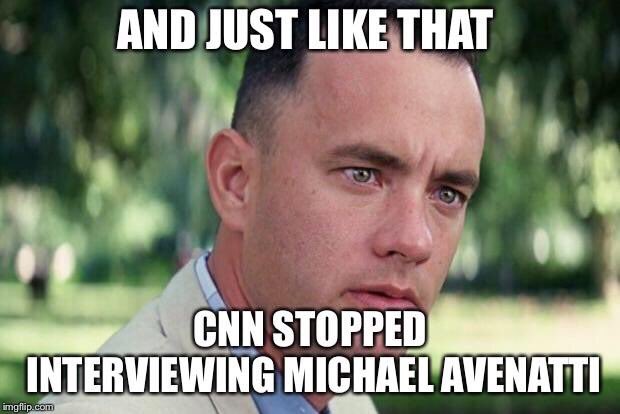
REMEMBER THIS GUY? I can’t help it…Hey: “Where’s your Messiah Now?”
CNN reporting that “Supreme Court turns away appeal from disgraced attorney Michael Avenatti.”
CNN not reporting that Avenatti appeared on a fawning CNN 108 times between March 7 and May 10, 2018.
There are some other gems out there they’d just love to dump down the memory hole:
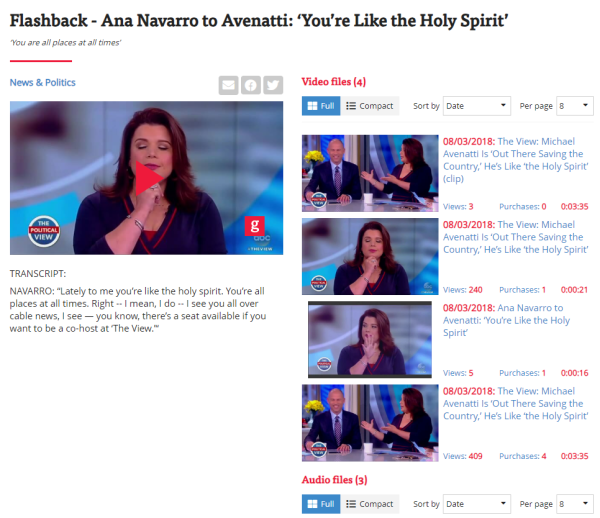
CNN forgot Chris Cuomo (he had his own problems) fawning all over Avenatti.
IT HAS AGED WELL: Revisiting Peter Thiel’s Prophetic 2016 RNC Speech.
Another major theme of Thiel’s 2016 remarks was what is referred to today as the “competency crisis” plaguing the U.S. government and a wide swath of American industries.
“Today our government is broken,” Thiel observed. “Our nuclear bases still use floppy disks. Our newest fighter jets can’t even fly in the rain. And it would be kind to say the government’s software works poorly, because much of the time it doesn’t even work at all. That is a staggering decline for the country that completed the Manhattan Project. We don’t accept such incompetence in Silicon Valley—and we must not accept it from our government.”
Following four years of hopeless incompetence from the Biden administration, Thiel’s comments likely resonate with most Americans even more so than they did eight years ago. From Biden’s disastrous withdrawal of American troops from Afghanistan, which resulted in the death of 13 U.S. servicemembers, to his creation of the worst border crisis in American history, to his galling mismanagement of the U.S. economy, it’s no wonder 65 percent of swing voters describe the Biden administration as a “failure” marked by ineptitude and decline.
The other 35% lied to pollsters — or themselves.
It was Ruddy and director Francis Ford Coppola’s decision to reach out to Marlon Brando to star as Don Vito Corleone, and the producer famously negotiated with the Italian-American Civil Rights League that led to the agreement that the words “mafia” and “cosa nostra” would not be uttered in The Godfather.
Al Pacino, who played Michael Corleone in the film for the first of his nine career Oscar nominations, said in a statement that Ruddy “was absolutely beautiful to me the whole time on The Godfather; even when they didn’t want me, he wanted me. He gave me the gift of encouragement when I needed it most, and I’ll never forget it.”
At the Dorothy Chandler Pavilion on March 27, 1973, Ruddy bounded up on the stage to accept the Academy Award for best picture. “The American dream and what we all want, for me at least, is represented by this [holding up the Oscar],” he said. “It’s there for everybody if we want to work, dream and try to get it.”
Clint Eastwood presented Ruddy with the statuette, and things came full circle when Ruddy offered Eastwood the opportunity to direct and star as the trainer in the boxing classic Million Dollar Baby (2004).
Paul Haggis had written the screenplay based on a pair of short stories from the collection Rope Burns by F.X. Toole. Anjelica Huston brought Toole’s work to Ruddy, who optioned it, but investors and talent didn’t see it as a movie — it seemed far too depressing.
“Who wants to do a movie about a girl boxer who dies with two old guys?” was the typical response Ruddy heard.
Well, Eastwood did; he came on as a producer, scored the film and then won the Oscar for directing. Meanwhile, Hilary Swank was named best actress and Morgan Freeman best supporting actor.
On the Paramount+ series The Offer, about the making of The Godfather, he was portrayed by Miles Teller. “It was an honor and a privilege to portray Al,” Teller said. “Al lived a life most could only dream of and all would envy.”
The Offer has some fun moments, and an enjoyable Mad Men-inspired production design. But it’s really a mini-series that was designed so that Ruddy could go out leaving the impression that everything that went right in The Godfather was as the result of his skill as a producer, and ends up leaving the actors playing Francis Ford Coppola and Mario Puzo as little more than comic relief. For a much better look at who did what on the film, as I wrote in 2022: ‘The Godfather’ at 50: Skip ‘The Offer,’ Take ‘The Cannoli.’
EVEN A FLATWORM IS SMART ENOUGH TO TURN AWAY FROM PAIN: Harvard won’t take official stance on controversial issues under new policy: No more ‘official statements about public matters that do not directly affect the university,’ president says.
Of course, these critics have a point:
Unexpectedly! https://t.co/rN8ZW1woAq
— Omri Ceren (@omriceren) May 28, 2024
GEORGE MF WASHINGTON HAS SOME GOOD ADVICE: Hollywood’s “Strong Empowered Girlboss” Fallacy.
If you’re an aspiring screenwriter, Hollywood is handing you a golden opportunity by ignoring well-drawn relatable female characters in favor of an endless series of unapproachable girlboss Mary Sues.
Go out and write yourself a Tess McGill, Leia Organa, Sarah Connor, Ellen Ripley, Marion Ravenwood, Lois Lane, Helen Tasker, Lindsey Brigham, Lenina Huxley or Joan Wilder.
The audience is waiting.
Audiences might have lost patience. Despite Furiosa not being a girlboss hero and the movie getting decent reviews (including from the Critical Drinker), “Furiosa: A Mad Max Saga” is tanking. Having “Mad Max” in the title without having any Mad Max is one problem, but girlboss exhaustion is another. The largely male audience for action flicks just doesn’t seem willing to risk getting burned again.
KRUISER’S MORNING BRIEFING: Democrats Are Bathing In Desperation and Flop-Sweat. “It’s odd that, with so many entertainment industry people in the bag for them, Democrats don’t understand the optics in situations like this. There should be someone involved in these decisions who can say, ‘Yeah, that’s a lousy idea.’ Maybe some famous actor.”
Related: Robert De Niro Remains the Poster Boy for ‘Just Shut Up and Sing.’