
WELL, THIS IS THE 21ST CENTURY, YOU KNOW: Virgin Galactic will fly you to space for the price of a house.
Author Archive: Glenn Reynolds
February 21, 2022
THEN: ONLY CONSPIRACY THEORISTS THINK MASKS ARE BAD FOR CHILDHOOD DEVELOPMENT.
NOW: CDC quietly lowers the bar for early childhood speech development. “For the first time in decades, the CDC has changed many of the recognized milestones for childhood development in terms of speech and cognitive functions. These markers are considered important in terms of recognizing when children aren’t progressing quickly enough, suggesting the potential need to determine if some sort of impairment is being observed and if the child may require greater medical attention. The curious thing about the changes instituted by the CDC is that in a majority of the cases, they have lowered the standards rather than raising them. . . . It’s hard to ignore the growing body of reports showing that childhood development has been suffering as a result of various COVID protocols, raging from ‘virtual learning’ environments to forcing children to wear face masks.”
POLICING FOR PROFIT: My colleague Penny White and I have a piece over at the Wall Street Journal based on our forthcoming law review artice on this subject.
Excerpt:
Everyone knows the speed trap: a sudden speed-limit drop, often poorly marked, with police waiting to pounce and local courts ready to assess fines for the local treasury. This has now gone mainstream, as communities large and small across the U.S. adopt policies that make citizens targets to be squeezed, not constituents to be protected.
This destructive exploitation is due in part to state and federal laws that allow jurisdictions—and sometimes law-enforcement agencies themselves—to keep the proceeds from fines, forfeitures and court costs. Fortunately, there is a simple fix.
In some places, police prey on citizens. In Brookside, Ala., as Birmingham News columnist John Archibald recently reported, from 2018 to 2020 “revenues from fines and forfeitures soared more than 640 percent and now make up half the city’s total income.”
So many tickets are issued that police have to direct traffic around the courthouse. Forfeitures—in which property is seized by police on suspicion of a crime, requiring the owner to prove his innocence in court to regain his property—are out of control. In 2020, taking advantage of its 1½ miles of Interstate 22, the town of about 1,250 residents had more misdemeanor arrests than residents. That year it collected $487 in traffic fine and forfeiture revenue for each resident, quite an achievement for a town with no traffic lights. Total town income more than doubled on proceeds from fines and forfeitures. Brookside’s police chief recently resigned under pressure from state lawmakers and the public. . . .
It is easy to see the appeal for government officials. Voters may punish politicians at the polls when taxes are raised to fund government, but when those same expenditures are funded by fines, forfeitures and court costs paid by those who “violate” the law, politicians face less risk. Some targets may be out-of-towners, but too often those targeted are poor and minority citizens who may be less likely to vote.
What is at risk, however, is the legitimacy of law enforcement. Policing for profit produces a predatory relationship between officers and citizens. Policing is no longer about protecting people, but about extracting money from them. This also promotes hostile interactions between police and citizens, which increases the likelihood of violence. The entire system winds up being corrupted. Can an accused person expect fair treatment when everyone in the system knows that its well-being depends on revenue from convictions?
The U.S. Supreme Court held in Tumey v. Ohio (1927) that when judicial officials profit directly from fines, defendants are denied due process. It also held, in Ward v. Village of Monroeville (1972), that if those administering the fines benefit indirectly from boosting municipal budgets, then due process is violated.
Two 2019 decisions from the Fifth U.S. Circuit Court of Appeals, Cain v. White and Caliste v. Cantrell, applied the due-process requirement that judges be entirely disinterested in the outcome. Noting that money from fines and fees went into a slush fund that covered judicial personnel and travel, the court held that judges’ knowledge that their day-to-day comfort depended on revenue from convictions was enough to bias them unacceptably, denying defendants the neutral decision makers to which they were entitled.
We agree. As municipalities’ and law enforcement’s reliance on revenue from fines, fees and forfeitures grows, the chance that defendants will get a fair shake falls. Judges are supposed to avoid even the appearance of impropriety, and relying on people targeted by law enforcement as a revenue source makes the entire process appear improper.
What to do? One would hope for greater judicial scrutiny, but the judiciary is part of the problem. Appellate courts and the U.S. Supreme Court should provide more supervision. So should state legislatures and Congress.
The solution is to send the money from fines, fees and forfeitures elsewhere. If that money went to a state’s general fund, municipalities would have no incentive to target people for extra revenue and could focus simply on public safety. Even if the state returned the money to municipalities based on a neutral formula, the incentive to engage in financially motivated law enforcement would vanish.
Instead of “defunding the police,” which is such a dumb idea even the Democrats are now pretending they never favored it, it’s more helpful to look at how the police are funded. Incentives matter.
21ST CENTURY MEDICINE: Once-taboo ketamine booms for US at-home mental care.
SHOCKING NEWS FROM THE WORLD OF SCIENCE: Most supplements touted for menopause aren’t effective, experts say.
THE LEFT’S DEMAND FOR RACIAL HATRED IN AMERICA FAR EXCEEDS THE SUPPLY: Another fake hate crime in California.
We’ve seen enough of these stories over the past several years to make them hardly worth mentioning, but the response to this incident by both the media and the Sacramento school district where it took place merits a closer look. The “hate crime” in question took place at C.K. McClatchy High School on February 11th. Someone spray-painted the words “colored” and “white” above a pair of drinking fountains at the school, suggesting racial segregation during the Jim Crow era. An investigation was immediately launched to determine who could have perpetrated such an outrageous, racist desecration of the school. Unfortunately for the perpetrator, the vandalism was caught on camera. And unfortunately for those who were loudly pointing to it as yet another example of racial intolerance in America, the graffiti had been applied by a female, Black teenage student who is not being named because she is a minor.
The first curious aspect of the story involves the fact that it took so long for a public announcement to be made. The school obviously had access to that video almost immediately and if it had been some white kid wearing a face mask who they couldn’t immediately identify, the calls would have been going out the same day seeking help in identifying the racist perpetrator. But they sat on the story for more than a week before finally admitting what had happened. (Assuming they actually did admit it, which we’ll get to in a moment.)
If it had been some random white boy, you don’t need me to tell you what the response from the school district and the media would have been. But since it was done by a Black teenage girl, district officials are simply describing it as “a prank that went sideways.”
Why are our public schools so racist?
NEWS FROM THE DUMPSTER FIRE THAT IS GEORGETOWN LAW SCHOOL: Georgetown Law Faculty And Students Debate Ilya Shapiro’s Fate.
A larger question is, if higher education has become an incubator of totalitarianism — and you can make a good argument that it has — why should society be funding it? There are other, cheaper, quite possibly better ways to educate people without producing the toxic social externalities that higher education increasingly seems to produce.
HIS WORST FAILURE, SO FAR. If Joe Biden Doesn’t Change Course, This Will Be His Worst Failure.
TODAY’S HIGHER EDUCATION ENVIRONMENT IN A NUTSHELL: Purdue professor worries campus mask-optional policy will give people ‘more freedom.’
If you want people to be less “combative” about “individual freedom,” stop trying to take it away from them.
SUNLIGHT IS THE BEST DISINFECTANT: Minnesota college cancels no-whites-allowed luncheon after College Fix report.
HIGHER EDUCATION AS POLICE STATE: GWU admits that it tracked student, employee locations on campus without consent.
TRUST THE SCIENCE! ALSO, YOU’RE NOT ALLOWED TO SEE THE SCIENCE, BECAUSE SCIENCE. The C.D.C. Isn’t Publishing Large Portions of the Covid Data It Collects: The agency has withheld critical data on boosters, hospitalizations and, until recently, wastewater analyses.
For more than a year, the Centers for Disease Control and Prevention has collected data on hospitalizations for Covid-19 in the United States and broken it down by age, race and vaccination status. But it has not made most of the information public.
When the C.D.C. published the first significant data on the effectiveness of boosters in adults younger than 65 two weeks ago, it left out the numbers for a huge portion of that population: 18- to 49-year-olds, the group least likely to benefit from extra shots, because the first two doses already left them well-protected.
The agency recently debuted a dashboard of wastewater data on its website that will be updated daily and might provide early signals of an oncoming surge of Covid cases. Some states and localities had been sharing wastewater information with the agency since the start of the pandemic, but it had never before released those findings.
Two full years into the pandemic, the agency leading the country’s response to the public health emergency has published only a tiny fraction of the data it has collected, several people familiar with the data said. . . . The performance of vaccines and boosters, particularly in younger adults, is among the most glaring omissions in data the C.D.C. has made public.
Plus: “Another reason is fear that the information might be misinterpreted, Ms. Nordlund said. . . . Concern about the misinterpretation of hospitalization data broken down by vaccination status is not unique to the C.D.C. On Thursday, public health officials in Scotland said they would stop releasing data on Covid hospitalizations and deaths by vaccination status because of similar fears that the figures would be misrepresented by anti-vaccine groups.”
AND IT WILL HAPPEN AS SOON AS OUR POLITICAL CLASS CAN MAKE IT HAPPEN: When Fascism Comes To America, It Will Look Like Justin Trudeau’s Canada.
Related:

SALENA ZITO: Mike Rowe scholarship highlights the lost virtues of hard work and sweat.
Rowe said in an interview that he was inspired to create the scholarship fund in the summer of 2008. “Dirty Jobs was a runaway hit, the country was entering a recession, unemployment was headline news,” he said. “But everywhere I went on Dirty Jobs, I saw ‘Help Wanted’ signs. It slowly dawned on me that high unemployment did not necessarily stem from a lack of opportunity. I remember being surprised to learn that 2.3 million jobs were open when the unemployment rate surpassed 10%.”
When a financial reporter at the Wall Street Journal asked his take on how such a skills gap could exist during times of high unemployment, Rowe shared his theory.
“Much of society had waged a war on work,” he said. “And I talked at length about the stigmas and stereotypes that surrounded many of the jobs we featured on the show, along with the myths and misperceptions that keep so many people from exploring a career in the trades.”
The reporter printed Rowe’s thoughts, word for word, and the next day, his phone started ringing off the hook. Companies and organizations wanted to partner with him to make a more persuasive case for the jobs in their industries.
“That’s what convinced me to do something; something to help the industries that had allowed me to get and keep Dirty Jobs on the air,” he said. “That led me to launch an informal PR campaign for unloved jobs that required skill, and not a four-year degree. I called it mikeroweWORKS and launched it on Labor Day of 2008.”
That led to an Online Trade Resource Center built by fans of the show — a job board of sorts for skilled trade workers.
“Today, we’re primarily a scholarship fund with an advocacy arm — which is me,” said Rowe.
Applicants must earn the scholarship, much like they would get a job through merit.
Is that even allowed?
WON’T HAPPEN WHILE OUR ESTABLISHMENT IS BOUGHT AND PAID FOR BY CHINA: British Conservative Calls for US Collaboration To Stomp Out China Threat.
SO WE KNOW WHO DONATED TO THE CANADIAN TRUCKERS, BUT NOT WHO GHISLAINE MAXWELL’S CUSTOMERS WERE.
Just saying.
K-12 IMPLOSION UPDATE: New York City parents pulling their children from public schools in record numbers.
TEACH WOMEN NOT TO RAPE! (CONT’D): Louisiana teacher pleads guilty to lacing students’ cupcakes with ex-husband’s sperm, other child sex crimes.
Related: Sealed Criminal Prosecution of Wealthy Connecticut Voyeur.
I GUESS PEOPLE HAVE FIGURED OUT WHICH SIDE YOU’RE ON: “A group representing Canadian journalists says it is shocked by the level of hatred, verbal harassment and physical confrontations some news reporters have experienced while covering protests against public-health measures cross the country.”
Identify with the oppressive regime, get treated like lackeys of the oppressive regime.
February 20, 2022
THE PARENTS’ — AND CITIZENS’ — REVOLT: FIRST SAN FRANCISCO, NEXT UP: LOS ANGELES? “Beyond another opportunity to go long on popcorn futures, this is a sign that traditional liberals in the Democratic Party may finally be rousing themselves to take back their party from the insane people in the faculty lounges and New York Times editorial page that have largely taken it over.”
Plus: “About Los Angeles ‘obtaining’ this donor information not yet public—I wonder if it was leaked deliberately as a signal to other Hollywood people that it’s okay to oppose crime.”

PUSHBACK: Evangeline Lilly Urges Justin Trudeau to Sit Down With Canadians Protesting Vaccine Mandates.
Plus: Freedom Convoy: Piers Morgan flames Justin Trudeau for ‘behaving like a fascist.’
UPDATE: Fight the Power:
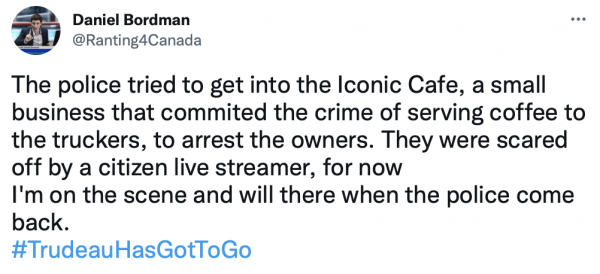
The whole world is watching.
Related:
Ottawa, brutality of Justin Trudeau's police toward a woman who wanted to have coffee. pic.twitter.com/LaDeLxiHaf
— RadioGenova (@RadioGenova) February 20, 2022
ANOTHER UPDATE: Ouch.
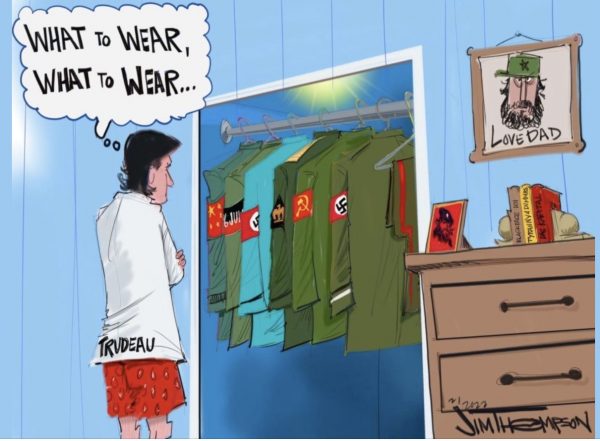
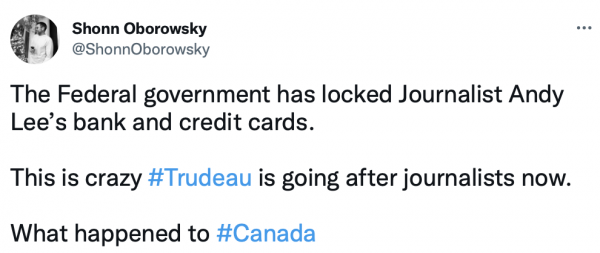
WALL STREET JOURNAL: Trudeau’s Destructive ‘Emergency:’ The truckers protest could have been handled without abusing the law.
Mr. Trudeau justifies the “public-order emergency” by inflating the protest into a terrorist plot to overthrow government. The Canadian Civil Liberties Association disagrees and sued Thursday. It says the standards for an emergency—“threat or use of acts of serious violence against persons or property” that “seriously endangers the lives, health or safety of Canadians” beyond “the capacity or authority of a province to deal with it”—are not met.
Protests aren’t emergencies, and Western leaders had better get used to handling civil disobedience firmly without traducing civil liberties. Mr. Trudeau criminalized a protest movement, deputizing financial institutions, without due process or liability, to find and freeze personal accounts of blockaders and anyone who helps them. These extraordinary measures are a needless abuse of power. . . .
Weak responses to civil disobedience have hurt Canada for years. New gas pipelines are increasingly stymied by blockades, often by green or aboriginal activists. On Thursday men wielding axes attacked a pipeline drill site and its workers in British Columbia. That’s worse than anything the truckers have done.
In early 2020 Mr. Trudeau urged dialogue with pipeline blockaders. Facing Black Lives Matter protests in violation of Covid rules in June 2020, Mr. Trudeau joined in. But with the truckers, the Prime Minister refused to meet or compromise. Even as province after province ends Covid restrictions, he drags his feet.
The establishment sees environmentalists and Black Lives Matter protesters, however violent, as essentially allies. It sees working-class protesters, however peaceful, as deadly enemies. Each group is treated accordingly.