
Archive for 2025
March 23, 2025
AT LEAST THEY’RE TEACHING THEM SOMETHING USEFUL: Brown University ‘SHAG’ group offers ‘sex-pertise’ for ‘Oral Sex Masterclass’ event.
ARRESTING POLITICAL OPPONENTS APPEARS TO BE THE DESPERATION-TACTIC-OF-CHOICE NOWADAYS:
Istanbul mayor İmamoğlu was arrested on the very day of the primary that would make official his candidacy for president. Crowds of unprecedented size are at the polls anyway. The scene shows citizens waiting to vote in Kadıköy, Asian side of Istanbul. https://t.co/tQih1IFShI
— Timur Kuran (@timurkuran) March 23, 2025
For six years, the Erdoğan regime dug for dirt on Istanbul mayor Ekrem İmamoğlu. It found none. But a panel of judges had him arrested anyway, based on hearsay from three anonymous witnesses. There’s a reason why Turkey ranks near the bottom of every global rule of law index. https://t.co/K9PYEhZZy1
— Timur Kuran (@timurkuran) March 23, 2025
Why is this not news all over the world, especially in America??
The Irish police have sent a file to the state prosecutor recommending charges of incitement to hatred against Conor McGregor.
The most blatant case of political policing we've ever seen! pic.twitter.com/j2KivxMOPS
— MichaeloKeeffe (@Mick_O_Keeffe) March 23, 2025
If you can’t get regime change via elections, you may get it via bloody revolution. If that happens, the people arresting opponents need to become ugly warnings to those who would so elsewhere.
LIMITED TIME DEAL: Alimens & Gentle Mens Solid Oxford Shirt. #CommissionEarned
GET WOKE, GO BROKE: ‘Revolt’: Dem Voters Turning on Their Leaders in Record Numbers, Polls Find.
IT’S ALL EXCUSE-MAKING AND MISDIRECTION:
One of the Swamp’s favorite debating tricks is to pretend that the only way to meaningfully reduce the deficit is to cut Social Security. No actually, you can go line by line through the budget and cut the waste, fraud and abuse. It all adds up. https://t.co/17CZQKbuRP
— David Sacks (@DavidSacks) March 22, 2025
What normal people call waste, fraud, and abuse, the ruling class calls its livelihood.
A NEW, GUN-FRIENDLY ATF? Rarely Has the Phrase ‘Elections Have Consequences’ Been More Clearly Illustrated.
March 22, 2025
HISTORY:
3 years ago today: Ketanji Brown Jackson at her confirmation hearing claims to be an originalist, says she is unfamiliar with RBG's VMI ruling, and can't say what a woman is.
— Ed Whelan (@EdWhelanEPPC) March 22, 2025
OPEN THREAD: Party on, dudes and dudettes.
YOU NEVER CALL, YOU NEVER WRITE: Next month NASA’s Lucy probe will visit an asteroid that’s been waiting 150 million years to say hello.
IS THERE ANYTHING THESE DRUGS CAN’T DO? Weight Loss Drug Semaglutide Shows Promise as Alzheimer’s Treatment.
REASON MAGAZINE’S PETER SUDERMAN: Forget Woke Snow White. Disney’s Remake Is More Like Socialist Snow White.
[Snow White] is indeed a trainwreck. The problem isn’t that it’s woke. It’s that it’s awful—and lamely, bluntly socialist.
The remake’s big idea was to twist the idea of the word “fair.” See, in earlier versions of Snow White, an evil queen asks a magic mirror, “Who is the fairest of them all?” It’s always the queen, until one day the mirror responds that it’s actually her stepdaughter, the Princess Snow White. The question, “who is the fairest,” in other words, has always been a question about beauty. But in the remake, there’s something else going on. The movie goes to great lengths to demonstrate that the queen isn’t fair because she’s not a socialist. I am not kidding.
The film doesn’t quite use that word. But early in the film, Snow White encounters a handsome thief named Jonathan in the castle. Jonathan is the leader of a group of bandits who live in the woods and survive by stealing food. He feels justified in stealing because he and other ordinary people have very little while the queen has a lot and she won’t share.
This isn’t just a generic lesson in being kind. Later, after Snow White takes up with seven computer-animated dwarfs in the forest, one of the dwarfs explains that the bandits in the woods are “only there because of the queen’s greedy economic policies, which forced them there into a liminal space where ethics are harder to define.” This might not be a precise word-for-word quote—the line gets spat out so fast I am not certain I transcribed it exactly right—but it’s pretty close. This is a movie about how stealing is justified because of the evil queen’s economic policies. She’s not fair, you see, because her privilege and selfishness have impoverished ordinary people. It’s Snow White by way of Occupy Wall Street.
And now we know why Disney cast arguably Hollywood’s most prominent Jewish actress in the role of the Evil Queen. Or as Jim Treacher tweeted:
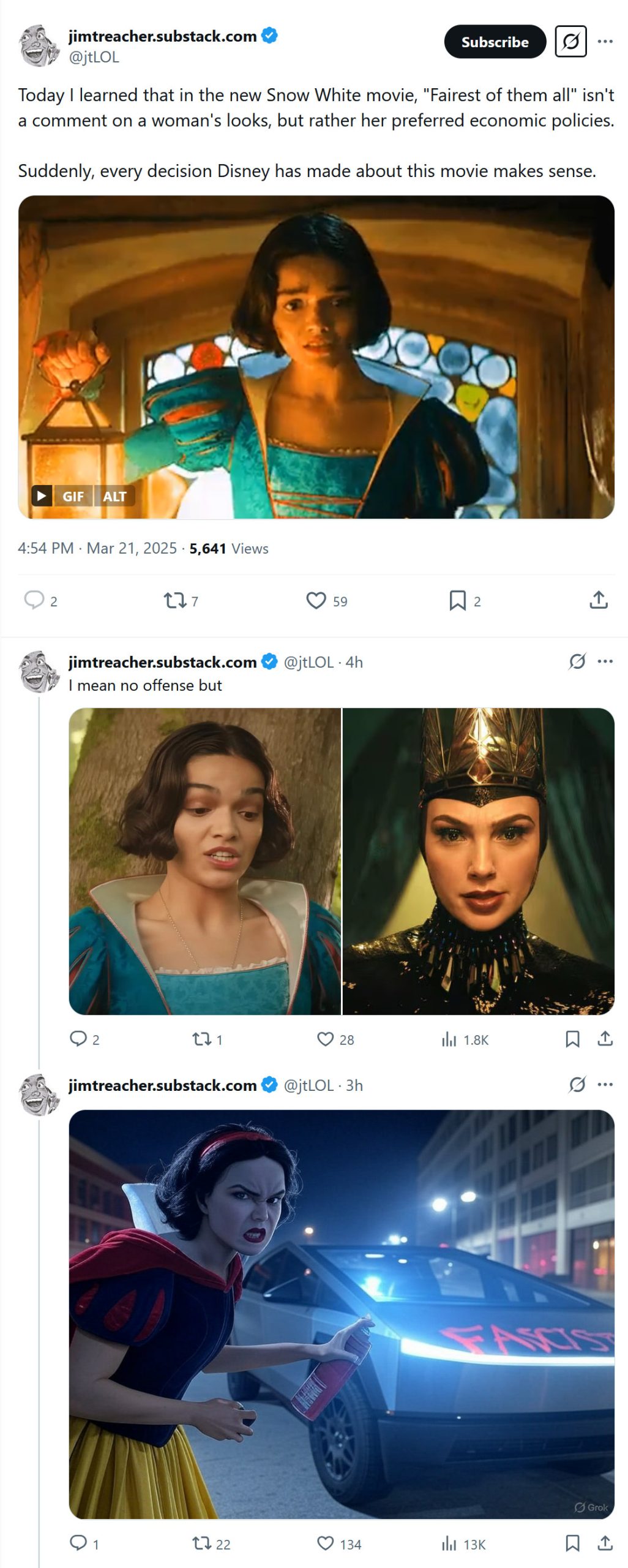
Though to be fair, between Zegler’s hatred of Israel, and the casting of Gadot as the capitalist Evil Queen its all pretty on-brand for Disney:
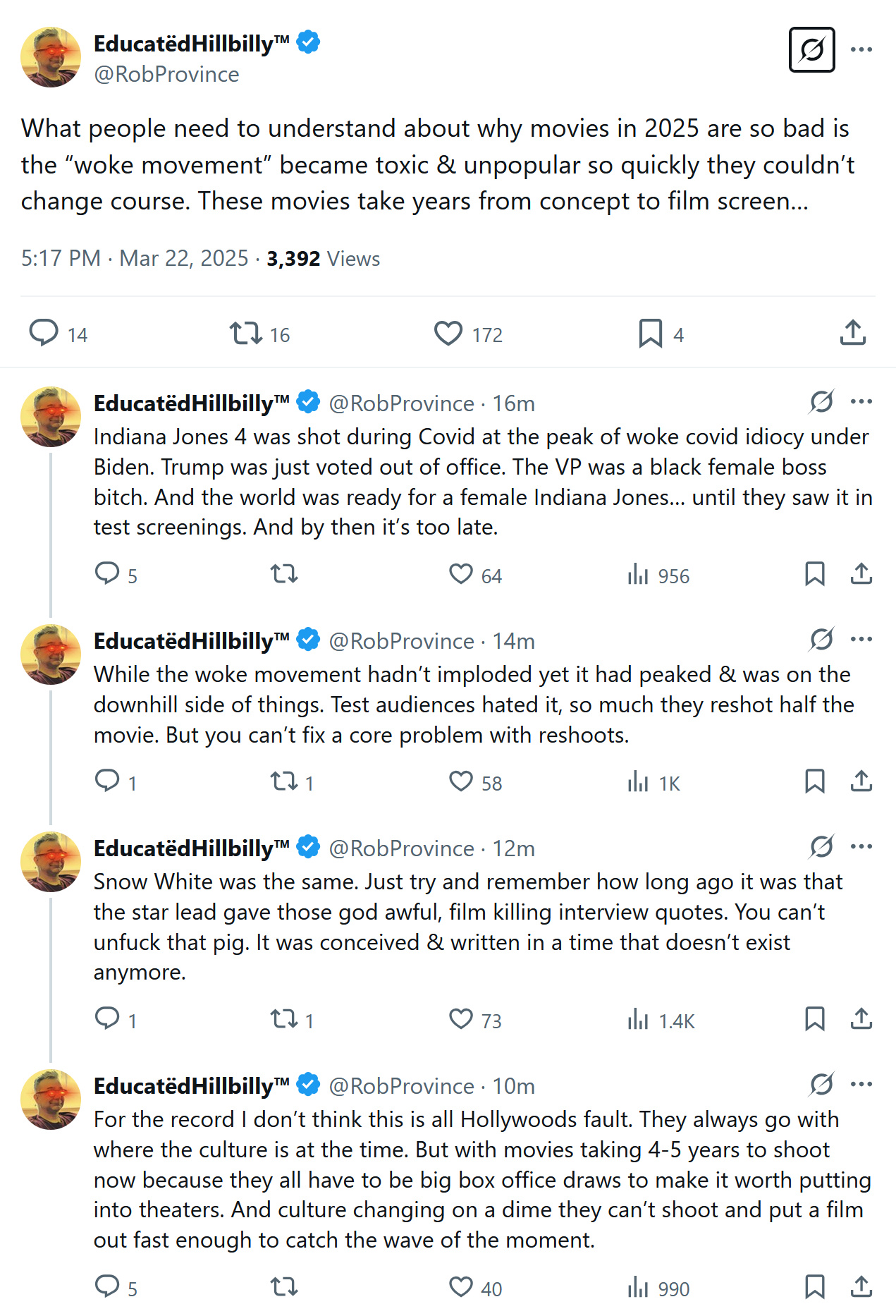
The slow speed it takes both to produce individual movies and for Hollywood to jump on new trends has long bedeviled the industry. One of the themes of Peter Biskind’s classic Easy Riders, Raging Bulls look at how the Young Turks such as Francis Ford Coppola, Martin Scorsese, John Milius and ultimately George Lucas and Steven Spielberg got their feet in the door is that in the mid-to-late 1960s, the aging original Hollywood moguls were all in a doomed quest for a repeat of the mammoth box office of 1965’s The Sound of Music, even as audiences were growing increasingly sour on traditional musicals. When Antonioni’s Blowup, Arthur Penn’s Bonnie and Clyde and Stanley Kubrick’s 2001: A Space Odyssey became surprise hits, the old moguls scrambled to find people who had some clue what those crazy “young people” in the audience wanted to see. (The trend would repeat starting in 1977, when now-corporate-dominated Hollywood was caught completely flat-footed by film that had unexpectedly massive legs: Star Wars.)
But moviegoing was still an ingrained habit in a world before VCRs, let alone streaming. In 2025, there will be lots more woke-era product dumped out by studios. But what comes next in an industry full of TDS, in thrall to the CCP, and conversely, a loathing of flyover country — but not their cash?
JOE NOCERA: The Luxurious Death Rattle of the Great American Magazine.
When he became the editor of Vanity Fair in 1992, [Graydon] Carter could have put a stop to the spending culture he inherited from his predecessor, Tina Brown. That would have made the magazine much more profitable. (David Remnick did exactly that when he replaced Brown as editor of The New Yorker in 1998, turning a money-losing magazine into a profitable one.) But Carter liked the lifestyle too much to let go of it. He liked flying on the Concorde when he went to Europe (round-trip ticket: $12,000). He liked having two assistants instead of one. He liked having his own personal driver, and he liked presiding over Vanity Fair’s uber-expensive Oscar party.
And so, Carter set the tone. “At Vanity Fair in those early days, anyone on the editorial floor could take out pretty much any amount of reasonable cash just by signing a chit,” he writes. “Flowers went to contributors at an astounding rate, sometimes just for turning a story in on time.”
He cites approvingly how his deputy, Aimée Bell, gamed expense accounting at Condé Nast: “She figured out early that the accountants budgeted your expenses based on what you spent the previous year,” he writes. “That meant that what you needed to do was set a high bar early and build on a large amount of expenses.”
He adds: “And I was fine with that.”
“This, in its essence, was Vanity Fair.”
Of course, Vanity Fair spent money on journalism, too—gobs of it.
He paid Dominick Dunne $500,000 a year to cover the O.J. Simpson and the Menendez brothers trials, “plus generous expenses and months of free and continuous accommodation at the Chateau Marmont or the Beverly Hills Hotel.” He recruited Michael Lewis and a half dozen other brand-name writers who were paid at least as much. He even proudly recounts the time Vanity Fair pursued a major story about Lloyd’s of London, the insurance company, “which may have been the most expensive per word magazine story ever written.” And it never ran! To hear Carter tell it, this is what you had to do: To get the best stories, you needed the best writers, and to get them and their stories, you had to spend lots and lots of money.
After five years working for Art Cooper, I moved to Time Inc.’s business magazine, Fortune. For the first half of my tenure, the good times rolled. Because Time Inc. was a public company, the editors were more conscious of profits than Condé Nast editors, but we flew business class, had staff retreats in the Virgin Islands, and sometimes spent months reporting stories, without thinking too much about it. Unfortunately, the other thing we weren’t thinking about was the prospect that the internet was about to eat our lunch.

In a non-paywalled article from 2009, John Podhoretz talked about his salad days at Time magazine in the 1980s as if it were something out of the Court of Versailles:
Time Inc., the parent company of Time, was flush then. Very, very, very flush. So flush that the first week I was there, the World section had a farewell lunch for a writer who was being sent to Paris to serve as bureau chief…at Lutece, the most expensive restaurant in Manhattan, for 50 people.So flush that if you stayed past 8, you could take a limousine home…and take it anywhere, including to the Hamptons if you had weekend plans there. So flush that if a writer who lived, say, in suburban Connecticut, stayed late writing his article that week, he could stay in town at a hotel of his choice. So flush that, when I turned in an expense account covering my first month with a $32 charge on it for two books I’d bought for research purposes, my boss closed her office door and told me never to submit a report asking for less than $300 back, because it would make everybody else look bad. So flush when its editor-in-chief, the late Henry Grunwald, went to visit the facilities of a new publication called TV Cable Week that was based in White Plains, a 40 minute drive from the Time Life Building, he arrived by helicopter—and when he grew bored by the tour, he said to his aide, “Get me my helicopter.”
The pre-Web era of mass media also allowed old media to be bottle up a story rather tightly. The dismantling of the Condé Nast empire, and other slick glossy magazines has implications beyond merely fashion, as Lee Smith wrote in his perceptive October 2017 article on the fall of Harvey Weinstein, “The Human Stain:”
A friend reminds me that there was a period when Miramax bought the rights to every big story published in magazines throughout the city. Why mess with Weinstein when that big new female star you’re trying to wrangle for the June cover is headlining a Miramax release? Do you think that glossy magazine editor who threw the swankiest Oscar party in Hollywood was trying to “nail down” the Weinstein story? Right, just like the hundreds of journalists who were ferried across the river for the big party at the Statue of Liberty to celebrate the premiere of Talk—they were all there sipping champagne and sniffing coke with models in order to “nail down” the story about how their host was a rapist.
That’s why the story about Harvey Weinstein finally broke now. It’s because the media industry that once protected him has collapsed. The magazines that used to publish the stories Miramax optioned can’t afford to pay for the kind of reporting and storytelling that translates into screenplays. They’re broke because Facebook and Google have swallowed all the digital advertising money that was supposed to save the press as print advertising continued to tank.
Look at Vanity Fair, basically the in-house Miramax organ that Tina failed to make Talk: Condé Nast demanded massive staff cuts from Graydon Carter and he quit. He knows they’re going to turn his aspirational bible into a blog, a fate likely shared by most (if not all) of the Condé Nast books.
Si Newhouse, magazine publishing’s last Medici, died last week, and who knows what will happen to Condé now. There are no more journalists; there are just bloggers scrounging for the crumbs Silicon Valley leaves them. Who’s going to make a movie out of a Vox column? So what does anyone in today’s media ecosystem owe Harvey Weinstein? And besides, it’s good story, right? “Downfall of a media Mogul.” Maybe there’s even a movie in it.
At the Yale Review this month, Bryan Burrough also writes about “Vanity Fair’s Heyday: I was once paid six figures to write an article—now what?”
Without straining, Graydon nicely positions his Vanity Fair in the flows of its day. Its ethos and popularity in the 1990s and 2000s were a sort of coda to the “New Journalism” perfected by Esquire during the 1960s and 1970s, when writers like Tom Wolfe and Gay Talese produced long, probing articles and in-depth profiles. Their style of writing went beyond the staid reporting and hard facts that readers had come to expect in print. Instead, they imbued their pieces with the stuff of novels: immersive stories, lyrical writing, vibrant descriptions, pacing on a par with the best propulsive fiction.
Vanity Fair embraced New Journalism, but as Graydon puts it in his book, it also “had an asset that no other magazine had in Annie Leibovitz. Annie was already a legend, a photographic visionary of huge gifts.” Leibovitz pushed the boundaries of what made a newsstand cover, from the arresting group photography showcased on Vanity Fair’s annual Hollywood Issue to its iconic image of a pregnant Demi Moore. The magazine mattered, especially in Hollywood and New York.
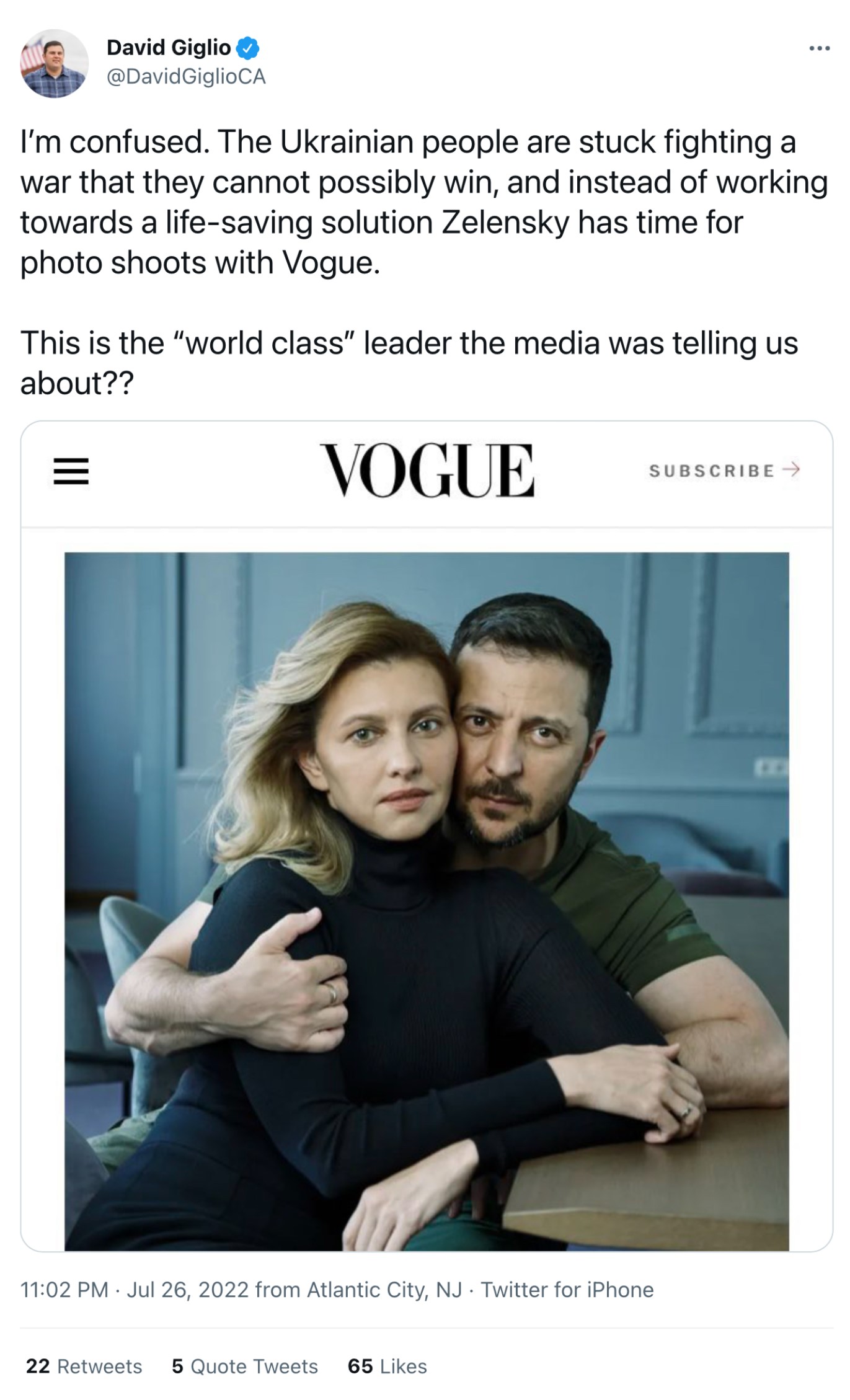
In more recent years, after her glamorous photoshoots led to the death knell of Robert “Beto” O’Rourke’s presidential bid and caused many in America to question Volodymyr Zelensky’s seriousness, Iowahawk quipped, “Whom the gods would destroy they first make pose for Annie Leibovitz.”
LIGHTEN IT UP: Guess Who Wants to Rename the Department of Defense?.
THESE SPECIALTY CARS ARE SO MUCH BETTER THAN THE STUFF GM SELLS GENERALLY: Tested! The 2025 Cadillac CT5-V Blackwing Precision Package Is Bombastic, Tracktastic, and Fantastic.
WORST. HITLER. EVER:
The term “constitutional crisis” has been so abused and overused it is losing all meaning. https://t.co/kPad3rzqBi pic.twitter.com/2FVysBIzvc
— Jed Rubenfeld (@Jed_Rubenfeld) March 22, 2025
SAVAGE:
🚨 YIKES! MIC DROP from SecDef Pete Hegseth in reply to a judge who decided to overrule Trump’s ban on transgenders in the military.
“Since ‘Judge’ Reyes is now a top military planner, she/they can report to Fort Benning at 0600 to instruct our Army Rangers on how to execute… https://t.co/MLSPNe0oRS pic.twitter.com/oADZwG8P5R
— Eric Daugherty (@EricLDaugh) March 22, 2025
READER FAVORITE: NEXPOW Portable Jump Starter. #CommissionEarned
THE CRITICAL DRINKER: Snow White — It’s Even Worse Than I Expected.
THE INSTADAUGHTER HAS SOME TURKISH FRIENDS AND WE WERE TALKING ABOUT THIS:
It’s amazing that US legacy media are still treating the Turkish protests as minor news. The Erdoğan Era, which began in 2003, has seen nothing like it, and the showdown is about to get ugly. A regime change in Turkey could shake the Middle East and improve Turkey-EC relations. https://t.co/GwGPfzoQwx
— Timur Kuran (@timurkuran) March 22, 2025