
Archive for 2023
March 6, 2023
TO HEAR MY 17-YEAR-OLD TELL IT, IT ALREADY IS: College Should Be More Like Prison.
Never have I been more grateful to teach where I do: at a men’s maximum-security prison. My students there, enrolled in a for-credit college program, provide a sharp contrast with contemporary undergraduates. These men are highly motivated and hard-working. They tend to read each assignment two or three times before coming to class and take notes as well. Some of them have been incarcerated for 20 or 30 years and have been reading books all that time. They would hold their own in any graduate seminar. That they have had rough experiences out in the real world means they are less liable to fall prey to facile ideologies. A large proportion of them are black and Latino, and while they may not like David Hume’s or Thomas Jefferson’s ideas on race, they want to read those authors anyway. They want, in short, to be a part of the centuries-long conversation that makes up our civilization. The classes are often the most interesting part of these men’s prison lives. In some cases, they are the only interesting part.
Best of all from my selfish point of view as an educator, these students have no access to cellphones or the internet. Cyber-cheating, even assuming they wanted to indulge in it, is impossible. But more important, they have retained their attention spans, while those of modern college students have been destroyed by their dependence on smartphones. My friends who teach at Harvard tell me administrators have advised them to change topics or activities several times in each class meeting because the students simply can’t focus for that long.
My students at the prison sit through a 2½-hour class without any loss of focus. They don’t yawn or take bathroom breaks. I have taught classes on the Enlightenment, the Renaissance, Romanticism, George Orwell, South Asian fiction. We’ve done seminars on Adam Smith and Alexis de Tocqueville. Together we have read Montaigne, Rousseau, Keats, Erasmus, Locke, Montesquieu, Wollstonecraft, Byron, Goethe, Petrarch, Rabelais, Saadat Hasan Manto, Rohinton Mistry. The students write essays in longhand; during the pandemic I taught a correspondence class via snail mail. Some of them do read “Middlemarch,” and their teacher finds the experience far more gratifying than trying to land a 747 on a rural airstrip.
High standards mean a lot — and do read the whole thing.
NOVAK DJOKOVIC FORCED TO WITHDRAW FROM INDIAN WELLS AS BIDEN ADMINISTRATION CONTINUES TO BE DETACHED FROM REALITY: “Meanwhile, over 2.76 million undocumented immigrants illegally entered the country at the southern border in 2022. This means that roughly 7,500 illegal immigrants entered the United States every day last year, and the U.S. government does not care about their vaccination status.”
AFTER BANNING GMO CROPS, TIME TO RETHINK: As Kenya’s crops fail, a fight over GMO rages. But NGOs are fighting this, because of course.
Flashback: In Sri Lanka, Organic Farming Went Catastrophically Wrong.
Plus: Sri Lanka Is the Future the Global Elites Want for Everyone.
Also: Looming food shortages is the next ‘slow-moving disaster’ to hit world.
BYRON YORK: The Peter (Buttigieg) Principle.
The Peter Principle suggests that Peter Buttigieg, at just 41 years of age, has already risen to his level of incompetence. It’s fair to say many national Democrats did not expect a rising star to peak so soon, and Buttigieg himself certainly did not. But moving up has its risks, and unfortunately for himself and for the nation, Buttigieg has found a job he cannot do.
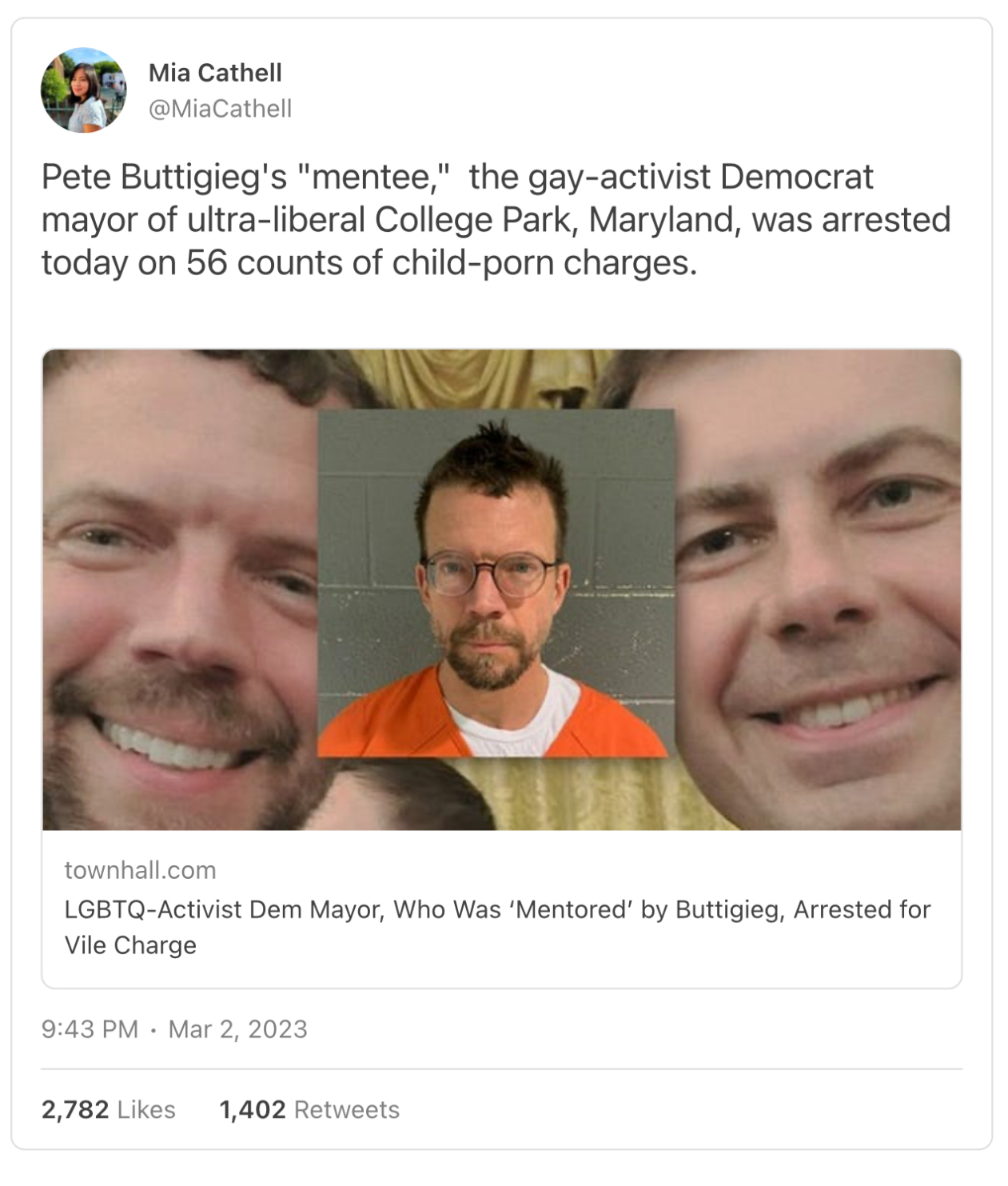
Jim Treacher spots another story that isn’t helpful for Buttigieg‘s narrative, though this already being tossed down the memory hole: Democrat Mayor Arrested for Child Porn Is Pals with Mayor Pete. So he’s also a Pete-ophile.
[On Thursday] Patrick Wojahn, the mayor of College Park, Maryland, was arrested on 56 counts of child pornography. And you know how you can tell he’s a Democrat? Because his political affiliation isn’t in any of the headlines. Hell, it isn’t even in most of the “news” stories. The journos all want this to go away very quickly. They’ll report that it happened, but they don’t want to tell you how it reflects on their team.
And it certainly doesn’t reflect well:
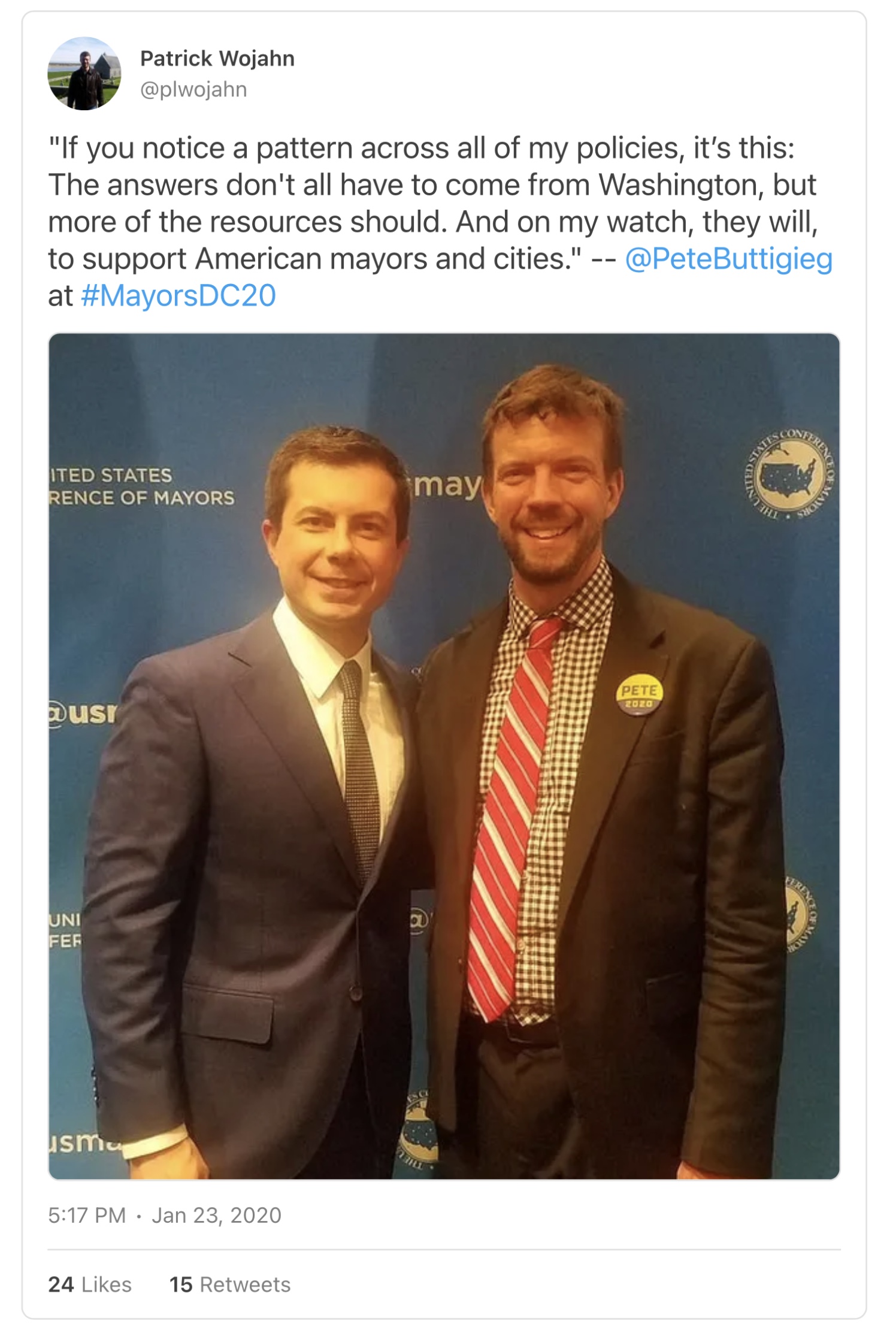
According to Wojahn’s own social media, he and Buttigieg are pretty, um, tight:
But the real question is, how are the above stories playing out in Buttigieg World?
Out of Politico last week came news that the global village’s Mayor Pete isn’t happy with the heat he’s been taking over the train derailment in East Palestine, Ohio. “Pete Buttigieg has taken a lot of bullets for the president on this,” an anonymous senior Democrat grumbled of the transportation secretary. That quote came in an article bearing the headline: “Buttigieg world frustrated at GOP attacks over train wreck.”
All of which raises a question: Buttigieg world? Is there a Buttigieg world now? I understand the use of the term Clinton world, given that the Clintons have accumulated so many clients and hangers-on as to constitute their own Central American-style cartel economy. Likewise Trump world, which is currently on a planetary collision course with DeSantis world.
But Buttigieg world? Other than Pete, his husband, and the Southwest Airlines listserv that notifies you your flight has been canceled, who actually lives there?
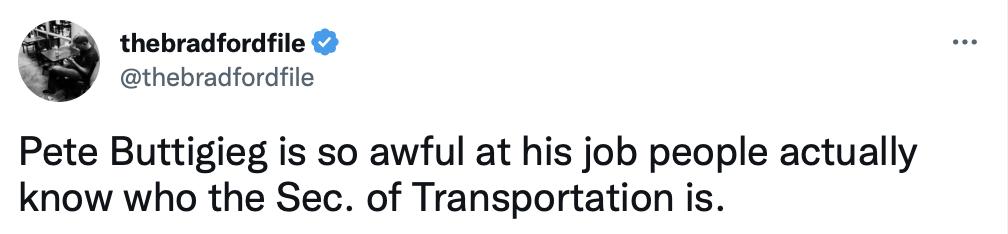
Well, everyone in the DNC-MSM, who spent much of 2021 and 2022 running puff pieces on how empathetic and swell Buttigieg is, even the supply chain was collapsing, inflation was skyrocketing, and trains were derailing, leading to this brilliant observation:
IS THIS A PREVIEW OF 2028 OR 2024? DeSantis Trashes Gavin Newsom on His Home Turf.
RIP: Gary Rossington, original Lynyrd Skynyrd guitarist, dead at 71.
No word yet if Skynyrd will be cancelling their upcoming “Sharp Dressed Simple Man Tour” alongside ZZ Top.
SO THEY’RE SHUTTING DOWN THE CDC? 50 U.S. medical, science organizations launch group to fight health misinformation. “Alarmed by the increasing spread of medical misinformation, 50 U.S. medical and science organizations have announced the formation of a new group that aims to debunk fake health news. Called the Coalition for Trust in Health & Science, the group brings together reputable associations representing American academics, researchers, scientists, doctors, nurses, pharmacists, drug and insurance companies, consumer advocates, public health professionals and even medical ethicists.”
Color me skeptical. You want to restore trust in health and science? Show yourselves trustworthy. This seems to have more to do with messaging, and probably censorship.
Related: Researchers: Misinformation’s Prevalence and Impact Wildly Overstated. Follow the science!
The first set of misconceptions concerns the prevalence and circulation of misinformation. First, scientists focus on social media because it is methodologically convenient, but misinformation is not just a social media problem. Second, the internet is not rife with misinformation or news, but with memes and entertaining content. Third, falsehoods do not spread faster than the truth; how we define (mis)information influences our results and their practical implications. The second set of misconceptions concerns the impact and the reception of misinformation. Fourth, people do not believe everything they see on the internet: the sheer volume of engagement should not be conflated with belief. Fifth, people are more likely to be uninformed than misinformed; surveys overestimate misperceptions and say little about the causal influence of misinformation. Sixth, the influence of misinformation on people’s behavior is overblown as misinformation often “preaches to the choir.” To appropriately understand and fight misinformation, future research needs to address these challenges.
Contrary to the opinion of the ruling class and the media — but I repeat myself — contrary opinions or uncomfortable facts are not “misinformation.”
THIS IS CNN: Credibility crisis: CNN boss ordered staff not to chase down COVID lab leak theory as pandemic unfolded. Then-CNN president Jeff Zucker considered the lab-leak theory a ‘Trump talking point,’ according to an insider.
Related: When it comes to COVID’s origin, maybe Stephen Colbert should stay in his lane.
MUSEUM PIECES [VIP]: Russia Pulling 60-Year-Old T-62 Tanks Out of Storage for Frontline Combat. “It’s unknown how many of Russia’s thousands of mothballed T-64s could be made serviceable again. But if Moscow is now hitting their even older inventory of retired T-62s, it’s easier to believe Kyiv’s claims of exceedingly high combat losses of armored vehicles.”
Don’t forget that VODKAPUNDIT promo code if you’ve been thinking of joining us.
DEAL OF THE DAY: HOMCA Cervical Memory Foam Pillows. #CommissionEarned (Bumped)
I’M SURE THAT CLOSING PUBLIC PARKS AND LOCKING PEOPLE IN THEIR HOMES HELPED: Diabetes and obesity rising in young Americans, study finds.
TRADITION IS THE NEW SUBVERSION: I Use Painting To Challenge The Left’s Vise-Grip On The Art World.
JIM TREACHER IS TAKING THE BOEING: “Goodbye forever, suckers! Just kidding. But seriously, as of next week I really will be writing part-time for Gutfeld!, the only late-night show with the punctuation built right in. Last year I gave G̶r̶e̶g̶ Mr. Gutfeld a free subscription to this newsletter, and he likes it so much that he’s hiring me. Finally, I’ll get back that 50 bucks he owes me!”
(Classical reference in headline.)
UPDATE (FROM GLENN): Actually, “take the Boeing” goes back when Mickey Kaus signed on with Slate, and I reported: “How much money is Kaus getting? I don’t know, but he offered to ‘send the Boeing’for me the next time I travel to L.A.” This turned into the phrase “take the Boeing” to describe media/blogger acquisitions a bit later.
ICYMI: ME ON SUBSTACK: How I Was Wrong About Covid. With a notation that Charlie Martin and Sarah Hoyt were right all along.
If you like it, please subscribe. (Bumped).
BECAUSE THEY ARE? Freddie DeBoer: Why Do So Many Elites Feel Like Losers?
The concept of “elite overproduction” has attracted a lot of attention in the past several years, and it’s not hard to see why. Most associated with Peter Turchin, a researcher who has attempted to develop models that describe and predict the flow of history, elite overproduction refers to periods during which societies generate more members of elite classes than the society can grant elite privileges. Turchin argues that these periods often produce social unrest, as the resentful elites jostle for the advantages to which they believe they’re entitled.
Consider societies in which aristocrats enjoy feudal privileges over land and are afforded influence in government. These sorts of dynastic privileges have been common in world history. Now imagine that over time, the number of people in this class has grown; more and more children of aristocrats means there are more and more people who hold aristocratic status. This creates a math problem: there’s only so much land to divide up and only so many people that can meaningfully guide government. The elites who have been denied their advantaged position in society, sometimes a literal birthright, will often respond to this denial with political and social unrest, and sometimes with violence.
Elite overproduction has been on my mind because of a condition that, I find, grows more acute over time: the sense that many people, particularly the college-educated and the financially secure, are deeply unsatisfied with their status in society. It’s impossible to quantify these feelings, but I think many would agree with me about a pervasive sense of discontent among people who have elite aspirations and who feel that their years toiling in our meritocratic systems entitles them to fulfill those aspirations. Recent political upheaval has given voice to this unhappiness. I personally am a supporter of a new economic system and the socialist movements that began with Occupy Wall Street. But I also recognize the influence of elite overproduction in those movements; an essential part of their genesis was when graduates of top colleges found themselves unable to get the jobs they thought they deserved after the financial crisis. That anger has only spread and intensified since.
Is it “impostor syndrome” if you really are an impostor? Because many of our elites are, to judge by performance.
Or maybe it’s that people succeed in the early phases of life but can’t stay on top as they advance. We kind of see this in law school, where our students come in having been at the top ten percent of their college class — but only ten percent of them can be in the top ten percent of their law class.
Regarding Occupy Wall Street, Kenneth Anderson had some thoughts on this quite a while ago:
In social theory, OWS is best understood not as a populist movement against the bankers, but instead as the breakdown of the New Class into its two increasingly disconnected parts. The upper tier, the bankers-government bankers-super credentialed elites. But also the lower tier, those who saw themselves entitled to a white collar job in the Virtue Industries of government and non-profits — the helping professions, the culture industry, the virtueocracies, the industries of therapeutic social control, as Christopher Lasch pointed out in his final book, The Revolt of the Elites. The two tiers of the New Class have always had different sources of rents, however. . . . The OWS protestors are a revolt — a shrill, cri-de-coeur wail at the betrayal of class solidarity — of the lower tier New Class against the upper tier New Class. It was, after all, the upper tier New Class, the private-public finance consortium, that created the student loan business and inflated the bubble in which these lower tier would-be professionals borrowed the money. It’s a securitization machine, not so very different from the subprime mortgage machine. The asset bubble pops, but the upper tier New Class, having insulated itself and, as with subprime, having taken its cut upfront and passed the risk along, is still doing pretty well. It’s not populism versus the bankers so much as internecine warfare between two tiers of elites. The downward mobility is real, however, in both income and status. The Cal graduate started out wanting to do ‘sustainable conservation.’ She is now engaged in something closer to subsistence farming.
It’s easy to have a comfortable life now, but people have been raised to crave distinction.
People didn’t used to do that. My mother tells about how she and a friend were primping for a college beauty contest and telling each other they were ready for Miss America. Her mother stuck her head in the door and said, essentially, don’t get your hopes up. You’re pretty, but you’re not that pretty. Bringing kids back to earth was considered good parenting back then, but now it’s considered dream-crushing. No surprise that many people have unfulfilled expectations.
It’s probably made worse now that our elite class is so uniform, meaning that people are comparing themselves with a larger set of competitors. You can’t be a big fish in a small pond if it’s the same big pond for all of your peers.
AT ONE LEVEL HE’S TALKING HIS BOOK, BUT AT ANOTHER HE’S PROBABLY RIGHT: Electromagnetic pulse expert warns EMP is biggest danger to America.
WELL, THAT’S NOT AN ACCIDENT, THAT’S THE GOAL: Critical Race Theory Teaches Kids To Hate Each Other, And The Proof Is On The Playground. “When people with authority, such as schoolteachers and administrators, tell children that one group is the oppressor and the other is oppressed, children tend to listen. These critical race theory lessons are fostering anger and aggression instead of empathy among children.”
Again, that’s the goal.
See also, Ron Jones’ Third Wave experiment. “By the end of the third day I was exhausted. I was tearing apart. The balance between role playing and directed behavior became indistinguishable. Many of the students were completely into being Third Wave Members. They demanded strict obedience of the rules from other students and bullied those that took the experiment lightly. Others simply sunk into the activity and took self assigned roles.” But it gets worse:
“You thought that you were the elect. That you were better than those outside this room. You bargained your freedom for the comfort of discipline and superiority. You chose to accept that group’s will and the big lie over your own conviction. Oh, you think to yourself that you were just going along for the fun. That you could extricate yourself at any moment. But where were you heading? How far would you have gone? Let me show you your future. . . . If our enactment of the Fascist mentality is complete not one of you will ever admit to being at this final Third Wave rally. Like the Germans, you will have trouble admitting to yourself that you come this far. You will not allow your friends and parents to know that you were willing to give up individual freedom and power for the dictates of order and unseen leaders. You can’t admit to being manipulated. Being a follower. To accepting the Third Wave as a way of life. You won’t admit to participating in this madness. You will keep this day and this rally a secret. It’s a secret I shall share with you.”
MICHAEL WALSH: In Praise of ‘Toxic Masculinity.’
In this case, it’s called ‘toxic’ because it makes the two unmasculine men talking about it feel inadequate, which in fact they are.
BIDENOMICS: Housing affordability hits historic low.
Fewer than a quarter of homes listed for sale nationwide qualified as affordable for the typical U.S. household, according to a new report shared exclusively with The Hill.
The report, released Friday by real estate brokerage Redfin, found that the number of affordable listings in 2022 fell by more than half from the previous year — the largest annual drop on the company’s record dating back to 2013.
Redfin analyzed home listings in the nation’s 100 most populous metros, marking a listing as affordable if its estimated monthly mortgage payment did not exceed 30 percent of the local county’s median income.
“Housing affordability is at the lowest level in history, which is widening the wealth gap—especially between generations,” said Redfin deputy chief economist Taylor Marr.
“Many millennials were able to buy homes before or during the pandemic homebuying boom, but many others were priced out of homeownership and forced to keep renting,” Marr added.
Previously: Why Team Biden might be purposefully grinding down the middle class.
SO IT EVER WAS: How Does A Leftist Hero Become A Villain? Oppose the Regime.