
OUT: EVs. IN: EREVs. “What’s EREV mean? It stands for extended-range electric vehicle, and it’s distinct from the plug-in hybrids Hyundai and others more commonly offer. As the name implies, it’s an EV, with a decent-sized battery powering electric motors that in turn propel the car down the road. The whole range-extender part comes in the form of an internal-combustion engine whose sole purpose is to act as an onboard generator for the electric bits. Simply fill the tank with gas, and you can extend the vehicle’s effective range beyond a set radius surrounding an EV charger, with the engine kicking on to generate electricity when the battery’s initial charge is depleted. A plug-in hybrid operates differently, typically with far more limited EV-only range, and the gas engine not only can charge up the battery but also is a primary motivator that can directly power the drive wheels, helping propel the vehicle along.”
Author Archive: Glenn Reynolds
August 31, 2024
SOMEONE SHOULD PAY: After Man Spends 2 Years In Jail, Charges Dropped In Texas Self-Defense Shooting. “This was always a justified homicide. In fact, we have the investigating officer at the scene saying six or seven times, ‘Yeah guys, this is a justified homicide here.’”
NANOTECHNOLOGY UPDATE: How stressed are you? Nanoparticles pave the way for home stress testing.
THERE’S A LOT OF THAT THESE DAYS: Doctors call for closer monitoring of patients who practice recreational drug use.
LIKE MOST GREEN NOSTRUMS, A FAILURE: Railroads not so green after all:
The new electric trains will buy electricity only from zero-emission sources, according to Caltrain spokesperson Dan Lieberman. These numbers sound very positive, until you step back and consider their actual meaning, namely that the old diesel caltrain was using many times more fuel than its passengers would have burned if they each drove private SUVs, and that the train in general is hugely inefficient.
This is surprising, as the common public perception is that trains are more energy efficient than cars, and the initial instinct is to consider public transit as the greener choice. The math says otherwise, and in the case of Caltrain, it says it overwhelmingly. Nonetheless, this issue is not just one for this particular railroad, and applies to all systems, particularly in the U.S.
The numbers mean Caltrain was burning about 25 million gallons of diesel annually. But today, Caltrain has around 590,000 boardings/year and an average of 24,600 on weekdays. That means 3.5 gallons of diesel per boarding, on average, which is equivalent to 4 gallons of gasoline. Each round trip thus burned the equivalent 8 gallons of gasoline per person. A 30 miles each way round trip in a car with the average load of 1.5 people, which is less that one gallon per person in a Prius, and 2 gallons per person in a large SUV. Even if each passenger were given a personal Hummer H2 to drive, they would only burn 4.6 gallons for that round trip. If diesel Caltrain were a car, it would be class as one of the heaviest polluters per passenger.
Are you really surprised?
HIGHER EDUCATION BUBBLE UPDATE: U.S. ‘hates women,’ faces future of cannibalism, ‘forced breeding camps’: ASU event. Speakers predict dystopian future, call for dismantling capitalism.
If you want a dystopian future, dismantling capitalism is the way to get it.
THE APPARAT LOOKS AFTER ITS OWN: Liz Magill hired by Harvard Law School despite resignation over anti-Semitism controversy.
PROFILES IN COURAGE:
Trump’s last four interviews:
-57 minutes (Dr. Phil)
-57 minutes (Theo Von)
-2 hours and 3 minutes (Elon Musk)
-1 hour and 11 minutes (Shawn Ryan)Kamala’s first interview in 40 days as the Democrat nominee:
18 minutes, edited, no transcript, and with a chaperone.
— Bad Hombre (@joma_gc) August 29, 2024
Related:
DEVELOPING: Kamala campaign has stopped referencing her alleged job at McDonald's and won't respond to media questions seeking the location of the McDonald's store and the dates of her employment at McDonald's, which appears nowhere in her memoirs or early resumes…developing…
— Paul Sperry (@paulsperry_) August 30, 2024
UPDATE:
Kamala malfunctioned like a McDonald’s soft serve machine when confronted with the mildest of adversarial questions in a controlled environment.
That was with the added luxury of splitting the “heat” with her sidekick.
They won’t let her do a solo interview.
— Bad Hombre (@joma_gc) August 30, 2024
JAZZ SHAW: What Happened to That Falcon 9 Booster?
TO BE FAIR, NBC IS INCAPABLE OF SHAME:
NBC SHOULD BE ASHAMED.
NBC News asked Gold Star mom Kelly Hoover if it was “appropriate” for President Trump to visit Arlington National Cemetery
"Are you in my shoes? I invited him. My son was murdered under the Biden-Harris administration." pic.twitter.com/zArtnd3sY9
— Graham Allen (@GrahamAllen_1) August 29, 2024
You can tell how bad the Afghanistan debacle is for Democrats by how vigorously the press is running interference here.
SELF-CARICATURING:
When the left mocks a meme and then literally becomes the meme. pic.twitter.com/3PdvTbqSQI
— Adam B. Coleman, Le Based Black (@wrong_speak) August 31, 2024
HE’S RIGHT:
Dem strategist know how to win elections, and I'm actually in awe of their abilities. But the cover-up of the manifold weaknesses of @KamalaHarris is very dangerous for the country. Even a softball interview like last night's shows she doesnt have a clue when it comes to basic… https://t.co/hr5c5Scdve
— Charles Gasparino (@CGasparino) August 30, 2024
ICYMI: MATTHEW CONTINETTI: Kamala Comes Out of Hiding.
It was, Dana Bash said on CNN at 9 p.m. Thursday, “a watershed moment.” Not just a watershed—”a defining moment.” Why the fuss? Kamala Harris was giving an interview.
Think about that. Somehow, in the whirlwind of campaign 2024, we have reached the point where it’s news that the Democratic nominee for president of the United States of America will answer questions from the press. Until now, if you’ve been interested in Harris’s views, you’ve had to rely, with one or two exceptions, on the Harris whisperers—the unnamed aides quoted in mainstream media disavowing the vice president’s previous positions on health care, energy, the environment, immigration, and crime. The interview mattered because it was the first time we heard the nominee unfiltered, without her teleprompter, no notes.
But bolstered by her sidekick:
After watching the CNN interview of Vice President Kamala Harris and Governor Tim Walz it is clear that Walz is the first “emotional support candidate” in history. Just as some people need an emotional support pet it is clear Harris is sufficiently insecure she needs an…
— Newt Gingrich (@newtgingrich) August 30, 2024
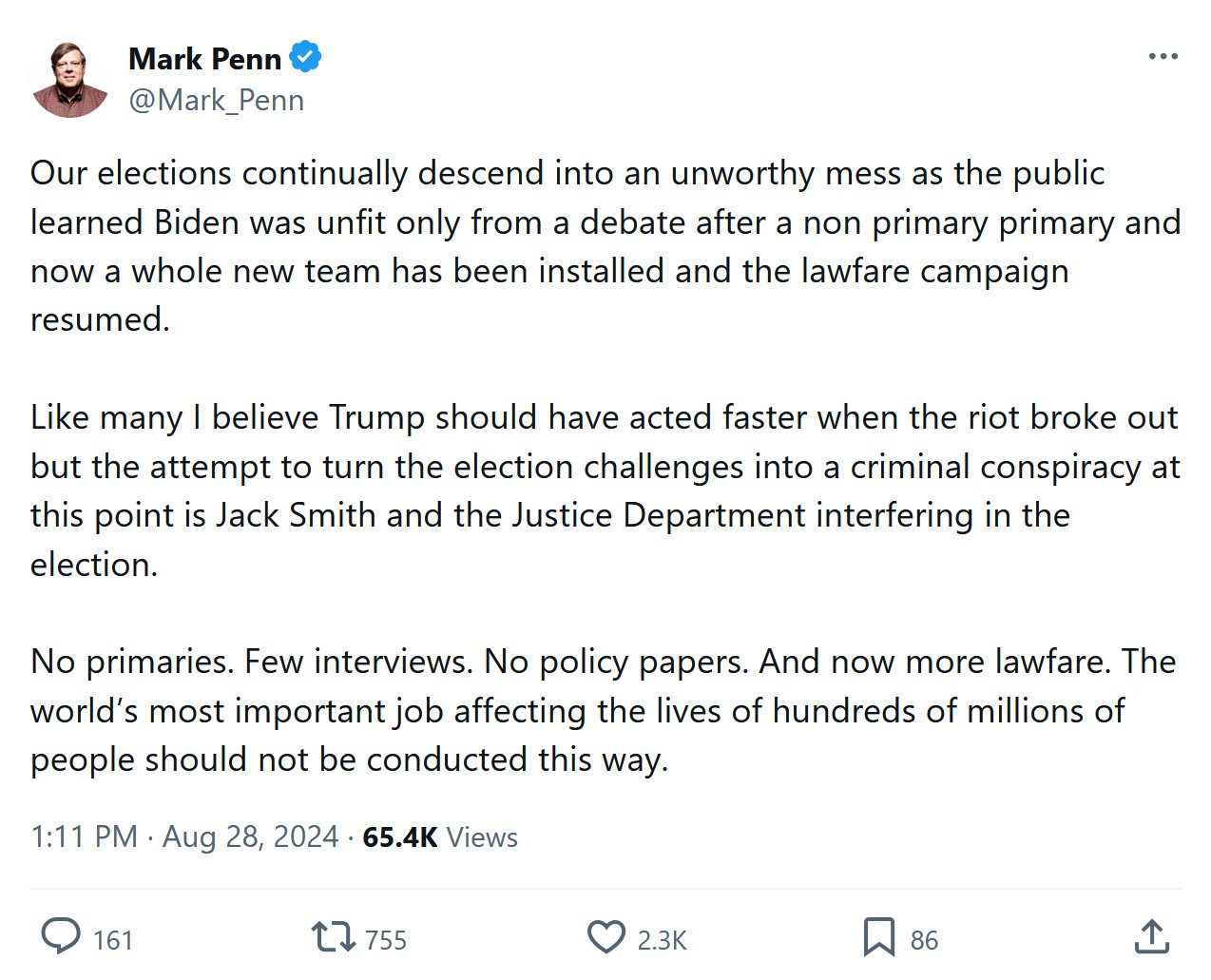
MORE: This is CNN.
The contrast between her gentle, loving, and indefensibly incurious treatment of her pals Kamala and Tim with this hostile and badgering debate against someone she clearly loathes could not be more dramatic. https://t.co/geMAWkZE0Y
— Mollie (@MZHemingway) August 30, 2024
THE FUTURE OF AI: Post-Apocalyptic Education.
August 30, 2024
OPEN THREAD: Ring in the weekend.
THE NEW SPACE RACE: Galactic Energy launches six satellites with third sea launch. “China’s Galactic Energy conducted its third Ceres-1 solid rocket sea launch Thursday, successfully sending six satellites into orbit. . . . Three of the satellites were Yunyao-1 spacecraft, equipped with GNSS occultation (GNSS-RO) and infrared imaging payloads, intended to provide meteorological data for commercial firm Yunyao Yuhang. Also aboard was Jitian-A03, the first satellite for Suzhou Jitian Xingzhou Space Technology Co. Ltd. The satellite is equipped with a hyperspectral remote sensing payload for high-resolution optical remote sensing technology verification. Hyperspectral sensors capture data across hundreds of narrow, contiguous spectral bands, allowing these sensors to distinguish between materials, making these useful for applications including mineral exploration, agriculture, and environmental monitoring.”
GIVE THEM THE GAWKER EXPERIENCE: Media Matters Loses Another Round to Musk.
21ST CENTURY HEADLINES: Trouble Above Earth: NASA’s Advanced Composite Solar Sail Grapples With Deployment Snag.
I QUESTION THEIR AUTHORITY TO DO THIS: FDA mandates photo ID for all under 30 to buy tobacco.