Author Archive: Ed Driscoll
July 24, 2023
BOMB CANADA—THE CASE FOR WAR: Toronto principal killed himself after being singled out during DEI training.
(Classical reference in headline.)
OPPENHEIMER, PRO AND CON:
Pro: John Podhoretz:
When middlebrow movies of this kind—Gandhi, Cry Freedom, The Killing Fields, and many others—vanish from the scene, that doesn’t make new space for highbrow stuff, because high culture will always be an elite minority taste. Instead, everything just goes lower. And that’s exactly what happened with Hollywood. Over the past two decades, movies that try to tell a real story about real people (and I don’t just mean actual real-life people like Oppenheimer, but just everyday folk) have gotten smaller and more insignificant. They are unambitious and unassuming. When they work, they work because they are touching slices of life and seek only to make us shed a tiny tear. They’re not weighty. They’re gossamer.
Oppenheimer is weighty, and it’s kind of magnificent. Writer-director Christopher Nolan has decided the story he is telling is the most important story in human history, and he wants to do it justice. This movie’s level of ambition is something I’m not sure we’ve seen in a major studio release in decades, and Nolan is so skilled a storyteller and so authoritative a director that his reach blessedly does not exceed his grasp. This is not a subtle movie, and there’s barely a joke or a laugh in it; as in all his pictures, Nolan presents us with an earnest, formal, and heavy world. But what he doesn’t do is preach, and that is what makes this movie such a triumph. Oppenheimer is a wildly ambiguous portrait of its titular subject, the work he did, the life he led, and even the humiliation to which he was subjected by political and ideological enemies. The titanic performance of Cillian Murphy, who does nothing to ingratiate himself with the audience, takes this incredibly complex and deeply troubled man and follows him through four decades of scientific growth, political activism, engineering achievement, and raw power politics. And it does a beautiful job posing the key question of his life without answering it: In doing something transcendently great, did he do something evil?
Con: Armond White: Oppenheimer’s Revenge of the Geeks. Christopher Nolan remakes Dr. Strangelove for today’s moral idiots:
On the way to turning pop cinema into a weapon of mass destruction, Christopher Nolan specialized in narratives about amoral excitation — Memento, and his Batman Begins / The Dark Knight / The Dark Knight Rises trilogy. These bad productions changed movie culture by appealing to the terrors of naïve film nerds the same way Stanley Kubrick corrupted adolescent pop-culture devotees — through technological preening that made geeks feel smart.
There’s always a moral vacancy in Nolan’s films. Now, Nolan has made his ultimate geeks’ movie: the overhyped biopic Oppenheimer, which mystifies physicist J. Robert Oppenheimer (played by the eccentric, intense Irish actor Cillian Murphy), credited for creating the atomic bomb that the U.S. dropped on Japan in 1945 to end World War II. This is Nolan’s subversive remake of Kubrick’s Dr. Strangelove or: How I Learned to Stop Worrying and Love the Bomb, from 1964. The real-life basis of Nolan’s film is all the more enticing for kids who know nothing about military or scientific history. He introduces them to Oppenheimer in the same way that Marvel distorted Oppenheimer’s wizardry in Doctor Strange in the Multiverse of Madness. And surely Nolan is aware of how Zack Snyder’s Watchmen used Oppenheimer’s oft-repeated quote — “Now I am become Death, destroyer of worlds.” It came from the Bhagavad Gita, a Sanskrit epic that polymath Oppenheimer knew, but the proclamation now teases pop-culture nihilists — and that’s the purpose behind Nolan’s Oppenheimer.
Not since David Fincher’s serial-killer epic Zodiac has there been a crime procedural as plodding as Oppenheimer, even though Nolan constantly switches to black-and-white flashbacks of the scientist’s early academic years, his wartime bomb research on the Manhattan Project, and his post-war persecution by the Atomic Energy Commission (AEC). Murphy is outfitted in a wide fedora, and his imperious manner makes him seem half-hero, half-nemesis. Nolan lacks the momentum to dramatize Oppenheimer’s travails (Murphy’s blue eyes do all the work), but the precarious portrait of a genius recalls Fincher’s worship of Mark Zuckerberg in The Social Network. Both Nolan and Fincher exploit the zeitgeist’s disinterest in what’s moral or immoral. This film dithers for three hours, as if viewers were also morally uncertain and aesthetically gullible.
Like Nolan’s Dunkirk, his latest film feels detached and Kubrickian. I watched The Imitation Game on Saturday night on Netflix as a sort of warmup for Sunday’s big movie. (In this case, England’s tortured WWII genius, Alan Turing). While the plastic CGI SFX from 2014 were nowhere near as good as Nolan’s practical effects, and I felt much more sympathetic to Turing as played by Benedict Cumberbatch than Cillian Murphy’s cool and detached Oppenheimer. And while the plot was also non-linear, it was much more obvious in each scene which period of Turing’s life was being recreated. But Oppenheimer is big, bravura, and smart filmmaking, something that as Podhoretz writes above is quite rare in post-’80s Hollywood.
MOVE ALONG, NOTHING TO SEE HERE: Hunter Biden’s gallery sold his art to a Democratic donor ‘friend’ who Joe Biden named to a prestigious commission.
OLD AND BUSTED: “I disapprove of what you say, but I will defend to the death your right to say it.”
The New Hotness? Students—Including Most Conservative Ones—Now Want Their Professors Censored.
Flashback: Freddie deBoer’s Planet of Cops. “The woke world is a world of snitches, informants, rats. Go to any space concerned with social justice and what will you find? Endless surveillance. Everybody is to be judged. Everyone is under suspicion. Everything you say is to be scoured, picked over, analyzed for any possible offense. Everyone’s a detective in the Division of Problematics, and they walk the beat 24/7. You search and search for someone Bad doing Bad Things, finding ways to indict writers and artists and ordinary people for something, anything. That movie that got popular? Give me a few hours and 800 words. I’ll get you your indictments. That’s what liberalism is, now — the search for baddies doing bad things, like little offense archaeologists, digging deeper and deeper to find out who’s Good and who’s Bad. I wonder why people run away from establishment progressivism in droves.”
NO THANKS, I’M STILL SOCIAL DISTANCING: Enter the Barbie Longhouse.
Spoiler alert: Lots of spoilers abound in this review. Beware!
I walked out of the Barbie movie stunned and in disbelief. Hollywood darling Greta Gerwig, the scowling girlboss writer-director of this guaranteed smash-hit, has somehow made the first movie explicitly set inside the Longhouse.
And she did it totally by accident.
What a time to be alive!
The Longhouse Dreamhouse
If you are still confused about what the “longhouse” is, the Barbie movie is here to set you straight.
To Greta Gerwig and her heavily longhoused life partner and cowriter Noah Baumbach, the feminist Longhouse is good, actually. It’s the only thing keeping men—and Ken—in their place. Greta and her doll-alter-ego are still, always, forever, fighting the mythological patriarchy from the privilege and safety of their Dreamhouses.
She seems totally oblivious of the fact that in modern-day Hollywood, just like in Barbieland, girls rule. Men, and Kens, are firmly in the backseat. Ms. Gerwig and her girlboss sisterhood are riding high.Gerwig is the most in-demand writer of the last decade. And yet—she is also somehow the victim of the patriarchy. This movie is her great Airing of the Grievances.
* * * * * * * *
The last scene is the newly human Barbie, in Santa Monica, wearing Birkenstocks instead of high heels, arriving at a doctor’s office. The receptionist asks her who she’s there to see. Barbie, now calling herself Barbara Handler, says with a gleeful smile, “My gynecologist!”
Cut, roll credits.Gynocracy, take a bow!
In another accidentally based twist, what makes Barbie a woman is having a vagina—paging Matt Walsh!
In the sequel, Depo-Provera Barbie and her uparmored sterilized innards will be living her best life on Tinder, going to Burning Man, attending Planned Parenthood rallies and abortion marches.
All she’s missing in the end is her Mattel-branded pink pussy hat.
And as Glenn noted yesterday. “In trying to make Barbie a feminist hero, they made Ken a Chad idol…Call it the Gordon Gekko effect, where the villain gets the most memorable lines. Or maybe the Colonel Jessup effect.” I saw Oppenheimer yesterday, and was amused by the number of women — and a few men — dressed in pink on their way to see Barbie. I’ll be curious to see what its next weeks of business are like.
As for Oppenheimer, the scenes set at Los Alamos are riveting, the Trinity explosion spectacular, and spectacularly loud, and the various show trial scenes a bit numbing as they shifted from color to black and white, and ran long after the A-bomb explosion, deliberately making it anti-climactic, a very Kubrickian choice. As Kubrick once told an interviewer, “if you end a story with somebody achieving his aim it always seems to me to have a kind of incompleteness about it, because that almost seems to be the beginning of another story. One of the things I like most about John Ford is the anticlimax endings — anticlimax upon anticlimax and you just get a feeling that you are seeing life and you accept the thing.”
AMERICA’S NEWSPAPER OF RECORD: Elon Musk Rebrands Twitter As ‘X’ After CEO Rejects His First Choice ’69Boobies420.’
THE WAPO’S GOT A FEVAH, AND IT NEEDS MORE COWBELL JASON ALDEAN! The Washington Post would like to endlessly wokesplain Jason Aldean’s EXTREMELY CONTROVERSIAL song “Try That in a Small Town” so let’s explore their offerings:
The Washington Post likes nothing better than a juicy scandal involving racist white supremacists being all supremacisty, and if there aren’t any, why, they’ll just make one up!
And so, over the course of three days we have no fewer than six pieces in WaPo in which a thoroughly innocuous paean to small-town values is magically transformed into a racist pro-lynching white supremacist anthem.
To accomplish this feat of wizardry requires you go all-in, and did they ever.
This was all hands on deck swarm reporting. It’s as if they were already making room on their shelves for their next Pulitzer.

Fortunately, at least for the moment, Aldean is surviving the Alinsky-esque “pick the target, freeze it, personalize it, and polarize it” tactics of the WaPo and the left (but I repeat myself) just fine: Jason Aldean Refuses To Apologize In Amazing Speech As ‘USA’ Chants Break Out.
UPDATE (FROM GLENN): The problem for the WaPo is that this sort of attack depends on pretending that the person being mobbed is an affront to normal, decent, everyday American values. This is difficult to pull off when you’ve spent the rest of your time either denying that such values exist, or crapping all over them, and even calling them racist and white supremacist.
OUT ON A LIMB: New job numbers prove red-state policies are the way to go.
Sensible, pro-growth policies have won the day, yet again.
Per the latest state-level jobs report from the Bureau of Labor Statistics, eight of the top 10 states for jobs recovered since the pandemic began are led by Republican governors.
All 10 have GOP-controlled state legislatures.
How out unemployment numbers?
Red-state good news dominates there too.
Of the top 10 states with the lowest unemployment rates, eight are led by Republican governors.
And of 17 states that have hit record-new lows of unemployment, 12 have GOP govs.
This news isn’t all that surprising when dealing with an administration full of Obama retreads: Obama should take notes on Texas. “Obama had two years of uncontested control of two branches of the federal government to push his own ‘recovery’ agenda. Yet unemployment has skyrocketed. Not a single job was created in August [2011] nationwide. But the business friendly climate of Texas, fostered by the leadership of Gov. Rick Perry, has created four out of every five jobs in America since 2005.”
I HOPE WE’RE NOT TOO MESSIANIC, OR A TRIFLE TOO SATANIC: Report: Fox News matches employee contributions to Satanic Temple, Planned Parenthood.
NBC ATTACKS REPUBLICANS FOR NOTICING BIDEN’S CRUELTY TOWARD HIS GRANDDAUGHTER:
It seems that some in the corporate press have made covering for President Joe Biden’s many faults a priority.
The latest example comes from NBC, which wrote, “President Joe Biden’s family story has long been one of his greatest strengths politically. Republicans are starting to think they can turn it into a liability.” How do they plan to do that? By pointing out that Biden categorically rejects one of his seven grandchildren, presumably because his son had her with a stripper. He says he loves his six grandchildren. But he has seven.
The piece continues: “That [the attacks] have now boiled over to the presidential campaign trail and focused on this young girl and her role in the Biden family underscores how Republicans are leaning into a deeply personal issue for the president — and that it isn’t going away.”
The framing is notable: It suggests the real story is Republicans attacking Biden over refusing to acknowledge the existence of his granddaughter rather than, you know, the cruelty of Biden doing so in the first place. The title of the piece, “Republicans up the personal attacks on Biden and his family,” all but confirms this.
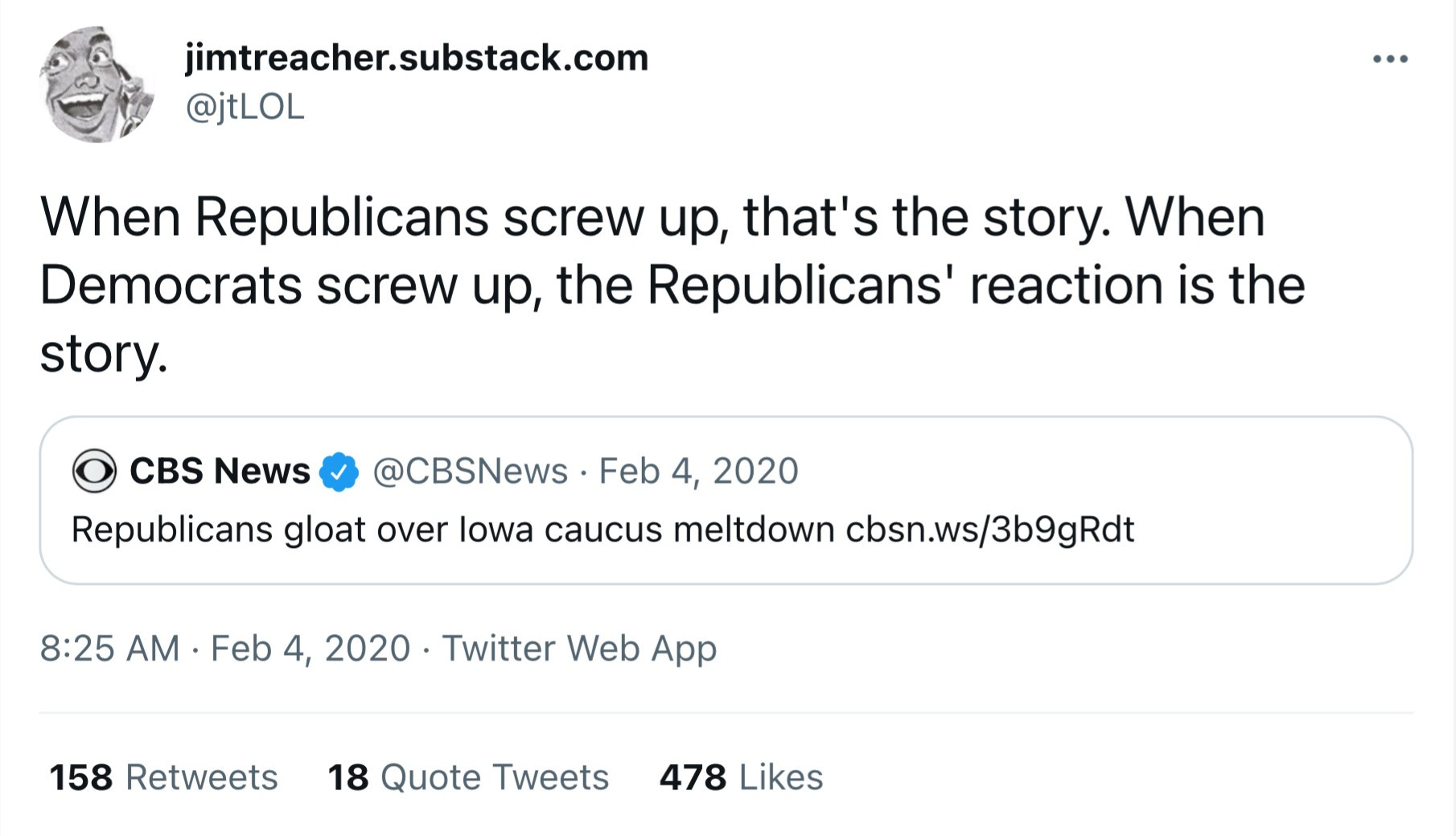
Evergreen:
July 23, 2023
NEO: COVID lab leak coverups, then and now.
And what of the lab leak theory? The first mention of the subject I could find on this blog is from April of 2020, which is pretty early. Here’s what I wrote back then:
You may have noticed that I haven’t written much if at all about COVID-19’s origins, despite having written a ton about the disease. Was it from a wet market? Was it from a lab? My opinion was that it was 50/50 and that we just didn’t know, so I didn’t want to waste much verbiage on it.
But now I’m leaning towards the lab theory.
Then I quoted this piece by Jonathan Turley:
When the coronavirus first appeared in Wuhan, China, many people immediately raised the concern that it might have been the result of a lab release from a controversial Chinese the Wuhan Institute of Virology. The lab was working on coronavirus and had raised concerns over its containment protocols. Then there was the fact that China hid the outbreak, arrested top doctors, and buried research on its origins. However, a narrative quickly emerged in countering President Donald Trump’s references to the “China virus.” People, including members of Congress, who referred to the lab were ridiculed on CNN and other outlets as conspiracy theorists like Politifact declared the theory to be utterly baseless. For some of us, the overwhelming media narrative seemed odd and artificial. It would seem obvious that a lab working on viruses in this area would be an obvious possible source. Now, after weeks of chastising those who mentioned the lab theory, another cache of documents and information shows that there are ample reasons to be suspicious and that concerns were raised two years ago within the State Department.
Turley is not a research biologist, nor am I. But it always was a theory that made sense, and the absolute denial of that theory was always suspicious and seemingly political. One didn’t have to be a scientist to see that – plus, there were other scientists who said that the virus had a structure that made it likely it was the result of bioengineering.
So if reporters were fooled it was because they wanted to be, or were simply stupid, or both. Or perhaps not so many were actually fooled.
When does Tom Cotton get his apology? Senator Tom Cotton Repeats Fringe Theory of Coronavirus Origins.
—New York Times headline, February 17th, 2020.
TURNING JAPANESE? I REALLY DON’T THINK SO: Here are 10 ideas San Francisco can import from Tokyo to save downtown.
San Francisco is at a pivotal moment.
With foot traffic down 31% from pre-pandemic levels, and over 54,000 residents permanently gone, the need for a compelling new vision to revitalize our urban infrastructure is paramount — especially downtown.
I recently had the privilege of visiting Tokyo for the first time — and the city left me nothing short of starstruck with its urban design. Here are 10 ideas I saw that San Francisco can integrate into its city fabric to reinvigorate our ailing downtown.
Car-free streets
Walking through Tokyo, one of the first things I marveled at was the abundance of car-free streets. This widespread flexibility to walk unencumbered by traffic was inspiring.
Moreover, Tokyo’s walkability creates a thriving environment for small businesses and restaurants, as more foot traffic clearly leads to higher patronage. I didn’t see a single corridor where residents weren’t lining up for their favorite restaurant.
By prioritizing pedestrians, Tokyo also lowers air pollution. While San Francisco has about 460 cars per 1,000 people, Tokyo has 232. With this reduction in cars comes a commensurate reduction in traffic, congestion and pollution.
Double our sidewalk size
In the districts of Tokyo where cars are allowed, the sidewalks are massive; The pedestrian-to-car space ratio is easily 2:1.
The benefits of these larger sidewalks compound. More sidewalk space attracts more pedestrians. More pedestrians mean more foot traffic. And more foot traffic means more patronage for local businesses.
Large sidewalks also allow innovative use of space. Many in Tokyo have metal railings to protect pedestrians from cars. There are designated paths for both incoming and outgoing pedestrian traffic (you always walk on the left side in Tokyo). There’s more room for public toilets. And there are vending machines serving water, ramen or even ice cream.
With more sidewalk, there’s more room for people and the things that they need and enjoy.
That’s nice. But curiously unmentioned in the above San Francisco Chronicle article is Japan’s astonishingly small homelessness problem. Why is it so small?
Drug Addiction
Tom Gill, a Japan-based social anthropologist, reported that Japan has a lower homeless population than the US and other countries because Japan has a much lower drug addiction problem. A 2014 study revealed that about 1.6% of the Japanese population tried drugs other than alcohol in their lifetime. Gill said that drugs other than alcohol are strictly illegal and usually only accessible through gangsters. Around 50% of drug users in Japan have gang connections. However, many of Japan’s homeless suffer from alcoholism.
A 67,500 person survey from the National Survey of Drug Use and Health In America showed that over 50% of the population in the US used some form of illegal drug in their lifetime. Drug addiction is one of the reasons for homelessness in America and can prevent people from finding homes and jobs due to a criminal record.
Karla Thennes, the director of a homeless organization called Porchlight in Madison, Wisconsin, described homeless shelters in Madison. Hundreds of people sleep on mats only inches apart with little sanitation. Madison and other cities across America need shelter reforms that are safer and more spacious.
Thennes explained to The Borgen Project that the homeless could not work past addiction in these shelter environments because of a failure to meet basic needs.“You can’t stay sober sleeping in a shelter,” Thennes said.
Mental Health
According to the Homeless Hub, 30-35% of all people who experience homelessness worldwide have a mental illness. In Japan, someone with a mental illness is typically placed into a mental health facility, sparing them from the streets. There are 269 psychiatric beds per 100,000 people in Japan, whereas, in the United States, the number is 25.
In fact, Japan has one of the most efficient health care systems in the world. However, a significant stigma revolves around mental health in Japan and the country sees one of the highest suicide rates in the world. Public insurance in Japan does not cover prescriptions for mental health medications such as antidepressants, and psychologists don’t always have enough training for their profession.
So while Japan’s mental health system ends up reducing the homeless population, their treatment of mentally ill people and available mental health resources struggle to meet an appropriate standard. “Japan has a conservative approach to the treatment of mentally ill people who are generally institutionalized,” reported Gill when he spoke to the Life Where I’m From Youtube channel.
So by all means San Francisco, crack down on drugs and institutionalize those with mental illness — use those ideas from Tokyo to start revitalizing the city.
UPDATE: Free Parking for the Homeless in CA.
Did you know that homeless people enjoy a constitutional right to free parking? That’s the main takeaway from a California Court of Appeals opinion issued Friday that ruled cities that tow cars with five or more unpaid parking tickets violate the 4th Amendment’s prohibition of search and seizure without a warrant.
The Coalition on Homelessness sued the City and County of San Francisco seeking an injunction against towing scofflaw cars that piled up parking tickets, and the trial court had denied the petition. But the Court of Appeals reversed, because “appellant [Coalition on Homelessness] presented declarations regarding the severe impacts of vehicle tows on unhoused San Francisco residents.”
Wait, I thought we wanted San Fran to be more like Tokyo:
(Updated and bumped.)
THE BASED AND HILARIOUS REASON GEN Z BROS ARE FLOCKING TO THE NEW BARBIE FLICK:
So if [Ryan] Gosling’s Ken is a pro-“patriarchy” (as Leftists imagine it) rube, his fans are going to celebrate every word from his plastic mouth. If that is what Big Woke thinks of them, then by gum, they will live up to that expectation (and have a blast doing it).
Guys aren’t angrily boycotting Barbie (which Big Left would take as a win because it would prove that they can’t handle a strong, feminist Barbie); they’re flocking to the movie specifically to applaud the ludicrous chauvinism espoused by Based Ken. And to demonstrate to Leftists that they are perfectly willing to behave as badly as Leftists claim they do. And to laugh at the Leftists’ fuming and sputtering when they do it.
If there’s one thing totalitarians (like the modern Left) cannot tolerate, it’s fun. They sold their sense of joy along with their souls years ago. Unfortunately for them, their “Barbie” feminist film will generate more laughter, memes, mockery, and joy than they ever intended.
Ron Swanson and Alex P. Keaton could not be reached for comment.
DEMOCRACY DIES IN DILETTANTISM: A Decade Ago, Jeff Bezos Bought a Newspaper. Now He’s Paying Attention to It Again.
The Post is on a pace to lose about $100 million in 2023, according to two people with knowledge of the company’s finances; two other people briefed on the situation said the company was expecting to miss its forecasts for ad revenue this year. They spoke on the condition of anonymity to discuss internal financial matters. The Post has struggled to increase the number of its paying customers since the 2020 election, when its digital subscriptions peaked at three million. It now has around 2.5 million.
A spokesperson for Mr. Bezos declined to make him available for an interview. Patty Stonesifer, The Post’s interim chief executive, said Mr. Bezos was happy with “every dollar invested” in the company. One person familiar with Mr. Bezos’ plans said The Post had planned for 2023 to be a “year for investment.”
“I’m very enthusiastic about what we can do here at The Washington Post in the decade ahead,” Ms. Stonesifer said in a statement. “Jeff’s second decade of ownership of The Post should be even more exciting.”
I just wanted to tell you good luck; we’re all counting on you, Jeff.
https://www.youtube.com/watch?v=Zhw0eBCVXR4
Related: Clay Travis: The Washington Post Tried To Bring Down Bill Clinton, Now It Ignores Joe Biden’s corruption, how did we get here?
DAVID THOMPSON: Sudden-Onset Womanhood.
From the comments, where a question is asked – and promptly answered:
Regarding which, John D replies,
Hard pass. Here’s an idea – make a good film with a good female character and start your own franchise. Or would that be too much work?
Ah, but then those of a progressive inclination couldn’t piggy-back their Current Year politics onto someone else’s work, established over many decades. Plus, there’s lots of self-congratulatory subverting to be done. All that signalling about how antiquated and tiresome it is to have a white, male hero being daring and heroic. Because hey, nobody wants that.

Tom Cruise could not be reached for comment: Why Mission: Impossible Has Become the Biggest Summer Blockbuster Franchise.
HOW IT STARTED: Next mayor wants NYC to be even more of a ‘sanctuary’ for illegal immigrants.
Every single one of the eight Democrats running for mayor vowed to protect illegal immigrants from deportation, solidifying the Big Apple’s often infamous status as a “sanctuary city.”
* * * * * * * *
Entrepreneur Andrew Yang, the son of legal Taiwanese immigrants, said, “I appreciate anyone who comes to this country or New York City for a better life.”
And Brooklyn Borough President Eric Adams said migrants were his neighbors growing up in Queens.
“My mother worked two jobs to provide for the six of us and we had a group of undocumented residents that lived in our community,” Adams said.
The other candidates — city comptroller Scott Stringer, former Obama housing secretary Shaun Donovan and nonprofit leader Dianne Morales — also voiced their support for the Big Apple as a sanctuary city.
—The New York Post, June 2nd, 2021.
How it’s going: Mayor Adams tells foreign brown people to go somewhere else.
Well, wait, WHUT?!
Don’t tell me that New York City is already rolling up the Sanctuary carpet?
Mayor Eric Adams is telling illegal migrants from the border don’t bother coming, and he’s doing it with rapper flare, baby.
Yo, stay home, homies.
“…capacity was verbalized and now it’s going to be visually actualized…”
—Beege, Welborn, Hot Air, Thursday.
I eagerly await the full Jim Acosta quoting the Statue of Liberty CNN freakout.
¡NO PASARÁN!: Hollywood Shocker: The Authors of the Book Behind Nolan’s Oppenheimer Were Both Editors and Writers at The Nation.
The New York Times seems to be deliriously in favor of the movie Oppenheimer, with assuring us in his New York Times piece that opposition to the Red Scare was good and principled, that he hopes that “Christopher Nolan’s stunning new film on Oppenheimer’s complicated legacy will initiate a national conversation”, and that we can rest assured that even TDS (Trump Derangement Syndrome) — our words, not his — manages to be part of the equation.
the director of the Leon Levy Center for Biography, the New York Times tells us, as well as, more importantly, co-author with the late Martin J. Sherwin of “American Prometheus: The Triumph and Tragedy of J. Robert Oppenheimer”, the book behind Christopher Nolan’s “brilliant achievement in formal and conceptual terms“.
* * * * * * * *
Over ten years after Antony Beevor came out with astonishing revelations from the Kremlin’s archives (his massive The Second World War was published in 2012), the historian’s conclusions are still not accepted by the élites (they are not challenged — with arguments good or ill — they are simply ignored), leading them to call opposition to communism and to the USSR “a political movement characterized by rank know-nothing, anti-intellectual, xenophobic demagogues.”
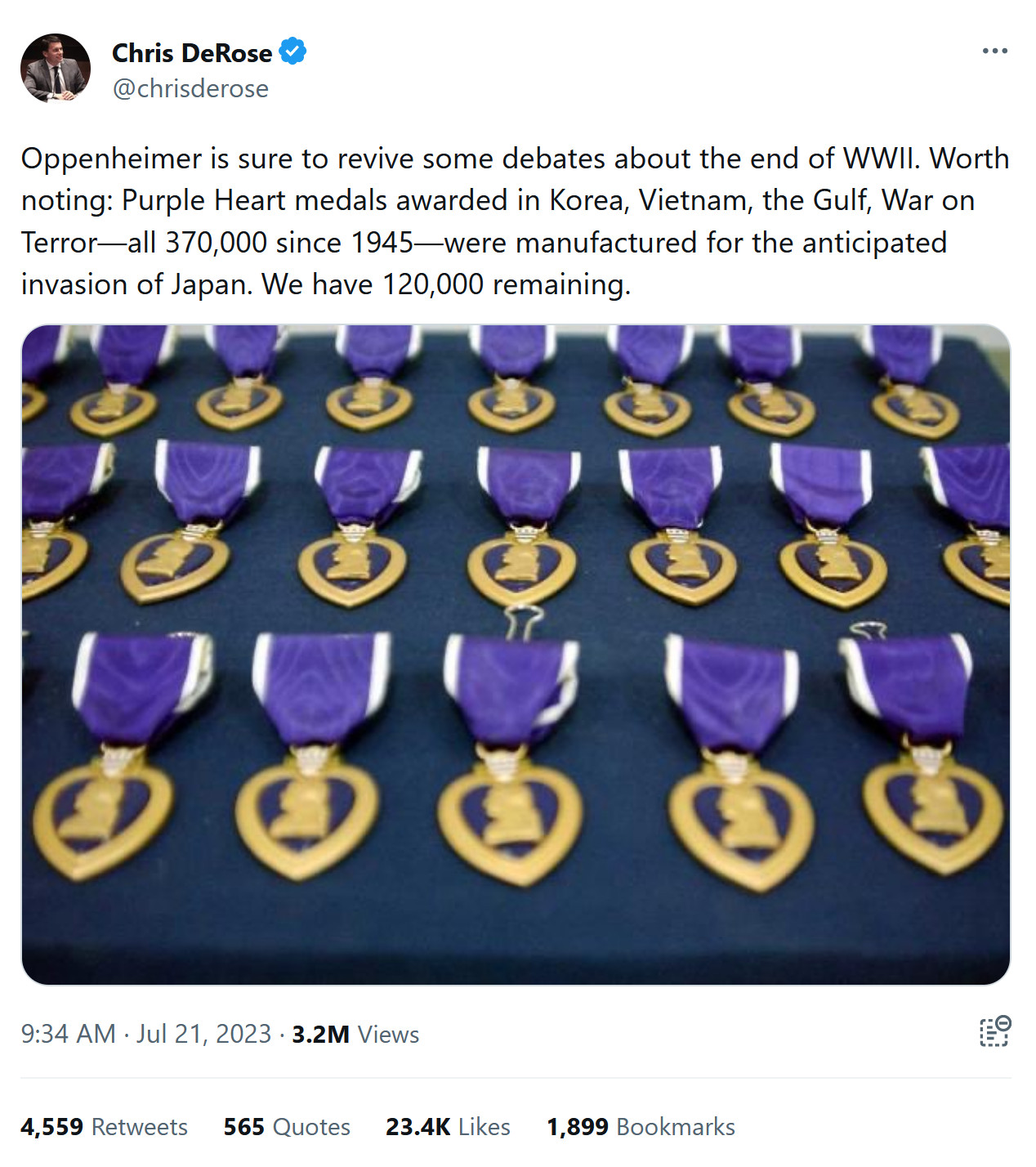
Astonishingly, [Oppenheimer] had gone so far as to say that the Hiroshima bomb was used “against an essentially defeated enemy.” The atomic bomb, he warned, “is a weapon for aggressors, and the elements of surprise and terror are as intrinsic to it as are the fissionable nuclei.”
“An essentially defeated enemy?” That would be news to the author of this 1946 Atlantic article: If the Atomic Bomb Had Not Been Used. Was Japan already beaten before the August 1945 bombings?
Was Japan already beaten before the atomic bomb? The answer is certainly “yes” in the sense that the fortunes of war had turned against her. The answer is “no” in the sense that she was still fighting desperately and there was every reason to believe that she would continue to do so; and this is the only answer that has any practical significance.
General MacArthur’s staff anticipated about 50,000 American casualties and several times that number of Japanese casualties in the November 1 operation to establish the initial beachheads on Kyushu. After that they expected a far more costly struggle before the Japanese homeland was subdued. There was every reason to think that the Japanese would defend their homeland with even greater fanaticism than when they fought to the death on Iwo Jima and Okinawa. No American soldier who survived the bloody struggles on these islands has much sympathy with the view that battle with the Japanese was over as soon as it was clear that their ultimate situation was hopeless. No, there was every reason to expect a terrible struggle long after the point at which some people can now look back and say, “Japan was already beaten.”
A month after our occupation I heard General MacArthur say that even then, if the Japanese government lost control over its people and the millions of former Japanese soldiers took to guerrilla warfare in the mountains, it could take a million American troops ten years to master the situation.
That this was not an impossibility is shown by the following fact, which I have not seen reported. We recall the long period of nearly three weeks between the Japanese offer to surrender and the actual surrender on September 2. This was needed in order to arrange details: of the surrender and occupation and to permit the Japanese government to prepare its people to accept the capitulation. It is not generally realized that there was threat of a revolt against the government, led by an Army group supported by the peasants, to seize control and continue the war. For several days it was touch and go as to whether the people would follow their government in surrender.
The bulk of the Japanese people did not consider themselves beaten; in fact they believed they were winning in spite of the terrible punishment they had taken. They watched the paper balloons take off and float eastward in the wind, confident that these were carrying a terrible retribution to the United States in revenge for our air raids.
We gained a vivid insight into the state of knowledge and morale of the ordinary Japanese soldier from a young private who had served through the war in the Japanese Army. He had lived since babyhood in America, and had graduated in 1940 from Massachusetts Institute of Technology. This lad, thoroughly American in outlook, had gone with his family to visit relatives shortly after his graduation. They were caught in the mobilization and he was drafted into the Army.
This young Japanese told us that all his fellow soldiers believed that Japan was winning the war. To them the losses of Iwo Jima and Okinawa were parts of a grand strategy to lure the American forces closer and closer to the homeland, until they could be pounced upon and utterly annihilated. He himself had come to have some doubts as a result of various inconsistencies in official reports. Also he had seen the Ford assembly line in operation and knew that Japan could not match America in war production. But none of the soldiers had any inkling of the true situation until one night, at ten-thirty, his regiment was called to hear the reading of the surrender proclamation.
Did the atomic bomb bring about the end of the war? That it would do so was the calculated gamble and hope of Mr. Stimson, General Marshall, and their associates. The facts are these. On July 26, 1945, the Potsdam Ultimatum called on Japan to surrender unconditionally. On July 29 Premier Suzuki issued a statement, purportedly at a cabinet press conference, scorning as unworthy of official notice the surrender ultimatum, and emphasizing the increasing rate of Japanese aircraft production. Eight days later, on August 6, the first atomic bomb was dropped on Hiroshima; the second was dropped on August 9 on Nagasaki; on the following day, August 10, Japan declared its intention to surrender, and on August 14 accepted the Potsdam terms.
On the basis of these facts, I cannot believe that, without the atomic bomb, the surrender would have come without a great deal more of costly struggle and bloodshed.
Flashback: Bill Whittle Jon Stewart, War Criminals & The True Story of the Atomic Bombs (Video).
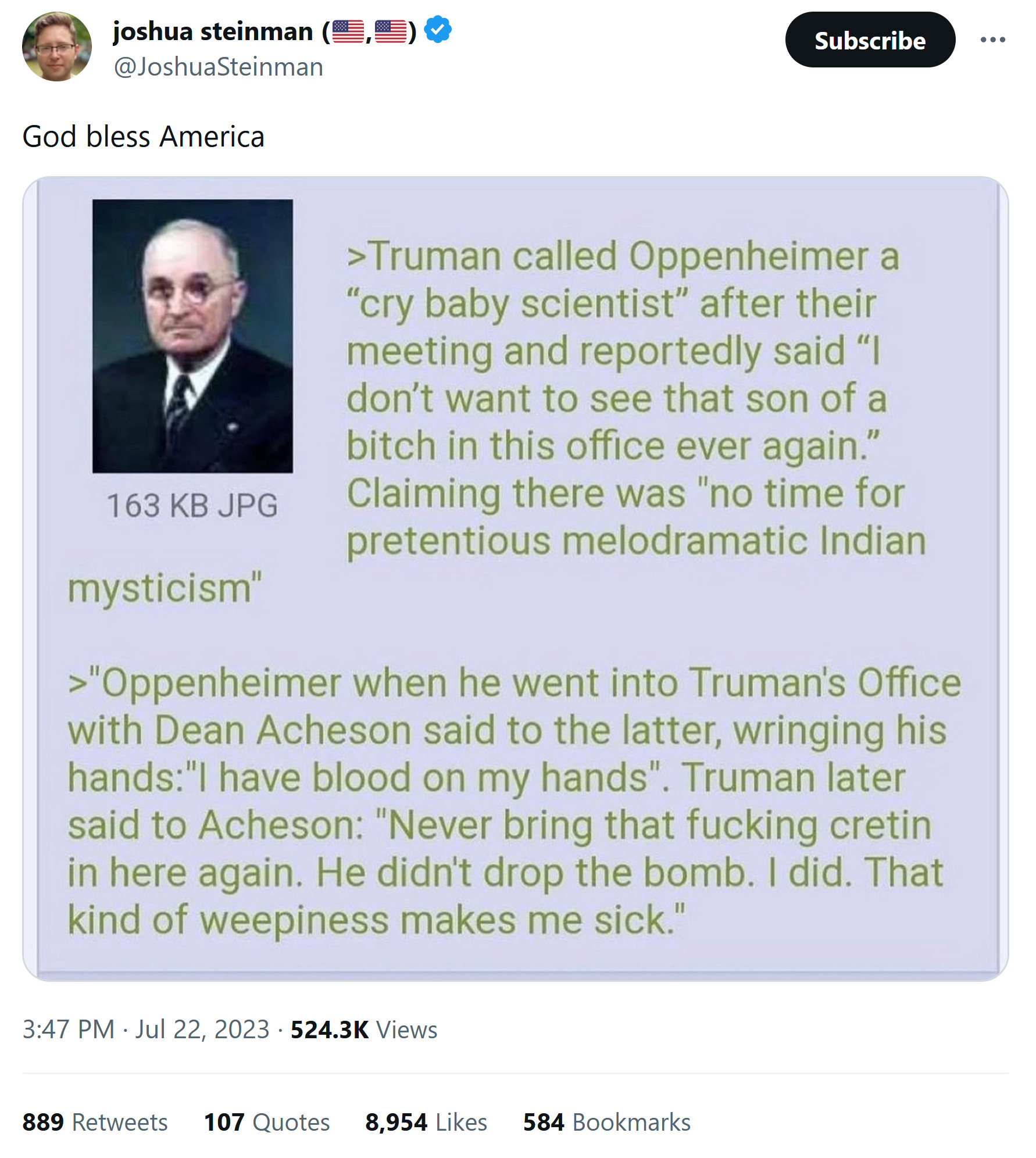
Related: Harry Truman was not fond of Oppenheimer:
21st CENTURY RELATIONSHIPS: US influencer works as ‘emotional support stripper’ in Ukraine.
BARBIE: A UNITER, NOT A DIVIDER! Midnight’s Edge, The Critical Drinker and Ben Shapiro agree: The Barbie movie is garbage.
OH, TO BE IN ENGLAND: Julie Burchill: My vagina is not a ‘bonus hole.’
I grew up working class in the 1970s; my mother taught me to call it Down There. Practically no one apart from sex-ed teachers used the v-word back then. Thanks mainly to feminists, its use is far more widespread now. But still there is work to be done. The Eve Appeal found in 2014 that a whopping 65 per cent of women aged 16 to 25 have a problem with using the word vagina or vulva, while 40 per cent said they used wimpy names such as ‘lady parts’ when discussing gynaecological health.
So imagine having a daughter today, just starting school. You’ve been scrupulous about using the correct word for her primary sex organ, and then she comes home from school squealing: ‘Mummy, mummy – I’VE GOT A BONUS HOLE!’ Do you think that couldn’t happen? If so, what planet have you been living on for the past few years?
George Orwell, to the white courtesy phone, please!