A new governor is coming on January 2, so hope springs eternal, I suppose.
At least she’s making sense when she sets out where she’s going to start first which means Bloomberg has a waah.
…Only 7% of Puerto Rico’s power comes from renewable sources despite 2019 legislation that set ambitious targets for clean energy adoption, including 40% use by 2025. At the time, lawmakers expected to use federal resources to rebuild the island’s grid to prioritize renewables, in particular solar.
Gonzalez says the targets are getting in the way of other, cheaper, forms of energy and have slowed the use of some $17 billion in federal aid.
“I’m willing to revise whatever legislation is available to secure power that dramatically reduces the outages we are suffering,” she said.
Gonzalez’s proposals underscore a broader pushback against clean energy.
…While pushing for more natural gas, Gonzalez said she favors allowing individual solar customers to sell power back to the grid. The policy, called net-metering, has led to a boom in rooftop solar installations in Puerto Rico but it’s being challenged in court by the federal oversight board who runs the island’s finances.
“I am very much in favor of net-metering,” she said. “If you take away the only incentive people have, then nobody’s going to invest in solar energy.”
I also like that she doesn’t suggest Puerto Rico subsidizes solar installations.
As power company LUMA is saying, anywhere from 24-48 hours before almost 2M customers have juice back on.
I hope they at least have lights for her to take the oath, maybe with one of those FEMA generators that’s still cranking away.
Let the girl get to work.
* I’ve heard vague rumors of penumbras of auras of perturbations that the island also has the teeny-tiniest problem with garbage and sanitation as well, which I’m sure is simply Trumpian crazy talk, right? Right?!
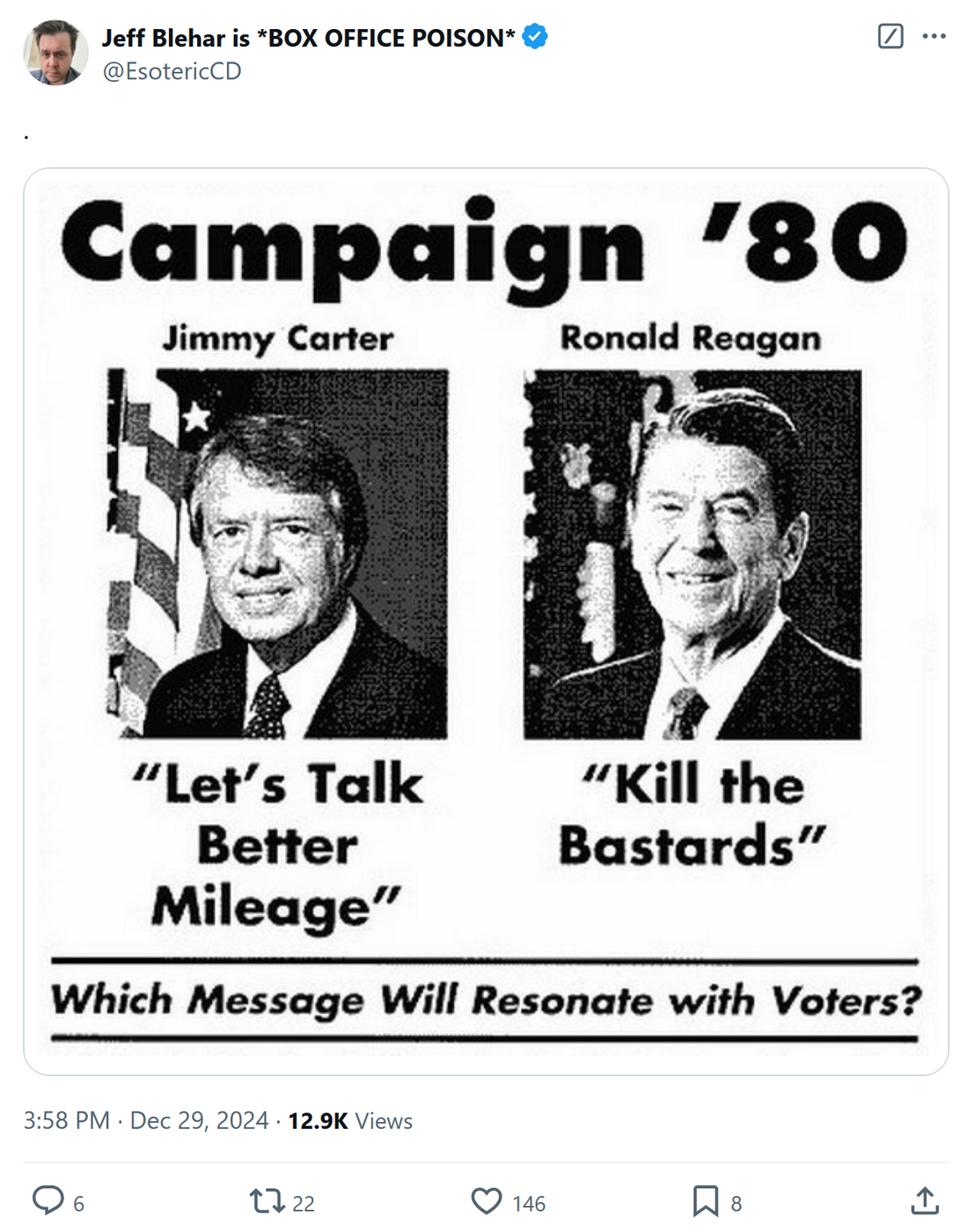
When a historical figure passes away, it’s almost inevitable that there will be a concerted effort to paint him in a favorable light — after all, the old adage of “don’t speak ill of the dead” prevails. However, the attempt to rewrite Jimmy Carter’s legacy following his death has reached such absurd, almost Orwellian heights, as if others are trying to erase history and pretend that Carter wasn’t one of America’s most ineffective presidents.
Like clockwork, media outlets have rushed to elevate his presidency, attempting to reframe his time in office as the golden age of moral leadership. The most egregious example of this revisionism comes from Washington Monthly, which published a piece under the headline “The Surprising Greatness of Jimmy Carter.”
This misguided attempt to elevate Carter goes beyond historical distortion — it risks rewriting history in a way that undermines the true facts of the 20th century. The article features a simian depiction of Reagan next to a towering image of Carter, who arrogantly rests his elbow on Reagan’s head.
This kind of visual assault on Reagan’s legacy is not only juvenile but also counterproductive to any serious discussion about Carter’s place in history. It’s like claiming that Barack Obama was scandal-free or that Joe Biden was a healthy, vigorous president who ran circles around his staff.
The news media is wrong all the time — though not exactly as its loudest critics claim. Reputable outlets get most of their facts right, and correct fast when they’re wrong. In fact, one way you can tell a reputable American news media outlet from an untrustworthy one is who admits they’re wrong, and corrects. Of course, when a big outlet makes a big error, it’s a news event, the subject of lawsuits, public embarrassment, and critical coverage from their competitors and in newsletters like this one.
More often wrong are the assumptions we in the information and “content” business make. Lacking in all of the necessary information or a crystal ball, members of the media nonetheless post their takes on social media, pop off a little too much on a podcast, or let our biases seep into reporting and analysis, only to be surprised when life proves more interesting than we expected.
At the end of 2023, we asked some of our most perceptive readers, up and down and across media, to share where they felt they missed the mark. That turned out to be one of your favorite editions, so we’re bringing it back in 2024, a year with some notable news events that yielded some major unexpected twists. While last year’s list varied, one of 2024’s most consequential news events, Joe Biden’s failure on the debate stage and subsequent decision to leave the presidential race, was clearly top of mind for many of our respondents this year.
This is what Ive been saying; it’s bigger than Watergate. Nixon lied about a third-rate break in he had nothing to do with; the people around @JoeBiden, the Dem Party leadership, @KamalaHarris misled the country about the ability of the President to carry out his duties as he was… https://t.co/YTgLXYqmkh
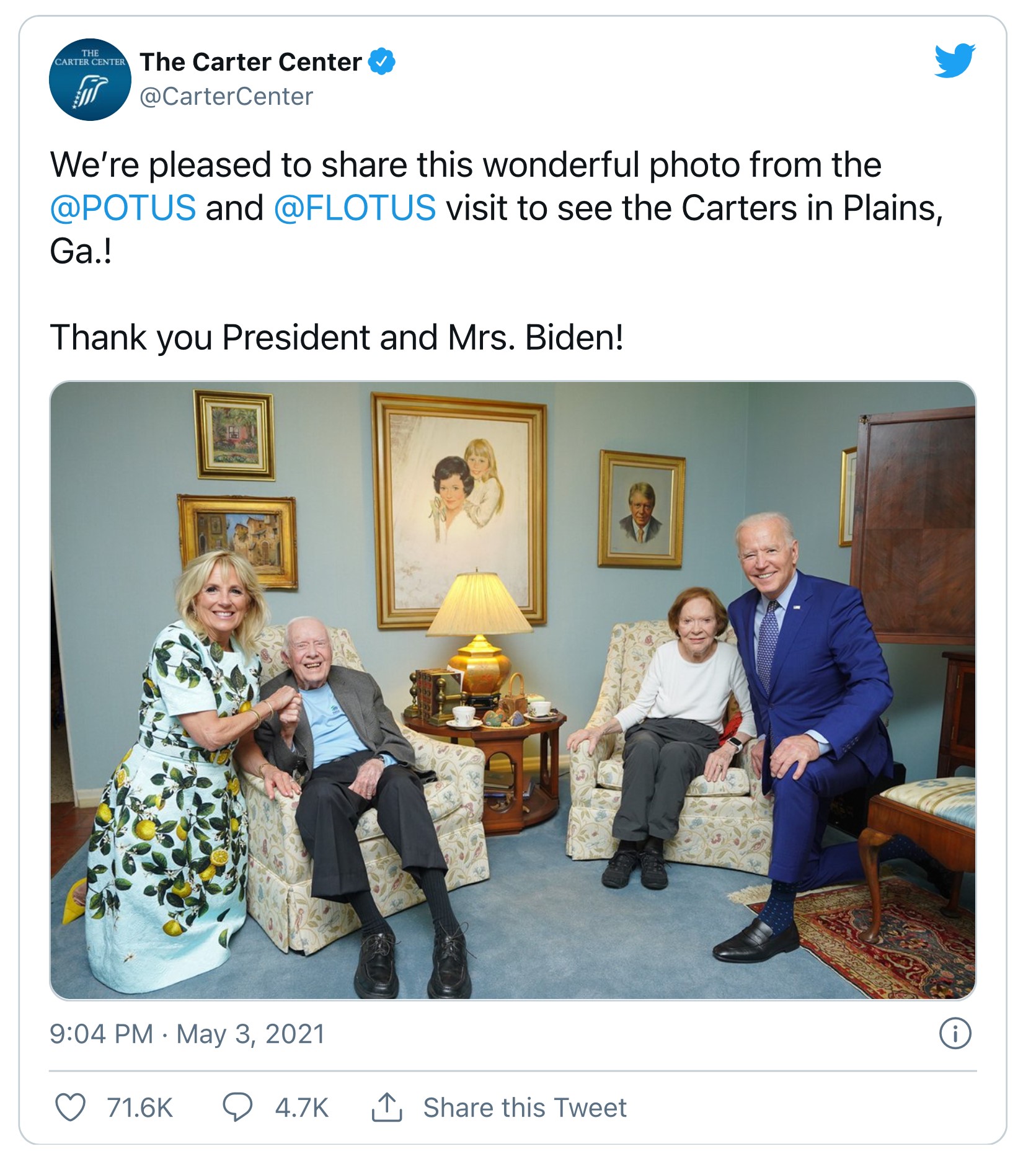
We knew the nation was in for rough times ahead, when early in Biden’s time as a presidential figurehead, the White House that nominally bore his name released a photo that appeared to make Joe and Jill tower over Jimmy and Rosalynn:
In a thread on Reddit that was full of Hobbit jokes, others countered that perhaps age had shrunk the former president to three feet. Or maybe, some wondered, there was something going on with the lens.
So which is it?
Reached by phone Adam Schultz, the chief official White House photographer, confirmed that he took the photo but declined to explain. “It’s for people to figure out and think about,” he said.
Everybody else in the Biden White House gaslit voters with haughty derision, apparently their photographer thought he should get in on the act as well.
Related: The memorial for Jimmy Carter should definitely do this, to give just a taste of the many ignominies of life in the Carter era:
“If you owned a car this May 9th in 1979, you were no doubt preoccupied with what number your license plate ended in. Because gas rationing was being enforced and was strictly limited to odd numbered or Personalized license plates on this day.”
After watching, waiting, and studying the squatters’ daily routines, the Squatter Hunter (as [“Flash”] Shelton is known) goes into action: He’ll change the locks, install ring cameras, and film the squatters while threatening to embarrass them on the internet. If that doesn’t work, he will move in with five or six other friends and, in his words, “turn it into a reality show.” He’ll even do “renovations” involving chainsaws. (Our strategy would have involved several cans of baked beans.)
Shelton, an ex-bouncer, is quick to remind homeowners to document encounters and never go alone. He carries a Glock and is experienced with deescalation tactics (he also wears a baseball cap that says “Get Out”). As Shelton told John Stossel, “They are not homeless people. They’re criminals. They’re people that are taking advantage of the system.”
Until now. Earlier this year, Gov. Ron DeSantis signed into law a bill ending squatters’ rights in Florida. Standing behind the governor was Flash Shelton, the Squatter Hunter himself and, now, a 2024 Washington Free Beacon Man of the Year.
As Glenn has written, “the breakdown of law and order won’t go as [leftists] hope. Ultimately, the police are there to protect criminals from the populace, not the other way around. Get rid of the police, and armed vigilantism is what you’ll get. And what you’ll deserve.”
See also, the rise of private security forces in Detroit, over a decade ago:
Elon Musk, Vivek Ramaswamy, and the new Department of Government Efficiency should help President re-elect Donald J. Trump implement a straightforward reform: Return federal spending to 2019 levels.
Americans lived large just before COVID-19. On New Year’s Eve 2019 — nearly five years ago — the US economy boomed. Real annual GDP grew 2.5%. Unemployment was just 3.5% and at or near record depths for blacks, Hispanics, and Americans of Asian descent. Female joblessness was at its lowest point since Eisenhower!
The economy blossomed amid robust federal spending that totaled $5.46 trillion. Uncle Sam was no aloof skinflint back then. Paring Washington’s activities to that pace will not starve babies or steer seniors into the streets.
So, as 2025 beckons, America should restore the budget threshold that prevailed before the China virus ruined everything. It sandbagged the US economy, sickened seemingly everyone, and — the Centers for Disease Control report — between January 11, 2020 and December 14, 2024, it killed 1,213,622 Americans.
These microbes (most likely from the Chinese Communist Party’s Wuhan Institute of Virology) also triggered some $2.48 trillion in emergency spending to relieve a totally quarantined national workforce, support padlocked employers, underwrite medical assistance, finance vaccine research, and otherwise shake the disease that gripped America and pounded the globe.
This once-in-a-century calamity guaranteed Big Government. Especially after it crippled the private sector, such federal activity and expenditures were unsurprising and not entirely unjustified.
* * * * * * * * *
Pruning Big Government to pre-COVID-19 dimensions and challenging every subsequent dollar will give America a fighting chance to deserve our 250th birthday in 2026 and survive until our tricentennial in 2076.
It seems like a simple benchmark to reach, but then, the amount of waste that could be cut out of the 21st-century federal government is bottomless.
Royal societies are urging the Government to make science less “Western” in an overhaul of the school curriculum.
Bridget Phillipson, the Education Secretary, announced an overhaul of the curriculum that explicitly aims to make subjects better reflect the “diversities of our society”.
A committee leading the Department for Education’s curriculum review is currently considering the proposals of Royal societies, teaching unions, and other experts.
Prestigious scientific institutions have supported the call for diversity, and proposed the teaching of more “non-Western” discoveries.
The Royal Society of Biology has advised the committee that children should be taught about “non-Western contributions to the sciences”.
The society has recommended a “no more heroes” approach which avoids “prescriptive lists of historic figures in biology” in favour of “diverse historic and contemporary figures”.
This builds on the society’s previous work on the curriculum, which claimed: “Science is universal, has been and is carried out in all cultures at all ages, creating a diverse scientific global community.”
‘Wokerati’
Richard Tice, the Reform UK deputy leader, told The Telegraph that he thought the plans were “a ludicrous proposal from the wokerati”.
He added: “We need more historic British heroes and achievements to be taught to our children, not less.”
Laura Trott MP, the shadow education secretary, said: “Labour’s curriculum changes will drive down educational standards.
“Instead of continuing with a rich, knowledge-based curriculum which has led to our children being the best readers and mathematicians in the Western world, they are tearing it all up.
In the 1980s, Tom Wolfe proposed that the 21st century be the era of “The Great Relearning.” Instead, because the left knows it can’t compete with the great men of the past, the great unlearning marches on.
December 30, 2024
JIMMY CARTER, ELECTION DENIER, RUSSIA HOAX ENABLER:
Former President Jimmy Carter: If fully investigated, it would show that Trump didn't actually win the election in 2016. He lost the election and he was put in office because the Russians interfered …on his behalf. 🎥 https://t.co/CYSBIK3qHFpic.twitter.com/o71Z4InVxB
This is a classy statement by Trump especially considering that Jimmy Carter denied the results of Trump's election victory and attacked the legitimacy of his presidency. https://t.co/FUJ9N9HMKs
As Jay Nordlinger wrote in “Carterpalooza,” “No one quite realizes just how passionately anti-Israel Carter is. William Safire has reported that Cyrus Vance acknowledged that, if he had had a second term, Carter would have sold Israel down the river. In the 1990s, Carter became quite close to Yasser Arafat. After the Gulf War, Saudi Arabia was mad at Arafat, because the PLO chief had sided with Saddam Hussein. So Arafat asked Carter to fly to Riyadh to smooth things over with the princes and restore Saudi funding to him — which Carter did…In The Unfinished Presidency, [Douglas] Brinkley writes, ‘There was no world leader Jimmy Carter was more eager to know than Yasir Arafat.’”
Hal Lindsey, who has died aged 95, was a former Mississippi tugboat captain who took the end of the world off sandwich boards and brought it into mainstream culture; his book The Late Great Planet Earth was the bestselling non-fiction title of the 1970s in America and popularised such apocalyptic notions as “the rapture” and “the mark of the Beast”.
Hailed by Time Out magazine as “the Jeremiah of his generation”, Lindsey did not present himself as a prophet along the lines of Nostradamus so much as an interpreter of eschatological predictions in the Bible. He belonged to the dispensationalist tradition of Christianity, which believes in literal readings of the scripture and in the return of the Messiah before the Millennium.
Stemming from the Plymouth Brethren in the early 19th century, these ideas had in America previously been confined to non-denominational evangelical churches. What was novel about Lindsey was that he saw in passages in Daniel, Ezekiel and Revelation descriptions of events in his time that suggested the world was, in the title of one of his later books, on a countdown to Armageddon.
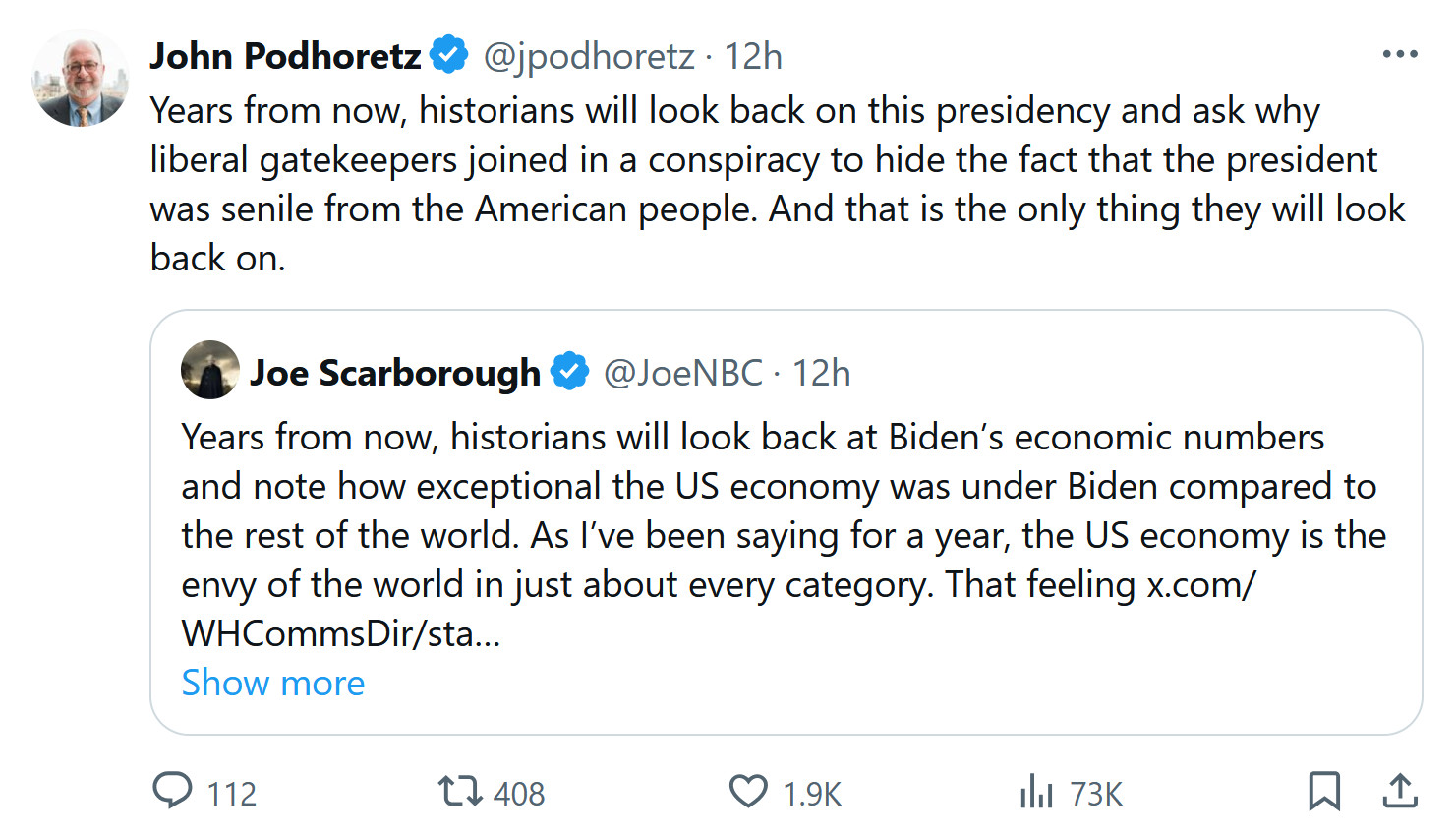
And of course, the biggest media scandal of them all — two weeks ago, the Wall Street Journal explored “How the White House Functioned With a Diminished Biden in Charge.” Ultimately the White House functioned (very badly) because the “news media” (aka Democratic Party operatives with bylines) let them get away with it:
UPDATE:
Clyp Keeper:
“All of those that spent the last four years lying repeatedly about Joe Biden's mental acuity should be run out of Washington and never be heard from again!
Carter presents layer upon layer of difficulty to untangle. Carter’s one-time speechwriter Patrick Anderson observed that in Carter’s hometown of Plains, Georgia, neighbors said of him that after an hour you love him, after a week you hate him, and after ten years you start to understand him. (Anderson added that anyone who didn’t have a personality conflict with Carter, didn’t have a personality.) Anderson also described him as a combination of Machiavelli and Mr. Rogers. The WashingtonPost’s Sally Quinn observed: “The conventional image of a sexy man is one who is hard on the outside and soft on the inside. Carter is just the opposite.” Fellow Southern Baptist Bill Moyers said “In a ruthless business, Mr. Carter is a ruthless operator, even if he wears his broad smile and displays his southern charm.” Part of the mystique of Carter was his careful and successful positioning as someone “above politics.” He gave off an air that he is too good for us, or certainly better than the rest of his peers in politics. Carter exemplified the paradox of taking pride in denouncing the sin of pride. He also displays a talent for combining self-pity and self-righteousness, sometimes in the same sentence.
He was a maddeningly contradictory figure. He first achieved statewide office in Georgia with a cynical race-baiting campaign, and then immediately proclaimed that the time had come for the South to repudiate its racist ways. An avatar of morality and truthfulness, Carter bent the truth and had a singularly nasty side to his character that ultimately helped cost him the presidency in 1980. David Brinkley observed of Carter: “Despite his intelligence, he had a vindictive streak, a mean streak, that surfaced frequently and antagonized people.” Eleanor Randolph of the Chicago Tribune wrote: “Carter likes to carve up an opponent, make his friends laugh at him and then call it a joke. . . [He] stretched the truth to the point where it becomes dishonest to call it exaggeration.” New York Times reporter James Wooten called Carter “a hyperbole addict.” And Gary Fink, author of a generally favorable study of Carter’s governorship, notes that “Carter usually claimed the moral and ethical high ground” but “practiced a style of politics based on exaggeration, disingenuousness, and at times outright deception.” Carter seldom if ever repented of his nastiness or asks forgiveness. Instead, when called out for an egregious personal attack, Carter displayed the advanced skills of evasion that made him such an effective presidential candidate, at least until the public caught on in 1980.
The man with the legendary smile could be unfriendly and cold. “There were no private smiles,” said one disgruntled campaign aide in 1976. His personal White House secretary, Susan Clough, recalled that Carter rarely said hello to her as he walked by her desk. Not a “Happy Thanksgiving,” or a “Merry Christmas.” Nothing, she says. Arthur Schlesinger Jr. judged Carter to be a “narcissistic loner.” “Carter was never a regular guy,” Patrick Anderson observed; “the sum of his parts never quite added up to that. . . Carter talked his way into the presidency, yet in some profound way he never learned the language of men.”
Musk makes short work of the farcical “far-right extremist” accusation:
“The portrayal of the AfD as rightwing extremist is clearly false, considering that Alice Weidel, the party’s leader, has a same-sex partner from Sri Lanka! Does that sound like Hitler to you? Please!”
AfD co-leader Alice Weidel SLAMS Angela Merkel and the CDU party, says she destroyed Germany in powerful 13-minute speech.
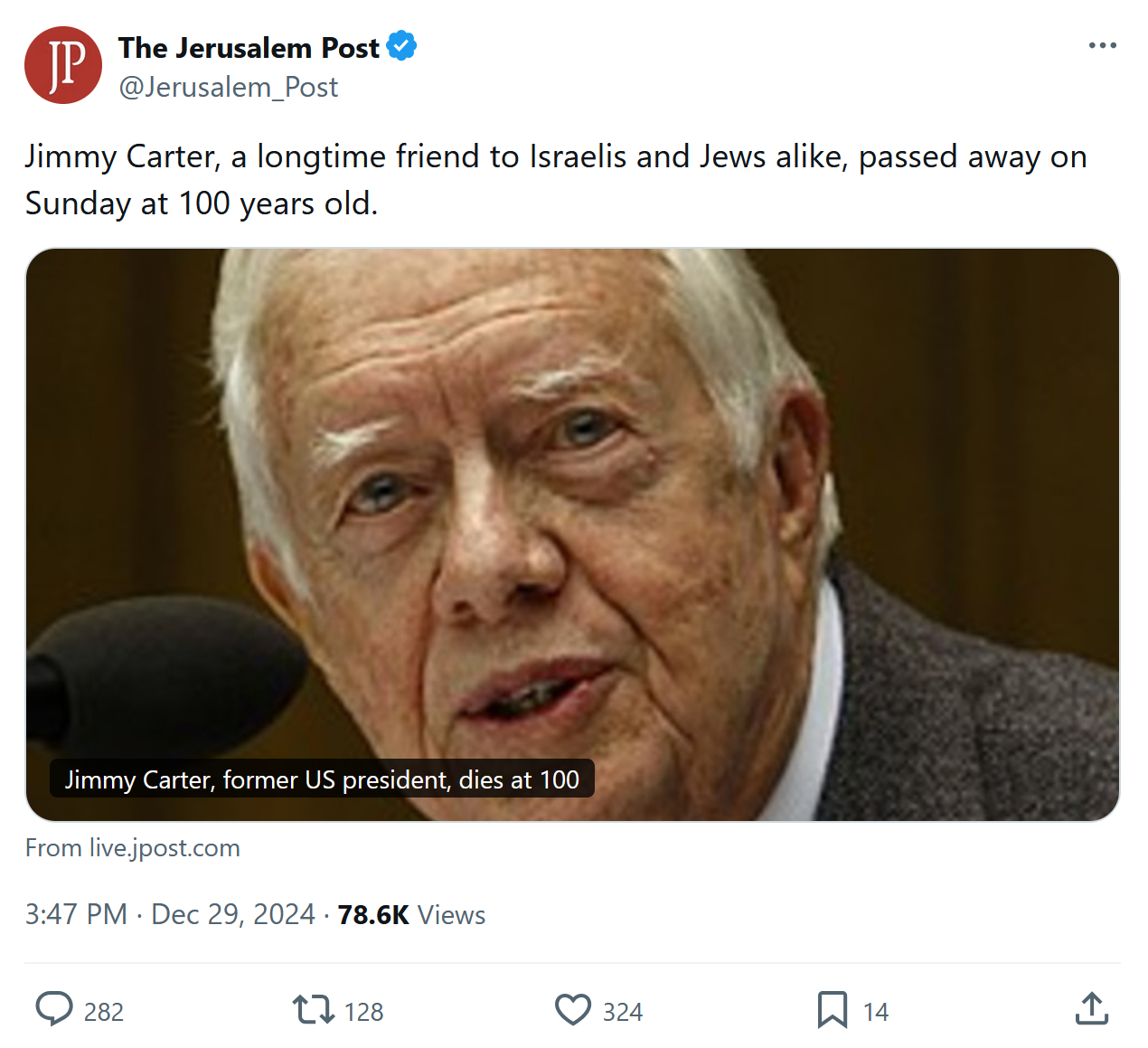
FLASHBACK: Jonathan S. Tobin: Don’t believe the Jimmy Carter revisionists. Despite the natural sympathy for a dying man, the revisionist attempt to erase his failures and their consequences should not prevail:
The stock of historical figures rises and falls with the changing times that follow them. That is especially true for presidents. Examples of these top leaders whose reputations have risen and fallen in succeeding generations abound. Some who exit office with low popularity ratings wind up being thought of with respect once the immediate political circumstances pass, and both historians and the public are able to judge their achievements with more dispassion.
The most outstanding example of this phenomenon is Harry Truman, who was deeply unpopular when his presidency ended due to the inconclusive and bloody Korean War, a sagging economy and the nation’s weariness with the Democrats after 20 years of their rule in Washington. But within a few decades, Truman’s reputation would soar. He would come to be appreciated for his postwar leadership against Soviet expansionism and for his plain-spoken style that at the time was judged as something of a letdown after the patrician bearing and soaring style of Franklin Roosevelt, whom he had succeeded. The most recent C-SPAN poll of historians now ranks Truman as the sixth greatest president in history—a development that few but his closest associates would have believed possible when he left the White House in 1953.
Supporters of former President Jimmy Carter are hoping that posterity will treat him in a similar treatment. And with the 39th president now in hospice at his Georgia home and the world anticipating the sad news of the end of his life, the campaign to revive his reputation is already in full swing. In the last month since the news about his terminal illness was released, articles and opinion pieces boosting the 98-year-old and attempting to depict his single term in office as both underappreciated and unfairly attacked have proliferated.
“Now, as far as whether the hostages would have been released before the election, whether Jimmy Carter would have won, that is unknowable.” And as the New York Times story concedes, “Confirming [Ben] Barnes’s account is problematic,” mostly because William Casey died in 1987 and John Connally passed away in 1993.
John B. Connally III, eldest son of the former governor, told Rolling Stone he disagreed with Barnes’ account. He accompanied his father to a meeting with Reagan and said there was no mention of any message to the Iranians. The hostage deal “doesn’t sound like my dad,” Connally said. “It’s not consistent with my memory of the trip.”
The story all hinges on the word of Barnes, a former Texas lieutenant governor and vice chairman of John Kerry’s 2004 election campaign. So, as Daniel McCarthy writes, “people less sophisticated than a Times White House correspondent might classify partisanship as an obvious motive.”
With Carter, 98, entering hospice care, Barnes set out to change the narrative of the Carter presidency—a rather tall order. As Alter concedes, “there were a number of other factors in 1980, including a wretched economy,” which is true. On Carter’s watch, the “misery index” a combination of inflation and unemployment, topped out at 21.98. Instead of his own inept presidency, the Georgia Democrat blamed the people.
“The symptoms of this crisis of the American spirit are all around us,” Carter said on July 15, 1979. “For the first time in the history of our country, a majority of our people believe that the next five years will be worse than the past five years. Two-thirds of our people do not even vote. The productivity of American workers is actually dropping, and the willingness of Americans to save for the future has fallen below that of all other people in the Western world.”
And so on.
Ezra Klein, formerly of The American Prospect and now with the New York Times, began the Carter rehabilitation tour way back in 2009 by trying to explain how, ackchyually, his “Malaise Speech” really wasn’t such a bad moment after all.
To fight stagflation, Carter appointed tight-money advocate Paul Volker to head the Federal Reserve Board, and Volker pulled the brakes on inflationary monetary policy — hard. It solved inflation but sent the economy into a painful correction that probably cost Carter reelection.
And despite his personal big government sympathies, Carter’s most lasting legacy is as the Great Deregulator. Carter deregulated oil, trucking, railroads, airlines, and beer. (H/t Caleb Brown.)
At the Atlantic, Derek Thompson chronicles the dramatic and almost unnoticed impact of Carter’s airline deregulation over the last thirty years. The bottom line: per-mile ticket prices fell by over fifty percent. And the results have transformed American social life and travel:
— The number of air passengers tripled between the 1970s and 2011.
— In 1974, it was illegal for an airline to charge less than $1,442 in inflation-adjusted dollars for a flight between New York City and Los Angeles. On Kayak, just now, I found one for $278.The impact of beer deregulation has been similarly overlooked: In 1978, the USA had just 44 domestic breweries. After deregulation, creativity and innovation flourished in the above-ground economy. Today, there are 1,400 American breweries. And home brewing for personal consumption is also now legal.
As for civil liberties, Carter also signed the most significant reform of government surveillance powers since World War II in the original FISA Act, and in 1979, he called for the decriminalization of marijuana, well ahead of the cultural and political curve. His legacy is also significant for what he did not do: he did not start any wars.
98. Carter let the Soviets have Angola, Ethiopia, and South Yemen. And, in retrospect, the Soviets deserved no better.
99. Carter wasn’t a throwback to the Carter era.
100. And let us not forget that Jimmy Carter gave us one thing Bill Clinton can never possibly give us—Ronald Reagan.
Perhaps as a result of that last item, it’s after Carter left the White House, that he really began to lose the thread, as Jay Nordlinger wrote in his classic 2002 NRO article, “Carterpalooza!”
In a 1997 op-ed piece entitled “It’s Wrong to Demonize China” (also for the New York Times), Carter wrote — and forgive the awkward prose — “American criticism of China’s human rights abuses are justified, but their basis is not well understood. Westerners emphasize personal freedoms, while a stable government and a unified nation are paramount to the Chinese. This means that policies are shaped by fear of chaos from unrestrained dissidents or fear of China’s fragmentation by an independent Taiwan or Tibet. The result is excessive punishment [excessive punishment!] of outspoken dissidents and unwarranted domination of Tibetans.”
Carter said that “ill-informed commentators in both countries have cast the other side as a villain and have even forecast inevitable confrontation between the two nations.” You see the exquisite moral equivalence between a giant and repressive Communist state and the American republic. He then said, “Mutual criticisms are proper and necessary [mutual criticisms, mind you: Communist China, America . . .], but should not be offered in an arrogant or self-righteous way, and each of us should acknowledge improvements made by the other.” Carter arrogant or self-righteous, ever? Improvements made by the United States, too?
Once in office, his popularity gradually began to fade, partly because of his drift to the Left. He supported the legalization of abortion by the courts, and his first act in office was to pardon all Vietnam War draft dodgers. In some ways, it was the McGovern agenda without the McGovern political baggage. His aides were often inexperienced in the ways of Washington, and like the only other engineer elected president, Herbert Hoover, Carter had an unfounded faith in his ability to both lead and micromanage his administration.
While in office, he created the Department of Energy and the Department of Education. In a hotly contested decision, he gave away the American-built Panama Canal. He faced an energy crisis sparked by war in the Middle East and an Arab oil embargo, which Carter called the “moral equivalent of war.”
But critics saw his address to the nation on the energy crisis while wearing a sweater as a sign of weakness in American global leadership. He seemed to ask Americans to get by with less and lower national expectations. In a struggling economy, he provided the equivalent of $11 billion to bail out a failing Chrysler Corporation as Japanese car imports flooded the struggling American automobile market.
In his famous “malaise speech” towards the end of his term, he epitomized the economic malaise the nation was experiencing under his leadership with high gas prices, inflation, and slow economic growth.
It all started off so promisingly though, complete with Gene Marshall’s absolutely groovy, perfectly 1970s song: “Can Our Government Be Competent? Jimmy Carter Says, Yes!”
Alas, it was not to be. As James Lileks wrote in 2021, “I think I got the second-shot blahs. I felt dull and fuzzy…The best word to describe it: malaise. Once I realized that was the best word, I wondered whether it could be due to gas lines, Mideast unrest or the return of inflation. As someone who came of age in the ’70s, and immediately regretted it, I associate these things with Jimmy Carter’s famous speech. He said the country suffered from malaise, which sounded like a bad sandwich spread. It wasn’t a popular speech. It’s one thing to be depressed, and another to be French depressed.”
The 2024 election marked a significant shift in political dynamics. Democrats, who have long had an advantage on social issues, continued to double down on the most radical of positions, ceding the advantage to Republicans and allowing them to go on the offensive rather than being defensive. For example, the Trump campaign managed to successively use Kamala’s radical positions on gender against her, telling voters, “Kamala is for they/them, President Trump is for you.”
It’s no secret that Democrats now have to reassess their agenda if they want to win back mainstream voters, particularly working-class Americans. These voters, who make up the majority of the electorate, have increasingly become alienated by the party’s focus on identity politics and divisive rhetoric.
According to an analysis from The Washington Free Beacon, internal divisions in the party continue to hinder any real progress in this effort.
At the Democratic National Committee’s winter meeting in Phoenix, party leaders made symbolic gestures that only served to further alienate average voters. A “land acknowledgment” meant to pay tribute to indigenous people was one such gesture, but for many, it felt more like a distraction than a meaningful attempt to address the concerns of working-class voters.
Smugness is the left’s Kryptonite in the hands of Trump, but it’s such an ingrained part of their psyche that it may be impossible for them to ever change. QED:
Finding comfort in the notion that their former allies were disdainful, hapless rubes, smug liberals created a culture animated by that contempt. The result is a self-fulfilling prophecy.
Scientific American, a 179-year-old magazine published by the German-British Springer Nature Group, appears increasingly keen to dirty itself with politics rather than engage in clean science.
Just weeks after Laura Helmuth stepped down as the magazine’s editor in chief after an ugly rant in which she effectively called over 77.3 million Americans who voted for President-elect Donald Trump both “fascists” and “bigoted,” and months after the magazine pushed gender ideologues’ pseudoscientific narrative, Scientific American published a piece claiming that Trump’s choice of Dr. Jay Bhattacharya to run the National Institutes of Health is “the wrong move for science and public health.”
Extra to insinuating that Bhattacharya was not actually censored during the pandemic and arguing that the destructive approach championed by the scientific establishment during the pandemic was not authoritarian, the author of the piece, Steven Albert, concern-mongered that Trump’s pick might prioritize Americans’ personal autonomy if confirmed as head of the NIH.
Debate over therapeutics, health protocols, and the origin of COVID-19 was stifled during the pandemic. Bhattacharya, among the experts whose views were suppressed at the urging of Biden health officials, refused to uncritically accept the prevailing wisdom of medical establishmentarians who advocated for lockdowns, vaccine mandates, masking for kids, and other ruinous COVID-19 policies.
Bhattacharya, a professor of health policy at Stanford University, co-authored the Great Barrington Declaration, which suggested that geriatrics and other higher-risk groups should engage in shielding, whereas healthy individuals should “immediately be allowed to resume life as normal.” According to the declaration, healthy individuals were better off catching the virus and developing natural immunity.
Scientific establishmentarians keen on coercive medicine and blanket lockdowns attacked Bhattacharya for proposing this alternative approach. President Joe Biden’s former chief medical adviser Anthony Fauci called the declaration “total nonsense.” Former National Institutes of Health Director Dr. Francis Collins conspired to issue a “quick and devastating takedown” of Bhattacharya’s criticism.
In the weeks since Trump announced that Bhattacharya would “restore the NIH to a Gold Standard of Medical Research,” establishmentarians have resumed their attacks on the esteemed epidemiologist both at home and abroad.
When a slate of Republicans worked together in 2022 to win back control of the Huntington Beach, Calif., city council, the four candidates signed a “contract” with voters. Most of the planks weren’t particularly controversial: They pledged to combat homelessness, crack down on crime, slash red tape, and roll out the red carpet to businesses.
But it was the first plank of the contract — a vow to give the city attorney the authority to fight Sacramento overreach, including state housing mandates — that has in many ways come to define an aggressive new brand of Surf City politics.
After taking over the board, those Republicans have transformed this laid-back beach community into the unofficial headquarters of the resistance to Governor Gavin Newsom and the blue-state policies championed by the Democrats who run the state. Huntington Beach leaders have repeatedly fought the state in court over laws they believe infringe on their rights to govern locally, and they’ve passed laws of their own taking aim at left-wing shibboleths, including Pride flags, Covid masks, and sexually-explicit library books.
The populist pushback is almost certain to intensify over the coming years after a slate of three more conservatives romped the council’s last three liberals on Election Day, giving them a 7–0 board supermajority. They celebrated on swearing-in day, donning red “Make Huntington Beach Great Again” hats with “7–0” embroidered on the side — a not-so-subtle poke in the eye to their left-wing critics.
Councilman Tony Strickland, a former Republican state assemblyman, dubbed the new majority the “MAGA-nificent 7.”
But while there will almost surely be plenty of more fights to be had as Newsom sets himself up for a likely 2028 presidential run, Pat Burns, a councilman who is now serving as Huntington Beach’s mayor, insists that despite their rambunctious reputation, sparring with the governor isn’t his and the board’s primary mission.
While Newsom begins any presidential election bid with a guaranteed 54 electoral college votes, from a state that as Dave Barry recently wrote, “apparently tabulates its ballots on a defective Etch-a-Sketch,” meaning it can come up with any result Sacramento chooses to manufacture, the anti-California commercials his opponents will craft will be loads of fun to watch. Or as Joel Kotkin asks and answers: California ruled with great jobs and boom times. What happened?
Yet another federal budget crisis is averted [in March] at the last minute when Congress passes a $1.2 trillion spending bill, which will enable the government to keep spending insanely more money than it takes in. The U.S. debt is now growing at the rate of a trillion dollars every 100 days, but fortunately this is not a problem because it will be taken care of by future generations. “No problem! Just put it on our tab!” is the view of future generations, and that is why we love them.
In other high-finance news, Donald Trump’s lawyers tell a New York court that he cannot raise the nearly half-billion dollars he needs for an appeal bond, having been turned down by more than 30 bond companies and an individual known as Anthony “Tony Three Nostrils” Avocado. Trump gets a break when an appeals court lowers the amount to $175 million, which Trump says he definitely has, although he left it in his other pants.
In a possibly related development, Trump announces that he is selling—we are not making this up—“God Bless the USA” Bibles for $59.95 a pop.
“It’s my favorite book,” he states, moments before being struck by lightning.
No, that did not happen and you are a bad person for even fantasizing about it.
In aviation news, a Boeing plane flying from Australia to New Zealand suddenly goes into a nosedive, injuring 50 people. Another Boeing plane, taking off from the San Francisco airport, loses a piece of landing gear. A Boeing spokesperson says that the company, after conducting an in-depth review, has tentatively identified the root cause of the recent problems.
“We think it’s gravity,” said the spokesperson. “It seems to be getting worse.” As a safety precaution, Boeing is advising pilots to avoid taking off, and simply taxi the planes from city to city, which the spokesperson says “may result in delays, especially to overseas destinations.”
Or as America’ Newspaper of Record reported earlier this year:
A man found on fire at Penn Station was rushed to the hospital with burn injuries Friday, cops said.
A passerby alerted two MTA police officers that a man was on fire at the bustling transit hub near W. 34th St. around 8:10 p.m., police said.
The man was on fire when police found him near the entrance to the Nos. 1, 2 and 3 trains, cops said.
Medics transported him to Weill Cornell Medical Center. His condition was not immediately available, cops and firefighters said.
It’s unclear how the man was set ablaze.
No word yet on whether this was a crime along the lines of last week’s attack on a woman in a Brooklyn subway car by a Guatemalan illegal immigrant, or if the man at Penn Station was drumming for Spinal Tap:
A post on the Amtrak subreddit went viral after one user claimed that a train left without 100 passengers in Washington, D.C.
According to the Reddit post, the 10 p.m. Northeast Regional train departed Union Station without its lined-up passengers.
Passengers were notified to line up for boarding 20 minutes before the scheduled departure. However, by 10:15 p.m., they realized the train had already left.
The station manager reportedly stated that the train departed because no one boarded, but passengers contend that the gate to the platform was never opened to allow them access.
Taxpayers pay more than $3 billion a year to fund a train service that is so incompetent it recently left a stop without all of its DC passengers, because Amtrak knows it doesn’t need to operate functionally or efficiently to stay in business. Defund it. https://t.co/Rj6EsFfDdF
In this column [Peggy] Noonan takes note of Biden’s patent incompetence to perform as president. Noonan recounts the story of Woodrow Wilson’s final years when Edith Wilson filled the president’s shoes. Gene Smith provided a popular account of the story in When the Cheering Stopped (1964). Noonan draws on Scott Berg’s biography Wilson (2014). It is at least worth noting in this context that I have referred to Jill Biden as “Edith” in posts extending back to “Quotations from Dementia Joe” (September 13, 2020).
I wish some cynical editor at the Journal had headlined Noonan’s column This Just In. Although it appears to have escaped Noonan’s notice, Biden’s decline has been visible to observers at least since since the 2020 presidential campaign. Mark Halperin states that he observed Biden’s senility up close in 2017. He hammers on Biden’s calling out to deceased Rep. Jackie Walorski at a White House event in September 2022: “Where’s Jackie?” This was in public over two years ago.
“Noonan calls herself a conservative,” but as Scott Johnson of Power Line wrote in August of 2020, she “all but endorsed Obama” at the end of October 2008, when it was obvious that Barry had the election virtually locked up, and Noonan wanted to jump aboard the bandwagon. During the 2020 election cycle she praised first Kamala Harris (“The daughter of East Bay professors grew up to become an excellent performer of politics,”) and then as Conrad Black observed in September of 2020, “Noonan’s decision to go full-metal-jacket for Joe Biden in the Wall Street Journal on Saturday opens a new flank in the Democratic assault on the incumbent president.”
Noonan would have regained some of the credibility she lost on the right for endorsing Obama if she had been willing during Biden’s term to consistently point out his obvious inability to lead, but that would risk being uninvited to Georgetown and Park Ave. cocktail parties.
Reason 4: Romney is winning the yard-sign battle, at least in Noonan’s eyes.
And there’s the thing about the yard signs. In Florida a few weeks ago I saw Romney signs, not Obama ones. From Ohio I hear the same. From tony Northwest Washington, D.C., I hear the same.
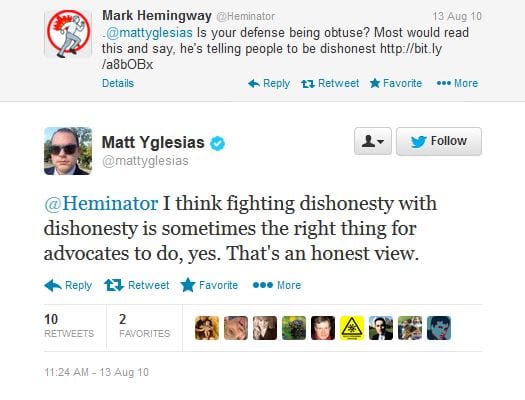
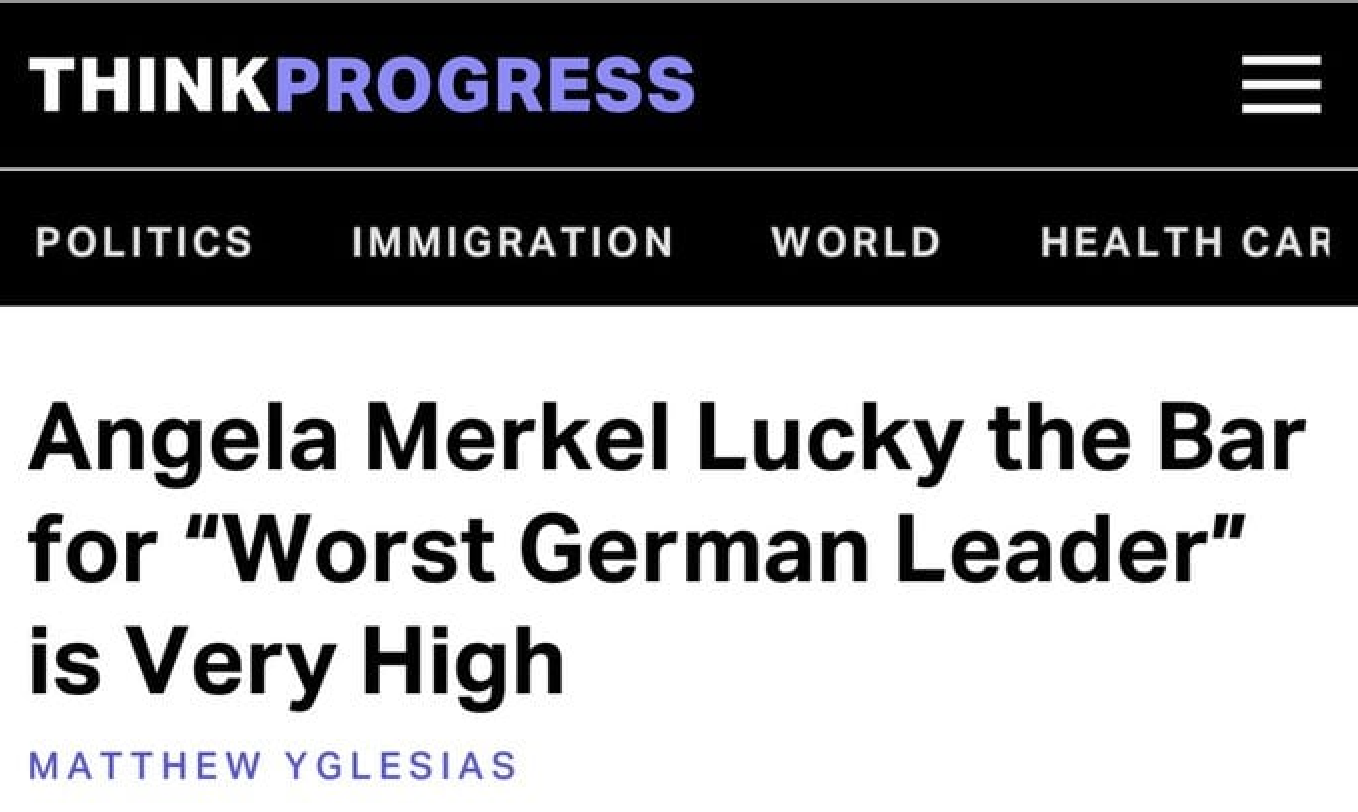
If by chance women of the world actually are getting cybernetically jiggy with it en masse next year, nobody tell notorious robophobe Matthew Yglesias.
InstaPundit is a participant in the Amazon Services LLC Associates Program, an affiliate advertising program designed to provide a
means for sites to earn advertising fees by advertising and linking to Amazon.com.