
Archive for 2024
June 10, 2024
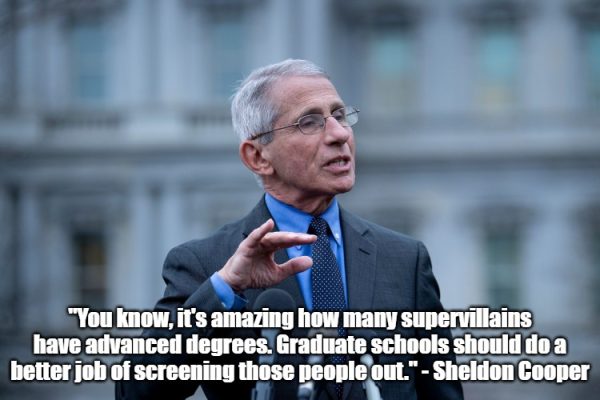
WHEN THIS IS THE BEST DEFENSE THEY CAN OFFER: “He is not a comic book super-villain.” — Rep. Jamie Raskin (D-Md.) discussing Anthony Fauci, MD, and the House subcommittee investigation on COVID-19’s origins. Not sure if he was responding to this very popular meme:
POP SOME CORN BUT BE PREPARED FOR DEM DIRTY TRICKS TO MAKE THE GOP CONVENTION LOOK EVEN WORSE: ‘This Will Not Be 1968,’ Says Chicago PD. It May Be Worse. “The police may be better trained but so are the protesters. And therein lie the seeds of trouble.”
“THEY WERE ALL, OF COURSE, CIVILIANS.”
Gaza Health Ministry Confirms 8 Billion Dead In Israeli Hostage Rescue https://t.co/XyoHi8iy7Q pic.twitter.com/ilGGGWxFVX
— The Babylon Bee (@TheBabylonBee) June 8, 2024
Related:
Liam Neeson Criticized For Killing 31 Innocent Human Traffickers Just To Get Back One Hostage https://t.co/CxaWBJ6T42 pic.twitter.com/ZEFdyHhuPb
— The Babylon Bee (@TheBabylonBee) June 8, 2024
LIMITED TIME DEAL: Van Heusen Mens Short Sleeve Dress Shirt. #CommissionEarned
THE MEDIA WILL CARE ENOUGH TO COVER IT UP:
George Soros funneled $19 million dollars into leftist groups attacking Justice Alito. https://t.co/l65wWrFxGS
— Media Research Center (@theMRC) June 9, 2024
CAN BLUE STATES AND CITIES RECOVER?
Blue states and cities are usually unconcerned about the throwaway culture when it comes to people, anyway. They’re usually “solving the climate crisis” or perhaps solving the Middle East, tasks that are not within their job description or their competency. Meanwhile, their actual tasks of providing safety and public order are often left in the dust.
Minneapolis, which makes its twin across the Mississippi look relatively sane, is in a world of hurt. Center for the American Experiment president John Hinderaker wrote on the fourth anniversary of the George Floyd arrest about the “world of hurt” that is a city he came to in 1974 because of its “easy commutes, low crime, pleasant neighborhoods, cultural amenities and relatively good schools.” Now, if commutes are still ok, that’s only because the city is a hollowed-out shell of itself with a high percentage of vacancies and very little foot traffic. One local at the conference told me he met someone for lunch in Minneapolis for the first time in years. He described it as many do—a “ghost town.” At the very nice restaurant he went to, there were only about five tables with customers. He shook his head and muttered, “This can’t go on.”
Another old friend who works in Minneapolis described his own company’s downsizing of their office space due to an inability to get workers to come into town. He is six feet, four inches tall and about 240, but he’s afraid of becoming a crime statistic, too. As Hinderaker observes, the declines in crime over the last year or so still haven’t brought the city back to pre-2020 levels. Even before I left in 2021, a colleague told me that police wouldn’t respond to his daughter’s mugging because she wasn’t hurt. Indeed, the recent ambush and murder of Minneapolis Policeman Jamal Mitchell happened in part because the hero was working without a partner on a mandatory overtime shift due to the staffing problems.
As James Lileks told Jon Gabriel last year when Gabriel asked if Minneapolis was going to the proverbial dogs:
Big question, and so many different ways to answer it. Is there hope? Yes of course there is. Are we going to the dogs? No. Are things worse than they were? Yes.
People believe somehow that downtown is in a state like San Francisco, where it’s just hordes of drug addicted zombies and the mentally ill staggering about accosting people. And that’s not the case. I mean I work downtown, and I never felt unsafe downtown walking around anywhere. It’s not particularly populated; it’s emptied out in a horrible fashion because of the pandemic, and everybody who went to work from home didn’t want to go back, because they hate to commute, and they like their jammies and their dog and the rest of it, So why go downtown? Well, you know the knockoff effects on that have been catastrophic to the local economic ecosystem.
We have all of the buildings downtown here connected on the second floor by skyways, which is great when it’s 20 below — really great when it’s 20 below. But unfortunately, the loss of something we used to call customers means that all the little shops that had the things to buy; the stores, the drugstores, the shoeshine places, the restaurants, have been just hammered.
So, what was a vibrant (and I hate to use that word because it’s always overused) and bustling — another cliche — but what was vibrant and bustling is now 20, 30 percent of what it used to be. And it’s hard because you walk around, and you see empty storefront after empty storefront. And you recall what was and you think, well, that’s not coming back is it, for an awful long time?
Now the solutions that are being put in place are the usual usual, usual. Nobody ever says, hey tell you what, we get a bad thing going on here let’s drop rents, let’s drop our tax rates, let’s cut regulations, let’s make it really easy for somebody to start up a business. Noooo. No, we have plans to, well, if we move the buses from this street to this street , we can create a vibrant and bustling Entertainment District in the night. And liberalize the liquor laws a little bit so people can walk around without fear of getting tagged if they’ve got a mango margarita. Maybe that’ll do it!
No, that’s not going to do it.
What’s going to do it is to have a sense of safety. And what we have, unfortunately, is a sense that there are feral elements at the margins, and nobody really seems to know what to do about that. I mean, you might say, okay your light rail system is a moving homeless shelter, with people just nodding off and doing meth and people feel really unsafe there. You might go back to your old Dragnet-era prescriptions and say okay well then, we should send people in there to remove them. But now you can’t really do that, because homelessness is a problem; economic inequality and the rest of it, and until we solve these problems, we’re just moving them around from one place to the other. So, we can’t do anything about the immediate disorder, because we haven’t solved the structural problems that created it in the first place.
Okay how about crime? Well we can’t really put people in jail. I mean, incarceration is a sign that we as a society have failed these people. So we can’t do that. And policing is good but if we let the police pull people over for what used to be the usual (now regarded as specious) reasons: You got a taillight out; you’ve got an equipment violation; you don’t have your tags on you; you’ve got no license plate. And if you pull them over, well, if there’s a disparate impact, with that then it shows that structural racism is the impetus again behind our law and order campaign. So we really can’t do that until we eliminate the problems with structural racism et cetera. So everybody knows what can be done; I mean, it’s not hard to have basic civil order in a society. But the will to do it is hampered by a little sort of squick factor that it’s not right to do these things. We did these before and what happened? We generally had a clean, well-ordered society with a social compact and high social trust and all the rest of it you know, but we don’t have that much anymore. Yeah that’s all really unfortunate. But like I say I don’t feel unsafe, I don’t.
But at the same time, my wife was almost held up at gunpoint about two blocks from our house…
More from Lileks and Gabriel here:
LARRY KUDLOW: ‘Look under the hood’ of Biden’s May jobs report and you’ll see the problem.
Once again, full-time jobs fell 605,000 in May. This is not a monthly problem — this is a long-playing record. It’s mirror image: Part-time jobs gained 286,000. So if full-timers are plunging and part-timers are surging, that cannot be a healthy economic sign. Additionally, in just May alone, 414,000 immigrants, both legal and illegal, gained jobs, while 663,000 native-born Americans lost jobs. This discouraging pattern has been going on for quite some time, but the trend line has accelerated significantly during the Biden years.
Now, in terms of the ongoing Biden affordability crisis, if you call through the numbers over the past 12 months, the combination of average hourly earnings — that’s wages — for production people — working folks — that times, hours worked, you get a proxy for their income, and that income number comes to only 3.4% increase, which is about the same as the consumer price index, which means they’re not getting ahead of the ongoing inflation.
Indeed, over Biden’s entire term, real wages have fallen while all these prices have exploded.
Everything is going swimmingly.
ARNOLD KLING: How to Fix Higher Education: Get rid of all the people who don’t belong.
This country is sending way too many young people to college. Instead, they should be going to training programs to become allied health professionals, or electricians, or solar panel installers, or something.
There are also many faculty members who do not belong on college campus. Obviously, you have the grievance studies departments. But if you were to dial back the number of students in the humanities and social sciences to a number that is actually qualified to study those subjects, you would have to cut the majority of faculty positions.
There are way too many administrators on campus. It is not just the DEI bureaucrats who could be jettisoned. Many of the administrators are there to coddle the students who should not have been admitted in the first place. Tighten up the admissions standards and you can get by with fewer administrators.
There are too many ungrateful foreign students on campus. A lot them engage in rampant cheating. Some of them participate in violent demonstrations. We should only be admitting students who are motivated to learn. Stop taking unmotivated foreign students just to collect their tuition money.
The trouble with higher education is bloat. The student bodies are bloated. The faculties are bloated. And the administrations are bloated.
He’s right, you know.
NORMALS NOT WANTED: What’s the Real Reason Caitlin Clark Was Snubbed From the Olympics?
ON SUNDAYS I DO A PROMO POST FOR (MOSTLY) INDIE AUTHORS: Book Promo And Vignettes By Luke, Mary Catelli and ‘Nother Mike.
There’s also a vignette challenge that has sparked a hundred novels. (Okay, probably only two dozen.)
THIS ISN’T SUPPOSED TO HAPPEN IN THE UNITED STATES OF AMERICA: RealClearPolitics: The Myth That Biden Had Nothing To Do with the Prosecutions of Trump. “Given Politico was publicly reporting six months ago about Biden’s anger at the pace of his DOJ’s prosecution of Trump, does anyone believe his special counsel, Jack Smith, was not aware of such presidential displeasure and pressure? Note Smith had petitioned and was denied an unusual request to the court to speed up the course of his Trump indictment.”
NEWS YOU PROBABLY CAN USE (NO SERIOUSLY. WE HAVE THEM IN THIS STORE NEAR US, IN FLYOVER COUNTRY. YOU PROBABLY DO TOO): The joy of Portuguese wines.
They’re even (relatively) cheap.
I’VE FLOWN THE APPEAL TO HEAVEN FLAG SINCE 2008. SUDDENLY IT’S CONTROVERSIAL: The Top 11 Flags You Should Fly To Trigger Communist Enemies Of The People.
If you object, do come to the door and tell me why. Should be fun. You can tell me why you have problems with the I stand with Israel sticker on the door while we’re at it. Oh, the fun we will have.
OH, NOES, THE HORRORS. WE’RE NOT LISTENING TO THE EXPERTS. HOW VERY DARE WE? Offline: The system is not working.
NOW THIS MILEI? WE NEED ONE LIKE HIM: Argentina’s Milei announces plans to lay off 50,000 more federal employees and cut the state bureaucracy by half.
THEY ARE DETERMINED TO LAWFARE US INTO SILENCE: Doctor Who Blew the Whistle on ‘Gender-Affirming Care’ Hit With Felony Charges.
MILLEY VANILLI WAS TERRIFIED HIS BUDDIES COLOR REVOLUTION WOULD BE OVERTURNED: The Silent Insurrection: General Milley’s Hand on January 6.
The guilty flee when no man pursues.
WE ARE NOT ALONE: Ayaan Hirsi Ali: We Have Been Subverted.
FIRST WE NEED TO USE A LOT OF AIRPLANES: Part 2: New solutions to fix the federal immigration system.
YOU DON’T NEED A JD TO KNOW THAT: Retired immigration judge says the federal immigration system is broken.