EVERYTHING IS GOING SWIMMINGLY: White House Report Card: Bad polls closer to pushing Biden out of the race.
I’d feel sorry about him, except that he’s terrible.

EVERYTHING IS GOING SWIMMINGLY: White House Report Card: Bad polls closer to pushing Biden out of the race.
I’d feel sorry about him, except that he’s terrible.
ROGER KIMBALL: Flirtation With Evil Will Not End Well for Leftists. I think they’re doing more than flirting.
LOL:
A sign at the Harvard-Yale football game reads: “Exchange each hostage for 100 Pro-Hamas Harvard Students & Faculty.” pic.twitter.com/Feo6MsVQEe
— Aaron Sibarium (@aaronsibarium) November 18, 2023
NOTHING TO SEE HERE, MOVE ALONG: Layoffs and bankruptcies pile up in logistics amid shocking downturn: We’re seeing too many trucks for too little freight. “Some analysts and industry experts said the freight slowdown was a reversion to the mean. Unfortunately, it is not. We are in one of the worst downturns in freight market history, caused by a massive buildup of capacity, and it’s going to take time to burn it all off. Simply put, the freight market is experiencing a severe recession. . . . Since early in 2022, many companies have gone out of business or severely cut back by letting employees go. Some of those companies were household names in the industry, such as Yellow Corp. and Convoy. Many others were much smaller, not known perhaps beyond their headquarters location. Nonetheless, the bankruptcies, closures and layoffs have piled up, and the financial and human losses have taken a toll.”
This may help explain why gas prices are down.
K-12 IMPLOSION UPDATE:
The next belated discovery of educators will be that Woke math and science has condemned a whole generation to innumeracy.https://t.co/34kmWdnWLz
— wretchardthecat (@wretchardthecat) November 19, 2023
JOHN LUCAS: A Thank-You from My 1st Cavalry Trooper.
SCIENCE: Sudden Cardiac Death in College Athletes.
A carefully done paper presented at the recent AHA meeting and published in Circulation found no increase in sudden cardiac death in NCAA athletes. In fact, the authors reported a decline in sudden cardiac death during the years 2021-2022.
This was a 20-year survey in which the authors used 4 independent databases to document the incidence and causes of sudden cardiac death in NCAA athletes.
They found 143 cases of sudden cardiac death over the 20 years. The overall incidence of SCD was 1:63,682 athlete-years, which is inline with published incidence rates from other studies.
Here are the plots of incidence rates over time. You can see a clear decline in the rates over the years. The last two years are the lowest. (Red line.) . . .
The authors acknowledge limitations. The main one I think is the absence of data on resuscitated arrests. This is important because of the positive trend of increased availability of automatic external defibrillators or AEDs. Namely, it’s possible that there was an increase in cardiac arrests, but not cardiac death—due to better interventions. (In fact, the lower incidence of sudden death in recent years is likely to be due to AEDs).
AEDs should be everywhere.
Plus: “Yet the lack of any signal of increased sudden cardiac death among NCAA athletes is reassuring. It argues against the idea that mRNA vaccines was causing excess cardiac deaths in young athletes. This doesn’t mean mandating the SARS-CoV-2 mRNA vaccine in some of the lowest risk groups was a wise decision. In my opinion, the downplay of the myocarditis signal from the vaccine as well as the mandates shredded public trust. It’s a mistake I hope medical leaders learn from. Yet this study again confirms that anecdotes don’t always sum to evidence.”
Nope. Anecdotes are a reason to look into things. They raise questions, they don’t answer them.
RICHARD LANDES, Jihadi Journalism.
OPEN THREAD: Nighty night.
THEY’RE ALWAYS IN THE LAST PLACE YOU LOOK: Mathematicians Have Found The Ninth Dedekind Number, After 32 Years of Searching.
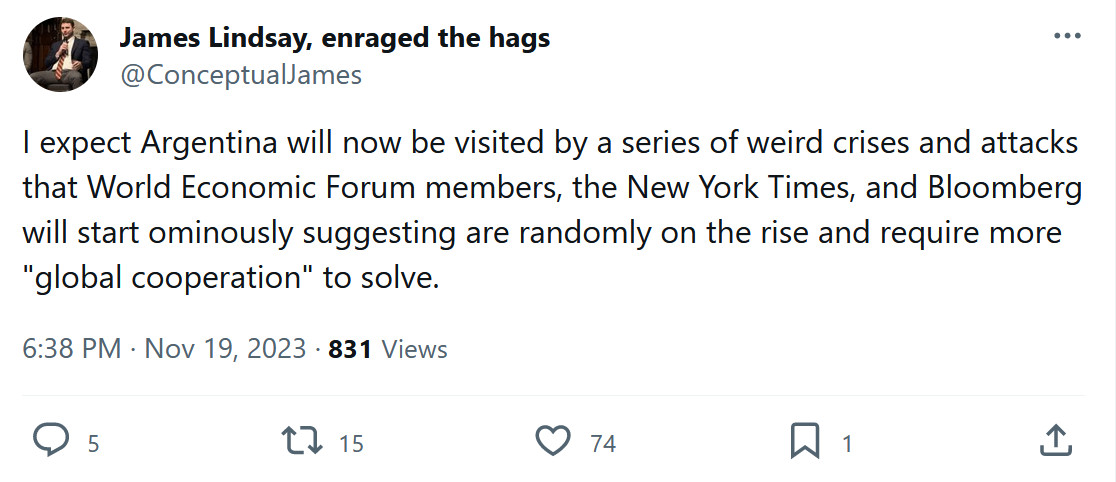
THE INTERNATIONAL PRESS CALLS HIM “FAR RIGHT’ AND WOULD HAVE PREFERRED THE PERONIST: Argentina elects ‘shock therapy’ libertarian Javier Milei as president. “Official results showed Milei with near 56% versus 44% for his rival, Peronist Economy Minister Sergio Massa, who conceded in a speech. His candidacy was hampered by the country’s worst economic crisis in two decades while he has been at the helm. . . . Milei is pledging economic shock therapy. His plans include shutting the central bank, ditching the peso, and slashing spending, potentially painful reforms that resonated with voters angry at the economic malaise.”
Could we get something like that going here? Probably not until after the collapse.
Plus, young voters seem to have delivered the election to him: “Milei has been particularly popular among the young, who have grown up seeing their country lurch from one crisis to another.”
UPDATE (From Ed): Looking 20 minutes into the future:
NOT FOR THE BETTER: Children’s brains shaped by their time on tech devices, research to-date shows.
HOW IMPORTANT IS ACADEMIA TO GROWTH? Less than advertised, probably:
In a 1991 study, University of Pennsylvania economist Edwin Mansfield, whose specialty was studying technology, reported the results of a survey he conducted on seventy-six firms in seven manufacturing industries. His goal, wrote Niskanen, was to “determine the share of the firms’ new products and processes that could not have been developed without academic research conducted within the prior fifteen years.” Only 11 percent of new products and 9 percent of new processes, Mansfield found, “could not have been developed, without substantial delay, in the absence of recent academic research.” Moreover, the products and processes that depended on academic research, pointed out Niskanen, “accounted for only 3 percent of sales and 1 percent of the industry savings attributable to technological innovation.”
In short, strong evidence should make one doubt the claim that basic research is crucial for advances in technology.
Nassim Taleb has argued that higher education doesn’t produce rich societies — it’s a luxury good purchased by societies after they become rich. So the causal arrow runs in the opposite direction most people assume when they notice that rich societies have big academic sectors.
ADVICE: Worried About an Unexpected Knock at the Door? Don’t Open it With a Gun in Your Hand.
Of course not. The drawn gun should be in the hands of your spouse, out of sightline from the door but with a clear shot at anyone who enters. Duh.
HEY, IF IT MAKES YOU FEEL BETTER: The Placebo Effect in Action: Research and Everyday Life. “The placebo effect occurs more often with subjective symptoms, such as pain, rather than objective medical evidence, such as a tumor identified on a computed tomography (CT) scan. In other words, a placebo treatment may help improve your pain, but it is not going to kill cancer cells the way actual chemotherapy drugs do.” That said, killing actual cancer cells would be good.
IS THERE AN ELECTION COMING OR SOMETHING? Gas prices have dropped below $3 per gallon in these 11 states.
YES, BUT CRONY BUSINESSES’ NEEDS ARE PARAMOUNT: Family Businesses Can’t Afford to Lose Access to Reliable Electricity.
HOW’S THAT RECRUITMENT CRISIS GOING? Beg Harder: Army Begging Soldiers Kicked Out Over Vax to Come Back.
I’VE SEEN THE LOCKDOWNS AND THE DAMAGE DONE: NYT Piece Calls Learning Loss “Startling” — But It’s Not. “It’s hard to describe how angry this “revelatory” piece of writing makes me. No, I don’t feel any sense of redemption. I just feel angry that it took them this long. And that the journalistic outlet fails to acknowledge their own complicity in these devastating results.”
InstaPundit is a participant in the Amazon Services LLC Associates Program, an affiliate advertising program designed to provide a means for sites to earn advertising fees by advertising and linking to Amazon.com.