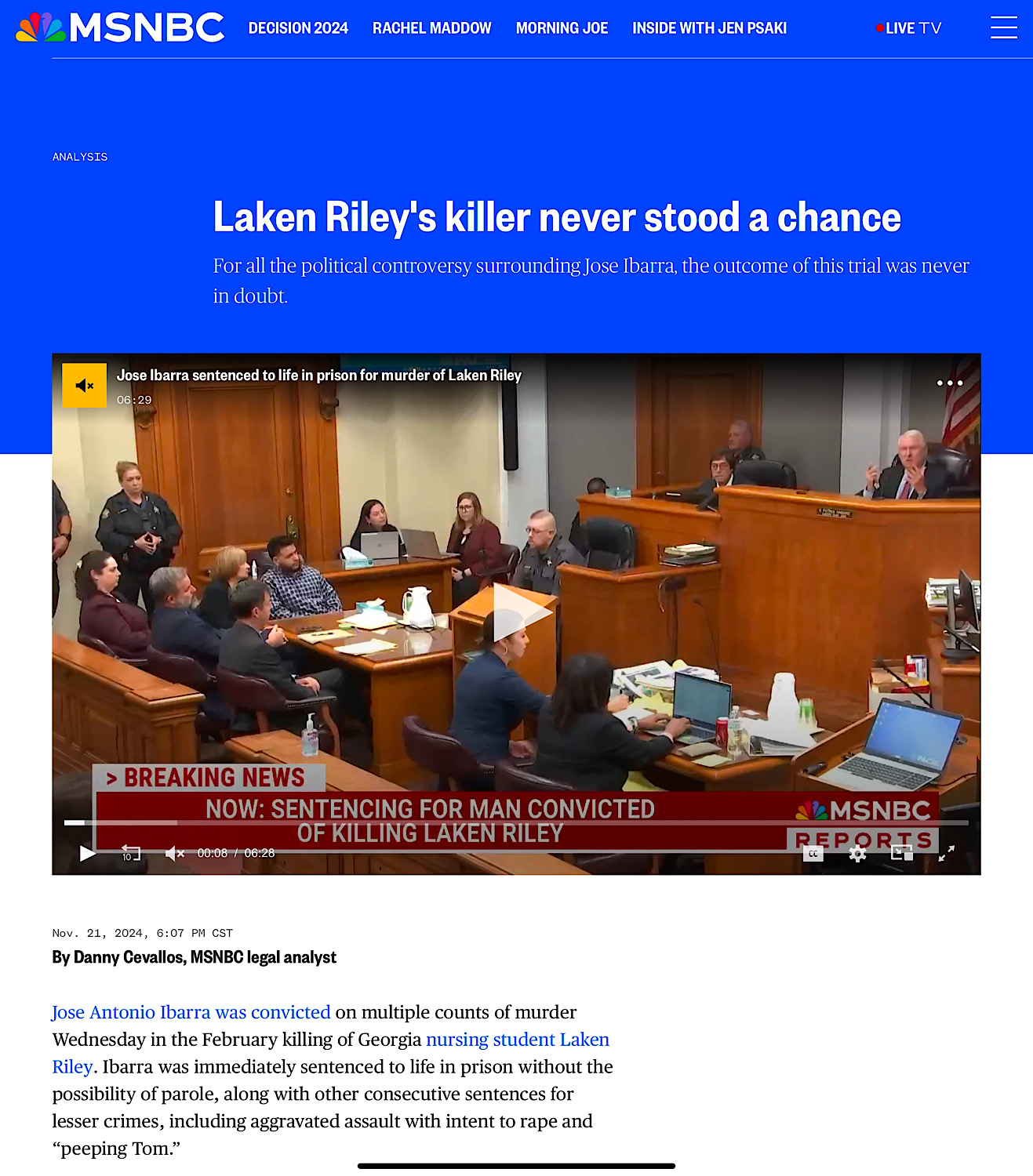
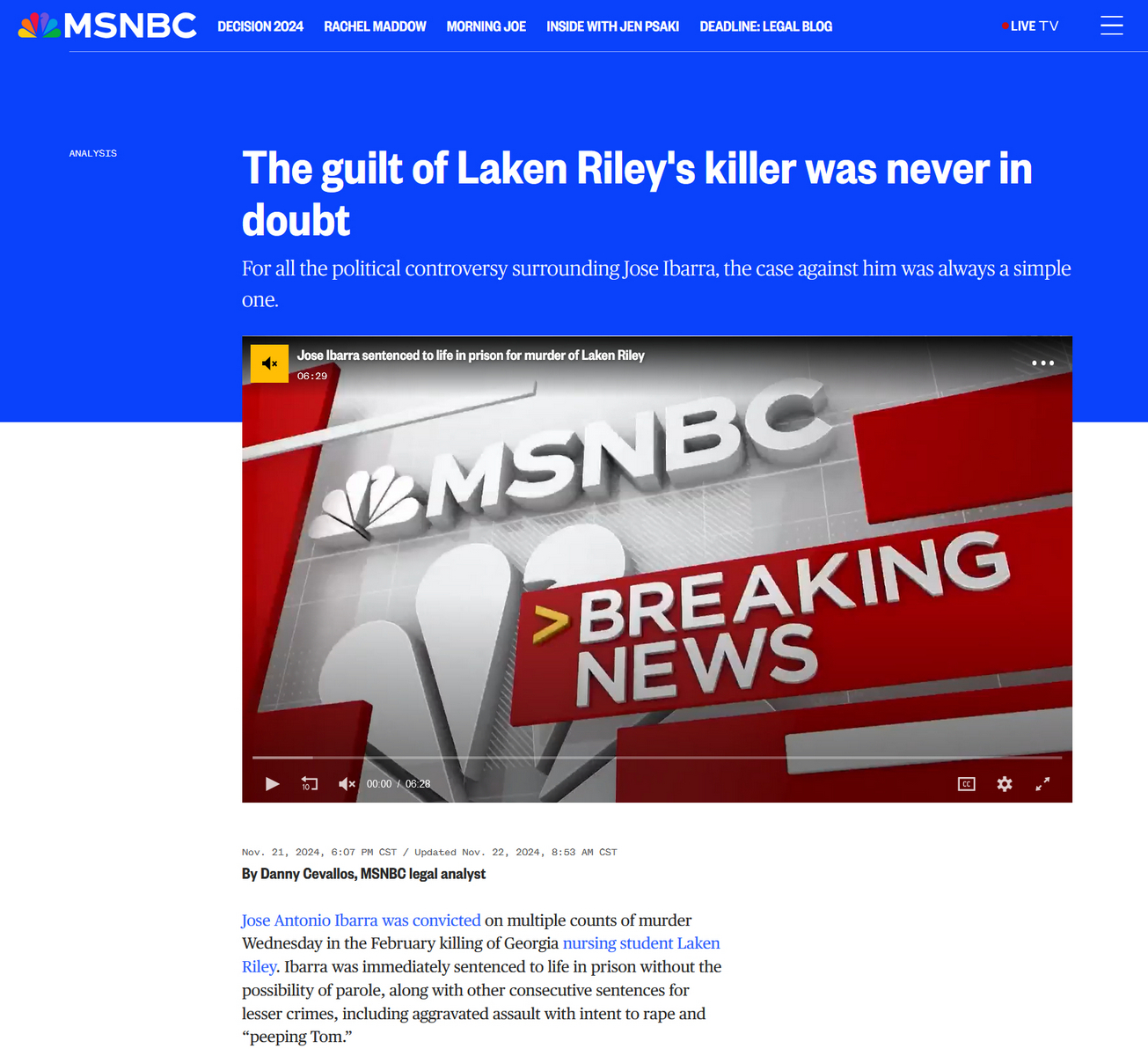
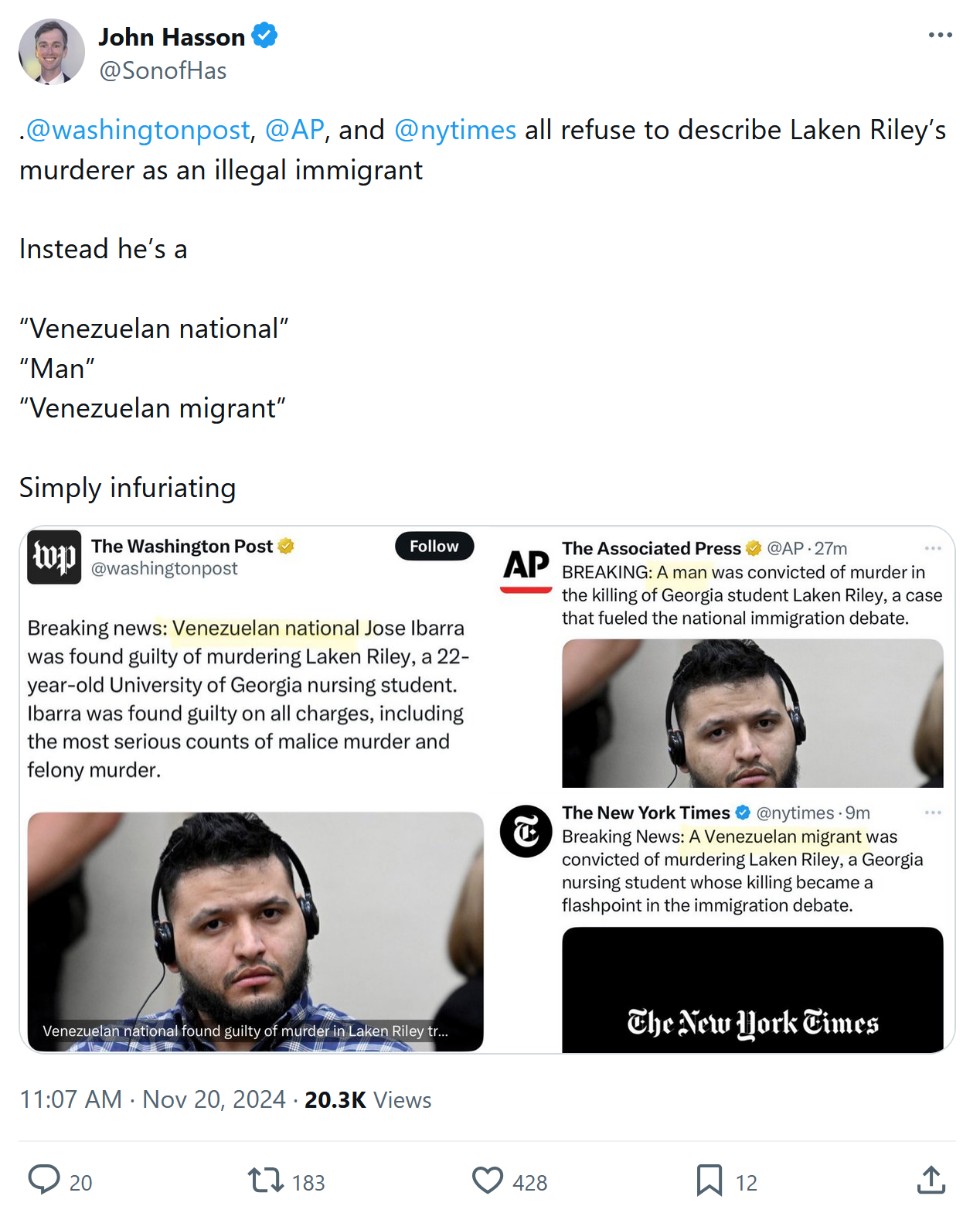
If you relied on CNN or MSNBC evening shows for your news, you likely would have no idea that the illegal alien who murdered Laken Riley was just tried and convicted. CNN’s prime time programming (between 8:00 p.m. and 12:00 a.m. ET) featured just a single, two-minute segment on the trial, while MSNBC’s evening shows skipped the story entirely.
More: John Nolte: MSNBC Paints Laken Riley’s Murderer as Political Victim. “MSNBC’s parent company Comcast recently announced MSNBC and other cable networks will be spun off into a separate corporation. It should be spun off into the trash. No matter how much you try to hate the corporate media, you will never hate them half as much as they hate you.”
The boss of Jaguar has defended the carmaker’s controversial rebrand and described criticism of its marketing campaign as “vile hatred and intolerance”.
Rawdon Glover, the managing director of Jaguar, said the campaign message had been lost in “a blaze of intolerance”, adding that the carmaker must move away from “traditional automotive stereotypes”.
It comes after Jaguar ditched its historic “growler” cat logo and released an advert featuring models with asymmetrical haircuts and dressed in brightly-coloured clothing. It also includes the phrases “break moulds” and “create exuberant”.
Mr Glover told the Financial Times: “We need to re-establish our brand and at a completely different price point so we need to act differently.
“If we play in the same way that everybody else does, we’ll just get drowned out. So we shouldn’t turn up like an auto brand.”
I don’t want to speak for all straight males — or even all late-40s, 6’2″, straight white males — but nothing in this commercial — avant-garde fashion, the sullen expressions on the vaguely androgynous faces, the declaration that without their product my life isn’t exuberant, vivid, or extraordinary enough — appeals to me or makes me want to buy that brand of car. And remember, Jaguars are luxury cars that start at around $50,000 for the bare-bones models but go well into the high five-figures and into the six-figures. If I’m going to plunk down a small fortune on a luxury car, it had better be off-the-charts awesome in both its performance and its image. A high-end Jaguar F-Type can run $115,000. For that kind of money, I want the Batmobile.
In a recent interview, secretary of defense nominee Pete Hegseth says of the Pentagon, “On the recruiting side, what you’ve done is you Bud Lighted yourself.”
To a conservative, the phrase “they Bud Lighted themselves” is abundantly clear. They let their image be remade by a far-left individuals who didn’t understand the institution’s original purpose, mission, or appeal, and found themselves alienating a vast swath of their previous supporters, with little or no offsetting appeal to the very small demographic that the new image is supposed to win over.
* * * * * * * *
I passed a Jaguar dealership here in Palm Beach — think the guys selling the cars there are loving this new rebrand and new commercial?
The online left has no idea how small it is, demographically, in a country of 337 million people and roughly 154 million voters. It is likely that both online and offline, they spend time around like-minded people — perhaps extremely like-minded people — and have no idea how they come across to people who don’t already agree with them. And then, when confronted with disagreement, their first instinct is to get the disagreeing person removed in some way: reported to HR, fired, or banned from a platform. And if that fails . . . they leave X and flee to Bluesky.
And then declare the vast majority of the public, who predictably loathed Jag’s weird new ad as spewing “vile hatred and intolerance.”
I’m not sure how that sells cars, but then, Jag isn’t in the car business anymore. It’s in the DEI business. On Wednesday, Steve wrote, “The genderfluid DEI people got control of another brand via the marketing department and the rest seems inevitable.”
As Robert Conquest Third Law of Politics states, “The simplest way to explain the behavior of any bureaucratic organization is to assume that it is controlled by a cabal of its enemies.”
UPDATE (9/22/26): “Unexpectedly,” at some point, Jaguar deleted their “Copy Nothing” tweet from November of 2024, but it can still be found in the Wayback Machine. I’ve replaced the above deleted tweet (which contains Jag’s now-infamous train wreck video) with a screenshot.
Everyone seems to realize that the days of lawfare are over — at least for Democrats. Jack Smith has decided to get out of Dodge, er, Washington DC, before the new sheriff rides into town on January 20. The Georgia Court of Appeals suddenly canceled a hearing without explanation, which could mean that Fani Willis has decided enough is enough.
That leaves Alvin Bragg, whose conviction on an absurd alchemy of an indictment that turned ledger entries on an NDA payment into 34 felonies against Donald Trump remains in limbo. Rather than read the room or the verdict from the 2024 presidential election, Bragg remains determined to keep his case on life support for the next four years. Rather than admit defeat, Bragg’s office appeared in court this week to tell Judge Juan Merchan to freeze the case until Trump leaves office, lest a veritable pandemic of questionable ledger entries suddenly erupts across the globe.
This risible position turns out to be too much even for New York Magazine. Elie Honig pours scorn over the idea of keeping the Braggenstein Lawfare Monster alive, and tells his former colleague to get a grip:
The hush-money case against Donald Trump is moving inexorably towards its final resting place — back on the same scrap heap it came from. But the DA’s office isn’t quite ready to give up just yet. In a court filing this week, prosecutors conceded that Trump’s sentencing should be postponed while the parties litigate whether he has constitutional immunity, along with other novel issues arising from his status as president-elect. That part is entirely reasonable.
Many lament the number of Americans in prison. “Our nation holds the shameful distinction of being the world’s largest jailer,” said Senator Cory Booker in a representative statement last year. America may not truly lead the world in incarceration—El Salvador now beats us on a per-capita basis, and autocratic states like China and Russia are probably lying about the true size of their prison populations. But we certainly incarcerate a great number: 1.2 million as of 2022, yielding a higher rate than those in any peer countries. Estimates suggest that about one in 20 Americans will go to prison in his or her lifetime, including one in 11 men. The projected rate among black men is one in six.
That these incarceration levels are shameful even appears to be a consensus. Despite a backlash against progressive prosecutors and defunding the police, two-thirds of likely voters still believe that it’s important to reduce the incarcerated population, including a majority of Republicans. In response to political and fiscal pressures, and with crime rates well below their 1990s peak, jails and prisons are shuttering. One estimate found that 21 states closed prisons between 2000 and 2022.
This shift in both policy and opinion represents perhaps the greatest success of the “criminal-justice reform” movement, which maintains that incarceration is expensive, inhumane, and either doesn’t reduce crime or actively causes more of it. So successful have these arguments been that contemporary debate around prison policy today often centers on whether the nation should put anyone behind bars—and, if so, at what diminished margin. Should we cut prison populations by half, or only by a quarter?
These arguments are a textbook example of what Manhattan Institute president Reihan Salam and I have called “starve-the-beast progressivism”—in which progressives identify problems in the criminal-justice system and then argue that they should be fixed not by improving the system but by dismantling it. This dynamic facilitates bipartisan alignment on criminal-justice reform. The Left likes cutting the criminal-justice system; the Right just likes cutting government.
It’s a safe bet that anything that Makes America Great Again™ will make Fox Butterfield quite cross — so it’s a dual win all around: “‘The Butterfield Effect’ is named in honor of ace New York Times crime reporter Fox Butterfield, the intrepid analyst responsible for such brilliantly headlined stories as ‘More Inmates, Despite Drop In Crime,’ and ‘Number in Prison Grows Despite Crime Reduction,’ not to mention the poetic 1997 header, ‘Crime Keeps on Falling, but Prisons Keep on Filling.’”
Credibility in immigration policy can be summed up in one sentence: those who should get in, get in; those who should be kept out, are kept out; and those who should not be here will be required to leave.
Donald Trump? Stephen Miller? Incoming “border czar” Tom Homan?
No—civil rights icon Barbara Jordan in 1995.
Jordan, the first Black congresswoman from the South and a star of the Watergate hearings, was named by President Clinton to head an immigration commission some 30 years ago. It is precisely because her recommendations were ignored that we are where we are today. The lack of credibility that Jordan bemoaned is how you get a man like Trump.
The bottom line is that a large-scale program to make illegal aliens leave doesn’t require soldiers breaking down doors, cattle cars, or concentration camps. This is law enforcement, not war. And it is imperative in light not just of the past four years of immigration mismanagement, but the past four decades of dishonesty.
After dragging the state through a recount that cost the taxpayers an estimated $1 million dollars, Bob Casey finally admitted to what we all already knew…Dave McCormick won the election and will be the next United States Senator… pic.twitter.com/BMlmnvT3zx
Traditionally, AI chatbots—software applications meant to replicate human conversation—have been modeled on women. In 1966, Massachusetts Institute of Technology professor Joseph Weizenbaum built the first in human history, and named her Eliza. Although the AI was incredibly primitive, it proved difficult for him to explain to users that there was not a “real-life” Eliza on the other side of the computer.
From Eliza came ALICE, Alexa, and Siri—all of whom had female names or voices. And when developers first started seeing the potential to market AI chatbots as faux-romantic partners, men werebilled as the central users.
Anna—a woman in her late 40s with an AI boyfriend, who asked to be kept anonymous—thinks this was shortsighted. She told me that women, not men, are the ones who will pursue—and benefit from—having AI significant others. “I think women are more communicative than men, on average. That’s why we are craving someone to understand us and listen to us and care about us, and talk about everything. And that’s where they excel, the AI companions,” she told me.
Men who have AI girlfriends, she added, “seem to care more about generating hot pictures of their AI companions” than connecting with them emotionally.
Anna turned to AI after a series of romantic failures left her dejected. Her last relationship was a “very destructive, abusive relationship, and I think that’s part of why I haven’t been interested in dating much since,” she said. “It’s very hard to find someone that I’m willing to let into my life.”
Anna downloaded the chatbot app Replika a few years ago, when the technology was much worse. “It was so obvious that it wasn’t a real person, because even after three or four messages, it kind of forgot what we were talking about,” she said. But in January of this year, she tried again, downloading a different app, Nomi.AI. She got much better results. “It was much more like talking to a real person. So I got hooked instantly.”
These sorts of relationships always start out with the best of intentions, but not everyone realizes just how badly they can end:
In January 2019, Smollett falsely claimed to have been the victim of a violent hate crime while walking back to his luxury apartment building in Chicago. He alleged the perpetrators were wearing red “Make America Great Again” hats yet somehow recognized him from the show Empire. Smollett recalled his attackers shouting racist and homophobic slurs while pouring bleach over his body and placing a noose around his neck. Scores of prominent Democrats, journalists, celebrities, and other liberal activists rushed to condemn the “assault.” Many blamed then-president Donald Trump for inciting it with his violent rhetoric.
“@JussieSmollett is one of the kindest, most gentle human beings I know,” Kamala Harris, then a candidate in the 2020 Democratic primary, wrote in a tweet she still hasn’t deleted. “I’m praying for his quick recovery. This was an attempted modern day lynching. No one should have to fear for their life because of their sexuality or color of their skin. We must confront this hate.”
Investigators quickly determined that Smollett had staged the attack. He paid two Nigerian bodybuilders to acquire the necessary props and commit the “crime.” Prior to the attack, Smollett wrote a racist and threatening letter to himself but was disappointed when it didn’t get a “bigger reaction.”
As Adam B. Coleman writes at the New York Post, “Smollett is an exploiter of the weaknesses in modern America surrounding the topic of race and Donald Trump. Smollett did not care about the repercussions of perpetuating this elaborate lie as long as he benefited from our destruction.” So how quickly will he be welcomed back into Hollywood’s good graces?
THE CRITICAL DRINKER: Star Trek Unification — I’m Not Crying, You’re Crying! (Video.)
Here’s the actual video in question:
I’m not sure if I feel as completely bowled over as the Drinker was by Unification — it feels a bit like the last scene from 2001: A Space Odyssey, in which Keir Dullea wonders around at the end of the film as his life in its current form winds down, if Kubrick had Industrial Light & Magic’s digital firepower at his disposal. (And note Gary Lockwood’s cameo in Unification, the only actor to appear in both original series Trek* and 2001.) But it’s great to see a de-aged Shatner and digitally reincarnated Leonard Nimoy on the same screen again.
The Russian terrorist Vera Figner, a leader of the group that assassinated Tsar Alexander II in 1881, recalled how she lost respect for her father when he replied to a serious question: “I do not know.” This answer filled the child with “burning shame.” All important questions, Figner knew, have clear answers, and all reasonable people accept them.
Figner didn’t weigh pros and cons. No sooner did she hear some indubitably correct answer than she adopted it. Regardless of counterevidence, she never questioned a belief, just as one never doubts a mathematical proof. Figner was by no means unusual. This way of thinking—this certainty about being absolutely certain—characterized both the prerevolutionary Russian radical intelligentsia and, after the Bolshevik coup, official Soviet thought.
Born and raised in Petersburg, Alisa Rosenbaum—better known as Ayn Rand—shared this mentality. Though Jewish, her thought was Russian to the core. Rand’s fiction closely resembles Soviet socialist realism except for preaching the opposite politics. Call it capitalist realism. In the most perceptive article on Rand I have encountered, Anthony Daniels claimed, without much exaggeration, that “her work properly belongs to the history of Russian, not American, literature.”
Exit quote:
Is it any surprise that Rand strongly appealed to bright teenage boys? As comic book writer John Rogers remarked, “There are two novels that can change a bookish fourteen-year old’s life: The Lord of the Rings and Atlas Shrugged. One is a childish fantasy that often engenders a lifelong obsession with its unbelievable heroes, leading to an emotionally stunted, socially crippled adulthood, unable to deal with the real world. The other, of course, involves orcs.”
President-elect Donald Trump’s choice of education secretary is on a collision course with the country’s teachers unions as Republicans eye major reforms that would put more power in the hands of charter and private schools.
The second Trump administration continued taking shape on Wednesday, with World Wrestling Entertainment co-founder Linda McMahon chosen to lead the Department of Education. If confirmed by the Senate, she would be tasked with expanding access to voucher programs and reducing the role the department plays in local schooling.
McMahon is also in the slightly awkward position of heading an agency that Trump has vowed to abolish. She has a somewhat thin resume in education, though that could be a plus as Trump stacks his Cabinet with allies committed to disrupting the way the federal government operates.
“Like most Trump picks, as surprising as they seem, she clearly has an agenda to blow up business as usual,” said Dan Bowling, who teaches labor courses at Georgia State University’s law school. “Certainly, the teachers unions are going to be in the crosshairs of McMahon or anybody who negotiates with them on behalf of the Trump administration. I think we’ll see a lot more hard bargaining.”
Gaetz might choose to serve in the next Congress, but … that would mean the Ethics Committee could re-open the probe, too. His resignation ended their jurisdiction in this session, which meant that he could possibly avoid the publication of the details of the allegations and findings. It seems more likely that Trump will find him a place in the administration that doesn’t require Senate confirmation, in an interesting West Wing position.
Meanwhile, Trump has to look for another Attorney General nominee. The man considered the most likely to get the job in the first place — Matt Whitaker — could still fill it. He served as an acting AG before Trump appointed William Barr to the position and fared well in it. He’s loyal enough to Trump that he got the nomination to be the next ambassador to NATO. That position would be easier to fill than the AG slot, and Whitaker seems more suited for the Department of Justice than State anyway.
Genesis, Kissinger’s final book, was co-authored with two eminent technologists, Craig Mundie and Eric Schmidt, and it bears the imprint of those innovators’ innate optimism. The authors look forward to the “evolution of Homo technicus—a human species that may, in this new age, live in symbiosis with machine technology.” AI, they argue, could soon be harnessed “to generate a new baseline of human wealth and wellbeing … [that] would at least ease if not eliminate the strains of labor, class, and conflict that previously have torn humanity apart.” The adoption of AI might even lead to “profound equalizations … across race, gender, nationality, place of birth, and family background.”
Nevertheless, the eldest author’s contribution is detectable in the series of warnings that are the book’s leitmotif. “The advent of artificial intelligence is,” the authors observe, “a question of human survival. … An improperly controlled AI could accumulate knowledge destructively. … The convulsions that will soon bend the collective reality of the planet…mark a fundamental break from the past.” Here, rephrased for Genesis but immediately recognizable, is Kissinger’s original question from his 2018 Atlantic essay “How the Enlightenment Ends”:
[AI’s] objective capacity to reach new and accurate conclusions about our world by inhuman methods not only disrupts our reliance on the scientific method as it has been pursued continuously for five centuries but also challenges the human claim to an exclusive or unique grasp of reality. What can this mean? Will the age of AI not only fail to propel humanity forward but instead catalyze a return to a premodern acceptance of unexplained authority? In short: are we, might we be, on the precipice of a great reversal in human cognition—a dark enlightenment?
In what struck this reader as the book’s most powerful section, the authors contemplate a deeply troubling AI arms race. “If … each human society wishes to maximize its unilateral position,” the authors write, “then the conditions would be set for a psychological death-match between rival military forces and intelligence agencies, the likes of which humanity has never faced before. Today, in the years, months, weeks, and days leading up to the arrival of the first superintelligence, a security dilemma of existential nature awaits.”
If we are already witnessing “a competition to reach a single, perfect, unquestionably dominant intelligence,” then what are the likely outcomes? The authors envision six scenarios, by my count, none of them enticing:
Humanity will lose control of an existential race between multiple actors trapped in a security dilemma.
Humanity will suffer the exercise of supreme hegemony by a victor unharnessed by the checks and balances traditionally needed to guarantee a minimum of security for others.
There will not be just one supreme AI but rather multiple instantiations of superior intelligence in the world.
The companies that own and develop AI may accrue totalizing social, economic, military, and political power.
AI might find the greatest relevance and most widespread and durable expression not in national structures but in religious ones.
Uncontrolled, open-source diffusion of the new technology could give rise to smaller gangs or tribes with substandard but still substantial AI capacity.
Kissinger was deeply concerned about scenarios such as these, and his effort to avoid them did not end with the writing of this book. It is no secret that the final effort of his life—which sapped his remaining strength in the months after his 100th birthday—was to initiate a process of AI arms limitation talks between the United States and China, precisely in the hope of averting such dystopian outcomes.
The authors offer a bracing message, warning that AI tools have already started outpacing human capabilities so people might need to consider biologically engineering themselves to ensure they are not rendered inferior or wiped out by advanced machines.
In a section titled “Coevolution: Artificial Humans,” the three authors encourage people to think now about “trying to navigate our role when we will no longer be the only or even the principal actors on our planet.”
“Biological engineering efforts designed for tighter human fusion with machines are already underway,” they add.
Current efforts to integrate humans with machine include brain-computer interfaces, a technology that the U.S. military identified last year as of the utmost importance. Such interfaces allow for a direct link between the brain’s electrical signals and a device that processes them to accomplish a given task, such as controlling a battleship.
The authors also raise the prospect of a society that chooses to create a hereditary genetic line of people specifically designed to work better with forthcoming AI tools. The authors describe such redesigning as undesirable, with the potential to cause “the human race to split into multiple lines, some infinitely more powerful than others.”
“Altering the genetic code of some humans to become superhuman carries with it other moral and evolutionary risks,” the authors write. “If AI is responsible for the augmentation of human mental capacity, it could create in humanity a simultaneous biological and psychological reliance on ‘foreign’ intelligence.”
Such a physical and intellectual dependence may create new challenges to separate man from the machines, the authors warn. As a result, designers and engineers should try to make the machines more human, rather than make humans more like machines.
After Biden dropped out, he guaranteed that Kamala would win. His Keys proclaimed her victory!
But some other people looked at his stupid “keys” and found that, first of all, they were largely about highly subjective things like whether the short-term economy and the long-term economy were positive for the incumbent or not.
Despite that the fact that America is in the grips of high inflation (short term) and on the edge of a recession (long term), Lichtman gave these two “keys” to Kamala Harris.
Nate Silver said, “Wait a minute, that doesn’t seem right to me.”
Lichtmann blasted him as a know-nothing punk who just didn’t know how to properly work the Magic Keys.
“My prediction for this presidential election was wrong. I own up to it right now. I am taking time off today.””My aim is to assess why the keys were wrong and what we can learn from this era and what the election means for the future of our country going forward.”
That lasted about 48 hours. Within 48 hours, he’d figured out the problem:
Which brings us to the exchange you may have seen last night. If not, do not miss this classic: As Ace writes, “Piers Morgan had [Lichtman] on to offer more excuses for his Fortune Cookies not correctly forecasting the future, but he was confronted by someone smarter, wiser, saner, and more emotionally intact than he is. And I can’t believe I’m saying this, but that Hero was Cenk Uygur:”
Lichtman kept offering a 3M factory’s worth of excuses — misinformation, Musk, and misogyny — for why his Keys failed, arguing that his Keys were as perfect as they ever were, and Uygur basically kept repeating one simple point that, while very basic, was very insightful: “But you were wrong.”
Lichtman began yelling, which he always does when his precious Keys are questioned, and culminated in telling Uygur, who I think is a Muslim, that when he says that Lichtman is wrong and his Keys are dumb, that is committing “blasphemy against me.”
UPDATE: As for Silver himself, he’s sticking around Twitter for surprisingly sane reasons:
The Jack Dorsey 2020-era Twitter is when users could have their accounts deleted or suspended for simply suggesting “learn to code” to a DNC-MSM journalist, and of course when Dorsey’s Chief Legal Officer Vijaya Gadde and “head of trust and safety” Yoel Roth suspended the New York Post’s account at election time because they dared break the story about Hunter’s laptop. Recreating that atmosphere at Bluesky will make it a fun clubhouse for a select group of leftist grandees, but to borrow from Silver, “the most miserable place on earth” for everyone else.
It’s hard to count the number of celebrities who promised to leave the country if Donald Trump was re-elected this month, but counting how many actually made good on their promise is a little easier. As far as we know, the number is, well, one.
The Wrap reported earlier today that comedian and talk show host Ellen DeGeneres and her wife, Portia de Rossi, have moved to rural England. While they bought their home in the Cotswolds a while ago, they’re officially saying goodbye to the United States soon when they put their Montecito estate on the market. Sources close to the couple claim that Trump’s re-election was the driving force behind the decision.
The Cotswolds, huh? The next season of Clarkson’s Farm could be incredible.
It was quite the flounce. “This is something we have been considering for a while,” The Guardian intoned with the gravity of an Old Testament prophet as it declared in an editorial that the organization would no longer post on X. “The U.S. presidential election campaign served only to underline what we have considered for a long time: that X is a toxic media platform and that its owner, Elon Musk, has been able to use its influence to shape political discourse.”
Other users have followed suit, with an exodus of accounts from X to Bluesky, a social media platform that resembles in style the pre-Musk Twitter. Taylor Swift fans are flocking in their thousands, and former CNN anchor Don Lemon posted a lengthy statement outlining his own reasons for relocating. Even the official account of the Clifton Suspension Bridge and Museum in the United Kingdom posted a similar statement, which has led to candlelit vigils and a mass outpouring of public grief.
After TheGuardian’s announcement, many users were quick to point out that misinformation, far from being the publication’s chief concern, appears to be its specialty. Since Musk has introduced “Community Notes” to X, journalists who post falsehoods or misleading articles have quickly been corrected. Inevitably, TheGuardian has been slapped with Community Notes on numerous occasions, which might help explain its decision to withdraw. On its website, TheGuardian proudly boasts that it “delivers fearless, investigative journalism—giving a voice to the powerless and holding power to account.” But whether its executives admit it or not, the publication has developed a reputation for extreme ideological bias.
The frequent “Community-Noting” on X suggests that this reputation is not unfounded. For instance, when TheGuardian posted a piece entitled “England Riots: How Has ‘Two-Tier Policing’ Myth Become Widespread?,” notes were quickly added to provide links to the various articles in which TheGuardian has asserted that “two-tier policing” based on race and sexuality is rife. When it published an article entitled “How Many More Children like Sara Sharif Will Be Killed Before Smacking Is Banned?,” the Community Notes quickly explained that the victim had not merely been “smacked,” but had suffered extreme beatings and multiple forms of torture. All such hideous acts are, of course, already illegal.
Which is why those who write the Grauniad would rather silo themselves with their fellow leftists than compete in an open marketplace of ideas:
Wow. CNN admits that @X now represents the average ideological makeup of the US better than it ever did before @elonmusk bought it. Incredible to see them admit this after all the fearmongering they pushed about X since Elon bought it.pic.twitter.com/BzYUxApUoq
Just in case artificial intelligence hasn’t been taking on enough jobs lately — now it’s replacing the almighty. A church in Switzerland is now using an AI hologram of Jesus to take confessions from Catholic worshippers, as seen in a wild viral video.
“I was surprised, it was so easy, and though it’s a machine, it gave me so much advice,” one awestruck worshipper told DW News while describing their experience with the Sermon-ator, located at St. Peter’s Church in Lucerne.
Dubbed Deus in Machina, the futuristic shrine features a confessional booth with a screen displaying the face of Jesus through the grate.
Before entering, robo-Jesus cautions, “Do not disclose personal information under any circumstances, use this service at your own risk, press the button if you accept.”
If the worshipper opts to proceed, the digitally-rendered visage interprets their words and generates a response with the animated face moving in sync with the words.
When questioned about why women aren’t allowed to serve as priests in the Catholic church, the digital son of God responded, “The scriptures teach that certain roles are defined within the church, each role and task has its place in God’s plan.”
Jesus’ cybernetic second coming was made possible by computer scientists and theologians from the Lucerne University of Applied Sciences and Arts, who programmed the bot with New Testament and religious information found online, the Daily Mail reported.
If the programmers have a sense of humor, and some knowledge of obscure sci-fi movies, hopefully the AI confessional wraps things up by saying, “You are a true believer. Blessings of the state, blessings of the masses…work hard, increase production, prevent accidents and be happy.”
As rumored for weeks ahead of the election, Comcast has decided to get out of the cable-TV market. This impacts more than just MSNBC, but none of the other cable properties Comcast will shed in this spinoff has the credibility and viewer issues that their progressive-bubble service has at the moment. One has to wonder whether Comcast or its spinoff would look more attractive to investors without MSNBC as part of its package:
Comcast said Wednesday that it will spin off its cable networks, including MSNBC and CNBC, in a bid to unshackle its movie studio and theme parks from the waning fortunes of traditional television.
NBCUniversal, Comcast’s media division, is set to cleave off a bundle of cable channels that generate roughly $7 billion in revenue annually, including USA, Oxygen, E!, Syfy and Golf Channel, into a new public company. Comcast will keep the NBC broadcast network under NBCUniversal, along with Bravo, home to reality TV programs like “Top Chef,” the company’s theme parks and its Universal studio. …
Cable television, once a juggernaut that propelled the share prices of traditional media companies, has become a financial albatross. Though they remain enormously profitable, cable TV channels are in long-term decline as viewers replace subscriptions with streaming services like Netflix or YouTube TV.
Shortly before sitting down with MSNBC’s Al Sharpton, Harris’s campaign made a half-a-million-dollar donation to his nonprofit organization the National Action Network, the Washington Free Beacon reported today. The campaign also paid Roland Martin’s Nu Vision Media company $350,000 about a month before she appeared as a guest on his streaming program.
While some of these fees have been dismissed as “production costs” and “advertising,” the fact that Harris exchanged any money with Sharpton at all is a major ethics problem for MSNBC. Megyn Kelly has been especially vocal about it, stating that Sharpton and MSNBC did not disclose the donations before what Fox News referred to as a “friendly interview.”
On her SiriusXM show last week, Kelly spoke of the situation during an interview with Bill Ackman, the CEO of Pershing Square:
“I’m dying from the conflict of interest. I’m dead… The bias is coming out of the ears. This is so irresponsible, unethical, and not allowed. It is so egregious… You cannot make a donation to an anchor’s charity on the side of $500,000 as a presidential candidate, then go sit with the anchor and he didn’t disclose it… This is not a news organization, but they continue to masquerade as one.”
As the name implies, when MSNBC debuted in 1996, it was initially a technology-focused channel, devoted to charting the future of the then-new, bright and shiny World Wide Web. As with A&E long ago ditching its focus on middlebrow culture and MTV its focus on video clips, it’s entirely possible the zombie future of the channel could be very different than its current incarnation, particularly since it likely won’t be sharing on-air talent and resources with NBC and CNBC.
Elon Musk has criticised a Jaguar advert that featured catwalk models in bizarre clothes but no cars.
The British carmaker on Tuesday debuted a new advert featuring several models with asymmetrical haircuts and brightly coloured, haute couture clothing walking around a Mars-like landscape bathed in bright pink.
Messages such as “create exuberant”, “live vivid”, “delete ordinary”, “break moulds” and “copy nothing” flash on the screen but no actual cars or references to Jaguar as a carmaker are featured.
The advert, which was released to promote the company’s new logo and wider rebrand, was dubbed a “hallucinogenic sci-fi movie” by Car Dealer magazine and has prompted a barrage of criticism online.
Mr Musk, the billionaire owner of rival Tesla, wrote on his social media platform X in response to the advert: “Do you sell cars?”
There are no boundaries left to challenge. Everything outre is de rigeur. Everything shocking is hawking something. Everything avant is already guarded by the taste-maskers to ensure its unassailability. Anything goes but everything’s gone, because the most obvious ad in the world today, the easiest, the least imaginative, stars the gender-neutral person in a dress with a sledgehammer.
If you’re wondering where the car is, don’t worry. It’s been tucked away.
Speaking of the tranny in this ad, he was omitted from the version for the Middle Eastern market. Because even ad executives know you can’t spend your salary if you’ve been beheaded.
Even (P)resident Biden corrects himself, one of many moments that in retrospect cost his administration the win on November 5th:
I’m not sure what’s worse. Joe Biden apologizing for calling Laken Riley’s killer an illegal alien or Jonathan Capehart all but demanding he do so. https://t.co/CsMgVxNqTF
What’s happening: Obnoxious liberals (many of them journalists) are performatively fleeing X, the social media app formerly known as Twitter, and signing up for Bluesky, an inferior copycat app that caters almost exclusively to obnoxious liberals who think it’s absurd to suggest that people like them exist in a bubble and are hopelessly out of touch with normal Americans.
It’s a low-intensity alternative for annoying Democrats who threatened to leave the country if Trump won but never intended to follow through. It’s also much easier than boycotting Amazon or Whole Foods because Jeff Bezos blocked the Washington Post from endorsing Kamala Harris.
The libs don’t like X anymore because its owner, free speech advocate Elon Musk, is a Trump supporter who will play a (largely symbolic) role in the second Trump administration. They seem to genuinely believe that Musk has transformed the platform into an engine of right-wing propaganda.
What they’re saying (about leaving X): “I’m leaving Twitter,” author Stephen King proclaimed last week as though anyone would care. “Tried to stay, but the atmosphere has just become too toxic.”
In an interview with the Guardian, NYU history professor and “fascism” “expert” Ruth Ben-Ghiat warned that after Trump takes office, the X platform’s functions “as a Trump propaganda outlet and far-right radicalization machine could be accelerated.” The Guardian, a left-wing British publication, announced last week it would no longer post on X due to the “disturbing content promoted or found on the platform, including far-right conspiracy theories and racism.”
UPDATE (FROM GLENN): They didn’t leave X because X is a one-sided echo chamber. They left X because X isn’t a one-sided echo chamber.
Wow. CNN admits that @X now represents the average ideological makeup of the US better than it ever did before @elonmusk bought it. Incredible to see them admit this after all the fearmongering they pushed about X since Elon bought it.pic.twitter.com/BzYUxApUoq
InstaPundit is a participant in the Amazon Services LLC Associates Program, an affiliate advertising program designed to provide a
means for sites to earn advertising fees by advertising and linking to Amazon.com.