Author Archive: Ed Driscoll

HMMMM: We Should Cheer for Bari Weiss to Fail in Her Effort to Rehabilitate CBS’ Reputation.

There is a civil war being fought at CBS News. The battle is being played out between Bari Weiss, its new left-of-center editor-in-chief, and the left-of-Trotsky journalists she inherited at the laughingstock news operation.

There are many conservatives cheering Ms. Weiss on in her battle against her hyper-partisan corps of journalists. I’m not one of them. In fact, I’m cheering for the insurgent “journalists” to prevail, and to maintain CBS News’ well-earned reputation for being unethical, dishonest, and openly hostile to impartial political coverage.

In fact, my worst fear is that Ms. Weiss might succeed in restoring CBS News to a level of respectability such that it might able to reassert its liberal influence on politics as it once did.

Read the whole thing.

FROM BAUHAUS TO BARRY’S HOUSE: The Obama Library Is Ugly for a Reason.

Like everything having to do with Obama, it started at one price — $500 million — but then the cost of it ballooned. Now it’s at $830 million. Sounds like the Affordable Care Act that was never affordable.

As I noted, it has to be one of the ugliest buildings I’ve ever seen. It reminds me of the dismal gray buildings of the Soviet Union or some dystopian prison. Some compared it to the “Death Star” of Star Wars.

But now the Obama team is explaining why it looks the way it does.

The odd design of former President Barack Obama’s new presidential center is supposed to evoke unity and not Darth Vader, according to an Obama Foundation official, who explained the bizarre look of the austere building.

The $830 million monolith — slated to open in Chicago next year — has drawn comparisons to the “Death Star” on social media, and some locals have described it as a “concrete tomb” and a “monstrosity.”

“The shape of the building was actually meant to mimic four hands coming together to show the importance of our collective action,” Obama Foundation Deputy Director Kim Patterson told CBS Chicago.

So I have a question. Is there anything in that building that comes close to looking like four hands? It just looks like a gray blob.

You mean it’s supposed to convey some esoteric greater meaning that no one is getting? Well, that’s certainly emblematic of Barack Obama.

Brutalism as a style made some sense in postwar France, where steel was scarce, but concrete wasn’t. But of course, for Le Corbusier, the real fun was plopping down a box that would look hideous unless you learned the code behind it. (Of course, for all but Corbu’s true believers, that style still looks hideous even when you do know the mindset behind it. Perhaps even more so.)

In his 2002 review of C.P. Snow’s 1959 book, The Two Cultures and the Scientific Revolution, Orrin Judd of the Brothers Judd blog wrote:

As Snow notes, as late as say the 1850s, any reasonably well-educated, well-read, inquisitive man could speak knowledgeably about both science and the arts.  Man knew little enough that it was still possible for one to know nearly everything that was known and to have been exposed to all the religion, art, history–culture in general–that mattered.  But then with the pure science revolution of which Snow spoke–in biology and chemistry, but most of all in physics–suddenly a great deal of specialized training and education was necessary before one could be knowledgeable in each field.  Like priests of some ancient cult, scientists were separated out from the mass of men, elevated above them by their access to secret knowledge.  Even more annoying was the fact that even though they had moved beyond what the rest of us could readily understand, they could still listen to Bach or read Shakespeare and discuss it intelligently.  The reaction of their peers in the arts, or those who had been their peers, was to make their own fields of expertise as obscure as possible.  If Picasso couldn’t understand particle physics, he sure as hell wasn’t going to paint anything comprehensible, and if Joyce couldn’t pick up a scientific journal and read it, then no one was going to be able to read his books either.  And so grew the two cultures, the one real, the other manufactured, but both with elaborate and often counterintuitive theories, requiring years of study.

And thus we we end up with the formulation of Tom Wolfe’s 1975 book, The Painted Word, where modern art exists almost solely to justify the theory behind it, and as Wolfe wrote, “In short: frankly, these days, without a theory to go with it, I can’t see a painting.”

Or a building. I’m sure the Obama Library looks wonderful to its architects, Tod Williams and Billie Tsien, and presumably to Barry and Michelle, but to the rest of us, it still looks like a flak tower on the Death Star.

BORAT’S GUIDE TO THE UNITED NATIONS:

FASTER, PLEASE:

NATIONAL LAMPOON’S NIGER VACATION HAS BEEN CANCELLED:

QUESTION ASKED AND ANSWERED:

OH, TO BE IN ENGLAND: Teacher ‘likened to terrorist’ after showing Trump videos to students.

A teacher in an English school was accused of posing a risk to children and referred to the Government’s counter-terrorism programme after showing Donald Trump videos to his US politics class.

The teacher, who is in his 50s, has told The Telegraph he was “likened to a terrorist” after showing the videos, including one of Mr Trump’s inauguration, to A-level students.

Henley College, a sixth-form in Henley-on-Thames, Oxfordshire, with more than 2,000 students, reported the politics lecturer to the local child safeguarding authority, which concluded a referral to Prevent, the Government’s counter-terrorism programme, was a “priority”.

The teacher was accused of causing his A-level students, aged 17 and 18, “emotional harm”. In one document, seen by The Telegraph, local officials in charge of child protection suggested the showing of the videos could amount to a “hate crime”.

The extraordinary claims prompted the teacher, who first qualified in the mid 1990s, to begin a grievance procedure against the college. In a negotiated settlement, it gave him a £2,000 payoff after effectively forcing him to resign from his £44,000-a-year post.

His case is the latest uncovered by The Telegraph in which child protection laws have seemingly been used to try to ban adults with alleged Right-wing views from working with children.

The Free Speech Union believes the laws, intended to protect children from murderers and rapists, are being wrongly used to go after adults with unfashionable opinions. It said the teacher’s case was a clear example of child safeguarding protocols “being weaponised to silence someone for political reasons”.

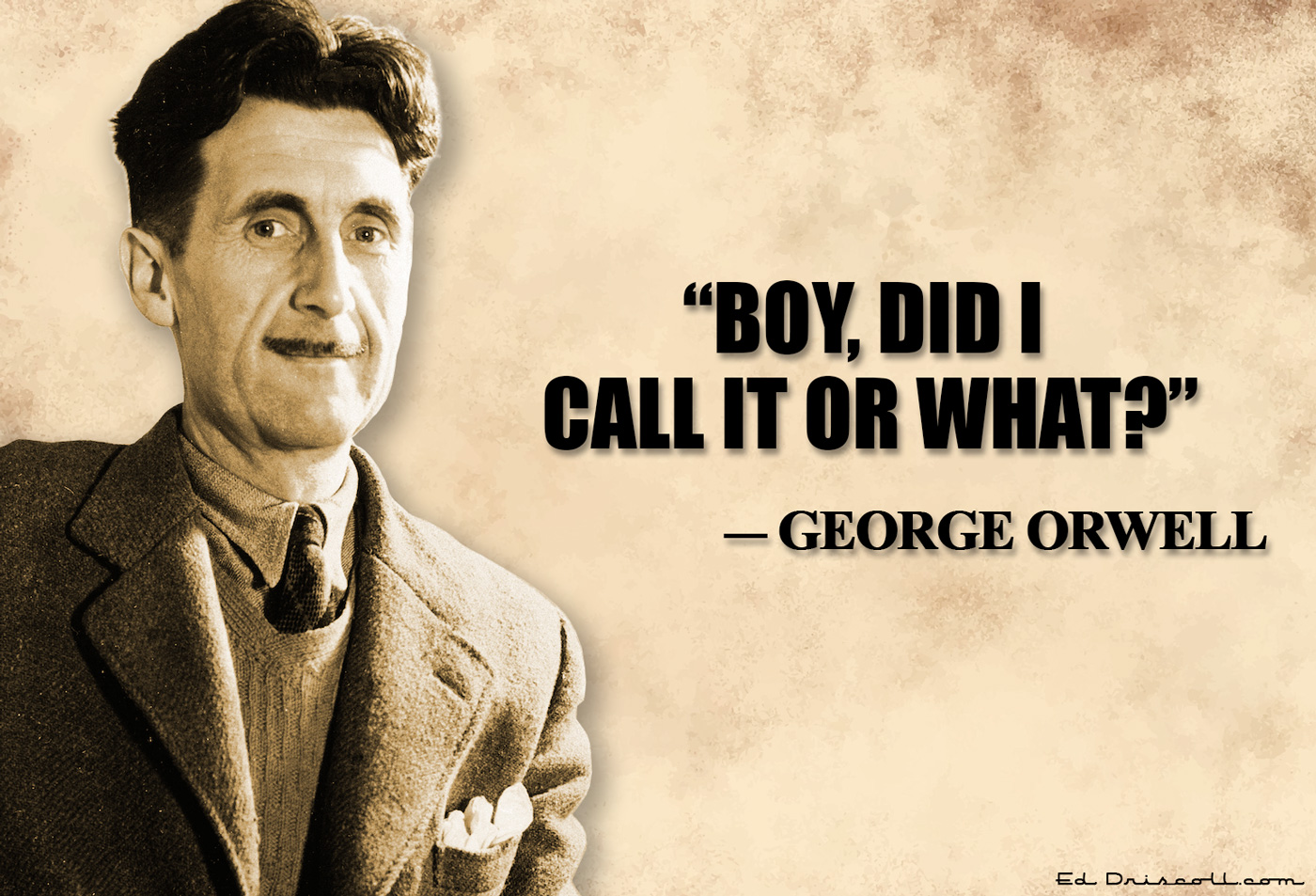
The teacher, who does not wish to be identified, said: “They likened me to a terrorist. It was completely jarring. It’s dystopian, like something from a George Orwell novel.”

1984: A warning for the rest of us; a how-to guide for the dystopian left to make Airstrip One a reality.

Related:

BEN SHAPIRO VS THE CRANK RIGHT:

​Say what you want about Ben Shapiro – he believes what he’s selling. The same cannot be said for many other prominent conservatives in America right now.

The Daily Wire founder used his opening speech during Turning Point USA’s annual AmericaFest conference – the first one held since founder Charlie Kirk’s assassination – to launch a blistering attack on the grifters and charlatans on the right.

Shapiro singled out Tucker Carlson and Candace Owens for peddling despicable conspiracy theories and falsehoods. And he was right to do so.

Carlson’s recent highlights include interviewing revisionist historian Darryl Cooper – who claimed it was Churchill, not Hitler, who was the true villain of the Second World War – and Holocaust denier Nick Fuentes.

If only the czar der führer knew!

SNOWFALLS ARE NOW JUST A THING OF THE PAST:

(Classical reference in headline.)

SASHA STONE: Why We Watch It’s a Wonderful Life:

There is only one movie most people watch around Christmas, and that has to be the ultimate Christmas movie, Frank Capra’s sublime It’s a Wonderful Life.

What’s remarkable to me about this movie is that everyone still watches it and loves it, even though it is unapologetically religious. It’s a Wonderful Life is what Hollywood today would label “faith-based,” even though no one would describe it that way. And yet, it’s inescapable. This is a movie about prayer. It’s a movie about angels and a movie about faith.

Hollywood would never make a movie that dared to say, as It’s a Wonderful Life does, that we all believe in God and that there are such things as angels watching over us and that in times of complete and total helplessness we pray.

Read the whole thing.

Earlier: It’s a Wonderful Life: Holiday Classic Takes On New Meaning As Jimmy Stewart’s Post-War Struggles Bleed Into Film.

COVID FOUR YEARS AGO: Jill breaks White House rules to go maskless as Joe is accused of staging bizarre dancing nurses show at the White House to distract from his catastrophic failure to order enough COVID test kits.

President Joe Biden was slammed on Thursday for holding Christmas festivities at the White House this week, complete with nurses singing ‘We Need a Little Christmas’ and a maskless First Lady, as critics claimed the event was ‘tone deaf’ and meant to distract from the president’s COVID policy failures.

The White House invited the famous Northwell Health’s Nurse Choir to perform at this year’s ‘Spirit of the Season’ TV special Tuesday night, and many were quick to point out the poor visuals of happy nurses singing amid the current Omicron surge.

The performance also featured some singers without masks, as well as a maskless Jill Biden off to the side, despite the White House’s indoor mask mandate in place.

To add to the schizophrenia, just a few days before the dancing TikTok nurses appeared with “Dr.” Jill,” the Biden Politburo was telling the rest of America — just in time for Christmas — that the Winter of Death was at hand:

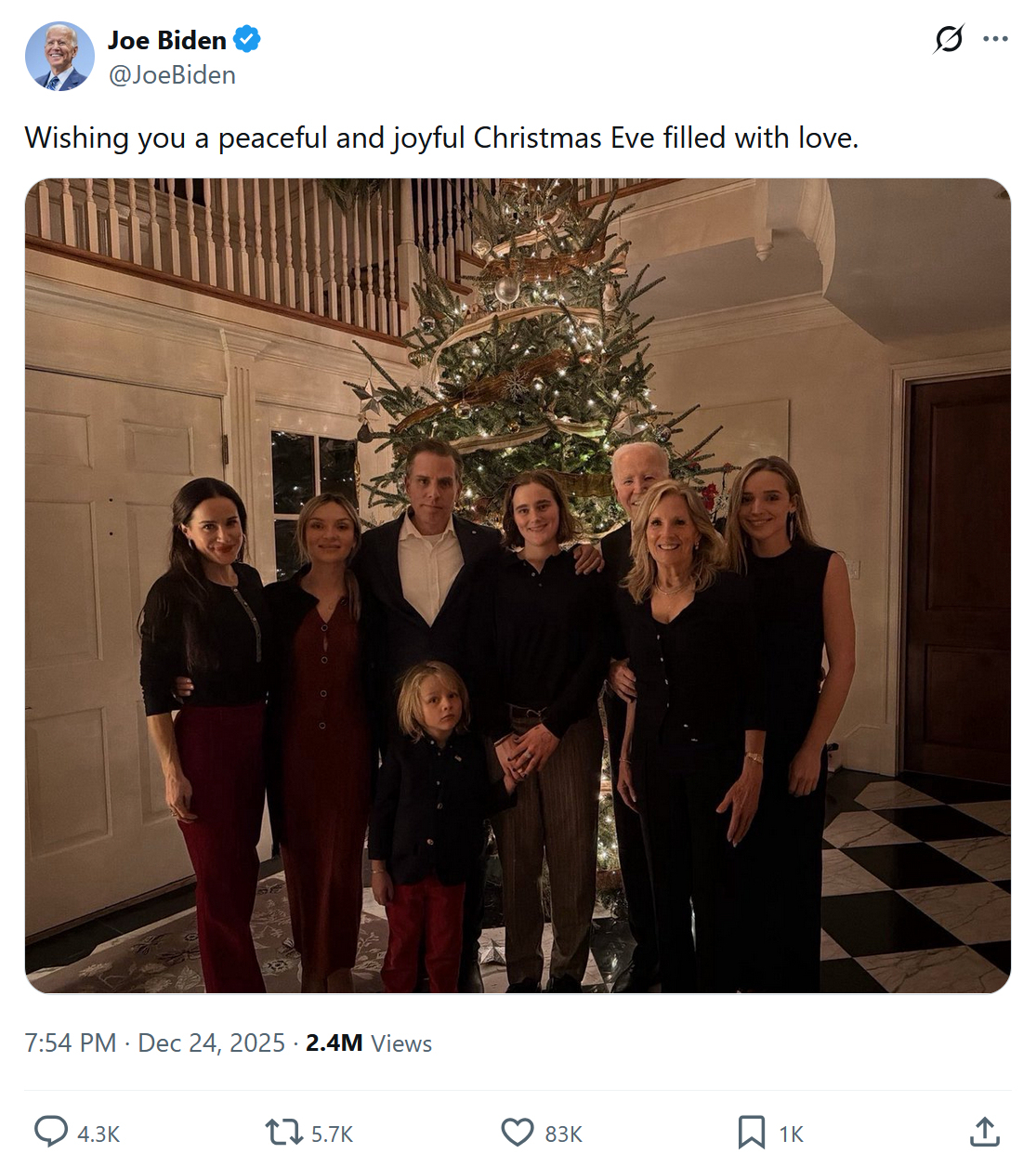
UPDATE: Merry Christmas from Hunter, “Dr.” Jill, and oh yes, the former president is (Photoshopped?) in there somewhere! — in the back of a gloomy, badly lit photo:

MORE: Biden shares perplexing family Christmas photo with Hunter front and center.

GET CHRIST OUT OF CHRISTMAS? Atheists Gets Their Tinsel in a Twist When Sarah Huckabee Sanders Refuses:

HEH, INDEED:

THE SAN FRANCISCO STORY BEHIND THE ‘CHARLIE BROWN CHRISTMAS’ ALBUM:

Unique among those Christmas hits are the songs from “A Charlie Brown Christmas,” the 1965 animated Christmas special starring Charles Schulz’s “Peanuts” gang. The movie’s soundtrack might be the most recognizable jazz music in history. Piano player Vince Guaraldi’s renditions of classics like “Christmas Time Is Here” have become the definitive versions, and tunes like “Linus and Lucy” — which the gang jams to onstage — have reverberated through pop culture ever since.

Schulz has close ties to the Bay Area. Although born in Minneapolis, he moved to Sebastopol in 1958, then relocated to Santa Rosa in 1969, where he lived until his death in 2000 (a museum and skating rink were built celebrating his work). But the Christmas special’s soundtrack has uniquely San Francisco roots and, if not for a string of coincidences, may have never actually been heard by the public — let alone hit No. 2 on Billboard’s album chart 57 years later. A four-hour “super deluxe” version was released in October featuring material recently discovered in the Fantasy Records vaults.

Guaraldi was born in North Beach in 1928. After a brief stint at San Francisco State and a tour in Korea as an army cook, he hit the SF jazz scene and quickly received a contract from locally based Fantasy Records. While playing live around San Francisco, he picked up nicknames like “The Italian Leprechaun” (he was just over 5 feet tall) and Dr. Funk. He and his trio gained some popularity through covers of Antonio Carlos Jobim and Luiz Bonfa on their 1962 album “Jazz Impressions of Black Orpheus,” then had a bona fide hit with the B-side “Cast Your Fate to the Wind.”

It’s hard to believe, but prior to its self-inflicted Weimar-ification*, San Francisco quite a brilliant city.

Related: Charlie Brown’s Inside Job. What gives the 1965 Peanuts special its staying power? “All the suits had said no to the religious element in the special, but Schulz insisted. Everyone at the network was prepared for a flop, but Schulz wasn’t thinking of network executives when he made the special. He was thinking about children and about the nature of God. The suits didn’t understand it, but from the first broadcast, the kids who watched it loved it, and made it a huge hit from then on.”

More: How Charles Schulz Got the Gospel Past CBS Execs in A Charlie Brown Christmas.

* Instagram v. reality! San Francisco unveils taxpayer-funded open-air Christmas market that’s become dystopian hellhole after being besieged by city’s famed druggies.

HOW A TELEVISION ICON WAS BORN: Why We Still Love the Yule Log.

This Christmas, countless Americans will celebrate the holiday with the mesmerizing flicker of a yule log as a backdrop to their domestic festivities, the glow emanating not from a traditional fireplace but from their flat-screen televisions, perhaps “hung by the chimney with care.” Traditional holiday tunes will surely accompany the video, sourced from the catalogues of Frank Sinatra and Bing Crosby, or perhaps plucked from the more recent yuletide earworms of Mariah Carey and Paul McCartney.

The televised yule log has become commoditized, available on countless YouTube channels and streaming services, but all of these videos are knockoffs of the one true filmed fireplace that started it all — the WPIX-TV Yule Log.

In the fall of 1966, Channel 11 in New York City was a scrappy independent television station owned by the New York Daily News. An inventive general manager helmed the station, Fred Thrower, aptly named, as he threw off sparks of creativity to light up the station’s programming lineup when resources were tight and competition was fierce. One of those sparks would light a fire of holiday magic, adding an enduring element to Christmas celebrations, first in New York and, in time, around the world.

Inspired by a Coca-Cola commercial featuring Santa Claus, Thrower envisioned a televised fireplace that would serve as a Christmas gift for his viewers. WPIX’s core audience was in the five boroughs of New York City, where millions of people lived in cramped apartments without suburban amenities like fireplaces. Thrower would bring the fireplace into their urban living rooms, not through a monumental public works project, but via the 198-to-204 megacycles of his station’s analog signal emanating from atop the Empire State Building.

In November 1966, with the holiday just weeks away, Thrower challenged his executive staff to figure out how to produce a televised fireplace, accompanied by music. His team got to work, securing access to a grand fireplace at New York’s Gracie Mansion, the traditional home of Gotham’s mayor, then John V. Lindsay.  The fireplace was shot on color 16-millimeter film that would be looped for the broadcast, and holiday music was selected with involvement from Thrower, relying heavily on the “beautiful music” format of the likes of Percy Faith, Ray Conniff, and other AM-radio old reliables of the era.

The WPIX Yule Log premiered on Saturday, December 24, 1966, at 9:30 p.m., preempting a telecast of a roller derby. The station lost money on the broadcast, as it has on every subsequent broadcast, simply because the Yule Log plays continuously for hours, and commercials, the bread and butter of station revenue, are suspended. For a few hundred minutes a year, commerce takes a back seat to cheer. Take note, Ebenezer Scrooges of the world.

Exit quote: “The Yule Log is a perfect example of ‘slow television,’ something that demands absolutely nothing of the viewer, if we can even call the person a viewer. It is designed less to be watched and more to set a mood and inspire feelings of comfort and joy, all while you entertain guests at a holiday party or open presents around the tree or just sit on your sofa and count your blessings with loved ones at your side.”

ANSWERING THE IMPORTANT QUESTIONS: Why Jews Wrote Your Favorite Christmas Songs.

Much of the Jewish migration to the U.S. at the start of the 20th century came from the Pale of Settlement, the area ruled until the Russian Revolution by the Romanov dynasty. Jews were segregated into isolated towns known as shtetls where they were marginalized and often subjected to pogroms. Imagine, then, these people arriving at Ellis Island, where they were greeted by opportunity, diversity, and technology, finally free to express themselves in a new land.

They brought with them the Jewish musical tradition: the cantorial minor keys found in Jewish prayer. It’s no accident that Harold Arlen (born Chaim Arluck), the composer of “Somewhere Over the Rainbow” and “Stormy Weather,” was the son of a cantor.

Then, there was the Yiddish language, a hybrid tongue with words plucked from German, Hebrew, and other languages. Yiddish lends itself to surprising rhymes and pleasant meter. In this respect Yiddish is a lot like American music itself—an alchemy of cultures that create a delightful and unexpected new combination.

So it’s this combination of factors—the Yiddish language, the freedom America afforded Jewish immigrants, and the haunting minor key found in Jewish prayer—that help explain why Jews wrote so many of the great American songs.

They gave us the American songbook. George and Ira Gershwin, the brothers who wrote “I Got Rhythm.” Richard Rodgers and Oscar Hammerstein II, who together wrote “The Sound of Music” and many other unforgettable Broadway shows. The great Jerome Kern, one of the first breakout stars of New York’s Tin Pan Alley, who composed the scores for “Show Boat” and “Swing Time,” two of the first major modern musicals.

But if there was one man who embodied the alchemy of the Jewish American experience in a single life, it was Irving Berlin, the greatest American composer of them all.

A decade ago, Mark Steyn described the horrible turn that Berlin’s life would take on the way to writing “White Christmas:”

Christmas was not kind to Irving Berlin. At 5 o’clock on the morning of Christmas Day 1928, his 31/2-week-old son, Irving Junior, was found dead in his bassinet. ‘I’m sure,’ his daughter Mary Ellin told me a few years back, ‘it was what we would now call “crib death”.’

Does that cast ‘White Christmas’ in a different light? The plangent melancholy the GIs heard in the tune, the unsettling chromatic phrase, the eerie harmonic darkening under the words ‘where children listen’; it’s not too fanciful to suggest the singer’s dreaming of children no longer around to listen. When the girls grew up and left home, Irving Berlin, symbol of the American Christmas, gave up celebrating it. ‘We both hated Christmas,’ Mrs Berlin said later. ‘We only did it for you children.’

To take a baby on Christmas morning mocks the very meaning of the day. And to take Irving Berlin’s seems an even crueller jest — to reward his uncanny ability to articulate the sentiments of his countrymen by depriving him of the possibility of sharing them.

Berlin was a professional Tin Pan Alleyman, but his story, his Christmas is there in the music. 23 years after his death, he embodies all the possibilities of America: his family arrived at Ellis Island as poor and foreign and disadvantaged as you can be, and yet he wove himself into the very fabric of the nation. His life and his art are part of the definition of America. Whatever his doubts about God, Berlin kept faith with his adopted land — and that faith is what millions heard 70 years ago in ‘White Christmas’.

But then, as Mark Judge wrote last year: From Superman to Bob Dylan: How Jews enriched our culture.

HOLIDAYS IN HELL: So This Is Christmas — and What Have Celebrities Actually Done?

As French authors would later conclude in their magnificent clean-up book on 20th-century communism, The Black Book of Communism, in 1999, nearly 100 million people died worldwide as a result of Marxist atheists.

To be sure, faith is no guarantee of a refuge from the evil that men do. Evil is also committed in the name of faith and by those who think they were/are on a mission from God. The Islamic Republic of Iran has been doing this since 1979, as one modern example.

However, it’s an analytical stretch that requires undue faith in the innate goodness of the religiously naked ape to believe atheism and atheist states will be any different from others who have complete power in a state. It’s an error to think that atheism will somehow thus serve as a peaceful refuge from humanity’s worst impulses. To believe this is to assume that religion — and not concentrated power — is the main problem in human affairs.

See China’s Xi Jinping today as the latest atheist incarnation of John Lennon’s imagined state and its consequences: a man on a mission for himself, who will run roughshod over his own population and others who want nothing to do with his view of how we should live. Xi’s repression is already obvious in China and in Hong Kong, and if he ever gets the chance, in Taiwan.

The same vapidity is evident in “Happy Xmas.” Its most famous line opens the song, and lodges in my cranium without asking permission: “And so this is Christmas/And what have you done?” Those ten words have enough hubris to inflate the Hindenburg. It’s as if ordinary folk somehow should justify themselves to a 1960s–1970s rock star consumed by self and by error, as in his musical worship of anti-religious belief and consequences.

The easy response from normal people to two celebrities who, by 1971, had been writing songs and giving interviews from their bedroom decked out in pajamas can be imagined as follows, perhaps from a single mom: “Oh, I don’t know, John — I’ve been raising three kids, caring for my aged Mom, and working double-shifts at the coffee shop to pay the bills. You?”

Other responses to imagine: From a Second World War veteran: “I fought my way on to Omaha Beach and survived D-Day — and the rest of the war, but many of my friends did not. We beat the Nazis, which is what mattered even more despite the sacrifices.”

Or imagine the response from a steelworker, miner, or farmer: “Endured another grinding day at the foundry/shaft/farm, this to afford the mortgage and Christmas presents.”

As Ian MacDonald wrote in Revolution in the Head: The Beatles’ Records and the Sixties, a trenchant analysis of the Beatles’ changing worldviews and how they fed their lyric writing, focusing on “The Ballad of John and Yoko,” an earlier attempt by Lennon to shift away from writing universal anthems to focusing on his day to day celebrity life:

Behaving as if they had personally invented peace, they jetted round the world in first-class seats selling it at third-rate media-events. This was arrogant as well as silly, and the news media’s derision, of which THE BALLAD OF JOHN AND YOKO self-righteously complains, was not only inevitable but, in the main, justified.

Of all the dangerous ideas Ono unloaded on her spouse around this time, the most damaging was her belief that all art is about the artist and no one else. Serving to confirm Lennon’s self-absorption, this also torpedoed his universalism, and it was as a man struggling to resolve this exacerbation of his lifelong emotional contradictions that he reeled from heroin to Primal Therapy to Maoism and finally to drink during the next three years. Otherwise scathingly honest, he unwittingly put himself into a position in which he was obliged to defend things that, deep down, he cared nothing about. Uncompromising as ever, he threw himself into this trap with total commitment, not only refusing to draw a line between his public and private life but going out of his way to personalise everything that happened in his vicinity, a self-centredness which could hardly avoid occasionally degenerating into paranoia, as THE BALLAD OF JOHN AND YOKO demonstrates. Indeed, so outrageously egocentric is this song that it’s difficult to know whether to deplore its vanity or admire its chutzpah in so candidly promoting Self to artistic central place.

In one of his last interviews, Lennon would finally admit, “I dabbled in politics in the late 1960s and 1970s, more out of guilt than anything. Guilt for being rich and guilt thinking that perhaps love and peace isn’t enough and you have to go and get shot or something, or get punched in the face to prove I’m one of the people. I was doing it against my instincts.”

His fans, though, cottoned on much more quickly: “The crowd I first saw the original [Let It Be before being Disney-fied by Peter Jackson] with weren’t interested in a happier spin on the Beatles. They were there to render judgment, to be the choric voice of the Beatles’ community declaring their disapproval. In other words, they were there to boo. They were there to boo Yoko Ono. If I remember the film correctly, the opening credits were barely done when we see John Lennon, and there is Yoko, sitting right beside him. ‘Boooo.’ Then, there is Yoko, knitting right beside him. ‘Boooo.’ For the length of the movie, every time Yoko was on camera, the crowd booed, as if to say, ‘Take that, Yoko, for breaking up the Beatles.’”

CHRISTMAS IN NAZI GERMANY: How Nazis Stole Christmas & Turned Adolf Hitler into Messiah (Video).

Earlier: The National Socialists Fought the Original War on Christmas.

Who knew? Other than everyone who read Jonah Goldberg’s Liberal Fascism in 2008, or this London Daily Mail article the following year. But it’s good to see this sort of thing in the Smithsonian’s house organ. Or as author Dave Shiflett quipped in 2002 at NRO, “A shocking story has been revealed: Adolf Hitler was not a Christian after all. Instead, he hoped to destroy Christianity.”

To borrow a line from another 19th-century born socialist God killer, as a reminder of the first time as tragedy and the second time as farce — while killing time before engineering the next tragedy — I found that above quote in a post of mine from right around this time in 2012. A few years before Angela Merkel turned the lights out on 21st Germany, Yahoo was reporting that “A minister in Angela Merkel’s government has sparked a pre-Christmas row among Germany’s ruling parties by suggesting God be referred to with the neutral article ‘das’ instead of the masculine ‘der.’”

But then, political correctness is what governments do in order to ignore their nation’s real, structural problems.

Related: Nazi Caroling: The Extremes Hitler Wanted to Go To in Order to Replace Christianity with the “Religion” of National Socialism).

And in the adjacent world of International Socialism, Peter Hitchens: The last Noël in the USSR.