
RICHARD LANDES, Jihadi Journalism.
Archive for 2023
November 19, 2023
OPEN THREAD: Nighty night.
WHY IS EURO-SOCCER UPPER MANAGEMENT SUCH A CESSPIT OF ANTISEMITISM? Israel and Poland Defy European Football Association and Hold Moment of Silence for 10/7.
FRENCH CRITICS RUSH TO SUPPORT RIDLEY SCOTT’S NAPOLEON: Director Ridley Scott Dismisses Critics: “The French Don’t Even Like Themselves.’
Ridley Scott has been typically dismissive of critics taking issue with his forthcoming movie Napoleon, particularly French ones.
While his big-screen epic, starring Joaquin Phoenix as the embattled French emperor with Vanessa Kirby as his wife Josephine, has earned the veteran director plaudits in the UK, French critics have been less gushing, with Le Figaro saying the film could have been called “Barbie and Ken under the Empire,” French GQ calling the film “deeply clumsy, unnatural and unintentionally clumsy” and Le Point magazine quoting biographer Patrice Gueniffey calling the film “very anti-French and pro-British.”
That’s good enough an endorsement for me; I’m really looking forward to seeing the film in a theater during its brief run before streaming on Apple TV.
GOODER AND HARDER, EMPIRE STATE: NY ranked ‘Least Free State,’ with high taxes, debt, regulation: study.
QUESTION ASKED AND ANSWERED: Why does the left hate white women?
All of my ladies out there who read this newsletter are probably familiar with the food blog “Half Baked Harvest.” Tieghan Gerard, the thirty-year-old founder and owner of the blog, has posted a cozy and delicious recipe nearly every single day since 2012, inspiring women everywhere to dust off their crockpots and grease their baking pans. Fellas, if the woman in your life suddenly decided to try her hand at pumpkin cinnamon rolls or made white chicken chili for game day, there’s a good chance she snagged the recipe from Half Baked Harvest.
Gerard has millions of loyal followers and naturally this has led to criticism from bitter, jealous losers. The New York Times recently managed to snag an interview with Gerard (no, Tieghan, run!) and used it as an excuse to rehash allegations that Gerard doesn’t deserve her success: “Ms. Gerard has also become an unwilling lightning rod for controversy, entangled in issues that have galvanized the food world in the last decade: cultural appropriation, intellectual property, body shaming, privilege and racism.”
In November of 1991, New York magazine spotted then-Maximum Timesman Pinch Sulzberger racially insulting one of his core subscribers:
Not long ago, Arthur Sulzberger, Jr., the 41-year old publisher of the New York Times, was greeting people at a party in the Metropolitan Museum when a dignified older man confronted him. He told Sulzberger that he was unhappy about the jazzy, irreverent new “Styles of the Times” Sunday section. “It’s very”—the man—paused—“un-Times-ian”
“Thank you,” Sulzberger replied. He later told a crowd of people that alienating older white male readers means “we’re doing something right.”
It was during that era that former Timesman Peter Boyer described the atmosphere in Sulzberger’s newsroom as “moderate white men should die,” according to William McGowan in his exceptional 2010 book Gray Lady Down. The following decade, then-editor Howell Raines, who was responsible for serial fabulist Jayson Blair joining the paper’s staff, described his preference towards diversity over a quality product in a classic Kinsley gaffe: “This [hiring] campaign has made our staff better and, more importantly, more diverse.”
You didn’t think the Times’ ever-metastasizing racialism would only ever obsess on white men, did you?
THEY’RE ALWAYS IN THE LAST PLACE YOU LOOK: Mathematicians Have Found The Ninth Dedekind Number, After 32 Years of Searching.
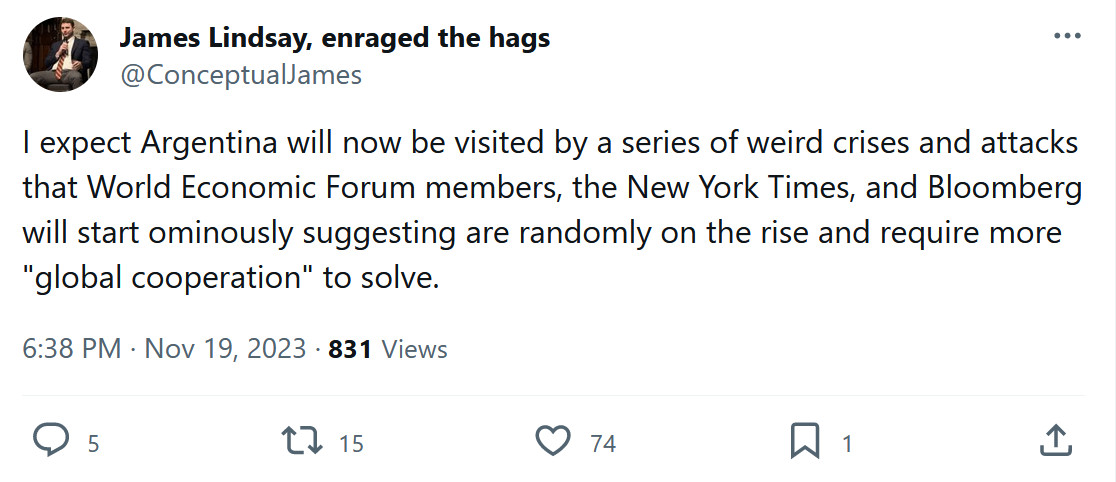
THE INTERNATIONAL PRESS CALLS HIM “FAR RIGHT’ AND WOULD HAVE PREFERRED THE PERONIST: Argentina elects ‘shock therapy’ libertarian Javier Milei as president. “Official results showed Milei with near 56% versus 44% for his rival, Peronist Economy Minister Sergio Massa, who conceded in a speech. His candidacy was hampered by the country’s worst economic crisis in two decades while he has been at the helm. . . . Milei is pledging economic shock therapy. His plans include shutting the central bank, ditching the peso, and slashing spending, potentially painful reforms that resonated with voters angry at the economic malaise.”
Could we get something like that going here? Probably not until after the collapse.
Plus, young voters seem to have delivered the election to him: “Milei has been particularly popular among the young, who have grown up seeing their country lurch from one crisis to another.”
UPDATE (From Ed): Looking 20 minutes into the future:
NOT FOR THE BETTER: Children’s brains shaped by their time on tech devices, research to-date shows.
HOW IMPORTANT IS ACADEMIA TO GROWTH? Less than advertised, probably:
In a 1991 study, University of Pennsylvania economist Edwin Mansfield, whose specialty was studying technology, reported the results of a survey he conducted on seventy-six firms in seven manufacturing industries. His goal, wrote Niskanen, was to “determine the share of the firms’ new products and processes that could not have been developed without academic research conducted within the prior fifteen years.” Only 11 percent of new products and 9 percent of new processes, Mansfield found, “could not have been developed, without substantial delay, in the absence of recent academic research.” Moreover, the products and processes that depended on academic research, pointed out Niskanen, “accounted for only 3 percent of sales and 1 percent of the industry savings attributable to technological innovation.”
In short, strong evidence should make one doubt the claim that basic research is crucial for advances in technology.
Nassim Taleb has argued that higher education doesn’t produce rich societies — it’s a luxury good purchased by societies after they become rich. So the causal arrow runs in the opposite direction most people assume when they notice that rich societies have big academic sectors.
DAVID THOMPSON: Bad Language.
One might think that the employees having babies and therefore on maternity leave are, in fact, by definition, mothers. One might even think that a hospital, and a maternity hospital in particular, is a place where physical realities of this kind would be difficult to avoid. And yet.
While none of the hospitals’ current staff classified themselves as confused about which of the two sexes they are, it is, I suppose, possible that at some point one of the mothers taking maternity leave may, potentially, be sexually dysmorphic – i.e., mentally ill. But mental illness, even fashionable mental illness, isn’t generally something that one should affirm. Nor should it be a basis for the coercion of others. Farce, after all, soon loses its charm.
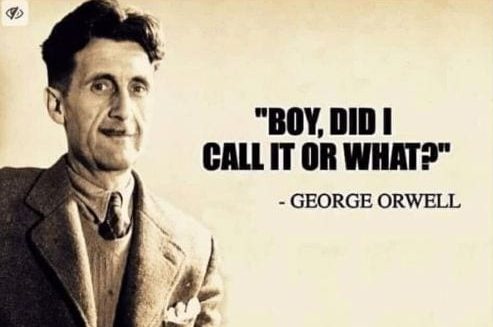
As George Orwell wrote in his 1946 essay, “Politics and the English Language:”
In our time, political speech and writing are largely the defence of the indefensible. Things like the continuance of British rule in India, the Russian purges and deportations, the dropping of the atom bombs on Japan, can indeed be defended, but only by arguments which are too brutal for most people to face, and which do not square with the professed aims of political parties. Thus political language has to consist largely of euphemism, question-begging and sheer cloudy vagueness. Defenceless villages are bombarded from the air, the inhabitants driven out into the countryside, the cattle machine-gunned, the huts set on fire with incendiary bullets: this is called pacification. Millions of peasants are robbed of their farms and sent trudging along the roads with no more than they can carry: this is called transfer of population or rectification of frontiers. People are imprisoned for years without trial, or shot in the back of the neck or sent to die of scurvy in Arctic lumber camps: this is called elimination of unreliable elements. Such phraseology is needed if one wants to name things without calling up mental pictures of them.
Which leads to “The Cambridge University Hospital Trust, which manages a maternity hospital called the Rosie, lost points because staff use the term ‘mother’ when referring to the policies it had in place regarding paid leave, instead of broadening it to include gender-neutral alternatives.”
ADVICE: Worried About an Unexpected Knock at the Door? Don’t Open it With a Gun in Your Hand.
Of course not. The drawn gun should be in the hands of your spouse, out of sightline from the door but with a clear shot at anyone who enters. Duh.
HOLIDAY DEAL: Apple AirPods Pro (2nd Generation). #CommissionEarned
HEY, IF IT MAKES YOU FEEL BETTER: The Placebo Effect in Action: Research and Everyday Life. “The placebo effect occurs more often with subjective symptoms, such as pain, rather than objective medical evidence, such as a tumor identified on a computed tomography (CT) scan. In other words, a placebo treatment may help improve your pain, but it is not going to kill cancer cells the way actual chemotherapy drugs do.” That said, killing actual cancer cells would be good.
IS THERE AN ELECTION COMING OR SOMETHING? Gas prices have dropped below $3 per gallon in these 11 states.
YES, BUT CRONY BUSINESSES’ NEEDS ARE PARAMOUNT: Family Businesses Can’t Afford to Lose Access to Reliable Electricity.
ROGER KIMBALL: Flirtation With Evil Will Not End Well for Leftists.
In some ways, the letter is run-of-the-mill Protocols-of-the-Elders-of-Zion-style Islamic insanity. Naturally, “the Jews” figure prominently as the boogeyman of history, abetted by horrible America. But the presentation is leavened by the fact that bin Laden had recently been responsible for the murder of nearly 3,000 Americans. That sort of thing, beyond the capacity of your usual speaker’s corner blowhard, tends to concentrate the mind. The videos, made exclusively, I believe, by women, are a different story. You’ll find them hard to come by now. TikTok, responding to public outcry, intervened to squash searches for them as well as “#lettertoamerica,” “osama letter,” and similar directives.
That may buy the company a little time in the court of public opinion. But more and more Americans, I suspect, have come around to Josh Hawley’s perspective about TikTok. It is, he just said on X, “a spy app for the Chinese Government—and now it’s a hotspot for antisemitic, pro-Hamas propaganda.”
Bingo. Sen. Hawley got it in one. The sudden resurrection of Osama bin Laden did not take place in a vacuum. It is happening in the midst of a recrudescence in America of an anti-Semitism more vicious than anything seen in decades in this country, maybe ever. The large-scale pro-Hamas public demonstrations are startling in their size and virulence. Equally shocking are the displays of violent (and, it should be noted, historically illiterate) anti-Israel sentiment on college campuses.
It is curious how people romanticize evil and insanity. The habit, I believe, is born in part of naiveté, or at least inexperience. The college student who prances about in a T-shirt bearing the image of Che Guevara, for example, generally has no idea of what a malignant figure Che was, how treacherous, how cruel, how murderous. He sees only a handsome “freedom fighter” swaddled in the gauze of exotic Latin flamboyance. The grubby reality escapes her entirely. Ditto with respect to Hamas.
As Charles Cooke adds, “Face It, the bin Laden TikTokers Are Just Stupid.”
“I suppose the only good thing that has happened here,” Cooke remarked mordantly, “is for once the people of TikTok have stopped claiming that George W. Bush carried out 9/11 and have now acknowledged that it was Osama bin Laden. Unfortunately, they have appended the word ‘good’ to that analysis.
“And these people are stupid,” he continued. “We can talk around this if we want to, but these people are stupid. They don’t know anything.”
He said that if a conservative opposes gay marriage, he becomes a non-person. “But when Osama bin Laden says that homosexuality must be banned in the new caliphate,” he noted, “they skip over it*. There’s so much in that bin Laden letter that should have been appalling to the TikTok brigade, but they seem to ignore it.”
Roger Kimball believes that “TikTok’s days may be numbered in the U.S.” Much faster, please.
* Same with the aforementioned Che Guevara as well, of course.
EARLY BLACK FRIDAY DEAL: Apple iPad (10th Generation). #CommissionEarned
MARK JUDGE: Muzzle: A Powerful Movie About Honor, Made by People Who Don’t Hate Americans or Christians.
When a movie on Rotten Tomatoes has a high audience approval rating and a low critical rating, it usually means that conservatives will like it. It’s usually a movie for the people and not for the “elites.”
Such is the case with Muzzle, a film that was released in September and is now out on DVD. Muzzle is is a good solid piece of movie-making created by that rarest of breeds: Hollywood people who don’t hate normal Americans. The film is rated 16+. Criminals are depicted as awful people, drugs as soul-killers, and moms and newborn babies as healing miracles. There is no nudity.
Read the whole thing, which makes for quite a contrast with what Disney is churning out these days: Movie Executives With Strange Pronouns Can’t Understand Why Movies Flop.