
IT LOOKS LIKE AN F-16 AND AN F-18 HAD A BABY JET: China’s L-15 Falcon: Cut-rate warfare on a budget.
Archive for 2020
January 3, 2020
CONGRATS TO MY COLLEAGUE MAURICE STUCKE, whose book Competition Overdose (written with Oxford’s Ariel Ezrachi) made a list of must-read business books from Inc. magazine.
DON SURBER: Liberals Mourn Death of Iranian General. “My how things have changed in just a few days. Democrats were gleeful on New Year’s Even when Iranians had attacked our embassy in Baghdad. They labelled it President Donald John Trump’s Benghazi. . . . What did killing the general in charge of Iran’s terrorism network escalate? Is Iran going to call for death to America — as it has for 40 years? Will it attack our embassy in Iraq again?”
THE CORBYNIZATION OF JEREMY CORBYN’S PARTY CONTINUES APACE: BBC Chief International Correspondent Accuses U.S. of ‘Murder’ for Strike on Evil Terrorist Soleimani.
Why, it’s as if there’s “A Powerfully Corrosive Internal Culture” operating at the BBC.
TEACH WOMEN NOT TO LIE ABOUT RAPE: Former Central Florida school employee faces charges, accused of lying about rape by football players.
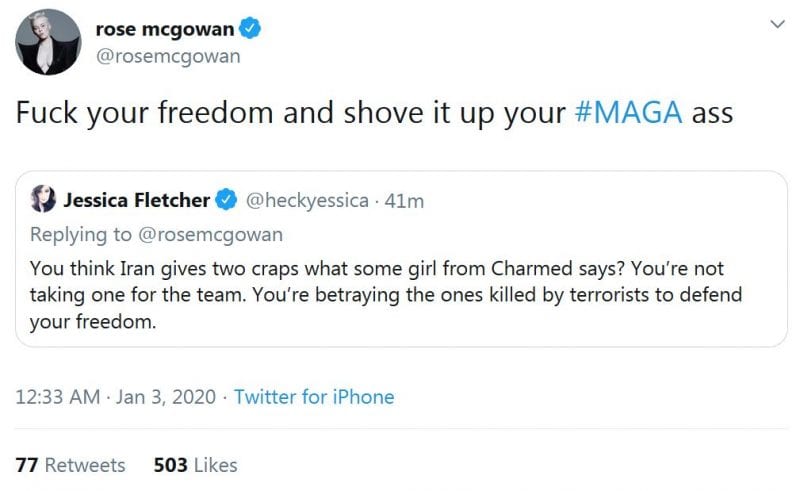
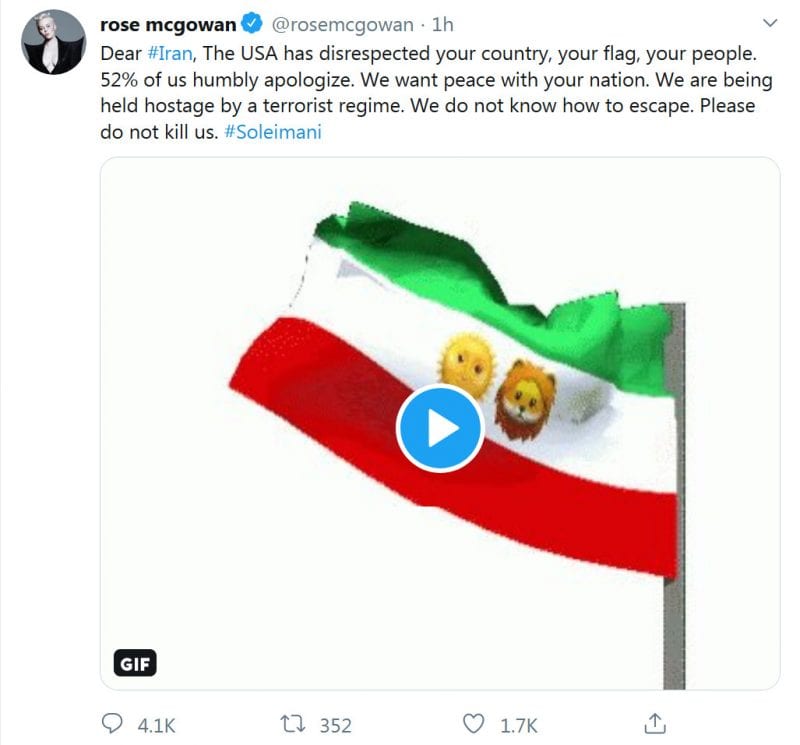
SO LET’S STIPULATE THAT THE DEMOCRATS’ ROSE-MCGOWAN-LIKE REACTION IS STUPID AND ANTI-AMERICAN. That doesn’t mean that there are no possible valid critiques of bombing Soleimani. But honestly, I can’t think of any. Here are the main candidates:
1. It will provoke Iran. Well, maybe. But Iran has been at war with us for 40 years; we’ve mostly chosen to pretend otherwise. Iran’s top priority is wrecking our presence in the mideast, and then eventually destroying America. This doesn’t change that. At most it might make them spring an operation earlier than they had planned, which is as likely to do them harm as it is to do anything.
2. It increases the risk of war. We’re already at war, see above. If anything, it makes Iran look weak, which hurts them in the region and gives domestic rebels heart and momentum. (See: ‘Overthrow is within reach’: Leader of Iranian resistance group hails death of Qassem Soleimani.)
3. It was illegal because there was no congressional authorization. Pretty hard to take that argument seriously in 2019, but at any rate Soleimani orchestrated an attack on the U.S. Embassy in Iraq, which is for these purposes an attack on American soil. (Even the governor of a state is allowed by the Constitution to wage war without Congressional authorization when actually attacked.) Besides which, we have a Congressional authorization for use of military force in Iraq, and this is covered by its exceedingly broad terms. Also, it’s reported that he had a large anti-American operation in the works.
4. We can’t know the ramifications. That’s true. But that’s also true of not acting. Unintended consequences rule in the sphere of government action, but you can’t base your policy choices on not having any.
5. Orange Man Bad. To be honest, this seems to be the real objection. It’s a stupid one.
Related: Trump’s Ground Game Against Iran.
Building up on this successful experience, Mr. Suleimani spent the last decade replicating the Hezbollah model in Iraq, Syria and Yemen, propping up local militias with precision weapons and tactical know-how. In Syria, his forces have allied with Russia to prop up the regime of Bashar al-Assad, a project that, in practice, has meant driving over 10 million people from their homes and killing well over half a million. In Iraq, as we have seen in recent days, Mr. Suleimani’s militias ride roughshod over the legitimate state institutions. They rose to power, of course, after participating in an insurgency, of which he was the architect, against American and coalition forces. Hundreds of American soldiers lost their lives to the weapons that the Qods Force provided to its Iraqi proxies.
Mr. Suleimani built this empire of militias while betting that America would steer clear of an outright confrontation. This gambit certainly paid off under President Barack Obama, but it even seemed to be a safe bet under President Trump, despite his stated policy of “maximum pressure.” Mr. Trump was putting an economic squeeze on Iran, and popular protests in Iran, Iraq and Lebanon were adding to the pressure, but Mr. Suleimani assumed that, in the end, control of military assets would win the day. Mr. Trump, it seemed, feared getting sucked into a war. Washington, in short, lacked a ground game.
In September, Mr. Suleimani and his colleagues reportedly pressed their advantage by attacking a Saudi Arabian oil field, an act of war that went unanswered. He followed this up by orchestrating attacks by Iranian proxies on Americans. The Trump administration had said clearly that attacking Americans was a red line, but Mr. Suleimani had heard threats in the past from American leaders. He thought he could erase Mr. Trump’s red line.
His departure will make Iran much weaker. It will embolden the country’s regional rivals —primarily Israel and Saudi Arabia— to pursue their strategic interests more resolutely. It will also instill in the protesters in Iran, Lebanon and, especially, Iraq, the hope that they will one day wrest control of their governments from the talons of the Islamic Republic.
In Washington, the decision to kill Mr. Suleimani represents the final demise of Mr. Obama’s Middle East strategy, which sought to realign American interests with those of Iran. Mr. Obama’s search for a modus vivendi with Tehran never comported with the reality of the Islamic Republic’s fundamental character and regional ambitions. President Trump, by contrast, realized that Tehran’s goal was to replace America as the key player in the Middle East.
One mild caveat: The Bush Administration in 2005 seemed to suddenly go soft on Iran. I speculated at the time that Iran was somehow deterring them, but with no obvious mechanism for that wondered about things like bioweapons. Whatever, they don’t seem to have deterred Trump in the same fashion.
UPDATE: Some thoughts on the subject from Spengler.
Without attempting to read the minds of Iran’s leaders, one may conjecture that Iran badly needed a moral victory to show that it was not cowed by massive Israeli airstrikes in Syria, nor, indeed, by a deteriorating economy at home. In November, the Iranian regime ruthlessly suppressed anti-regime protests, killing up to 1,000 demonstrators. After the US struck five bases of Iran-backed militias in Iraq on Dec. 30, Iran decided that its credibility required a demonstration of power, and ordered the attack on the US embassy.
That left Trump with few good choices. After 5,000 dead, 50,000 wounded and trillions of dollars in expenditures in Iraq, the US had succeeded in turning a former counterweight to Iranian ambitions into an Iranian satrapy. The embassy attack was intended by Iran as a public act of ritual humiliation, and the United States had no choice but to respond. Trump chose to respond by subjecting Iran to an even more poignant form of humiliation, by assassinating a national hero, Gen. Qassam Sulemaini. It is easy to criticize the US president, but harder to recommend an alternative course of action. US airpower has limited effectiveness in constraining the diffuse Iranian-backed militias.
Neither Iran nor the US has good choices here. Iran must respond or its credibility will collapse. The question is how. An Iranian attack on an American ally like Israel or Saudi Arabia would not suffice, now that Washington has acted in its own name against a key Iranian leader. The indicated course of action is to attack an American asset. In the extreme case, Iran could use a combination of intermediate-range missiles, cruise missiles and drones to attack the Doha base.
Iran’s problem is that it has the most to lose here, and it’s weak. That suggests that they will do something symbolic but essentially back down, rather than escalate and invite still further escalation in return. But that assumes they will act rationally, which in fact they usually do, but usually isn’t always. And read Spengler’s entire piece.
And lurking behind all of this is a new reality that the Iranians may not have fully absorbed: Thanks to fracking, the United States doesn’t have to keep the straits of Hormuz open anymore. We only have to be able to keep them closed.
THEY’RE BLUFFING: Will It Be War? Iran Officials Warn of ‘Major Escalation’.
MASSACHUSETTS DELEGATION CONDEMNS TRUMP’S ORDER TO KILL IRANIAN GENERAL: PRESIDENT DOUBLES DOWN.
U.S. Senator and 2020 presidential candidate Elizabeth Warren tweeted: “Soleimani was a murderer, responsible for the deaths of thousands, including hundreds of Americans. But this reckless move escalates the situation with Iran and increases the likelihood of more deaths and new Middle East conflict. Our priority must be to avoid another costly war.”
U.S. Edward Markey tweeted: “Trump’s apparent assassination of Soleimani is a massive, deliberate, and dangerous escalation of conflict with Iran. The President just put the lives of every person in the region – U.S. service members and civilians – at immediate risk. We need de-escalation now.”
Markey added, “Congress is the only entity that can authorize military force. We cannot and must not get drawn into war with Iran.”
Related: Wielding A Pen And A Phone, Obama Goes It Alone.
—Headline, NPR, January 20, 2014.
UPDATE (FROM GLENN): Seen on Facebook:
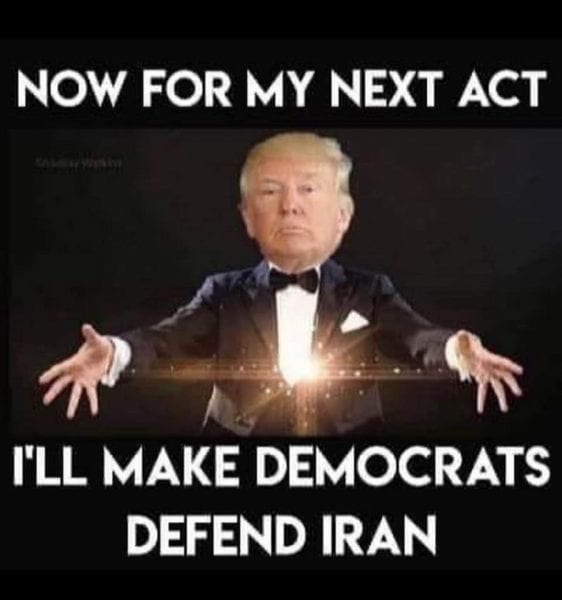
Yeah, pretty much.


TREAT THE BOGUS CHARGES WITH ALL THE RESPECT THEY DESERVE: Senator Josh Hawley To Seek Dismissal of Impeachment Articles.
IT’S A MYSTERY: Washington Post Writer Can’t Figure Out Why Trump Supporters Won’t Talk To Her. “These outlets, and many others like them, offer such blatantly critical and condescending perspectives on conservative Americans and their values. This is palpable even in Dvorak’s article, which rather than attempting empathy for conservative women who don’t equate feminism with pro-choice politics, simply belittles them.”
Flashback: “Yeah, I’m in the media. Screw you.”
HIGHER EDUCATION BUBBLE UPDATE: Appeals court orders Arizona State to reinstate male student expelled for having a threesome.
According to James Rund, ASU senior vice president for educational outreach and student services, a rational woman would not consent to a threesome. You’re a sad little weenie, James, but just because a rational woman wouldn’t consent to a threesome involving you . . . . Or even a twosome, methinks.
NOT THE BABYLON BEE OR THE ONION: Congressional Democrats Denounce Killing of Soleimani.
Meanwhile, Hollywood actress Rose McGowan is taking Soleimani’s death particularly hard:
UH-HUH: Iraqi Militant Leader Warns Of ‘Upcoming Battle’ With US, Promises ‘Great Victory.’
Why not go ahead and organize that victory parade already? We’ll see you there.
IT’S MARQUETTE AGAIN, BECAUSE OF COURSE: Prof threatens to dock students grade for not using ‘gender inclusive’ language.
Cost of Attending Marquette University for one year: $58,057.

KRUISER’S MORNING BRIEF: Trump Fulfills His New Year Promise to Iran. “There isn’t a lot of ‘Thank Allah It’s Friday’ going around in Terroristland today. Several players from the terrorist game were removed from the board in rather swift fashion and the world is a better place because of it. OK, maybe Democrats don’t think that.”
Well, many don’t because Orange Man Bad.
STRATEGYPAGE’S ANNUAL WARS UPDATE: Empires Versus The Rest Of Us.
This is our annual (formerly twice-a-year) summary of current war zones and an overview of where it is all heading. Doing this once a year rather than twice is a reflection of the decline in the number and severity of wars since the 1990s. After the overview there is the alphabetical list of the war zones and a quick summary of how the local mayhem has been proceeding.
The report includes an overall global assessment and regional or country assessments, from Afghanistan to Yemen.
Some extracts. From the global assessment, comments on overall violence:
Since the end of the Cold War in 1991 deaths from wars and large scale civil disorder (which is often recorded as some kind of war) have led to a sharp (over 20 percent so far) drop in violence worldwide. This occurred despite increasingly active and lethal Islamic terror groups. While the terror attacks themselves were news, the current and historical causes of Islamic terrorism were not. Examining that would have revealed that Islamic radicalism has a large anti-technology component, which is why Islamic terrorist violence tends to be low tech and disorganized. Thus most war deaths are not caused by terrorists and even in 2014 (a peak year for Islamic death cults seeking to revive the Caliphate), terrorism-related deaths (mostly Islamic terrorism) accounted for 20 percent of all war-related deaths. Islamic terrorism gets the most publicity but less glamorous disputes do most of the killing.
An extract from the Iran summary:
Since late 2017 Iran suffered continuing nationwide outbursts against the religious dictatorship running the country. There was similar activity in 2009 to protest the lack of fair elections. The 2009 protests were put down with force as were the recent ones (with over a thousand dead in 2019). What started in late 2017 was different, with the protestors calling for the corrupt religious rulers to be removed, even killed if necessary. Some protestors called for a return of the constitutional monarchy the religious leaders replaced in the 1980s (after first promising true democracy). Even more disturbing was that some of the protestors are calling for Islam to be banned and replaced with something else, like Zoroastrianism, the ancient Persian religion that Islam replaced, violently and sometimes incompletely in the 7th and 8th centuries. Right before the late 2017 unrest, the religious rulers saw Iran on the way to some major victories in Syria, Iraq, Lebanon and Yemen. The optimism turned out to be premature. The good times were supposed to begin in the wake of a July 2015 treaty that would lift the many sanctions Iran operated under. That did not, as many financial experts pointed out, solve the immediate cash crises because oil prices were still low. This was because Saudi Arabia refused to cut production to keep oil prices high. This was made worse by the continued use of fracking in North America which triggered a massive (more than 70 percent) drop of the price of oil in 2013. Iran made their situation worse by trying to avoid complying with the 2015 treaty while still getting most of the sanctions lifted and for a while, that seemed to be working. That deception turned out badly as the U.S. accused Iran of violating the 2015 deal and by the terms of that agreement the American could and did withdraw. That meant many of the sanctions returned in 2018. Even before the American action foreign economists believed the Iranian economy wouldn’t get moving again until the 2020s. Now it is going to take even longer and Iranians, in general, are not pleased with that at all. The 2017 protests are continuing and intensifying. The violent reaction to the demonstrations has not halted them. The protests keep reviving. The senior clerics are worried and openly seeking a solution that does not include them losing their power. Few Iranians are willing to accept that kind of compromise. The religious dictatorship is not only hated but also seen as corrupt and untrustworthy.
And there’s much more. Check out the whole thing.
FAIL: Democrats Rethink Bail Reform After Hate Crime Spike. “The change eliminates cash bail for those accused of committing a litany of misdemeanors and felonies, including many nonviolent hate crimes.”
UTILITY TASK VEHICLE WORKOUT: Marines drive a Utility Task Vehicle during a tactical vehicle driving course in Kuwait.
“WOMAN-MAN?” “MAN-WOMAN?” “IT-THING?” Marvel to get first transgender superhero.
Superhero origin stories have been tired and worn out for years, even without a “T” twist. If this movie flops, however, it’ll be because we’re all awful people.
WELL, NOT LITERALLY, AT LEAST NOT YET: Virginia governor’s call for 18-person gun ban force comes under fire. But I gotta say, the Northam regime is acting in what seems to be a deliberately provocative fashion. If Bush had acted this way in Iraq, they’d have called cowboy-style bullying of a native population.