
TRUMP’S SPACE DIPLOMACY CONTINUES TO SUCCEED: New Zealand joins NASA’s Artemis Accords.
Author Archive: Glenn Reynolds
June 2, 2021
ESPECIALLY SINCE IT’S GROWING INCREASINGLY UNCOMMON: U.S. blood supply safe from coronavirus, study says.
I become eligible to donate convalescent plasma again on Friday, but the Medic website doesn’t have a place to schedule it anymore.
SYSTEMIC RACISM: High school program sponsored by several NY colleges does not allow white students to apply. Illegal, immoral, and sadly also typical.
GOOGLE DIVERSITY CHIEF: “Jews have insatiable appetite for war.”
I’m beginning to think that this whole “diversity” thing is a mistake. And maybe Google, too.
SALENA ZITO: There Are Deep Roots in These Mountains.
EVERYTHING IS GOING SWIMMINGLY: Biden failing with blacks, military, seen as weak and ineffective.
It’s already been a big week for President Joe Biden to show off his commander in chief and race relations credentials, but two separate polls show that the public finds his actions weak and ineffective.
In one timed for Memorial Day, voters by a margin of 43%-32% said that Biden was a weaker chief compared to recent presidents.
Worse, it found that most feel Biden is “less aggressive” with foreign leaders in pushing American interests first.
And in another timed for Biden’s trip to Tulsa, Oklahoma, today for ceremonies on the 100th anniversary of the so-called Tulsa massacre, voters 39%-28% said race relations have turned worse since Biden took office.
Well, that’s because they have. Biden replaced a president whose opening statement was “When you open your heart to patriotism there is no room for prejudice,” with one of the most racially-divisive administrations since Woodrow Wilson’s.
Related: Biden’s Divisive and False Tulsa Speech. To be fair, Biden has already forgotten what he said.
QUALIFIED IMMUNITY: Biden Administration Embraces Democrats’ Least Favorite Legal Defense. Perhaps they have reason to think they’ll need it.
AMERICA THE OUTLIER: Photo IDs for Voting Are the Rule in Europe and Elsewhere.
I REMEMBER WHEN ACADEMIA WAS SUPPOSED TO BE VALUABLE BECAUSE IT FOSTERED MEASURED, CRITICAL THOUGHT: “As non-native speakers of English we are grateful to Steven Dean for pointing out to us that the initial title of this article (Breaking the Shackles of Tax Competition) could be understood as invoking the imagery of slavery.”
Though perhaps as non-native speakers of English, what they’re really saying is “the Anglosphere’s academic sector is so batshit crazy now that we aren’t taking any chances with a mass hysteria we don’t understand” — in which case I’d say “hit the nail on the head with that one.”
DEFUNDING/DEMORALIZING POLICE LEADING TO SECESSION? Amid rising crime, wealthy Atlanta neighborhood considers forming its own city.
It’s not just homicides that are up. Rape and assault have also gone up about 30 percent this year compared to last year. And that has residents of Buckhead, a well-off, mostly white Atlanta neighborhood, thinking about splitting off and forming their own city. The move is largely seen as a way to deal with the increased crime.
If you ruin it, they will go. Look for more of this.
June 1, 2021
OPEN THREAD: Insert obscure musical reference here.
THE NEW SPACE RACE: China is gaining ground in space. Should the US be concerned?
I SPOKE ON THE PHONE THE OTHER NIGHT TO MICHAEL YON, about his trip to the Darien Gap to see the tide of illegal immigrants heading for the United States with two members of Congress, Tom Tiffany and another. You can read about it here.
FASTER, PLEASE: Drug acts as Trojan horse to kill cancer cells.
TRACKING PROGRESS TOWARD AIR TAXIS.
AND IT SHOULD BE: If the Wuhan lab-leak hypothesis is true, expect a political earthquake.
I am no expert on epidemics. Like everyone else I know, I spent the pandemic doing as I was told. A few months ago I even tried to talk a Fox News viewer out of believing in the lab-leak theory of Covid’s origins. The reason I did that is because the newspapers I read and the TV shows I watched had assured me on many occasions that the lab-leak theory wasn’t true, that it was a racist conspiracy theory, that only deluded Trumpists believed it, that it got infinite pants-on-fire ratings from the fact-checkers, and because (despite all my cynicism) I am the sort who has always trusted the mainstream news media.
My own complacency on the matter was dynamited by the lab-leak essay that ran in the Bulletin of the Atomic Scientists earlier this month; a few weeks later everyone from Doctor Fauci to President Biden is acknowledging that the lab-accident hypothesis might have some merit. We don’t know the real answer yet, and we probably will never know, but this is the moment to anticipate what such a finding might ultimately mean. What if this crazy story turns out to be true?
The answer is that this is the kind of thing that could obliterate the faith of millions.
And it should, because the institutions in question were not worthy of faith, and were themselves faithless. Plus:
Consider the details of the story as we have learned them in the last few weeks:
• Lab leaks happen. They aren’t the result of conspiracies: “a lab accident is an accident,” as Nathan Robinson points out; they happen all the time, in this country and in others, and people die from them.
• There is evidence that the lab in question, which studies bat coronaviruses, may have been conducting what is called “gain of function” research, a dangerous innovation in which diseases are deliberately made more virulent. By the way, right-wingers didn’t dream up “gain of function”: all the cool virologists have been doing it (in this country and in others) even as the squares have been warning against it for years.
• There are strong hints that some of the bat-virus research at the Wuhan lab was funded in part by the American national-medical establishment — which is to say, the lab-leak hypothesis doesn’t implicate China alone.
• There seem to have been astonishing conflicts of interest among the people assigned to get to the bottom of it all, and (as we know from Enron and the housing bubble) conflicts of interest are always what trip up the well-credentialed professionals whom liberals insist we must all heed, honor, and obey.
• The news media, in its zealous policing of the boundaries of the permissible, insisted that Russiagate was ever so true but that the lab-leak hypothesis was false false false, and woe unto anyone who dared disagree. Reporters gulped down whatever line was most flattering to the experts they were quoting and then insisted that it was 100% right and absolutely incontrovertible — that anything else was only unhinged Trumpist folly, that democracy dies when unbelievers get to speak, and so on.
• The social media monopolies actually censored posts about the lab-leak hypothesis. Of course they did! Because we’re at war with misinformation, you know, and people need to be brought back to the true and correct faith — as agreed upon by experts. . . .
If it does indeed turn out that the lab-leak hypothesis is the right explanation for how it began — that the common people of the world have been forced into a real-life lab experiment, at tremendous cost — there is a moral earthquake on the way.
Because if the hypothesis is right, it will soon start to dawn on people that our mistake was not insufficient reverence for scientists, or inadequate respect for expertise, or not enough censorship on Facebook. It was a failure to think critically about all of the above, to understand that there is no such thing as absolute expertise.
In fact, when virtually every institution in America decided in lockstep that it was “racist” to call it a Chinese virus, or Wuhan virus, even though it was clearly a virus that came from Wuhan, China, it told the discerning observer two things: First, that it was indeed China’s fault, and second, that all of these institutions were on the Chinese payroll, or at least on the Chinese team.
Those “experts” were arrogant, ignorant, and often dishonest and corrupt. Why wouldn’t people lose faith in them? Why shouldn’t they?
Related: The Suicide of Expertise.
ANALYSIS: TRUE. It’s Time to Break Down the Ivy League Cartel: How Meritocracy Became Trickle-Down Education.
One of the great puzzles of American society is the position of the Ivy League. It is a bastion of privilege and power, and yet full of left-leaning professors who one might imagine would favor the redistribution of wealth. According to the Harvard Crimson, 77.6 percent of Harvard professors define themselves as left-leaning, and just 2.9 percent as conservative. What explains this dynamic? Harry R. Lewis, a former dean of Harvard College, said that such anti-conservatism gets to the basic point of the school, which is to advance radical ideas: “It’s almost by definition anti-preservationist because we place such a high value on the creation of new knowledge.”
A wildly different explanation is apparent from watching Netflix’s Operation Varsity Blues: The College Admissions Scandal, about a highly publicized fiasco in which wealthy parents used bribery to get their kids into top colleges. What is most interesting about this episode wasn’t the corruption, but a poignant feature of normal American meritocracy. Even in the midst of acts of bribery, many of the parents were beset with fear that their children might find out about the crooked machinations to win their admission to elite schools. They took desperate steps to shield their kids from facing questions of deservedness. Of course, most involved in our supposed meritocracy don’t use bribery, but a tremendous amount of energy now goes into preserving similar basic fictions about the nature of elite private education and its role in the United States.
We most often hear about inequality in terms of super-rich corporations and individuals or families. But the same gulf between haves and have-nots has opened in U.S. colleges and universities. Since the pandemic began, 570,000 jobs have disappeared in American academic institutions. More than 75 percent of college faculty in the U.S. are contingent workers or not on the tenure track. Meanwhile, as of 2020, the aggregate value of the endowments of the richest 20 U.S. colleges rose to over $311 billion, all of which are subsidized by taxpayers through the tax-free treatment we offer nonprofit educational institutions. The joke that Harvard is a hedge fund with an educational arm is not so far off.
According to the International Monetary Fund, the value of these endowment funds is greater than the GDP of New Zealand, Finland, or Chile. In the last five years, the U.S. has fallen in the United Nations’ Human Development Index, but its elite universities have risen in the world rankings — and gotten richer. America’s richest colleges and universities, in effect, exist in a country of their own (though paid for in part with the public’s money).
This inequity reflects a restructuring of political power toward an aristocracy. In historical perspective, we are seeing the collapse of the great post-World War II democratization of post-secondary arts and sciences education alongside the appearance of a meritocracy alienated from the public and at odds with democracy. If anyone points out the role of elite education in the reproduction of inequality today, Americans tend to see it as flawed or compromised meritocracy rather than “true” meritocracy. But such responses are signs of a kind of Stockholm syndrome. The “merit” of meritocracy has nothing to do with the worth or value of people as human beings and citizens. It has something to do with intelligence and ability, but also a great deal with résumé-building — which for some starts before kindergarten.
Meritocracy and democracy are not the same thing. The goal of meritocracy is to produce, or reproduce, an elite. There is nothing necessarily democratic about that. The Puritans who founded Harvard, Yale, and Princeton were very good at building stable and exclusive institutions, for many reasons, including that the elite, for them, were the elect: those specially chosen to receive God’s grace, the sanctified and saved few among the masses of the damned. In the early United States, however, New Englanders quickly discovered, to their dismay, that the fact that they thought themselves God’s elect did not mean much to many Americans, and they would be hard pressed to win national elections. Thomas Jefferson feared and reviled the Puritan schools, and founded the University of Virginia to counter what he saw as their anti-democratic influence.
Plus:
he United States has spent the last 30 years moving away from this kind of democratic education — and toward a gilded meritocracy. America’s elite private schools remain strongholds of the drunken post-Cold War triumphalism that hoards wealth and privilege to private institutions at the expense of public and democratic ones.
Elite universities in the United States use their collective power to set the terms of cultural discourse, but they also have a financial impact on the cost of education. Sometimes the collusion veers into violations of anti-monopoly law. In 1991, for instance, the Justice Department investigated 23 prestigious Northeastern universities — including Harvard, Yale, and the Massachusetts Institute of Technology — for holding an annual meeting in which they “discussed the financial-aid applications of 10,000 students who had been accepted to more than one institution in the group,” ultimately colluding to offer the same financial package to these students. The attorney general called them a “collegiate cartel.” After a settlement, top universities agreed to stop the meetings, but it’s hard to watch the Ivy League without concluding that they continue to mimic each other carefully. . . .
In 1940, the acceptance rate at Harvard was 85 percent. In 1970, it was 20 percent. This year, for the class of 2025, it was 3.4 percent. On the surface, a far more selective Ivy League seems to support the notion of meritocracy as something approximating what Jefferson characterized as the purpose of (unrealized plans for) free public schooling in 18th-century Virginia: “the best geniuses will be raked from the rubbish annually.” In practice, however, American meritocracy has gone from producing an elite to reproducing one.
The economist Raj Chetty has found that nearly 40 of the country’s elite colleges and universities, including five in the Ivy League, accept more students from families in the top 1 percent of income earners than from the bottom 60 percent. The computer scientist Allison Morgan recently released a study examining 7,218 professors in Ph.D.-granting departments in the United States across the arts and sciences. She found that the faculty come from families almost 34-percent richer than average and are 25 times more likely than average to have a parent with a Ph.D. Faculty members at prestigious universities are 50 times more likely than the average person to have a parent with a Ph.D. American meritocracy has become a complex, inefficient, and rigged system conferring its graces on ambitious children of highly educated and prosperous families.
It’s like all the talk of “equity” and “ending inequality” is just a smokescreen for elitist entrenchment.
And: “Incredibly, philanthropic organizations are still giving big grants to America’s richest universities, recirculating resources among the most exclusive and wealthy while chanting social-justice keywords. This has to stop if Americans want to restore their democracy.”
WHEN PISTONS GO FLYING INTO THE STANDS, I think it’s fair to speak of “catastrophic engine failure.”
FIRST BIRTH CONTROL HORMONES, NOW THIS: High Levels of Viagra, Other Drugs Found in Seoul Sewers.
NEWS YOU CAN USE: Keto Diet Improves Testosterone Levels in Obese and Overweight Men. “At the end of the study, the participants showed a significant decrease in body weight, fat mass, and body mass index (BMI), as well as a “substantial increase” in total testosterone and SHBG levels. The medical researchers say their findings have shown a link between insulin action, energy balance, and testicular function.”
Not really shocking.
THE NATURAL IMMUNITY LOOKS STRONG: Your COVID-19 immunity could last ‘possibly a lifetime.’ “The papers are consistent with the growing body of literature that suggests that immunity elicited by infection and vaccination for SARS-CoV-2 appears to be long-lived.”
Related: Nature: Had COVID? You’ll probably make antibodies for a lifetime. I think it’s fair to say that we’re close to a scientific consensus that people who have had Covid don’t need to be vaccinated.
I STILL DON’T KNOW WHAT’S REALLY GOING ON HERE, BUT IT LOOKS BAD: SALT Calls For Review Of Dismissal Of University Of Miami Law Dean Tony Varona, ‘UM’s First Latinx And Openly Gay Dean.’ They knew he was gay and Latino when they hired him, so I doubt that has anything to do with it. But they won’t say why they fired him, which naturally raises suspicions. He is by all accounts well-liked by the law faculty, and he had just gotten a positive review and a merit raise, so who wants him out?
My guess is, the non-woke segment of the alumni. While lots of important virtue has been signaled, Miami’s bar passage rate has cratered:
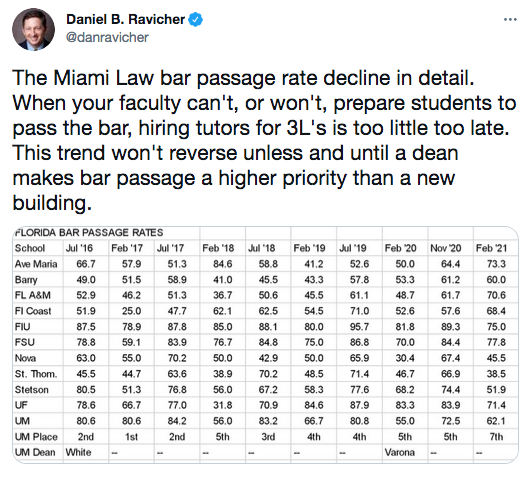
And the author of the above post, whom Varona fired last year, has been campaigning against Miami’s woke culture.
More here.
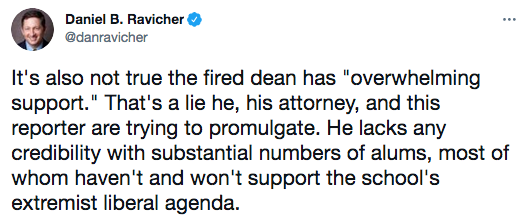
And he seems to be taking a bit of a victory lap:
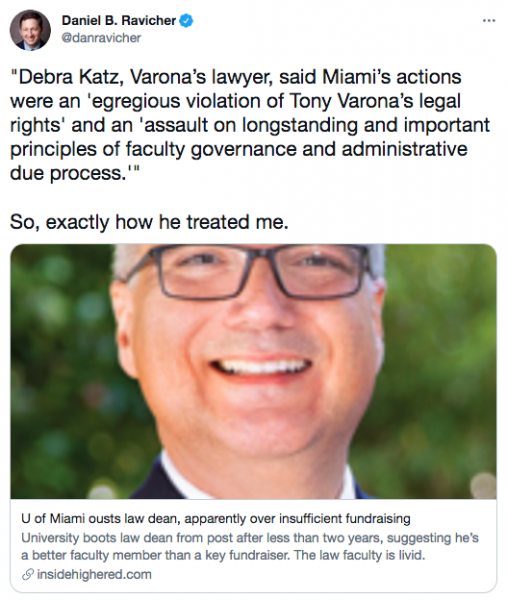
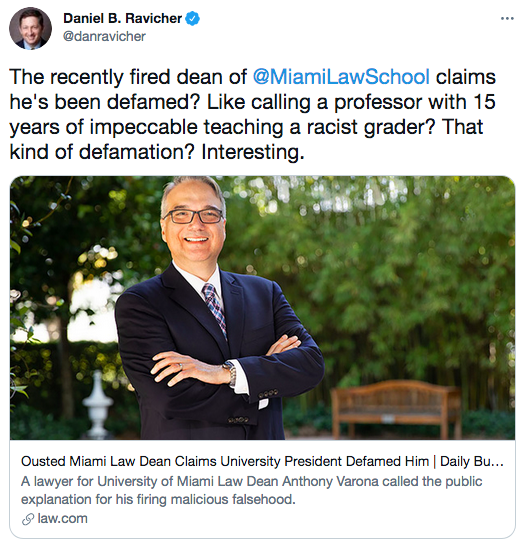
So reading the tea leaves, I’d say that an overdose of wokeness led to a lot of alumni becoming deeply uninterested in contributing to the university’s big new capital campaign, and the university higher-ups decided that Varona was too expensive to keep. Just speculation on my part, but I’m sure we’ll learn the truth eventually.
UPDATE: Related: The Risks When Law School Deans Go Woke.
And I have to say, Ravicher is fighting back the right way. If you’re “canceled,” don’t slink away — punish them. Talk to alumni, talk to prospective students — heck, here I’d buy Google ads saying the school discriminates and that bar passage is bad — and if it’s a public school, talk to legislators. And, also for public schools, file state Freedom of Information Act requests for salary and travel expense information; there’s usually a rich lode of embarrassment there if you look hard enough.
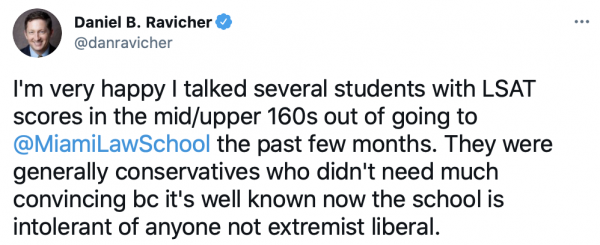
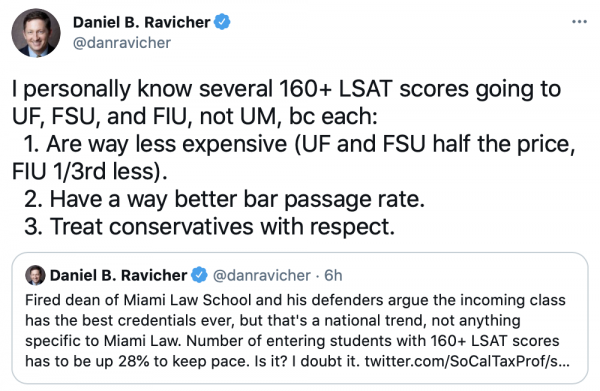
If you go to FIU, you can take classes from former InstaPundit co-blogger Elizabeth Price Foley, which is reason enough to choose it over Miami. (Bumped).
UPDATE: Dean Tony Varona responds here.
WELL, IT’S HARD TO GET AN STD FROM SIX FEET APART: As the Pandemic Wanes, Sexually Transmitted Infections Are Likely to Rise.