Author Archive: Elizabeth Price Foley

I SMELL A WISCONSIN RAT:  Reporter M.D. Kittle at WisconsinWatchdog.org asks a very interesting question:  What did the Milwaukee Journal Sentinel know, and when did it know it?  The question relates to the Journal-Sentinel reporters’ knowledge of a pre-dawn paramilitary-style raid of the home of Cindy Archer, a fomer aide to Wisconsin Governor Scott Walker and one of the architects of Wisconsin’s Act 10, which reformed that State’s public sector unions.

The raid of Archer’s home occurred in the early morning hours of Wednesday, September 14, 2011.  At the time of the raid, Archer saw an individual that she believed to be a reporter, standing in her lawn.  But the question became:  How would a reporter even know that Archer’s home was being raided?  Someone had to tip the Journal-Sentinel off.  But under Wisconsin law, disclosure of a search warrant’s issuance, prior to its execution, is a Class I felony and could also violate the judge’s secrecy order of the John Doe investigation itself.

The Journal Sentinel ran a story on the Archer raid on the same day that the raid occurred (Sept. 14, 2011), authored by reporter Jason Stein.  In that story, Stein suggests that the raid was associated with the ongoing John Doe investigation:

About a dozen law enforcement officers, including FBI agents, raided the home of a former top aide to Gov. Scott Walker on Wednesday as part of a growing John Doe investigation.

The home on Dunning St. on Madison’s east side is owned by Cynthia A. Archer, who was until recently deputy administration secretary to the Republican governor. Archer, 52, now holds a different state job but is on paid sick leave, records show.

“We’re doing a law enforcement action,” one of the FBI agents told a reporter.

He didn’t identify himself or provide further comment but confirmed that he and three others were with the FBI and that a Dane County sheriff’s deputy was present.

The raid on Archer’s home coincides with a John Doe investigation in Milwaukee County.

That probe was started last year after the Journal Sentinel reported that another Walker staffer who was being paid by Milwaukee County taxpayers to help citizens with county services was instead using her work time to post anonymous comments supporting candidate Walker on websites and blogs. As part of the investigation, authorities earlier seized the work computers of two former Walker staffers and executed a search warrant of one of their homes.

Stein also intimates that Milwaukee District Attorney John Chisholm, one of the John Doe prosecutors, was involved in the raid:

Milwaukee County District Attorney John Chisholm also declined to comment.

Dane County Sheriff Dave Mahoney said one of his deputies had been placed at Archer’s house during the search at the request of investigators from Chisholm’s office. Mahoney said his office wasn’t involved in the investigation.

Sources indicated that Chisholm’s office continues to take the lead in the case of Walker’s former county staffers, with federal authorities providing assistance with computers and other digital technology.

The rest of the Stein story describes prior John Doe raids initiated by Chisholm’s office.  Stein may have just guessed that the raid was John Doe-related, but the tone of his piece seems more confident than that.

Journal Sentinel reporter Patrick Marley–not Stein– has admitted that he was the reporter Cindy Archer saw in her lawn.  But Stein admits that he, not Marley, was tipped off about the Archer raid, and he merely asked Marley to observe and take notes because Marley lived closer to Archer’s home.

So the question remains:  Who tipped off Stein (a political reporter) about the Archer raid?  Stein denies that his source was a prosecutor or law enforcement officer, and it’s theoretically possible (though somewhat farfetched) that one of Archer’s groggy neighbors just happened to know Stein’s home or cell phone number and called him in the middle of the night to tip him off.

The John Doe investigation has been plagued by selective leaks all along, is an ongoing problem, and is almost invariably favorable to the prosecutors. All of this strongly indicates that the source of these leaks is an insider in the John Doe investigation.  While Stein appears to claim a reporters’ privilege to protect his source regarding the Archer raid, Wisconsin does not have a reporters’ shield statute, its courts have recognized only a qualified privilege pursuant to its state constitutional equivalent of the First Amendment.  So in theory, the identity of Stein’s source could be revealed under the right circumstances.

But regardless of Stein’s possible privilege, it seems evident that there is a serious and continuing leak in the Wisconsin John Doe investigation, and that it warrants an investigation of its own.

Indeed, if it hadn’t been for the courage of Eric O’Keefe of the Wisconsin Club for Growth–who has defied the ridiculous gag order imposed on John Doe targets–the only knowledge the public would have today about the investigation would come from these one-sided, pro-investigation leaks. But getting the truth about an issue of such public importance shouldn’t depend upon the courage of one person. The leak’s one-way nature and suspicious timing only amplify the impression that the entire investigation is, as O’Keefe’s lawsuit contends, a political witch hunt, designed to silence conservatives in the State.  Thankfully, O’Keefe is punching back twice as hard.
PRAY THIS WOMAN NEVER TEACHES YOUR CHILDREN:  Meg Stentz, a teacher in North Charleston, S.C., has written an “opinion” piece in Cincinnati.com (apparently she grew up in Cincinnati) lamenting racial violence.  Her lead paragraph is unremarkable, but her second paragraph is worth a close read:

Just over a week after Walter Scott was gunned down, the Rev. Jesse Jackson returned to his home state to speak about the national tragedy. He spoke to less than 100 people, including media. The event was put on by the small, young, grassroots group leading the local resistance, Black Lives Matter of Charleston.

Jackson offered the media a chance to ask questions after his talk. The first came from a flushed white man, who said that since Jackson was calling for police to wear cameras, he wanted to know how many officers Jackson had spoken to himself. This white micro-aggression, this nearly purposeful missing the point, has been largely how I’ve perceived Charleston to be taking this horrifying incident.

So apparently, in Ms. Stentz’s infinite wisdom, asking Jesse Jackson a logical question about whether he had spoken to police about wearing cameras is a “white micro-aggression.”  Not a “micro-aggression,” mind you– a white micro-aggression.  Is there really any other kind?

And of course this “aggressive” question came from a flushed white man.  Again, is there any other kind?  They’re just so, you know, pasty-faced– a bunch of Pillsbury Dough Boys, really.  I’m sure his “flushing” emanated from some unconscious physiological acknowledgment of his own whiteness and micro-aggressive behavior.

But wait, it gets worse:

After being raised in Ohio, I moved to now-well-known North Charleston to teach in a Title 1 middle school. My roommates are also transplants and teachers, meaning they’re at least as liberal as most of the North and still observant of how the South operates.

Of course, Ms. Stentz never bothers to explain “how the South operates,” but the educated (read: liberal) reader will understand what this means without elaboration (wink, wink, nod, nod).  You know, it’s how the South operates.  In case you don’t understand (because your white privilege or something is blocking your awareness), she thankfully makes her meaning clear in her closing paragraph:

In the Deep South, complacency is king, and the reaction here, even to sensationalized coverage, is minimal. My students are not angry, because anger only springs from a belief that things could be different. This racial violence is all they’ve known. I hope one day, that won’t be true, but from where I’m standing, the only people up in arms about this “news” are north of the Mason-Dixon line.

Well, thank you Ms. Stentz for condemning an entire region as racists.  I’m sure you know this is true, since you grew up in the pure, non-racist, above-the-Mason-Dixon State of Ohio and everything.

And I’m sure Southern racism persists because of the enormous influx of Northerners over the last several decades, as well the reverse migration of  of blacks into the South.  Oh, wait–those aren’t “real” Southerners (wink/nod)–they’re virtuous transplants from north, so they don’t really count as Southerners.  That term only applies to people who are direct descendants of Confederate soldiers–such as Bushrod Johnson, a Confederate General from Ohio— as any intelligent person knows.

And besides, there’s never any racial violence anywhere else, and it’s never initiated by minority groups.  #Ferguson #FreddieGray #NYCcopambush

This is the kind of intelligent discourse our universities are encouraging, awarding degrees to those who reflexively mirror their liberal/progressive professors’ views, all while flying the banner of #diversity and #tolerance.   And to make matters worse, she is a teacher.

BECAUSE DIVERSITY!:  A “diversity” officer at Goldsmiths, University of London, Bahar Mustafa, sponsored a meeting recently to discuss the need for greater “diversity” in the curriculum, announcing on Facebook:

Invite loads of BME [Black and Minority Ethnic] Women and non-binary people!! Also, if you’ve been invited and you’re a man and/or white PLEASE DON’T COME just cos i invited a bunch of people and hope you will be responsible enough to respect this is a BME Women and non-binary event only.

Non-binary is a term that apparently refers to individuals who don’t identify as exclusively male or female.  Ms. Mustafa tried explain the exclusion of whites and men:

Don’t worry lads we will give you and allies things to do.

How thoughtful and inclusive of her, especially for a department that touts as its goals:

  • combat discrimination, victimisation and harassment
  • advance and promote equality of opportunity between different groups
  • foster good relations between people from different groups

Ms. Mustafa–is it a microagression to refer to her as “Ms.”?– describes herself as follows :

I am particularly interested in looking at the gendered body in Japanese pornographic anime and horror through a Foucauldian framework in order to analyse the West’s gaze upon a world it attempts to categorize.  My politics are intersectional, queer, feminist, anti-racist . . . I am a working class, Turkish Cypriot, queer, disabled woman and activist.

Um, okay.  I cannot for the life of me translate that first sentence into English.  She is interested in Japanese anime porn’s portrayal of “gendered” bodies (is there any other kind?) because it attempts to “categorize”?  Whatever.  Yawn.

Apparently, the University was forced to back-walk its exclusionary policy, later posting “ALLIES NOW WELCOME.”   Yeah, right– about as welcome as a bleeding pig in a lion cage.

Can you imagine a University holding an event and publicizing it as “whites only, please?”  Of course you can’t.  “Diversity” is a just a politically-correct label for discrimination against whites, especially white males.  And it most certainly does not include diversity of viewpoint (i.e., conservative thought).

RELATED (kind of):  Abercrombie and Fitch decides to ditch its uber-sexual teen marketing and simultaneously announced  plans to continue to encourage “inclusion and diversity,” such as hiring more non-white “associates” (formerly called “models”).   It also announced plans to establish the A&F Global Diversity and Leadership scholarship program with the National Society of High School Scholars.

Gee, I wonder if this has anything to do with the Supreme Court case currently under consideration, Equal Employment Opportunity Comm’n v. Abercrombie & Fitch?  This is a discrimination claim by a Muslim individual who was not hired by Abercrombie.  During the interview, she wore a headscarf, though it wasn’t mentioned during the interview. She was later told by a friend that she wasn’t hired because of the headscarf.

Bottom line:  Make it very expensive not to hire anyone other than a white male.  And of course, make white men feel unwelcome as much as possible.  Because #diversity!

A TORTUROUS WASTE OF TIME:   Apparently, banning torture — even in one’s constitution — doesn’t do much to reduce the incidence of torture.  A recent study conducted by a couple of law professors concludes that they “do not find any evidence that constitutional torture prohibitions have reduced rates of torture in a statistically significant or substantively meaningful way.”  The authors find that 84% of national constitutions prohibit torture, and yet “countries without constitutional torture bans have actually engaged in less torture” over the 1990-2010 time period studied.

The definition of “torture” itself is highly subjective.  The UN Convention on Torture, for example, defines it as “any act by which severe pain or suffering, whether physical or mental, is intentionally inflicted on a person”.  But putting that definitional problem aside, torture may well work in some situations, yielding information that could not otherwise be obtained.  Robert Jervis, examining the Senate Intelligence Committee’s controversial report on the CIA’s interrogation program, put it this way in the latest issue of Foreign Affairs:

In judging the torture’s effectiveness, the majority report looks for direct connections between the intelligence derived from the torture and its benefits to national security. But the minority and CIA rebuttals are right to urge a broader view. For one thing, analysts needed a great deal of information about al Qaeda before they could make sense of any one source. By the majority report’s standard, the torture was not effective if it merely contributed to a general understanding of al Qaeda, rather than leading directly to the foiling of a terrorist plot or the capture of an 
al Qaeda member. Yet crucial insights often result from indirect links. It might have been, as the majority report argues, that breaks in many cases came from prisoner interrogations that did not involve torture. But in some cases, interrogators asked those detainees questions because of intelligence that came from others who were tortured. And although the majority report lends little weight to information that simply confirmed other intelligence, such findings can prove invaluable, since tips from individual sources are rarely sufficient to merit action on their own. In essence, the report and the rebuttals talk past each other on this point: the Democrats dismiss evidence of a type that the Republicans and the CIA (rightfully) consider central.

This past week, Amnesty Intenational issued a new report, complaining that the Obama Administration has “done nothing” after the Senate Intelligence Committee’s report, and urging DOJ to prosecute CIA and other U.S. officials involved.

Even if one agrees that what the CIA did, post 9/11 was “torture,” the truth remains that in some situations, the risk of not using such techniques may well exceed societal benefits of refraining from their use.  As liberal law professor Alan Dershowitz has put it, “No President would want to be responsible for the deaths of thousands of innocent citizens if he could have prevented these deaths by authorizing the use of nonlethal torture against a guilty terrorist.”

Indeed, there is a logical reason why constitutional prohibitions on torture don’t reduce its use:  We may ban torture, to make ourselves “feel” better.  But given its amorphous definition and potential to save thousands of innocent lives, it will continue to be used in extraordinary situations.  So there is a legitimate question as to whether it is desirable, from the perspective of the rule of law, to ban something society knows (and indeed expects) will be disregarded in the most difficult situations.   And polls show Americans overwhelmingly believe torture is appropriate in such situations.

DEATH BY A THOUSAND LAWSUITS?:   The death penalty may be dying a slow death, by litigation.  The Republican-controlled unicameral Nebraska legislature voted 30-13 (with 17 Republican “yes” votes) to repeal that state’s death penalty. The reasons for lost Republican support are varied:  the inefficiency (and cost) of years of litigation to carry the penalty out; perceived incongruity with pro-life beliefs; fear of wrongful executions; and a shortage of drugs needed to carry out executions.

The drug shortage is the biggest culprit.  The death penalty in most states is carried out by a lethal injection of a three-drug “cocktail”:  (1) an anesthetic (to prevent pain); (2) a paralytic (to paralyze); and (3) potassium chloride (which stops the heart). But in early 2011, U.S. drugmaker Hospira announced it would no longer manufacture sodium thiopental, the primary anesthetic used in the lethal injection cocktail.

Hospira’s exit from the market left States scrambling for a substitute, including purchases of the drug from foreign markets. When death penalty lawyers complained that States lacked legal authority to import sodium thiopental from foreign countries, the Obama Administration seized State stockpiles of the drug, claiming its possession violated federal law.  States then turned to pentobarbital, manufactured by Danish drug company Lundbeck.  But by summer 2011, Lundbeck, too, announced it was denying distribution of the drug to U.S. prisons.

The State of Oklahoma has turned to midazolam hydrochloride as a substitute anesthetic, though it hasn’t specifically been approved by the FDA as such.  It is widely used off-label, however, for anxiety and sedation.  On Thursday, the Supreme Court will hear an Eighth Amendment challenge, Glossip v. Gross, to Oklahoma’s use of midazolam, which claims that its use constitutes “cruel and unusual punishment” because midazolam isn’t foolproof at inducing unconsciousness.

The Supreme Court has never struck down a specific death penalty method as unconstitutional.  Indeed, in 2008, the Supreme Court upheld the constitutionality of a four-drug lethal injection cocktail in Baze v. Rees.  The Court suggested, however, that a state may violate the ban on cruel and unusual punishment if it continues to use a lethal injection method, without sufficient justification, in the face of superior alternative procedures.  In the Glossip case pending before the Court, therefore, Oklahoma asserts–in an excellent brief authored by Oklahoma Attorney General Scott Pruitt and well-known constitutional lawyer David Rivkin— that the inmate must carry the burden of proving that there are, indeed, superior alternative anesthetics available. They assert:

This Court requires Petitioners to demonstrate the availability of a constitutional alternative method of execution for good reason. Capital punishment is constitutional, and this Court has made clear that States must have a means of carrying it out, even if some pain results as an inescapable consequence of execution. Accordingly, challenges to a method of execution must demonstrate that there exists a feasible alternative method that will result in substantially less pain. Otherwise, a petitioner’s challenge would constitute a challenge to the death penalty itself – an issue foreclosed by the Constitution.

In the event that the Supreme Court uses Glossip to reopen the constitutionality of lethal injection, States are now bringing back older methods of execution including nitrogen gas, the electric chair and firing squad.

States’ adopting a variety of methods is probably the best way to ensure that the death penalty can survive these liberal/progressive “lawfare” tactics.

UPDATE:  Midazolam’s use for anxiety and sedation is “on label,” but its use for maintenance of general anesthesia is off-label.  It should be noted, however, that off-label uses of all FDA-approved drugs is perfectly legal and indeed, common.

SUPREME ETHICS:  Democrats on the Hill, led by Congresswoman Louise Slaughter (D-NY), are once again pushing legislation that would impose a code of ethics upon the U.S. Supreme Court.  The Supreme Court itself has repeatedly rejected the idea of adopting such an ethics code, including the current Roberts Court.  Members of the Court do voluntarily agree, however, to follow the same rules as other federal judges on honoraria, gifts, and outside income.

There is a Judicial Code of Conduct for United States Judges— which binds all federal judges except the U.S. Supreme Court–which requires recusal in certain instances of bias and prohibits federal judges from engaging in various acts that may create an appearance of partiality, including engaging in political activities. So why doesn’t this Judicial Code of Conduct also apply to Supreme Court Justices?  Because the Supreme Court is the only court that is constitutionally required to exist, with all lower federal courts existing only insofar as Congress wishes to establish them.  The lower federal courts, therefore, are “creatures” of Congress, established and controlled by it.  Congress’ ability to impose a code of conduct upon judges it creates is thus clear, as a legal matter.

But the Supreme Court is not created by Congress; it has independent constitutional existence.  While Congress has power to regulate the appellate jurisdiction of the Supreme Court, give Senatorial advice and consent to Supreme Court nominations, impeach Justices, control the Supreme Court’s budget and even to enact legislation defining the number of Justices that sit on the Court, it otherwise lacks a clear textual authority to regulate the way the Court adjudicates cases.  The Court’s historic position is that because it isn’t created by Congress, Congress cannot impose a code of ethics upon it; doing so would violate separation of powers.

While having the Supreme Court abide by a Code of Ethics sounds good at first blush, the question isn’t really whether it should have such a code, but whether Congress should be able to impose one upon a co-equal branch of government.  And the reasons cited for congressional enactment of such a code focus exclusively on supposed unethical behavior by conservative Justices.  For example, Justice Clarence Thomas failed to report his spouse’s income from conservative groups, necessitating several years of revised disclosure forms.  Justices Antonin Scalia and Thomas have attended events at the National Lawyers’ Convention of the Federalist Society.

But of course, liberal Justices have engaged in the exact same behavior.  Justice Ginsburg has lent her name and given speeches to the NOW Legal fund and recently made comments about same-sex marriage cases that clearly indicate her prejudgment on the issue. Justice Elena Kagan refused to recuse herself from the recent Obamacare subsidy case, King v. Burwell, even though she served as the U.S. Solicitor General and was intimately involved in the defense of the law. And like Ginsburg, Kagan’s comments and officiating at a same-sex marriage ceremony have called for her recusal from the same-sex marriage cases now pending before the Court.  Justice Breyer has faced his own calls for recusal, based on potential financial conflicts.

The point is that while it may be a good idea for the Supreme Court voluntarily to adopt ethics rules for itself (which it de facto seems already to have done), I am highly skeptical about Congress imposing them, and the political mischief that could ensue.  Indeed, liberals/progressives are already overtly attempting to bully the Court, calling for term limits (which, btw, would require a constitutional amendment), and generally calling for “reforms” of a Court they think is too conservative (and likely to stay that way for some time).

My hunch is that congressionally-imposed SCOTUS ethics rules would only further politicize the Court, which would not be good for the rule of law.

HEADY STUFF:  An Italian neurosurgeon named Sergio Canavero claims he plans to conduct the world’s first head transplant soon, and it should only take about an hour.  Valery Spiridonov, a 30-year-old computer scientist from Vladimir, Russia, is the first person to volunteer for the procedure.  Spiridonov suffers from Werdnig-Hoffman disease, a rare, genetic spinal muscular atrophy disease.

In a meeting of the American Academy of Neurological and Orthopedic Surgeons this June, Dr. Canavero plans to detail the specifics of his surgical procedure.   In a February article in the Surgical Neurology International Journal, Canavero described the basics of how he plans to fuse the spinal cord of Spiridonov’s head with that of the donor (cadaveric) body.  The goal, according to Dr. Canavero, is “immortality.”  Apparently, elderly wealthy individuals are already lining up for this procedure, in the hopes of replacing their frail, older bodies with fresh, 20-something ones.

NYU Bioethicist Arthur Caplan says Dr. Canavero’s plans are unethical, because the surgical technique for spinal surgery isn’t perfected, the chance of immunosupressive rejection is high, and the brain may not be able to “integrate” with a body with which it isn’t familiar.  According to Caplan, “[T]he most likely result is insanity or severe mental disability.”

Dr. Canavero seems to be a legitimate neurosurgeon with the Turin Advanced Neuromodulation Group, but his obsession with becoming the first successful surgeon to perform a head transplant is a bit Frankenstein-y.   He does seems more legitimate, however, than some prior high profile oddballs, such as Dr. Richard Seed, who made a big splash in the late 1990s when he proclaimed he wanted to perform the first human cloning.

But then again, recent media reports suggested that Dr. Canavero’s talk of head transplants was all an odd publicity stunt for a video game called Metal Gear Solid.  But just today, it’s being reported that Dr. Canavero has filed a sworn affidavit with Italian police, denying that he has anything to do with the game maker, and that it’s using his likeness without his permission.

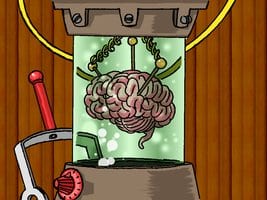
If Dr. Canavero is legit, this could be the beginning of a very interesting chapter in transplant history.  I think it would be pretty weird, though, to put an older person’s head on a hot, young body.  I kind of liked the old school notion of  achieving immortality via the ‘brain in a jar” scenario.  But bodies are nice.  Stay tuned.

brain in a jar

MONKEYING AROUND:  You can’t make this stuff up, folks.  A New York state judge, Barbara Jaffe, has ordered a hearing in May to determine if two chimpanzees, Hercules and Leo,  owned by Stony Brook University, are being “unlawfully detained.” The lawsuit has been filed on the chimps’ behalf by the Nonhuman Rights Project (NhRP), a group formed to establish the legal rights of nonhumans through litigation, “beginning with some of the most cognitively complex animals on earth, including chimpanzees, elephants, dolphins, and whales.”

The NhRP initially convinced Jaffe that Hercules and Leo were entitled to habeas corpus— the first time any U.S. court has granted such a right to a nonhuman. A few hours later, Jaffe apparently became aware of the fact that non-humans are not entitled to habeas (guess she forgot that basic legal principle?), and issued an order for Stony Brook to “show cause” for “detaining” Hercules and Leo–which is bad enough, as it imposes a burden upon the owner of an animal to explain to a judge why an animal is being “detained.”  I would hate to think that some radical leftist neighbor could haul me into court to “show cause” as to why I am “detaining” my dog, Thomas Jefferson.

And indeed, this nightmare scenario is already unfolding.  A similar habeas corpus petition was brought in NY state courts in December on behalf of a 26 year-old chimpanzee named Tommy, owned as a pet by a couple who kept Tommy in a cage– an understandable “detention,” for a potentially dangerous animal, as illustrated by the tragic recent case of Travis the chimpanzee.   An appellate court rejected the extension of habeas corpus to Tommy, reasoning:

Needless to say, unlike human beings, chimpanzees cannot bear any legal duties, submit to societal responsibilities or be held legally accountable for their actions. In our view, it is this incapability to bear any legal responsibilities and societal duties that renders it inappropriate to confer upon chimpanzees the legal rights – such as the fundamental right to liberty protected by the writ of habeas corpus – that have been afforded to human beings.

The amazing thing about this rationale is that it implies that if some animals could bear a legal duty, submit to societal responsibilities, or be held accountable for their actions (any one of which could conceivably be imposed via enactment of statutes declaring such), the court would be willing to entertain the proposition that a pet–or any other “detained” nonhuman– could be granted corresponding legal rights equal with humans.  Why even open the door to that possibility?

A similar legal “opening” came from another New York state judge, who in January denied a habeas corpus petition filed by NhRP on behalf of Kiko the chimpanzee, reasoning as follows:

Here, petitioner does not seek Kiko’s immediate release, nor does petitioner allege that Kiko’s continued detention is unlawful. Rather, petitioner seeks to have Kiko placed in a different facility that petitioner deems more appropriate. Consequently, even assuming, arguendo, that we agreed with petitioner that Kiko should be deemed a person for the purpose of this application, and further assuming, arguendo, that petitioner has standing to commence this proceeding on behalf of Kiko, this matter is governed by the line of cases standing for the proposition that habeas corpus does not lie where a petitioner seeks only to change the conditions of confinement rather than the confinement itself.

Ugh.  The judge didn’t say he would have granted a habeas petition challenging Kiko’s confinement per se, but he also didn’t shut the door on that possibility.

I like animals as much as anyone, but they aren’t human.  This doesn’t mean, of course, that our legal regime should tolerate any animal abuse. Indeed, counsel for Tommy’s habeas petition stated that the goal of the lawsuit was not to challenge the conditions of Tommy’s confinement (there was no allegation that he was being abused, which would have triggered protection under state animal cruelty law), but  “to obtain recognition for a single right: the right to not be imprisoned against one’s will” because “Tommy is the equivalent of a human child.”

This argument is gaining ground around the globe.  In December, an Argentine court recently granted a habeas corpus petition and ordered the release of an orangutan being “detained” in a zoo.  Even Obama’s regulatory czar, Cass Sunstein, has argued stridently that animals should have legal standing to sue.

Do these radical left-wing animal rights activists stop to think about what the world would look like if they succeed?  They actually argue that since corporations and other business entities have legal rights, “other nonhumans” should, too.  Um, I hate to break it to these bozos, but corporations and other business entities are merely legal mechanisms by which HUMANS join together for purposes of efficiently carrying on a business.

If animals have human rights, it’s not merely that you and I might find ourselves sued by Fido or Mittens, who no longer wish to be “detained” as our pets or in our zoos.  Much of this country’s medical research would shut down, as preclinical trials on animals is necessary for approval of human drugs and invaluable for numerous other medical research.  What is it about radical leftists that their tree-hugging, whale-loving concern for life doesn’t extend to humans?

UPDATE:  Today’s Wall Street Journal has an excellent oped extolling the human benefits from animal testing, including recent progress on Ebola and brain tumors.

DOES SAME-SEX MARRIAGE INCREASE ABORTIONS?:  According to an unusual amicus brief filed by “100 Scholars of Marriage,” the answer is “yes.”  The brief is one of many “friend of the court” briefs submitted in the same-sex marriage case, Obergefell v. Hodges, slated for Supreme Court oral argument next Tuesday (Apr. 28).

One might understandably inquire, “How could recognizing same-sex marriage increase the number of abortions?” According to a summary penned  by the brief’s author, D.C. attorney Gene Schaerr (a former Scalia clerk):

The metamorphosis of marriage from a gendered to a genderless institution conveys to men (and women) that society no longer needs men to bond to women to form well-functioning families or to raise happy, well-adjusted children. And that message is especially likely to be influential among those on the margins: the poor, the relatively uneducated or others who are highly influenced by cultural messages promoting casual or uncommitted sex.

The weakening or destruction of these norms would result in fewer marriages, more procreation out of marriage, and a higher percentage of children raised in a home without both parents—usually without a father. The consequences would be stark and disastrous: more childhood poverty; increased psychological and emotional problems; more teenage pregnancy; poorer performance in school; higher amounts of substance abuse; more youth committing crimes; and more girls undergoing abortions.

Schaerr’s estimates of increased abortions are very specific:

Accordingly, with 1.275 million additional women never getting married, nearly 900,000 more children of the next generation would be aborted as a result of their mothers never marrying. This is equal to the entire population of the cities of Sacramento and Atlanta combined.

I’m frankly not sure what to make of this.  The problem, as Schaerr freely admits, is that there is no hard statistical evidence that recognizing same-sex marriage would actually cause these consequences. And the limited data that is available suggests that the availability of same-sex marriage does not cause a decline in opposite-sex marriage rates.

On the other hand, there is something instinctive about the notion that if the definition of marriage keeps expanding–even beyond same-sex unions of two adults–its meaning will be diluted and, over time, its value and prevalence.  But this is a slippery slope argument, and the slope isn’t always as slippery as one fears, though it may be somewhat slippery.

The dilution and devaluation may not happen with recognition of same-sex marriage alone, but what if a recognition of same-sex marriage leads to recognition of consensual adult bigamous, polygamous or incestuous unions?  Would “marriage,” defined this broadly, still be something as deeply valued as it is today?  Or is it akin to giving every kid on the team a trophy– i.e., everybody gets one, so it isn’t so special anymore?  Or if marriage continues to be perceived of as a union based on “love,” is there sufficient love to go around, such that a greater number and variety of love-based unions won’t dilute the specialness of marriage?

Given the seeming inevitability of a Supreme Court ruling in favor of same-sex marriage, how broad marriage becomes– and thus how “special” it is perceived–will be determined by our children, or grandchildren.

WILL SCOTUS AGREE TO HEAR WISCONSIN “JOHN DOE” CASE?:  The Supreme Court will decide Friday whether to grant review on a case relating to the infamous Wisconsin “John Doe” investigation of conservative groups that supported Governor Scott Walker and his reform of public sector union collective bargaining.

The case, O’Keefe v. Chisholm, was filed by Eric O’Keefe and the Wisconsin Club for Growth after they each received John Doe subpoenas in October 2013, demanding that they turn over all Club records and communications–including all emails, financial materials and donor lists–to prosecutors.  Consistent with Wisconsin’s John Doe law, the subpoenas gagged O’Keefe and the Club, prohibiting them from speaking to anyone (including lawyers or the press) about the existence or nature of the subpoenas, under pain of contempt.  Numerous other conservative activists’ homes were searched in middle-of-the-night SWAT raids, their computers, phones and other papers seized, and their victims also gagged.  Documents divulged in the litigation revealed that the prosecutors hoped to expand the John Doe investigation by issuing subpoenas to high profile conservatives such as radio show host Sean Hannity.

O’Keefe’s lawsuit centers primarily around a claim that the John Doe investigation was being conducted in bad faith, in an attempt to silence the First Amendment speech and association rights of O’Keefe and the Club.  In May 2014, a federal trial judge, Rudolph Randa, granted O’Keefe and the Club a preliminary injunction, halting the investigation and finding that their First Amendment claims were likely to succeed on the merits.

The U.S. Court of Appeals for the Seventh Circuit reversed, reasoning that federal courts should not entertain O’Keefe’s First Amendment claims because of the Anti-Injunction Act (AIA)– an argument that none of the parties to the O’Keefe litigation (nor Judge Randa) had argued or briefed.

Specifically, the 7th Circuit ruled that O’Keefe’s federal constitutional lawsuit should not be considered because considerations of “equity, comity and federalism” that underlie the AIA required Wisconsin state courts be given an opportunity to halt the John Doe investigation before federal courts should get involved.  Unfortunately, as O’Keefe’s Supreme Court petition rightly points out, this interpretation of the AIA directly contradicts the Supreme Court’s decision in Mitchum v. Foster (1972), which held that federal civil rights lawsuits were an exception to the AIA.

To make matters worse, the 7th Circuit’s ruling also directly contradicts the Supreme Court’s 2013 decision in Sprint Communications, Inc. v. Jacobs, that federal courts should not abstain from deciding federal law claims because federal courts “are obliged to decide cases within the scope of federal jurisdiction” and “[a]bstention is not in order simply because a pending state-court proceeding involves the same subject matter.”  Federal constitutional rights are sufficiently important that victims of abusive state government power shouldn’t be forced to wait years to see if state courts will halt abusive state officers’ behavior, before they are able to seek relief from neutral federal courts.

The Supreme Court is also being asked to consider the propriety of the Seventh Circuit’s alternative ruling that a viable First Amendment claim cannot be grounded in an assertion of retaliatory, bad faith investigation– a question the Supreme Court has unfortunately punted since its obscure footnote 9 in Hartman v. Moore (2006).   Since Hartman, five federal appellate courts have disagreed with the Seventh Circuit, and concluded that any retaliatory investigation that would deter a reasonable person from exercising his First Amendment rights is, in fact, actionable.  And this is as it should be:  just consider the IRS scandal, in which the agency has targeted tea party groups for investigation and scrutiny, all in an attempt to chill those groups’ First Amendment activities.  Retaliatory investigation is the quintessential abuse of government power, and it must be actionable lest John Doe-type investigations become a model for intimidating those who dare to participate in the political process.

If the Supreme Court cares about vigorously defending the First Amendment–and recent cases have suggested it does— the O’Keefe case warrants review, to set the record straight about abstention in federal civil rights cases, and to close the gaping First Amendment loophole (disallowing retaliatory claims) endorsed by the 7th Circuit.

SNIFFING AROUND  FOR PRIVACY:  The Supreme Court yesterday ruled that police cannot detain motorists stopped for a routine traffic violation any longer than it takes to complete their resolution of the traffic violation (running a driver’s license/registration/insurance check and writing a ticket).  The case, Rodriguez v. United States, involved a pull-over for erratic driving.  After running routine checks associated with the traffic violation, the officer asked Rodriguez to consent to a police drug dog sniff of his vehicle.  When Rodriguez declined, the officer radioed for backup and the dog sniffed Rodriguez’s vehicle anyway.  The dog discovered methamphetamines.

The Court, 6-3– with an interesting and broad ideological coalition of Ginsburg, Roberts, Scalia, Breyer, Sotomayor and Kagan– ruled that the dog’s use was “unreasonable” under the Fourth Amendment absent “reasonable suspicion” that Rodriguez had drugs.   Whether the officer in Rodriguez’s case actually had a reasonable suspicion that Rodriguez possessed drugs is a question upon which the Court did not pass, remanding the case back to the lower courts to determine.  So Rodriguez may yet lose.

The Rodriguez decision allows drug-sniffing dogs to be used during routine traffic stops– a practice upheld in the 2005 case, Illinois v. Caballes– but the dogs cannot extend the time necessary to complete investigation of the traffic offense.  What’s even more intriguing is that the Rodriguez decision seems to imply that a dog sniff constitutes a “search” under the Fourth Amendment, which contradicts the Court’s 1983 decision in United States v. Place.  The Place Court concluded that a dog sniff doesn’t invade one’s “reasonable expectation of privacy,” in the same way that opening up one’s luggage would.

I’ve always thought Place was wrongly decided and hope the Court is walking back its position that dog sniffs aren’t “searches.”  If use of a GPS tracker or thermal imager are “searches” under the Fourth Amendment– and the Supreme Court has said they are– then a dog sniff should be, too.  They are all mechanisms by which the government can “see” or learn things it otherwise could not.  If I put materials in an opaque container– purse; car trunk; suitcase–I have a reasonable expectation of privacy therein, and if the government wants to peek inside, it’s a search.  The Court’s recent cell phone case, Riley v. California, is a similar positive step toward enhancing privacy under the Fourth Amendment, particularly outside the home.

PUNCH EPA BACK TWICE AS HARD:  The Obama Administration’s EPA has recently discovered, buried in obscure language (section 111(d)) of the Clean Air Act, that it has authority to demand drastic reductions in carbon dioxide (CO2) emissions from existing power plants.  The net effect of its demands would be the shut-down of many of the nation’s coal-fired electricity plants, which are by far the most common and cost-effective means of generating our nation’s growing electricity needs.  The Obama Administration’s goal of shutting down coal-fired plants is no secret, and the EPA Administrator has admitted that its proposed rule is not designed to reduce pollution, but in fact to kill America’s coal sector by “investing” in the Administration’s favored “renewable” energy sources, such as its disastrous solar energy “investment” in Solyndra.

As part of EPA’s 111(d) rule–set to be finalized this summer– the EPA is bullying States to completely alter existing plant-to-plug energy regulation, which will not only shut down most of nation’s coal-fired plants, but require dependency on much less reliable forms of electricity generation, including solar, natural gas and nuclear– at a cost of between $41 to 73 billion per year.

Writing in today’s Wall Street Journal, the director of the Tennessee Regulatory Authority urges States to refuse compliance with EPA’s unreasonable, expensive, and dangerous demands:

While the short-term effects may be painful, the long-term consequences of submitting to this federal power grab are far worse.

For one, compliant states will enter into a “Mother may I?” relationship with the federal government. Not only will the initial SIP require the EPA’s blessing, so will any future modifications. This gives the EPA de facto veto power over any proposed state energy regulations, thus centralizing all energy decisions in Washington.

Compliance also would absolve the federal government of accountability once the disasters of this regulation begin to unfold. The regulation is designed so states will share blame with the EPA when electricity rates skyrocket. If federal regulators want to raise Americans’ electricity bills by thousands of dollars each year, they can do that. State lawmakers would be wise to let them walk that road alone.

The more states that refuse to give in to the EPA’s demands, the more likely it is that the agency will be forced to hold back the most burdensome elements of its Clean Power Plan. This could mean anything from nonenforcement to amending provisions of the regulation to mitigate their impact.

Amen.  States should simply refuse to play ball with the EPA, and force the Obama Administration to own all of the cost increases, reliability decreases (brownouts; blackouts) that their “climate change” agenda will create.  It’s a dangerous game of chicken, admittedly, but sometimes you have to stare a bully in the eye.  Chief Justice John Roberts put it in the Obamacare decision, NFIB v. Sebelius, “The States are separate and independent sovereigns.  Sometimes they have to act like it.”   Refusing to cave into the Obama Administration’s outrageous Clean Air Act demands is a good way to start.

RELATED:  In addition to the possibility of refusing to implement EPA’s 111(d) rule, several States have filed lawsuits (with more expected to come) in an attempt to stop the madness before it can become reality.  Unfortunately, the Obama Administration has stacked the D.C. Circuit with liberals/progressives (and former Senate Majority Leader Harry Reid employed the “nuclear option” and abolished the filibuster rule in order to make this happen).  So any legal success will likely have to come from a lawsuit filed outside the D.C. Circuit.

TWO (MILLION) SCOOPS!:   . . .of raisins, taken by the federal Raisin Administrative Committee.  The U.S. Supreme Court will hear oral arguments in a case tomorrow, Horne v. U.S. Dep’t of Agriculture, to decide whether this Committee may constitutionally confiscate–without compensation–raisins grown in excess of a quota established by the Committee.  The case is being brought (finally) by brave raisin farmers Marvin and Laura Horne, who were ordered by the Committee to hand over about 300 tons (approximately 30% of their crop) of raisins that the government decided were excessive.  The Committee is a vestige of the New Deal era, which in its wisdom, too often attempted to control agricultural prices by controlling supply.  According to today’s Wall Street Journal editorial:

The Hornes say this raisin toll is an unconstitutional seizure of their property. Under the Fifth Amendment’s Takings Clause, “private property” shall not “be taken for public use, without just compensation.” That clause is typically understood to make it illegal for the government to grab houses, cars or even raisins.

A three-judge panel of the Ninth Circuit Court of Appeals had a different view, ruling in 2011 that “the Raisin Marketing Order applies to the Hornes only insofar as they voluntarily choose to send their raisins into the stream of interstate commerce.” In other words, if you don’t want your raisins seized, you always have the option of going out of business.

After the Hornes sought rehearing en banc, the Ninth Circuit three-judge panel withdrew its opinion and replaced it with one that said the Hornes would first have to pay the fines and then appeal to the Court of Federal Claims. In June 2013 a unanimous Supreme Court overturned that decision and remanded it to the Ninth Circuit to decide on the merits. The court should “figure out,” Justice Elena Kagan said, “whether this marketing order is a taking, or just the world’s most outdated law.”

Hearing the case again, the Ninth Circuit went on another legal flight, ruling that the Takings Clause was meant to address the seizure of land, not other personal private property. And even if the government did take raisin farmers’ property, the confiscation created raisin scarcity which raised raisin prices, so the Hornes were compensated for their property in that way.

This is rewriting the Fifth Amendment. Under the Ninth Circuit’s logic, why couldn’t the government demand that an auto company hand over 20% of the cars off its production line to give to the poor or sell overseas? How about pharmaceuticals or iPhones to maintain stable prices or serve another regulatory purpose?

Exactly.  If the government can (literally) take raisins without compensation, they can take anything else, and sellers of virtually anything can have their goods confiscated by a government intent on regulating “supply.”  This regulation of supply was one of the basic principles of Soviet collectivism of agriculture, as well as industry, in Stalin’s Five Year Plans.  It is telling to see how the U.S. Court of Appeals for the Ninth Circuit–the most liberal federal court of appeals–has engaged in contortions to avoid honoring the Takings Clause of the Constitution.

HEY GUYS, CHECK OUT THIS MICRO-AGGRESSION!:  Man, it’s really bad.  I mean, bro, it’s serious.  It’s the micro-aggression of patriarchcal, male-centric words like “guys,” “mankind,” and “dude.”  And apparently, according to this self-described “very serious feminist,” it’s why us chicks pay more for deodorant and razors and other stuff — an unofficial “pink tax” against all things feminine, which is a micro-aggression of its own!

Plus, let’s not forget the daily assault of manspreading, which is a pressing microaggression that threatens all mankind chickdom personhood.

Seriously, dude, cut it out.  Because #waronwomen.

OF UNICORNS & INCOME INEQUALITY:   “Income inequality” is fast becoming the unicorn of the 2016 presidential campaign– a mythical creature that has captured the hearts and minds of the political left and a good number of independents.

Hillary Clinton has signaled it’s going to be the centerpiece of her presidential bid.  She recently complained about CEO pay being “300 times what the average worker makes.” But the more accurate figure is that the average CEO makes only about four times the wages of the average worker (not 300).  And let’s face it, folks:  The average business owner/CEO often invests personal funds, mortgages personal assets, and puts in hours far in excess of the “average” worker.

Liberals/progressives tout income inequality as “America’s biggest problem.”  Self-described socialist-democrat Rep. Bernie Sanders (who caucuses, unsurprisingly, with the Democrats) is pushing Hillary even further left, threatening to challenge her and asserting that his campaign would be built around an argument for “fundamental changes in the way we do business in the United States of America in terms of income inequality.”

The problem with all of this is that there is zero evidence that higher incomes for the top X percent of Americans causes a rise in poverty rates.  If the rich get richer, in other words, the poor don’t get poorer.  Indeed, the population of America’s poor has remained steady at 15% since the advent of the “Great Society” programs.  The “war on poverty” is an income-sucking hamster wheel, getting us nowhere.

The income inequality “problem,” is merely a Marxist cry for income redistribution— i.e., theft of the earnings of one segment of society (mostly middle income) to subsidize another segment of society that wants a slice of someone else’s pie.  But the top 20% of income earners in the U.S. already pay 84% of all income taxes.  The bottom fifth pays zero– and, in fact, gets a 2.2% income bonus, paid for by the rest of society.  So any arguments about the rich not paying their “fair share” for the costs of our swollen government are ludicrous.

What we need is re-invigoration of the belief in the American dream–that any child can, with hard work and intelligence, improve his lot and achieve greatness.  And the data supports that this is still true.  One would think that someone with President Obama’s biography would have ardently touted this optimistic truth.   Off all the current GOP presidential candidates, Marco Rubio seems, at the moment, to embrace this optimism the most.  I hope they all do, eventually.

unicorn

BECAUSE DEATH IS SO FUNNY (OR BECAUSE THE DEAD DON’T VOTE?):   An op-ed in today’s Washington Post argues that it’s okay for health care professionals to make fun of dying patients.  And while I confess to chuckling at some of the euphemisms for death (e.g., “circling the drain”), overall I find such attitudes crass.  But in typical liberal/progressive style, the author tries to assure us that there are some limits:    “That’s not to excuse all humor by health-care professionals. For example, mocking disabilities and using racial, ethnic or other cruel epithets go too far.”

Okay, so let me get this straight:  It’s okay to make fun of the dying, but not their ethnicity or race.  Because racism and stuff.   Plus, cynically, dead people can’t vote Democrat, so they are fair game for off-color humor.  Well, wait a minute, that’s not quite true.

UPDATE:  As a viewer points out, apparently such macabre humor is completely unacceptable, however, when it emanates from conservatives, as the tea party candidate for U.S. Senate in Kansas (unsuccessfully challenging Pat Roberts), Dr. Milton Wolf,  found out.   As an added bonus, our informed reader notes that Dr. Wolf is a distant cousin of none other that President Obama.

“HANDS UP, DON’T SHOOT!”:   But it’s not your stereotypical white-officer-in-minority-neighborhood situation, where we are admonished by the political left that “Black Lives Matter.”  Instead, it’s in America’s Heartland, Wisconsin.  And the targets are–gasp!–conservatives who supported modification of Wisconsin’s collective bargaining rules for public employees.  In this terrific new piece at National Review Online, David French breaks down the shocking excessive force used against conservative targets of the so-called “John Doe” investigation.  In the words of one target, “Anne”:

“It’s a matter of life or death.”

That was the first thought of “Anne” (not her real name). Someone was pounding at her front door. It was early in the morning — very early — and it was the kind of heavy pounding that meant someone was either fleeing from — or bringing — trouble.

“It was so hard. I’d never heard anything like it. I thought someone was dying outside.”

She ran to the door, opened it, and then chaos. “People came pouring in. For a second I thought it was a home invasion. It was terrifying. They were yelling and running, into every room in the house. One of the men was in my face, yelling at me over and over and over.”

It was indeed a home invasion, but the people who were pouring in were Wisconsin law-enforcement officers. Armed, uniformed police swarmed into the house. Plainclothes investigators cornered her and her newly awakened family. Soon, state officials were seizing the family’s personal property, including each person’s computer and smartphone, filled with the most intimate family information.

Why were the police at Anne’s home? She had no answers. The police were treating them the way they’d seen police treat drug dealers on television.

In fact, TV or movies were their only points of reference, because they weren’t criminals. They were law-abiding. They didn’t buy or sell drugs. They weren’t violent. They weren’t a danger to anyone. Yet there were cops — surrounding their house on the outside, swarming the house on the inside. They even taunted the family as if they were mere “perps.”

As if the home invasion, the appropriation of private property, and the verbal abuse weren’t enough, next came ominous warnings.

Don’t call your lawyer.

Don’t tell anyone about this raid. Not even your mother, your father, or your closest friends.

The entire neighborhood could see the police around their house, but they had to remain silent. This was not the “right to remain silent” as uttered by every cop on every legal drama on television — the right against self-incrimination. They couldn’t mount a public defense if they wanted — or even offer an explanation to family and friends.

Yet no one in this family was a “perp.” Instead, like Cindy, they were American citizens guilty of nothing more than exercising their First Amendment rights to support Act 10 and other conservative causes in Wisconsin. Sitting there shocked and terrified, this citizen — who is still too intimidated to speak on the record — kept thinking, “Is this America?”

Sadly, it is America, as controlled by a liberal/progressive agenda that inanely believes that conservatives who “coordinate” their political messages are somehow subverting the democratic process (rather than actually furthering it).

These secretive “John Doe” proceedings in Wisconsin are but a page in the progressives’ political playbook, evidenced by IRS targeting of tea party and other conservative groups, pressure on A&E to suspend Duck Dynasty’s Phil Robertson for making politically incorrect comments, and Rep. Raul Grijalva’s letter to 7 university presidents outing professors who dared to question global warming climate change (just to name a few): Harass conservatives; make it hard for them to raise money/make a living; get the media onboard to paint them as “shady,” subversive or dangerously ignorant; and tie them up with legal fees and lawsuits, with the goal of marginalizing and silencing them.

The Wisconsin Supreme Court is considering arguments in the case via papers only, to decide whether the secret prosecutions should be halted under Wisconsin law.  Oral arguments were cancelled to protect the identities of the targets.  Frankly, it’s shocking that it’s taken over 5 years to get consideration from the Wisconsin Supreme Court–5 years of abuse of free speech and association rights is too much.

HUNTING THE WHITE MALE VOTER:  Democrats are beginning to reap the electoral effects of the hatred and divisiveness they’ve sown.  White, male voters are increasingly abandoning the Democrat party, which has shown disinterest in their concerns about economic opportunity and national security, preferring instead to focus on balkanizing Americans with the “war on women,” paranoia about/hostility toward police, and global warming climate change.

Good luck, Democrats.  With op-eds like this one from Charles Blow at the New York Times, I think you’ve got a lot of introspection and attitude readjustment to undertake before you will convince any Americans who define themselves as just “American” rather than “hyphen-American” to vote Democrat.  Blow’s attitude is typical:  Shut up and take it, white men.  You’re increasingly irrelevant, we think you are “privileged,” angry closet racists (talk about projection) and we don’t care about you.  Message received.

RELATED:  Former Virginia Senator Jim Webb has suggested he may challenge Hillary Clinton for the Democrat nomination because he thinks her campaign isn’t capable of wooing white male voters.  His perspective is almost quaint.  The post-Obama Democrat party is incapable, at present, of realizing the damage it has done and reforming its “divide and conquer” strategy.

GYROCOPTER STUNT SHOWS GOVERNMENT INCOMPETENCE:   When a left-wing, postal civil servant nut-job lands a gyrocopter on the Capitol Hill lawn to publicize the supposed need for campaign finance reform (i.e., to oppose Citizens United and free speech under the First Amendment), it seems pretty clear that D.C.–and the country in general–isn’t being adequately secured.

House Oversight Committee Chairman Jason Chaffetz is demanding a Secret Service briefing.

It’s good to have a hearing–especially about national security matters–but it seems to me that the Secret Service scandals under Obama’s watch are indicative of a larger theme of government incompetence/rulebreaking, and excessive liberal/progressive tolerance thereof, from the VA scandal to the DEA sex parties to the GSA Las Vegas parties to the EPA porn addict.

Congress would be better advised amending the Civil Service Act of 1978 to make it easier to fire incompetent employees and vigorously enforcing existing security measures, such as the Air Defense Identification Zone, rather than holding a bunch of dog-and-pony show hearings.  It’s the toleration of lawbreaking and bad behavior that sends a signal that the U.S. government will look the other way.

This liberal attitude toward lawbreakers also helps embolden Iran and other bad actors around the globe.

FROM CALIFORNIA DREAMIN’ TO CALIFORNIA NIGHTMARE:  Joel Kotkin over at Daily Beast has a great piece explaining how California’s drought crisis illustrates the State’s devolution into a feudalistic society dominated by an oligarchy of super-rich liberals who’ve handcuffed the State’s ability to grow and prosper:

But ultimately the responsibility for California’s future lies with our political leadership, who need to develop the kind of typically bold approaches past generations have embraced. One step would be building new storage capacity, which Governor Jerry Brown, after opposing it for years, has begun to admit is necessary. Desalinization, widely used in the even more arid Middle East, notably Israel, has been blocked by environmental interests but could tap a virtually unlimited supply of the wet stuff, and lies close to the state’s most densely populated areas. Essentially the state could build enough desalinization facilities, and the energy plants to run them, for less money than Brown wants to spend on his high-speed choo-choo to nowhere. This piece of infrastructure is so irrelevant to the state’s needs that even many progressives, such as Mother JonesKevin Drum, consider it a “ridiculous” waste of money.

And there needs to be, at least for the short term, an end to dumping water into San Francisco Bay for the purpose of restoring a long-gone salmon run, or to the Delta, in order to save a bait-fish, the Delta smelt, which may already be close to extinct. This dumping of water has continued even as the state has faced a potentially crippling water shortage; nothing is too good for our fish, or to salve the hyper-heated consciousness of the environmental illuminati.

Kotkin concludes:

What we are witnessing the breakdown of a once-expansive, open society into one dominated by a small group of plutocrats, largely in Silicon Valley, with an “amen” crew among the low-information donors of Hollywood, the public unions, the green lobby, and wealthy real estate developers favored by Brown’s pro-density policies. This coalition backs Brown and helps maintain the state’s essentially one-party system. No one is more adamant about reducing people’s carbon footprint than the jet set of Silicon Valley or the state’s planning elite, even if they choose not to live in a manner that they instruct all others.

Yep–pretty much sums up the progressives’ approach to problems:  Political correctness+ignorance+crony capitalism= preferred “solution.”   Read the whole thing.

IS THAT REALLY A SPIDER, OR ARE YOU BEING MONITORED?:   Today’s Wall Street Journal oped by a Harvard Law prof and a Brookings Institution fellow assert that we need a “new social contract” to handle the coming privacy and security threats:

You walk into your shower and see a spider. You don’t know whether it is venomous—or whether it is even a real spider. It could be a personal surveillance mini-drone set loose by your nosy next-door neighbor, who may be monitoring the tiny octopod robot from her iPhone 12. A more menacing possibility: Your business competitor has sent a robotic attack spider, bought from a bankrupt military contractor, to take you out. Your assassin, who is vacationing in Provence, will direct the spider to shoot an infinitesimal needle containing a lethal dose of poison into your left leg—and then self-destruct.

Meanwhile, across town, an anarchist molecular-biology graduate student is secretly working to re-create the smallpox virus, using ordinary laboratory tools and gene-splicing equipment available online. Not content to merely revive an extinct virus to which the general population has no immunity, he uses public-source academic research to make it more lethal. Then he infects himself and, just as his symptoms start, strolls around the airport to infect as many people as he can.

They’re undoubtedly right about the nature and extent of these threats, but their proffered solution is itself quite frightening:

All this challenges our security—and the way we think about the state itself. The liberal state was predicated on a social contract: We give up a certain amount of liberty to a government, which promises in turn to protect us. But that promise is becoming increasingly difficult to keep as more Big Brothers—and lots of Little Brothers too—come to command awesome technological powers.

For the state as we know it to endure, we’ll have to adapt some of the most basic organizing principles of governance, both domestic and international. . . . Still, today’s international legal order remains very much boundary-centered. It gives countries the power to legislate and enforce laws within their territories but allows relatively little latitude to regulate the conduct of foreign subjects abroad—and even less latitude to actually enforce their laws beyond their borders.

Threats that routinely span borders will force states to routinely reach across their borders through legislation that governs foreign conduct, surveillance of citizens in foreign countries, and even targeted killings. A growing number of states are already claiming that more of their laws should apply beyond their territories—for instance, by unilaterally defining cyberattacks or cybercrimes and by enforcing their domestic laws against foreign offenders acting overseas. To avoid turning the world into the Wild West, we must ensure that this increased unilateralism is checked by greater international cooperation: better governance for fragile states, more information-sharing among states and more effective means of enforcing laws where jurisdictions are unclear.

In other words, the liberal/progressive solution to this growing privacy/security threat is more government, more and greater transfer of power away to international bodies such as the U.N.  They seem to have something in mind like a beefed up International Criminal Court, in which the U.S. has thus far wisely declined participation. One World Government, anyone?

No thanks.  The last thing the U.S. needs to do is relinquish sovereignty over privacy and security matters.

How about this alternative solution:  Beef up our military and national security surveillance, improve (voluntary) information sharing with our Allies, encourage the development of enhanced privacy and security devices for individual use, and enact tougher privacy laws to make sure that your nosy neighbor with that spider drone gets some time in the pokey.

HIGHER EDUCATION BUBBLE UPDATE:  President Obama’s labor-dominated NLRB agrees to hear a petition by Columbia grad students who seek the right to unionize.  The grad students want to join the United Auto Workers (that’s not a typo) because they claim they’re being treated like serfs by universities who understand that there is a glut of Ph.D.s and that most grad students will never score permanent, tenure-track positions.According to today’s Wall Street Journal editorial:

The universities argue that unionization would make the nature of their relationship with students adversarial. They too have a case. Most of America’s top universities aren’t unionized. So the schools have valid concern about elevating union interests over academic merit. Meanwhile, NYU is a rare private university that has voluntarily recognized a grad-student union.

But none of this lets academe off the hook. For one thing, the universities contribute to a glut of Ph.D.s by admitting students who take out loans (some 40% of the $1 trillion in student debt is for graduate school) even when they know few will ever work as full professors. By admitting them into graduate programs, the schools in effect are producing for themselves a low-paid work force.

“To put it crudely, they are hiring their own serfs,” says Richard Vedder, an Ohio University economist who runs the Center for College Affordability and Productivity. He says it’s “as much a moral issue as an economic one.” A university truly devoted to the well-being of its students would be more honest to grad students about the dismal job prospects for Ph.D.s—and more candid to undergrads about their actual instructors.

Unionization isn’t the best solution for grad students or universities. Mr. Vedder has a better idea when he suggests that universities accept some responsibility for defaults on student loans or pick up some of the tab for students who can’t find jobs after graduation.

Of course the real solution is to shut down the bulk of these duplicative, unneeded Ph.D. programs, eliminate the supply glut, and let these students put their talents to work in another field.  Unionizing grad students only kicks the can down the road, giving them more money while they’re in school, with no improvement in their prospects for long-term employment.  More importantly, unionization will further raise the cost of tuition for everyone.