EMBRACE THE HEALING QUALITY OF “AND ALL OF THE ABOVE:”
2/ What are the possible motivations? To get accolades from the Left? To publicly display his hatred of Trump? To get Trump killed? Thing is, even if not the latter, the ONLY way the first to motives are achieved is if you give 86 natural meaning of "to off."
With the contraction of the theatrical model has come the death of entire genres, most notably the mid-budget romantic comedy. Sure, you can still find a new rom-com, but you will have to settle for streaming quality, where monotonous, blunt, and intentionally repetitive “second-screen-friendly” scripts that indulge multitasking home viewers are becoming the norm. “Now everyone has a phone in hand while watching,” says Rubinstien. “And because of the absolute deluge of content, a small, subtle, smart independent movie or season of television can be dumped on a streamer and washed away with the tide.”
This brings us to one of the larger problems of streaming entertainment, and of online journalism as well: quantity, not quality, is king. The streaming production model naturally incentivizes rushed output because a streaming platform is only as good as its latest offering. But quality and speed cannot coexist. The lightning-fast streaming production model doesn’t just allow for sloppy writing; it practically encourages it.
Examples abound. Take Amazon Prime’s 2021 Lucille Ball biopic, Being the Ricardos, in which Nicole Kidman, playing Lucy in 1952, uses the expression “circle back.” Or FX’s Feud, in which Jessica Lange, playing Joan Crawford in 1962, refers to herself as a “brand ambassador.” Or Paramount’s Starfleet Academy, set in the 3190s, in which a character says, “Visit the mess hall because sometimes hanger is the greatest enemy of all.” (That’s “hanger” as in the noun form of “hangry.”) And if that doesn’t do it for you, another character on the same show says of herself, “I give unpaid dating coach energy.” It’s unclear how online Gen-Z-speak survives into the 32nd century, but there it is.
Perhaps with a little more time, and a culture that values doing it well over doing it first, these scripts could have been sharper. Perhaps with a deeper bench of seasoned writers, slipshod and lazy wouldn’t be the norm.
In January 2014, desktop internet use was overtaken by mobile internet use in America. This means screens got smaller, layouts moved primarily from horizontal to vertical, and physical keyboards were largely unavailable.
This means writing a longer post was more difficult. Formatting it to appear nicely with photos in line with the text became more difficult. Reading a post that was text-heavy became more onerous. As people drifted away from their desktop computers, they began to drift away from forums.
Social media sure is easy
With most popular forms of social media, you’re being served interesting things all the time with cross-pollination all in a one-stop dopamine hit. Do you love golf, Audi cars, retro-cafe motorcycles, and sushi? Social media can easily serve that up to you in a seemingly constant stream. With forums, however, you’d probably have to log in and catch up on four or five different places. Granted, that conversation may be deeper and more helpful for technical topics, but most folks aren’t trying to read about the best way to do a valve check on a Suzuki GS450 every day when they have a few minutes to burn.
You may be saying, “Hey, it’s easier to consume, but it’s a pain to create content on Insta or Facebook.” I’d agree with you. I’d also argue it’s going to be much harder to find great content in the future (if it even exists) because traditional social platforms like Twitter and Facebook are designed to deliver the latest content, not the deepest.
— “Why are online motorcycle forums drying up and dying?” RevZilla, June 20th, 2022. (As is obvious with the headline, this is a motorcycle forum-themed article. However, anybody who has seen their favorite hobbyist Websites transform from having huge active memberships producing loads of updated content, and then shrivel down to just a few remaining diehards by the end of the previous decade, will relate to everything being described at the above link.)
How it’s going: The Great Inversion: AI Is Quietly Draining the Public Internet of Thought. “The Internet is no longer primarily a place where thinking is externalized and shared. It is becoming a place where thinking is extracted and contained:”
The Great Inversion: AI Is Quietly Draining the Public Internet of Thought
Something profound is happening to the Internet, and almost no one is naming it clearly.
A Texas judge denied Karmelo Anthony a new trial Saturday, after his attorneys argued that courtroom restrictions, hearings held without Anthony present and the handling of an unwritten agreement between his former lawyers and prosecutors violated his rights.
Retired District Judge Michael Chitty denied Anthony’s request after reviewing the motion, court record, evidence and arguments, briefs and relevant case law, according to his order. The order did not detail his reasoning for the decision.
The decision leaves Anthony’s murder conviction and 35-year prison sentence in place. His challenge will continue on direct appeal.
Well, look at that. Sometimes the system actually works. The guilty get held accountable, the legal process runs its course, and the sky somehow remains above our heads.
I’ve watched this case unfold from the beginning, and longtime readers already know my usual approach: let the story actually play out before rendering my own verdict in these pages. Don’t convict somebody because Twitter demands it. Don’t exonerate somebody because activists demand it. And, above all, don’t decide the answer first and then go rummaging through the facts looking for something you can staple onto it.
At RedState, Kyle Becker adds, “Anthony’s legal battle isn’t necessarily over. His attorneys can now take their challenge to the Fifth Court of Appeals in Dallas, where his direct appeal of the murder conviction is already headed. The defense can raise some of the same issues there, and potentially advance additional claims involving the conduct of the trial. That process could take a while. Dallas appellate attorney Brett Ordiway, who isn’t involved in Anthony’s case, previously told The Dallas Morning News that the appellate court may not even have the complete record and briefing necessary to seriously consider the case until early 2027. ‘That’ll be a long road ahead there,’ Ordiway said. For now, though, the most immediate attempt to undo Anthony’s conviction has failed.”
DISPATCHES FROM THE EDUCATION APOCALYPSE: A dream of Cambridge. The university’s place in the public imagination is as illusory as Jason Arday’s academic credentials.
Arday’s case is egregious on many levels. Perhaps the worst of it is the university’s original response to allegations of plagiarism, which it immediately denounced as a witch hunt. It is one thing to fail to spot evidence of academic misconduct, but it is something else entirely to fail to acknowledge it when it is pointed out to you. Still, though, this sorry tale is symptomatic of a wider university culture in which so many people fear for their futures and are uncertain of what their purpose is.
Anyone who thinks Cambridge should be immune from this by dint of its prestige and privilege is missing the point. So much of the prestige and privilege of Cambridge is now bound up in leveraging the university’s – and the town’s – advantages in tech and scientific research. Social science and humanities academics can argue as much as they like about how important their subjects are for critical thinking and human flourishing – but as the new technology marches on, it gets harder and harder to feel confident that these arguments will win out.
AI is helping scientists capture Nobel prizes and helping mathematicians solve puzzles that seemed beyond human reach. What is it doing for people who read and write books for a living except to make them worry whether they can trust anything that matters again, including the essays being written by their students? Grandstanding can sometimes feel like it’s all that’s left. The joke used to be that academic politics are so poisonous because the stakes are so low. Now, it’s more like the politics are so performative because the real stakes are being played out somewhere else entirely.
Read the whole thing.
CHANGE:
Who owns Stars & Stripes? Hint: It's run by a guy named @PeteHegseth
Key elements of the current charter (DoWI 5122.11) "prioritizing content not readily available via commercial media." i.e. don't be the MSM
“It does not take its own editorial positions.” i.e. just the news not the liberal viewpoint. You lot failed those miserably and were properly let go when you refused to change your ways. You will not be missed.
Was it a good decision by Hegseth? If George Conway isn’t happy, then it probably was:
The problem is, George, that nobody in uniform trusts them. We’ve learned the hard way.
And, you’ve never read that rag either. You never served.
It’s a massive problem, one that late-night stars like Jon Stewart, Jimmy Kimmel, Seth Meyers and Jimmy Fallon won’t touch.
And then there’s Mark Ruffalo.
The “Avengers” star is one of Hollywood’s most strident pro-Palestinian voices. And, as is often the case with that sub-set, the messaging can appear critical of more than just the Jewish state.
This week, Ruffalo attacked the proposed Paramount/Warner Bros. Discovery merger, but he didn’t stop there.
The actor shared a video of Oracle Executive Vice Chair Safra Catz discussing the company’s assistance to Israel after Hamas’ Oct. 7, 2023 terrorist attacks. “Look how she revels in what we now have come to see as a genocide, which was built on an apartheid system of oppression powered by Oracle,” Ruffalo wrote on his social media channels.
“We are, as always, troubled when antisemitic tropes are invoked in purported service of a business dispute. Words like ‘genocide’ and ‘apartheid,’ applied to a corporate transaction, aren’t just wrong — they’re a bridge too far, and they cheapen the very real suffering those words are meant to describe.
The mega-studio wasn’t the only one to lash out at Ruffalo. Sharon Waxman, the veteran Hollywood journalist and founder of the far-Left TheWrap.com, took the unusual move to call out Ruffalo directly.
Naturally, Ruffalo is in full “I’m not antisemitic, I’m merely anti-Zionist” mode in response to Paramount’s pushback:
The thing people like this never acknowledge is that the majority of the anti-Israel sentiment is just people who hate Jews and don’t give a rat’s ass about Palestinians. And yes, that influences you when you hang around such people all the time. https://t.co/AH2jfSmQ8k
Ruffalo has always been an unhinged anti-Semite, but there is a method to his current madness. He is seeking to establish that American Jews who support Israel cannot conduct business. As Jews in Nazi Germany could not conduct business. https://t.co/eFRdcPKYZd
He’s now “trying to walk it back by saying criticism of the Israeli government or a tech contract is somehow different. It’s not. Injecting those specific words into a corporate fight against Jewish business leaders is the problem.”
Mark Ruffalo is now claiming he’s not antisemitic after using classic tropes in a business dispute.
He dragged “genocide” and “apartheid” into an attack on the Paramount merger, specifically targeting Jewish executives and their ties to Israel. Paramount correctly called it what…
“No studio should want this. Disney, Marvel, and every other employer should drop him. Antisemitism is not a political opinion that deserves a free pass because the person is a famous actor.”
To be fair, he’s probably safe at Disney, at least based on their past reputation:
WE’VE DESCENDED INTO SOME SORT OF BIZARRE HELL-WORLD IN WHICH JOHN FETTERMAN IS A VOICE OF SANITY:
It's impossible to have a nuanced, conversation about data power centers on social media; the politics right now is to demonize them, call them predators rather than show examples of good industry stewards. Few have the courage to raise the consequences of that. Except Fetterman. https://t.co/LXx2kIzFAe
The so-called robber barons of the 19th century had the same understanding. It’s why they built hospitals and concert halls and train stations, and made the buildings timeless works of art. If you want protection and popularity from the people, you have to pay for it.
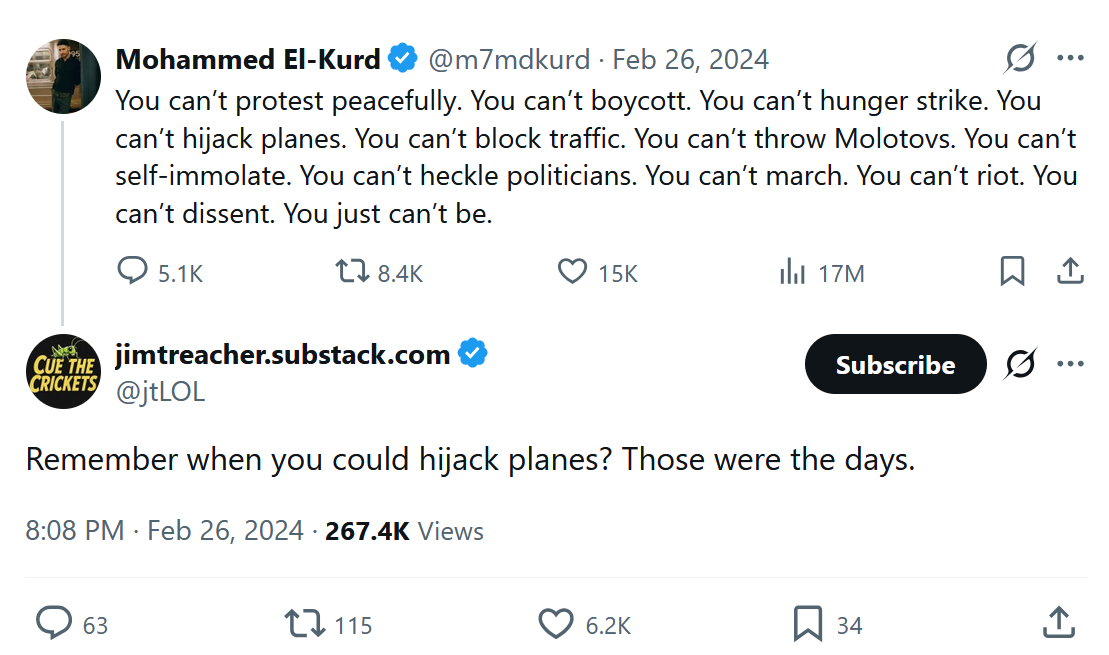
Palestinian activist Mohammed El-Kurd likened hijacking planes and other extreme acts of violence to more peaceful forms of protest, and complained that none of them were acceptable on a post on X, late Monday night.
“You can’t protest peacefully. You can’t boycott. You can’t hunger strike. You can’t hijack planes. You can’t block traffic. You can’t throw Molotovs. You can’t self-immolate. You can’t heckle politicians. You can’t march. You can’t riot. You can’t dissent. You just can’t be,” he said in the post.
Shortly after posting, the unorthodox statement gained a lot of traction on X and warranted hundreds of replies, including from the Israeli government spokesman, Eylon Levy.
“Imagine associating your whole being with hijacking planes,” Levy said in his response.
Mohammed El-Kurd made this post as a response to US airman Aaron Bushnell, who self-immolated in front of the Israeli embassy in New York while yelling “Free Palestine.”
Provided they clear a wide enough berth around them, I’m personally okay with the whole self-immolation thing, but as with the “take this plane to Cuba!” era, it does seem like an awfully retro ’60s throwback.
Hell, I suggest we ride this train all the way into the station here. Let’s have an investigation as to whether or not someone drugged (and overdosed him at that) the President of the United States.
It’s not like there is anybody within close proximity of the former President who heavily dabbled in drugs or anything. I mean, it was cocaine found in the White House after all, not Ambien.
Oh, speaking of which, Jill’s comments are very similar to the same theory Hunter Biden had as to why Joe lost his ever-loving mind during that debate.
“I’ll tell you what, I know exactly what happened in that debate,” Hunter said in an interview last year. “He flew around the world basically, and the mileage that he could have flown around the world three times. He’s 81 years old.”
“He’s tired as s***. They give him Ambien to be able to sleep. He gets up on the stage, and he looks like he’s a deer in the headlights.”
Because Joe looked as sharp as the proverbial tack when he originally challenged Trump to a debate:
Happy two year anniversary of Joe Biden challenging Trump to a debate for those who celebrate https://t.co/K6DZU4q5u2
— Dr. Richard Harambe (@Richard_Harambe) May 15, 2026
14 seconds; five jump cuts; one absolutely cooked (p)resident.
Is the rapid growth of therapy today making people worse, not better? Might it be a cause, perhaps even the central cause, of today’s political polarization and related phenomena like Trump Derangement Syndrome (TDS)? These are questions posed by New York-based psychotherapist Jonathan Alpert in his recently released book, Therapy Nation: How America Got Hooked on Therapy and Why It’s Left Us More Anxious and Divided.
Today, the claim that “not everyone needs therapy” is considered controversial, as therapy has become as accepted a part of reality as exercise. This is particularly true in blue cities and counties, which far outpace their red counterparts in the use of therapy. It’s now even a form of identity for the left, in which suffering from say, ADHD grants the sufferer special treatment, such as being excused for chronic truancy. Given the incredible growth of the therapy industry over the last couple decades, Alpert thinks he’s found an explanation for the parallel rise of wokeness.
He sets out his central thesis early and forcefully:
My colleagues would rather I not say this, but I will: As access to mental health care has expanded, so have rates of mental illness. And this isn’t simply a matter of greater awareness leading to more diagnoses. The more therapy people get, the more fragile, anxious, and dysfunctional they seem to become. This isn’t just an individual crisis—it’s a societal one. Which raises an uncomfortable but urgent question: Is modern therapy not only failing patients, but making them—and the culture at large—sicker?
Yes. Next question?
You guys realize that the leftist reaction to the Jason Arday case is going to incentivize more and more people to just "self-ID" as autistic or neurodivergent right?
Why? Because it instantly unlocks two-tier judgment. There will be massive upside to identify as…
A Hofstra University political science professor has been trapped in a nearly one-year investigatory nightmare after a colleague reported him for racial discrimination for using the phrase “word salad.”
Professor Richard Himelfarb made the remark at a Nov. 3, 2025 faculty meeting about proposed new courses at the private Long Island University.
Santiago Slabodsky, the chair of the school’s Jewish Studies program, sparked an outcry when he proposed two courses — one on conspiracy theories and another tying religion to “revolutionary movements in Latin America” be taught in his department, Himelfarb told The Post.
When five professors objected, Slabodsky allegedly launched into a meandering diatribe where he waxed poetic about his professional accomplishments but didn’t address the professor’s concerns, Himmelfarb said.
After the rant, Himelfarb called out his colleague, saying, “That is complete word salad; I don’t understand a thing Professor Slabodsky said.”
The next day, Slabodsky — who was born in Argentina — filed a complaint against Himelfarb alleging that the use of the term “word salad” disparaged his accent and South American heritage.
“University politics are so vicious precisely because the stakes are so small,” as Henry Kissinger was attributed as saying (along with many others).
Every 6 months or so all of academia takes a break from their important scholarship in order to remind us that each and every single hillbilly luddite stereotype about higher education being a cocoon of berserk shrieking Stalinist savages is 100% correct.
Woody Allen will turn 91 this November but that’s not stopping him.
By the time the Oscar winning director and writer reaches his birthday, he will have filmed his 51st movie in Madrid, Spain.
I’ve confirmed that Woody will make the film, possibly called “Madrid,” in September and October. No cast has been announced yet. This was the film he was supposed to shoot last spring, but now he’s ready.
I’m also told that Woody is putting the finishing touches on a second novel, and on a stage play.
Spain has proved to be a good luck setting for Allen. His “Vicki Cristina Barcelona” is a classic, and Penelope Cruz won her Oscar in that film. An all time classic.
Good luck, and if completed, I’ll look forward to reading the initial reviews, but as Peter Biskind wrote in Easy Riders, Raging Bulls:
The kind of reckless passion that Scorsese brought to Raging Bull is the privilege of the young, and as the New Hollywood directors got older, as they had more to protect and more to lose, as they grew familiar with failure, the passions of their youth were replaced by lassitude and cynicism. “When I first came out here, in the late ’60s, I met guys like Richard Brooks and Billy Wilder who were still active,” says Friedkin. “The two of them would invariably talk about what shit was being produced then. I thought, These guys who made films that I thought were astounding, are totally out of it today. How can this happen? The truth is, in America, film is a young man’s game. When I made French Connection and The Exorcist there was no doubt in my mind that those pictures would be popular. Because they were exactly what I wanted to see and what I wanted to see was what most people wanted to see.”
I studied in the academic department at Cambridge that later employed Jason Arday. My degree was in ‘Politics, Psychology and Sociology’, and one of my papers was on the Sociology of Education. Arday became a professor of Sociology of Education a few years after I left.
I want to give a few examples of the scale of progressive ideological capture even then, pre-Peak Woke, in 2012 (when I graduated). As well as to try to illustrate the sheer intellectual bankruptcy of so much of what gets passed off as chin-rubbingly profound academic scholarship at some of the most elite educational institutions in the world.
Where to begin?
For one module, I wrote a lengthy essay about how cultural products like kids’ cartoons and jazz songs serve as instruments of capitalist oppression. I got a top mark on that paper (despite knowing at the time that I was essentially regurgitating complete crap).
While studying for another paper I had a debate with the professor, an eminent anthropologist, because she insisted that native tribes could fly through the trees – not metaphorically, but that they could literally fly because they believed they could fly. After all, who are we to question ‘indigenous ways of knowing’…
O’Brien smiles: “‘We control matter because we control the mind. Reality is inside the skull. You will learn by degrees, Winston. There is nothing that we could not do. Invisibility, levitation — anything. I could float off this floor like a soap bubble if I wish to. I do not wish to, because the Party does not wish it. You must get rid of those nineteenth-century ideas about the laws of Nature. We make the laws of Nature.’”
Read the whole thing.
Another example of the corruption of sociology and education departments that changed their telos for the search for truth to social activism. The goal of these professors is to indoctrinate students into far left progressive woke politics, not research, rationality & science. https://t.co/09IO4oYwku
For years we were told Fauci was the infallible expert who never made a mistake and never lied. Now his lawyers are admitting the legal exposure is so large they need a special fund to handle it.
On Wednesday, speaking at the White House alongside crypto executives, President Trump noted that he would “absolutely” want a data center in his community.
“If I were the mayor of a town or the governor of a state, and I had a chance to get a big plant in, an AI plant or a data center, I would absolutely want it because the jobs are enormous and the money paid, the taxes paid, are just enormous,” he said.
It was a rare and refreshing defense of infrastructure that has become a bête noire for Republicans and Democrats alike, despite the fact that data centers have dramatically improved life in communities where they’re built — think $50K teacher bonuses, reduced tax burdens for residents and the creation of high-paying jobs.
These facilities are powering a revolution, providing the necessary energy for the huge amounts of compute needed for LLMs to work — and for America to beat China in the AI race.
In a midterm environment where politicians across the board are running from data centers, Trump is right to push back against the anti-data center hysteria and give them some “public relations help” as he put it.
When it comes to data centers and AI more generally, it’s not growth alone that can make us feel powerless. The architects and titans behind it all have risen up as dreamlike figures of global consequence. We hang on their pronouncements as if they were a new, self-elected class of remote lawgivers. There’s also the bewildering speed at which this technology is overtaking so many aspects of our lives. Finally, there’s the looming mystery of the technology itself. The more it encroaches on us, the less we understand what it portends.
Whatever arguments are proffered about rising energy prices, water consumption, and sound pollution, I suspect that the deeper objection to AI data centers is that they are hulking concrete monuments to our individual displacement in a world of strange new gods. They may contribute to an unimaginably bright future or something like its opposite. But either way, I understand why people don’t want to look at them every day.
Perhaps though, there’s a way to reframe the issue:
Free messaging tip: instead of saying data center opponents are Chinese dupes, scare them with horror stories about how their Netflix streams will degrade to 480p or, gasp, occasionally crash entirely if we don’t have capacity. Americans will not stand for mild inconvenience.
BALLROOM BLITZ: SCOTUS Cuts In on Ballroom Battle, Lets Construction Proceed — for Now. “In court filings, the administration has said that as of Aug. 14, construction was 65% complete on the $400 million, privately funded project, with a 250-person crew working 20 hours a day, seven days a week.”
InstaPundit is a participant in the Amazon Services LLC Associates Program, an affiliate advertising program designed to provide a
means for sites to earn advertising fees by advertising and linking to Amazon.com.