
‘TRUTH TO POWER:’ Democrats Prove the Point in Salty Tribute Tweets to Stephen Colbert.
When last we left you, it had been reported that the show was losing around $40 million a year, which, more than anything else, including alleged political considerations, would appear to explain why he, in essence, was handed his walking papers:
Puck News’ Matt Belloni reported the late-night show “has been losing more than $40 million a year” for CBS and that it had a budget of “more than $100 million per season,” contrasting it with network’s daytime and primetime programming, which he noted were “still profitable.”
“‘Late Show,’ with its topical humor and celebrity interviews pegged to specific projects, has struggled on Paramount+. And of the three network late-night shows, ‘Late Show’ has by far the smallest digital footprint on YouTube and other platforms,” Belloni wrote. “So from a business perspective, the cancellation makes sense.”
Belloni said the sources he spoke with at CBS and Skydance Media, the company that is set to buy the network’s parent company Paramount Global as part of an $8 billion merger, insist Colbert’s cancellation was “based on economics, not politics”….
Regardless, fauxfended Democrats are now on the case, including Sen. Elizabeth Warren (D-MA), who appears to be conducting her own little investigation:
Yesterday morning, I rounded up tweets by Warren and loads of other Democrats and their operatives with bylines melting down that their late night network infomercial was being cancelled next year by CBS. Most were arguing that the network news division whose anchors once declared Barry Goldwater a crypto-Nazi, that George W. Bush shirked his duty in the Texas Air National Guard, and gave pro-Obamacare poetry readings on-air was bending the knee to the Bad Orange Man with an (R) after his name. Which is far more melodramatic than understanding that the network is trying to stop the hemorrhaging from, as Stacey Matthews writes above, a $40 million annual loss caused in by a combination of a lack of viewers, and those who are tuning having an advanced average age that makes them undesirable to television advertisers.
Here’s another, Rep. Jim Himes (D-CT):
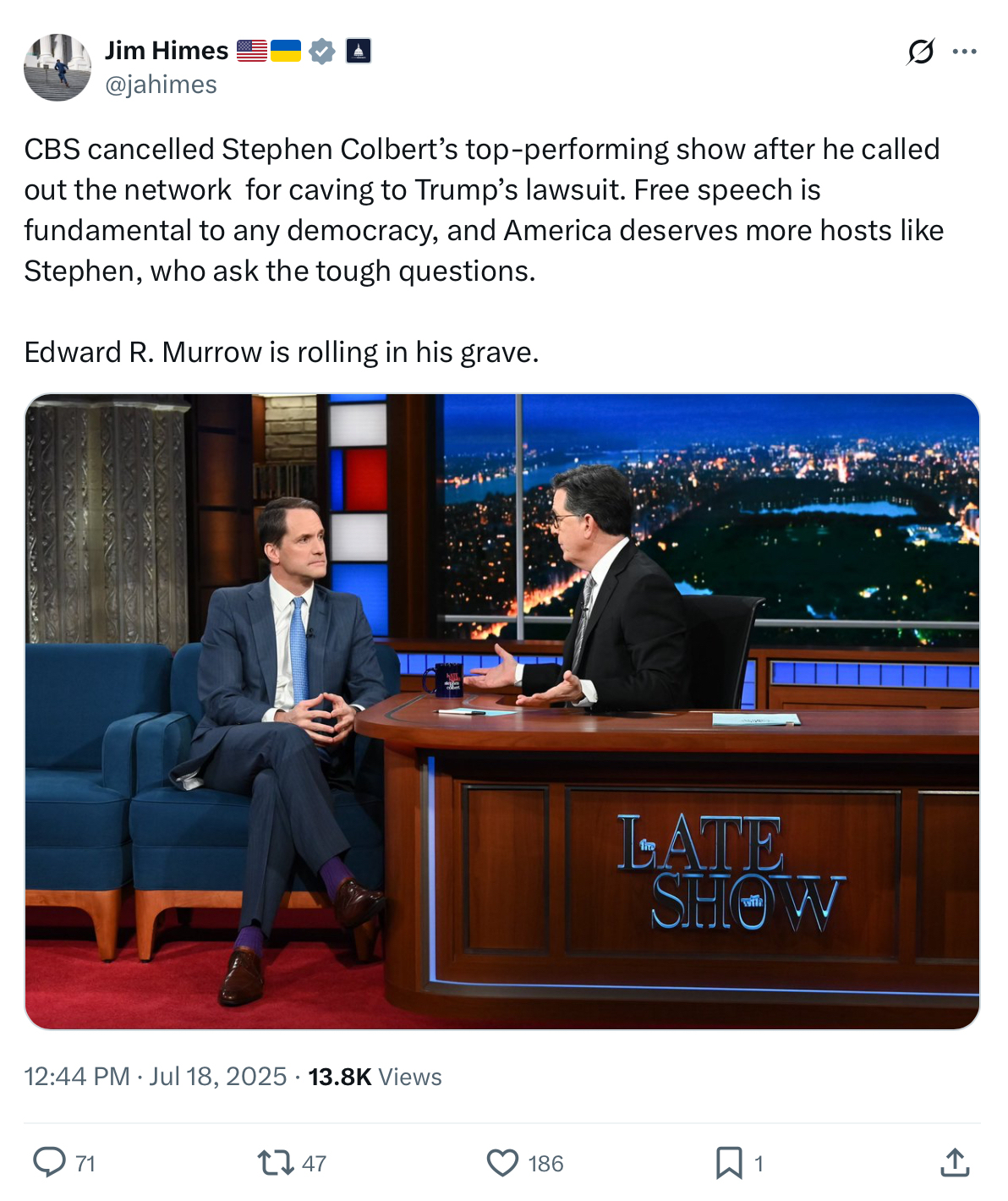
In his Entertainment Weekly profile last year, Colbert compared himself to Walter Cronkite. Similarly, notice that Himes is comparing the CBS replacement for David Letterman (who Johnny Carson viewed as his successor in the late 1980s), to a widely-respected CBS news anchor from TV’s golden era rather than a comedian or late night host. Back in the previous decade, it was the man who gave Colbert his start who was often compared to Morrow, including this 2010 New York Times article co-written by Bill Carter (the author of several books on late-night TV) and (of course) Brian Stelter, who was then about 25-years old: In ‘Daily Show’ Role on 9/11 Bill, Echoes of Murrow.
There have been other instances when an advocate on a television show turned around public policy almost immediately by concerted focus on an issue but not recently, and in much different circumstances.
“The two that come instantly to mind are Murrow and Cronkite,” said Robert J. Thompson, a professor of television at Syracuse University.
Edward R. Murrow turned public opinion against the excesses of Senator Joseph McCarthy in the 1950s. Mr. Thompson noted that Mr. Murrow had an even more direct effect when he reported on the case of Milo Radulovich, an Air Force lieutenant who was stripped of his commission after he was charged with associating with communists. Mr. Murrow’s broadcast resulted in Mr. Radulovich’s reinstatement.
Walter Cronkite’s editorial about the stalemate in the war in Vietnam after the Tet Offensive in 1968 convinced President Lyndon B. Johnson that he had lost public support and influenced his decision a month later to decline to run for re-election.
I can already hear the gnashing of Media Myth Alert author Joseph Campbell’s teeth as he reads the above quoted paragraphs:
● Murrow ‘risked his career to confront demagogic Joe McCarthy’? Hardly.
● Murrow: No white knight–and not above the political fray.
● After the ‘Cronkite Moment,’ LBJ doubled down on Viet policy.
But setting the media myths aside, why was the successor to Chevy Chase’s SNL “Weekend Update” segment and why is the successor to David Letterman being compared to a serious newsman like Murrow?
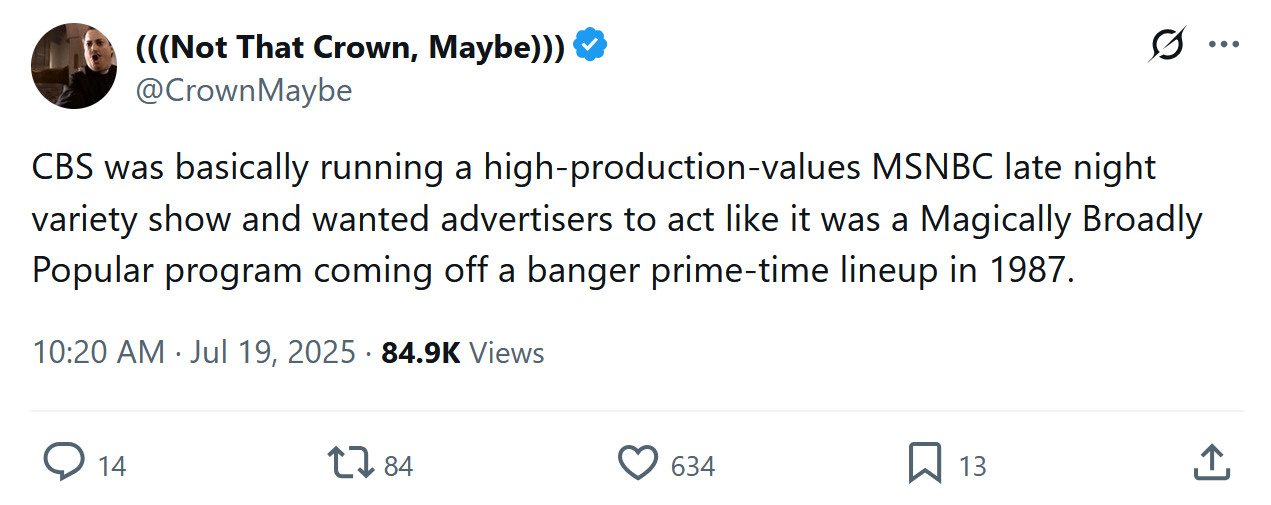
Related: Stars No More: Colbert Treated ‘Journos’ and Dems Like Celebrities — No Wonder They’re So Upset!
UPDATE: Molly Jong-Fast: Cancelling CBS cancelling a low-rated late-night show is the equivalent of the blacklist or something:
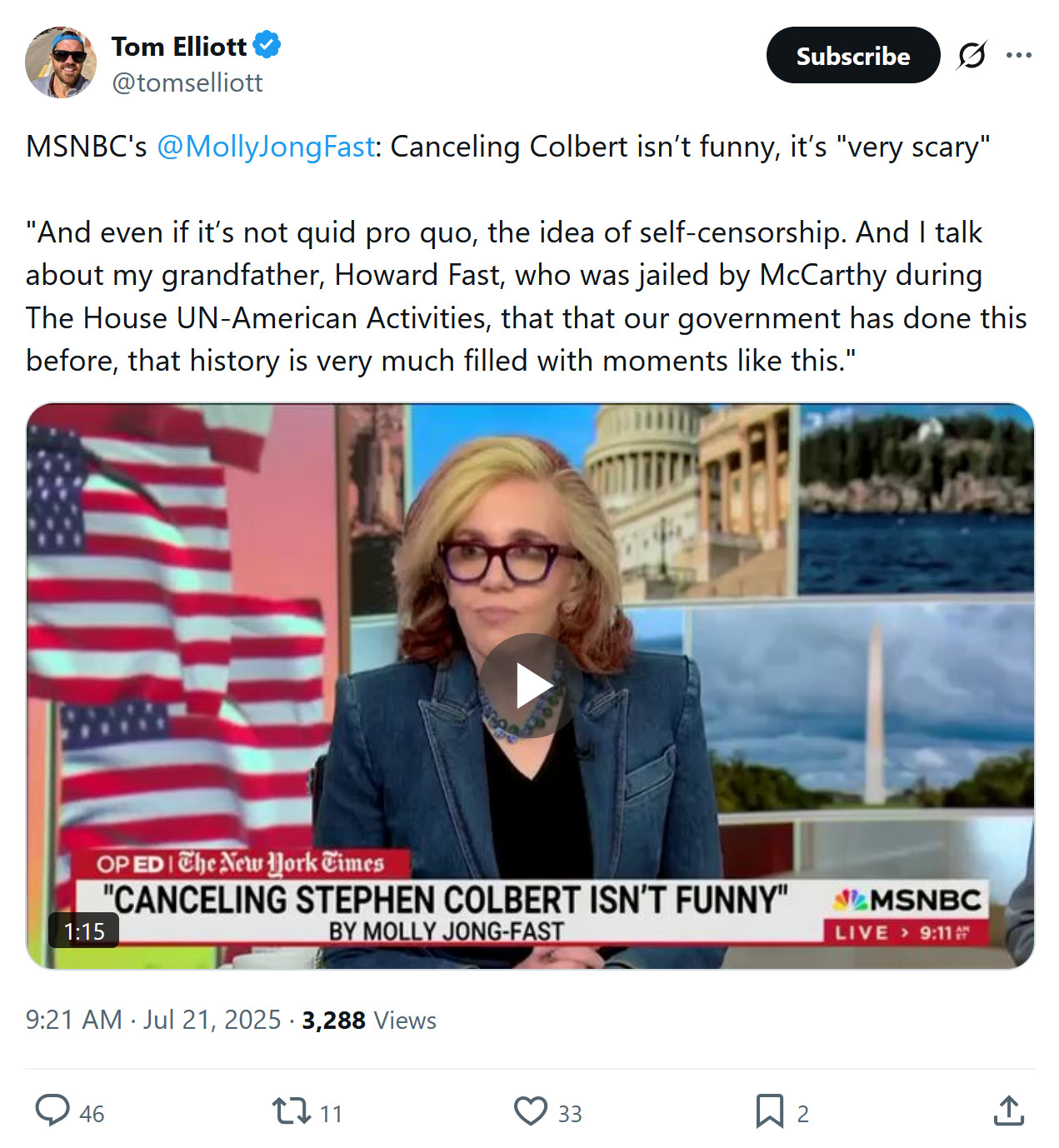
Huh — I didn’t realize Colbert’s politics were that far to the left. Also, I don’t recall Les Crane, Dick Cavett, Tom Snyder, Joan Rivers, Pat Sajak or Arsenio Hall ever playing the blacklist card when their late night shows were cancelled due to poor ratings.