
JOEL KOTKIN: The New Corporatism That’s Killing Capitalism.
Over the years since the financial crisis, economic power and wealth has become ever more concentrated in fewer hands. This is something leaders have acknowledged, and policymakers have tried to do something about. And yet, despite brave talk of breaking up mega-giant companies, anti-trust efforts have been anemic, as most recently demonstrated by the failure to stop Microsoft from swallowing game maker Activision. . . .
Consolidation has been especially dramatic in the financial sector. Since the 2008 financial crisis the power of the largest investment banks has greatly expanded and they now account for almost half of the sector. The rapid concentration of US banking assets accelerated with the collapse of several regional banks and could be further accelerated by bad commercial loans. The steady loss of smaller banks — their numbers down by half over the past twenty years — removes the predominant source of credit for smaller businesses. Between 1983 and 2018, the number of banks fell from 11,000 to barely 4,000. By itself JP Morgan accounts for 13 percent of the nation’s deposits and over 20 percent of all credit cards. Profits for these large financial instutions have soared amidst a stagnant economy due to rising intersst rates.
Tech, once the bright hope for a new, innovative grassroots economy has followed suit with five or six major companies dominating the space. In fields such as social media, search, online retail, cell and computer operating systems, there is no serious challenger in sight. Stock market values are increasingly dominated by a handful of players, with large tech firms increasing their share of S&P companies from 14 percent in 2001 to almost 30 percent two decades later. Microsoft and Apple now account for over 13 per cent of the entire stock market. The current AI driven stock market bubble is accelerating this pattern. Apple, now with an unprecedented $3 trillion and its seven closest tech rivals have expanded their US technology-stock dominance. The eight most heavily valued tech companies in the US — Alphabet, Amazon, Apple, Meta, Microsoft, Netflix, Tesla and Nvidia — have risen in the past year from 22 percent to 30 percent of the S&P 500’s market capitalization.
This same pattern of concentration can be seen in industries ranging from food to media. Meanwhile small businesses, accounting for half of all US private sector employment are being pummeled by rising interest rates while tech startups outside of artificial intelligence have fizzled miserably. Today in the US, nearly two in five small businesses cannot pay their rent and many are cutting back hiring plans even as big chains, like McDonald’s and Starbucks, enjoy rising sales. Small business optimism in the US is at its lowest point in ten years.
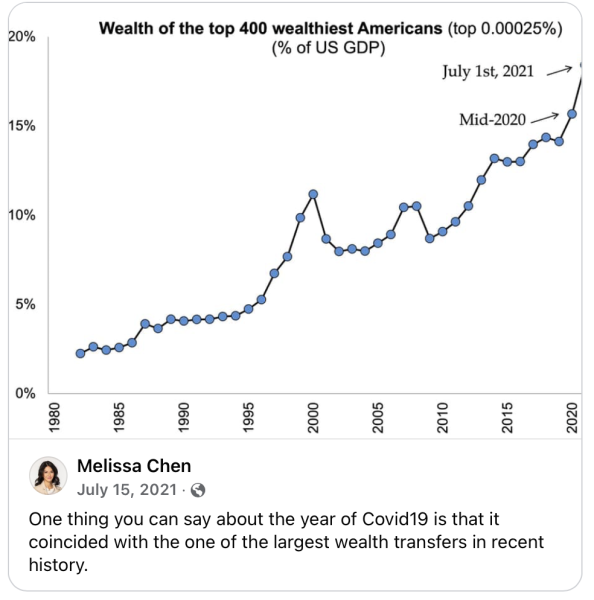
Also: The rich and powerful thrived as the rest of us suffered in the year of lockdowns. “The pandemic saw a huge amount of power and money transferred to what Michael Lind calls the ‘overclass’ of politicians, corporate managers and bureaucrats. Small businesses shut down while big-box stores deemed ‘essential’ remained open. The laptop class worked from home — to the delight of many of its members — while the working class brought them stuff. Federal money flowed like water to the connected. The national debt went from scandalous to essentially absurd, an amount of money that no one expects to be repaid.”