
Archive for 2024

STEVE HAYWARD: The Under- and Over-Estimated Jimmy Carter, RIP.

Carter presents layer upon layer of difficulty to untangle. Carter’s one-time speechwriter Patrick Anderson observed that in Carter’s hometown of Plains, Georgia, neighbors said of him that after an hour you love him, after a week you hate him, and after ten years you start to understand him.  (Anderson added that anyone who didn’t have a personality conflict with Carter, didn’t have a personality.)  Anderson also described him as a combination of Machiavelli and Mr. Rogers.  The Washington Post’s Sally Quinn observed: “The conventional image of a sexy man is one who is hard on the outside and soft on the inside.  Carter is just the opposite.”  Fellow Southern Baptist Bill Moyers said “In a ruthless business, Mr. Carter is a ruthless operator, even if he wears his broad smile and displays his southern charm.” Part of the mystique of Carter was his careful and successful positioning as someone “above politics.”  He gave off an air that he is too good for us, or certainly better than the rest of his peers in politics.  Carter exemplified the paradox of taking pride in denouncing the sin of pride.  He also displays a talent for combining self-pity and self-righteousness, sometimes in the same sentence.

He was a maddeningly contradictory figure. He first achieved statewide office in Georgia with a cynical race-baiting campaign, and then immediately proclaimed that the time had come for the South to repudiate its racist ways.  An avatar of morality and truthfulness, Carter bent the truth and had a singularly nasty side to his character that ultimately helped cost him the presidency in 1980. David Brinkley observed of Carter: “Despite his intelligence, he had a vindictive streak, a mean streak, that surfaced frequently and antagonized people.” Eleanor Randolph of the Chicago Tribune wrote: “Carter likes to carve up an opponent, make his friends laugh at him and then call it a joke. . .  [He] stretched the truth to the point where it becomes dishonest to call it exaggeration.”  New York Times reporter James Wooten called Carter “a hyperbole addict.”  And Gary Fink, author of a generally favorable study of Carter’s governorship, notes that “Carter usually claimed the moral and ethical high ground” but “practiced a style of politics based on exaggeration, disingenuousness, and at times outright deception.” Carter seldom if ever repented of his nastiness or asks forgiveness.  Instead, when called out for an egregious personal attack, Carter displayed the advanced skills of evasion that made him such an effective presidential candidate, at least until the public caught on in 1980.

The man with the legendary smile could be unfriendly and cold.  “There were no private smiles,” said one disgruntled campaign aide in 1976.  His personal White House secretary, Susan Clough, recalled that Carter rarely said hello to her as he walked by her desk.  Not a “Happy Thanksgiving,” or a “Merry Christmas.”  Nothing, she says.  Arthur Schlesinger Jr. judged Carter to be a “narcissistic loner.”  “Carter was never a regular guy,” Patrick Anderson observed; “the sum of his parts never quite added up to that. . .  Carter talked his way into the presidency, yet in some profound way he never learned the language of men.”

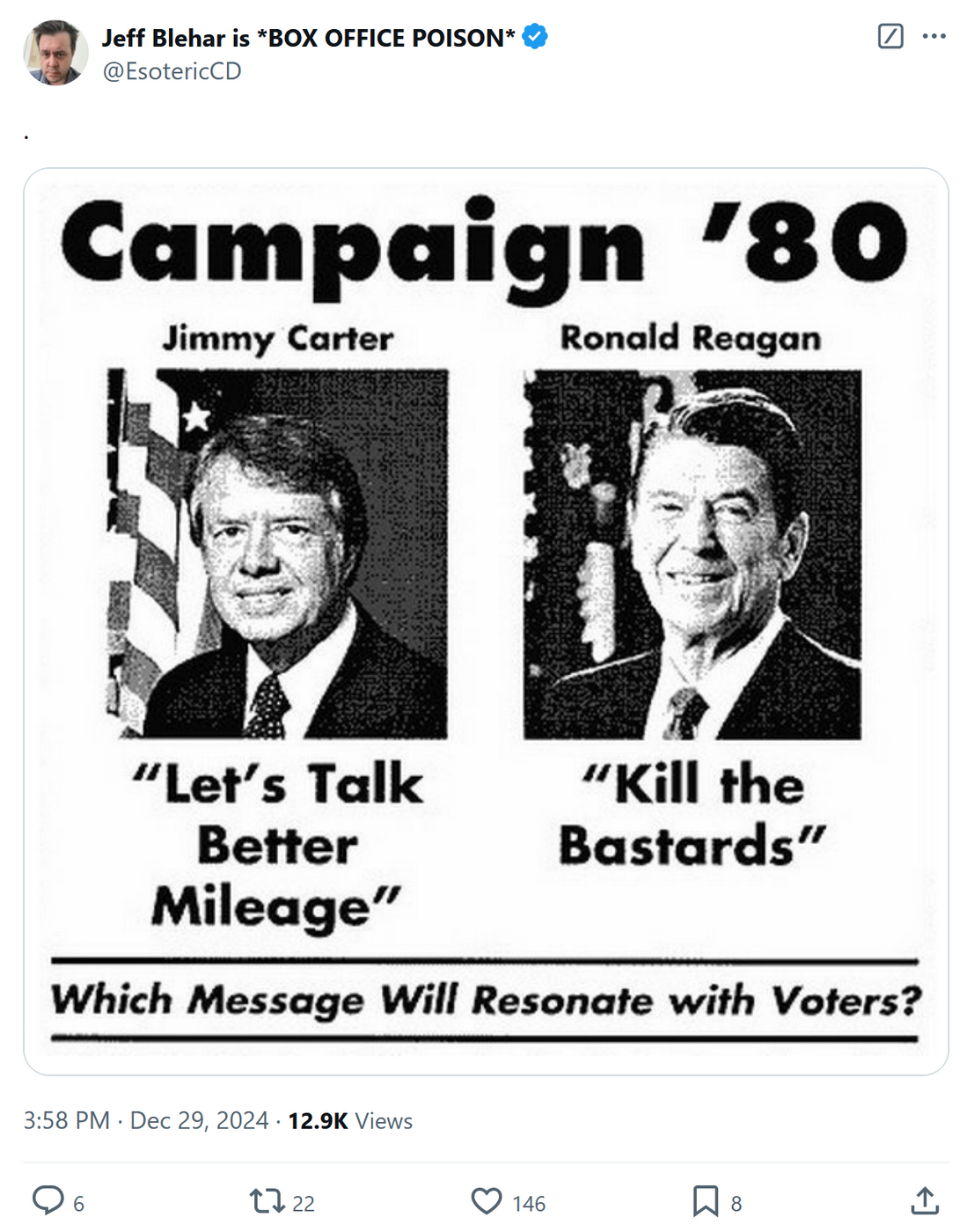
Exit question from 1980:
UPDATE (FROM GLENN): “He’s history’s greatest monster!!”
IT’S RELATIVITY, THAT’S THE TICKET: Friday Sky Candy on Sunday This Week — By Jove.

By the way, this was impeded in part because I finally moved into my own place and have concluded my rescue from Costa Rica and I just want to thank everyone who contributed.

IT’S COME TO THIS: “The Last Spark Of Hope” For Germany — Musk Pens Pro-AfD Op-Ed In Major Paper; Editor Resigns.

Musk makes short work of the farcical “far-right extremist” accusation:

“The portrayal of the AfD as rightwing extremist is clearly false, considering that Alice Weidel, the party’s leader, has a same-sex partner from Sri Lanka! Does that sound like Hitler to you? Please!”

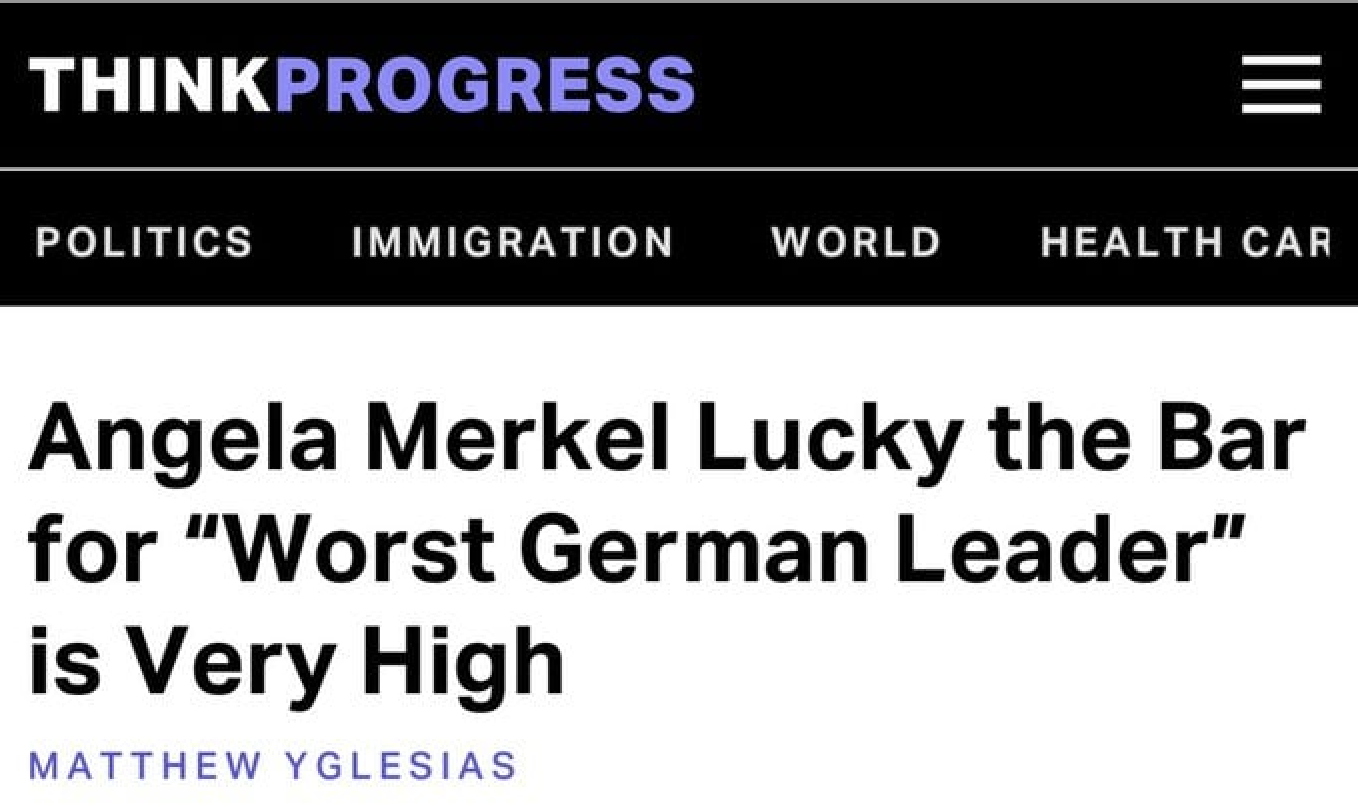
AfD co-leader Alice Weidel SLAMS Angela Merkel and the CDU party, says she destroyed Germany in powerful 13-minute speech.

If you missed it yesterday as part of Power Line’s Week in Pictures:

FLASHBACK: Jonathan S. Tobin: Don’t believe the Jimmy Carter revisionists. Despite the natural sympathy for a dying man, the revisionist attempt to erase his failures and their consequences should not prevail:

The stock of historical figures rises and falls with the changing times that follow them. That is especially true for presidents. Examples of these top leaders whose reputations have risen and fallen in succeeding generations abound. Some who exit office with low popularity ratings wind up being thought of with respect once the immediate political circumstances pass, and both historians and the public are able to judge their achievements with more dispassion.

The most outstanding example of this phenomenon is Harry Truman, who was deeply unpopular when his presidency ended due to the inconclusive and bloody Korean War, a sagging economy and the nation’s weariness with the Democrats after 20 years of their rule in Washington. But within a few decades, Truman’s reputation would soar. He would come to be appreciated for his postwar leadership against Soviet expansionism and for his plain-spoken style that at the time was judged as something of a letdown after the patrician bearing and soaring style of Franklin Roosevelt, whom he had succeeded. The most recent C-SPAN poll of historians now ranks Truman as the sixth greatest president in history—a development that few but his closest associates would have believed possible when he left the White House in 1953.

Supporters of former President Jimmy Carter are hoping that posterity will treat him in a similar treatment. And with the 39th president now in hospice at his Georgia home and the world anticipating the sad news of the end of his life, the campaign to revive his reputation is already in full swing. In the last month since the news about his terminal illness was released, articles and opinion pieces boosting the 98-year-old and attempting to depict his single term in office as both underappreciated and unfairly attacked have proliferated.

And with the help of one of the men who gave us Rathergate in 2004, the spin has already begun! Malaise Memory Loss:

“Now, as far as whether the hostages would have been released before the election, whether Jimmy Carter would have won, that is unknowable.” And as the New York Times story concedes, “Confirming [Ben] Barnes’s account is problematic,” mostly because William Casey died in 1987 and John Connally passed away in 1993.

John B. Connally III, eldest son of the former governor, told Rolling Stone he disagreed with Barnes’ account. He accompanied his father to a meeting with Reagan and said there was no mention of any message to the Iranians. The hostage deal “doesn’t sound like my dad,” Connally said. “It’s not consistent with my memory of the trip.”

The story all hinges on the word of Barnes, a former Texas lieutenant governor and vice chairman of John Kerry’s 2004 election campaign. So, as Daniel McCarthy writes, “people less sophisticated than a Times White House correspondent might classify partisanship as an obvious motive.”

With Carter, 98, entering hospice care, Barnes set out to change the narrative of the Carter presidency—a rather tall order. As Alter concedes, “there were a number of other factors in 1980, including a wretched economy,” which is true. On Carter’s watch, the “misery index” a combination of inflation and unemployment, topped out at 21.98. Instead of his own inept presidency, the Georgia Democrat blamed the people.

“The symptoms of this crisis of the American spirit are all around us,” Carter said on July 15, 1979. “For the first time in the history of our country, a majority of our people believe that the next five years will be worse than the past five years. Two-thirds of our people do not even vote. The productivity of American workers is actually dropping, and the willingness of Americans to save for the future has fallen below that of all other people in the Western world.”

And so on.

Ezra Klein, formerly of The American Prospect and now with the New York Times, began the Carter rehabilitation tour way back in 2009 by trying to explain how, ackchyually, his “Malaise Speech” really wasn’t such a bad moment after all.

BREAKING: Former President Jimmy Carter Has Passed Away.

Flashbacks: Jimmy Carter Was a Better President than You Think.

To fight stagflation, Carter appointed tight-money advocate Paul Volker to head the Federal Reserve Board, and Volker pulled the brakes on inflationary monetary policy — hard. It solved inflation but sent the economy into a painful correction that probably cost Carter reelection.

And despite his personal big government sympathies, Carter’s most lasting legacy is as the Great Deregulator. Carter deregulated oil, trucking, railroads, airlines, and beer. (H/t Caleb Brown.)

At the Atlantic, Derek Thompson chronicles the dramatic and almost unnoticed impact of Carter’s airline deregulation over the last thirty years. The bottom line: per-mile ticket prices fell by over fifty percent. And the results have transformed American social life and travel:

— In 1965, no more than 20 percent of Americans had ever flown in an airplane. By 2000, 50 percent of the country took at least one round-trip flight a year. The average was two round-trip tickets.

— The number of air passengers tripled between the 1970s and 2011.

— In 1974, it was illegal for an airline to charge less than $1,442 in inflation-adjusted dollars for a flight between New York City and Los Angeles. On Kayak, just now, I found one for $278.The impact of beer deregulation has been similarly overlooked: In 1978, the USA had just 44 domestic breweries. After deregulation, creativity and innovation flourished in the above-ground economy. Today, there are 1,400 American breweries. And home brewing for personal consumption is also now legal.

As for civil liberties, Carter also signed the most significant reform of government surveillance powers since World War II in the original FISA Act, and in 1979, he called for the decriminalization of marijuana, well ahead of the cultural and political curve. His legacy is also significant for what he did not do: he did not start any wars.

As P.J. O’Rourke wrote in his classic 1993 American Spectator article, “100 Reasons Why Jimmy Carter Was a Better President than Bill Clinton:”

98. Carter let the Soviets have Angola, Ethiopia, and South Yemen. And, in retrospect, the Soviets deserved no better.

99. Carter wasn’t a throwback to the Carter era.

100. And let us not forget that Jimmy Carter gave us one thing Bill Clinton can never possibly give us—Ronald Reagan.

Perhaps as a result of that last item, it’s after Carter left the White House, that he really began to lose the thread, as Jay Nordlinger wrote in his classic 2002 NRO article, “Carterpalooza!”

In a 1997 op-ed piece entitled “It’s Wrong to Demonize China” (also for the New York Times), Carter wrote — and forgive the awkward prose — “American criticism of China’s human rights abuses are justified, but their basis is not well understood. Westerners emphasize personal freedoms, while a stable government and a unified nation are paramount to the Chinese. This means that policies are shaped by fear of chaos from unrestrained dissidents or fear of China’s fragmentation by an independent Taiwan or Tibet. The result is excessive punishment [excessive punishment!] of outspoken dissidents and unwarranted domination of Tibetans.”

Carter said that “ill-informed commentators in both countries have cast the other side as a villain and have even forecast inevitable confrontation between the two nations.” You see the exquisite moral equivalence between a giant and repressive Communist state and the American republic. He then said, “Mutual criticisms are proper and necessary [mutual criticisms, mind you: Communist China, America . . .], but should not be offered in an arrogant or self-righteous way, and each of us should acknowledge improvements made by the other.” Carter arrogant or self-righteous, ever? Improvements made by the United States, too?

That’s what Xi said.

UPDATE: From Peanut Farmer to President: Former President Jimmy Carter Dead at 100.

Once in office, his popularity gradually began to fade, partly because of his drift to the Left. He supported the legalization of abortion by the courts, and his first act in office was to pardon all Vietnam War draft dodgers. In some ways, it was the McGovern agenda without the McGovern political baggage. His aides were often inexperienced in the ways of Washington, and like the only other engineer elected president, Herbert Hoover, Carter had an unfounded faith in his ability to both lead and micromanage his administration.

While in office, he created the Department of Energy and the Department of Education. In a hotly contested decision, he gave away the American-built Panama Canal. He faced an energy crisis sparked by war in the Middle East and an Arab oil embargo, which Carter called the “moral equivalent of war.”

But critics saw his address to the nation on the energy crisis while wearing a sweater as a sign of weakness in American global leadership. He seemed to ask Americans to get by with less and lower national expectations. In a struggling economy, he provided the equivalent of $11 billion to bail out a failing Chrysler Corporation as Japanese car imports flooded the struggling American automobile market.

In his famous “malaise speech” towards the end of his term, he epitomized the economic malaise the nation was experiencing under his leadership with high gas prices, inflation, and slow economic growth.

It all started off so promisingly though, complete with Gene Marshall’s absolutely groovy, perfectly 1970s song: “Can Our Government Be Competent? Jimmy Carter Says, Yes!”

Alas, it was not to be. As James Lileks wrote in 2021, “I think I got the second-shot blahs. I felt dull and fuzzy…The best word to describe it: malaise. Once I realized that was the best word, I wondered whether it could be due to gas lines, Mideast unrest or the return of inflation. As someone who came of age in the ’70s, and immediately regretted it, I associate these things with Jimmy Carter’s famous speech. He said the country suffered from malaise, which sounded like a bad sandwich spread. It wasn’t a popular speech. It’s one thing to be depressed, and another to be French depressed.”

SHOCKER: Workers found in “slavery-like conditions” at BYD construction site. “Brazilian authorities have halted construction of a BYD electric vehicle (EV) factory in Brazil’s Bahia state after rescuing 163 Chinese workers from what they described as ‘slavery-like conditions.’ The workers were employed by Jinjiang Construction Brazil Ltd., a subcontractor hired to build the plant for the Chinese EV manufacturer.”

DEMOCRATS ARE FAILING HARD AT WINNING OVER THE NORMIES:

The 2024 election marked a significant shift in political dynamics. Democrats, who have long had an advantage on social issues, continued to double down on the most radical of positions, ceding the advantage to Republicans and allowing them to go on the offensive rather than being defensive. For example, the Trump campaign managed to successively use Kamala’s radical positions on gender against her, telling voters, “Kamala is for they/them, President Trump is for you.”

It’s no secret that Democrats now have to reassess their agenda if they want to win back mainstream voters, particularly working-class Americans. These voters, who make up the majority of the electorate, have increasingly become alienated by the party’s focus on identity politics and divisive rhetoric.

According to an analysis from The Washington Free Beacon, internal divisions in the party continue to hinder any real progress in this effort.

At the Democratic National Committee’s winter meeting in Phoenix, party leaders made symbolic gestures that only served to further alienate average voters. A “land acknowledgment” meant to pay tribute to indigenous people was one such gesture, but for many, it felt more like a distraction than a meaningful attempt to address the concerns of working-class voters.

DNC Chairman Jaime Harrison recently lashed out at critics who urged the party to distance itself from identity politics. His defensive response, which included belittling concerns about alienating blue-collar Americans, reflects a broader resistance within the party to change its focus.

Smugness is the left’s Kryptonite in the hands of Trump, but it’s such an ingrained part of their psyche that it may be impossible for them to ever change. QED:

Finding comfort in the notion that their former allies were disdainful, hapless rubes, smug liberals created a culture animated by that contempt. The result is a self-fulfilling prophecy.

—“The Smug Style In American Liberalism,” young adult Website* Vox.com, April 21st, 2016.

* Classical reference.

SCIENTIFIC AMERICAN STILL WORKING THROUGH ITS TDS: Scientific American attacks Jay Bhattacharya for prioritizing Americans’ autonomy over ‘the science.’

Scientific American, a 179-year-old magazine published by the German-British Springer Nature Group, appears increasingly keen to dirty itself with politics rather than engage in clean science.

Just weeks after Laura Helmuth stepped down as the magazine’s editor in chief after an ugly rant in which she effectively called over 77.3 million Americans who voted for President-elect Donald Trump both “fascists” and “bigoted,” and months after the magazine pushed gender ideologues’ pseudoscientific narrative, Scientific American published a piece claiming that Trump’s choice of Dr. Jay Bhattacharya to run the National Institutes of Health is “the wrong move for science and public health.”

Extra to insinuating that Bhattacharya was not actually censored during the pandemic and arguing that the destructive approach championed by the scientific establishment during the pandemic was not authoritarian, the author of the piece, Steven Albert, concern-mongered that Trump’s pick might prioritize Americans’ personal autonomy if confirmed as head of the NIH.

Debate over therapeutics, health protocols, and the origin of COVID-19 was stifled during the pandemic. Bhattacharya, among the experts whose views were suppressed at the urging of Biden health officials, refused to uncritically accept the prevailing wisdom of medical establishmentarians who advocated for lockdowns, vaccine mandates, masking for kids, and other ruinous COVID-19 policies.

Bhattacharya, a professor of health policy at Stanford University, co-authored the Great Barrington Declaration, which suggested that geriatrics and other higher-risk groups should engage in shielding, whereas healthy individuals should “immediately be allowed to resume life as normal.” According to the declaration, healthy individuals were better off catching the virus and developing natural immunity.

Scientific establishmentarians keen on coercive medicine and blanket lockdowns attacked Bhattacharya for proposing this alternative approach. President Joe Biden’s former chief medical adviser Anthony Fauci called the declaration “total nonsense.” Former National Institutes of Health Director Dr. Francis Collins conspired to issue a “quick and devastating takedown” of Bhattacharya’s criticism.

In the weeks since Trump announced that Bhattacharya would “restore the NIH to a Gold Standard of Medical Research,” establishmentarians have resumed their attacks on the esteemed epidemiologist both at home and abroad.

Earlier:

The Mask Comes Off: Determined to defend face coverings, a Scientific American article dismisses scientific “rigor.”

Scientific American: “As the daughter of a cancer researcher, Kamala Harris would bring a lifelong familiarity with science to the presidency, experts say.”

Scientific American Editor-in-Chief Resigns After MAGA Meltdown Went Viral.

FIGHT THE POWER! How a Laid-Back California Beach Town Emerged as Headquarters for the Anti-Newsom Resistance.

When a slate of Republicans worked together in 2022 to win back control of the Huntington Beach, Calif., city council, the four candidates signed a “contract” with voters. Most of the planks weren’t particularly controversial: They pledged to combat homelessness, crack down on crime, slash red tape, and roll out the red carpet to businesses.

But it was the first plank of the contract — a vow to give the city attorney the authority to fight Sacramento overreach, including state housing mandates — that has in many ways come to define an aggressive new brand of Surf City politics.

After taking over the board, those Republicans have transformed this laid-back beach community into the unofficial headquarters of the resistance to Governor Gavin Newsom and the blue-state policies championed by the Democrats who run the state. Huntington Beach leaders have repeatedly fought the state in court over laws they believe infringe on their rights to govern locally, and they’ve passed laws of their own taking aim at left-wing shibboleths, including Pride flags, Covid masks, and sexually-explicit library books.

The populist pushback is almost certain to intensify over the coming years after a slate of three more conservatives romped the council’s last three liberals on Election Day, giving them a 7–0 board supermajority. They celebrated on swearing-in day, donning red “Make Huntington Beach Great Again” hats with “7–0” embroidered on the side — a not-so-subtle poke in the eye to their left-wing critics.

Councilman Tony Strickland, a former Republican state assemblyman, dubbed the new majority the “MAGA-nificent 7.”

But while there will almost surely be plenty of more fights to be had as Newsom sets himself up for a likely 2028 presidential run, Pat Burns, a councilman who is now serving as Huntington Beach’s mayor, insists that despite their rambunctious reputation, sparring with the governor isn’t his and the board’s primary mission.

While Newsom begins any presidential election bid with a guaranteed 54 electoral college votes, from a state that as Dave Barry recently wrote, “apparently tabulates its ballots on a defective Etch-a-Sketch,” meaning it can come up with any result Sacramento chooses to manufacture, the anti-California commercials his opponents will craft will be loads of fun to watch. Or as Joel Kotkin asks and answers: California ruled with great jobs and boom times. What happened?

NO JEWS, NO NEWS:

Meanwhile: