Archive for 2023

KYLE SMITH: Ferrari Review: Adam Driver in a Drama of Speed and Steel.

[Michael] Mann has been developing this project for more than 20 years. His screenwriter, Troy Kennedy Martin, died in 2009. Mr. Mann’s first choice to play the lead, Christian Bale, eventually backed off and made another movie about the same milieu, 2019’s “Ford v. Ferrari.”

Now Adam Driver is the one with his foot on the gas, and it’s a relief to note that Mr. Driver, who gave a cartoonish performance as another Italian icon in the awful “House of Gucci,” this time is elegantly restrained, without overdoing the accent, as the man who in 1939 founded the eponymous car company. He tells us all we need to know about his obsession when he says, “Jaguar races to sell cars. I sell cars in order to race.” Enzo isn’t an especially likable man: He has adopted a strategy of steadfast stoicism in the face of adversity, which looks like coldness when one of his racers gets killed, seemingly because of a manufacturing flaw in one of Ferrari’s cars. He cheats on his wife, who sometimes responds with gunfire. But with all of his personal failings, Mr. Driver’s Ferrari becomes a monument to all of the fanatically obsessed men who, determined to produce something great, correctly bet that their creations would outlive the memories of their sins.

Mr. Mann’s slow-burning, intensely focused drama is occasionally ponderous, especially in its sleepy midsection, but its third act is absolutely thrilling.

It’s not a great film, and no one will mistake Mann’s Ferrari with Thief, Manhunter, or Heat. But as a biopic with some brilliant racing scenes, it’s well worth a watch on the big screen during the holiday season, if only to see Driver performing a grownup character, rather than Kylo Ren in yet another execrable Disney Star Wars sequel.

QUOTE OF THE DAY:

I wonder if I might crave your momentary indulgence in order to discharge a by no means disagreeable obligation which has, over the years, become more or less established practice in government service as we approach the terminal period of the year — calendar, of course, not financial — in fact, not to put too fine a point on it, Week Fifty-One — and submit to you, with all appropriate deference, for your consideration at a convenient juncture, a sincere and sanguine expectation — indeed confidence — indeed one might go so far as to say hope — that the aforementioned period may be, at the end of the day, when all relevant factors have been taken into consideration, susceptible to being deemed to be such as to merit a final verdict of having been by no means unsatisfactory in its overall outcome and, in the final analysis, to give grounds for being judged, on mature reflection, to have been conducive to generating a degree of gratification which will be seen in retrospect to have been significantly higher than the general average.

In other words:

WE’VE DESCENDED INTO SOME SORT OF BIZARRE HELL-WORLD IN WHICH PIERS MORGAN IS A VOICE OF SANITY: Piers Morgan dismantled cancel culture for ‘ruining’ Christmas: ‘Sucking joy out of life.’

Beloved Christmas song “Baby, It’s Cold Outside” which was written by Frank Loesser and popularised in the 40s film “Neptune’s Daughter”, has caused controversy in the past decade. The song, which has been covered by world-famous crooners such as Dean Martin, has faced criticism among some listeners for the alleged implications of its lyrics. The male vocal part’s unrelenting pressure for the female to “stay” despite repeated suggestions she should go home have been described in certain quarters as suggestive of sexual harassment.

The first time the song was widely criticised for its lyrics was 12 years ago.

Then, in 2018 “Baby, It’s Cold Outside” was cancelled by a number of radio stations in Canada and the US after social media criticism and public pressure.

In a throwback episode of Good Morning Britain, Mr Morgan was apoplectic about efforts to ban the song, and suggested that cancel culture was “sucking the joy out of life”.

As Mark Steyn wrote in 2014:

A few decades back, a young middle-class Egyptian spending some time in the US had the misfortune to be invited to a dance one weekend and was horrified at what he witnessed:

The room convulsed with the feverish music from the gramophone. Dancing naked legs filled the hall, arms draped around the waists, chests met chests, lips met lips . . .

Where was this den of debauchery? Studio 54 in the 1970s? Haight-Ashbury in the summer of love? No, the throbbing pulsating sewer of sin was Greeley, Colorado, in 1949. As it happens, Greeley, Colorado, in 1949 was a dry town. The dance was a church social. And the feverish music was “Baby, It’s Cold Outside,” as introduced by Esther Williams in “Neptune’s Daughter.” Revolted by the experience, Sayyid Qutb decided that America (and modernity in general) was an abomination, returned to Egypt, became the leading intellectual muscle in the Muslim Brotherhood, and set off a chain that led from Qutb to Zawahiri to bin Laden to the Hindu Kush to the Balkans to 9/11 to the brief Muslim Brotherhood takeover of Egypt to the Islamic State marching across Syria and Iraq. Indeed, Qutb’s view of the West is the merest extension of “Baby, It’s Cold Outside” — America as the ultimate seducer, the Great Satan.

I’m a reasonable chap, and I’d be willing to meet the Muslim Brotherhood chaps halfway on a lot of the peripheral stuff like beheadings, stonings, clitoridectomies and whatnot. But you’ll have to pry “Baby, It’s Cold Outside” from my cold dead hands and my dancing naked legs. A world without “Baby, It’s Cold Outside” would be very cold indeed.

Indeed.™

CHRISTMAS IN NAZI GERMANY: How Nazis Stole Christmas & Turned Adolf Hitler into Messiah (Video).

Earlier: The National Socialists Fought the Original War on Christmas.

Who knew? Other than everyone who read Jonah Goldberg’s Liberal Fascism in 2008, or this London Daily Mail article the following year. But it’s good to see this sort of thing in the Smithsonian’s house organ. Or as author Dave Shiflett quipped in 2002 at NRO, “A shocking story has been revealed: Adolf Hitler was not a Christian after all. Instead, he hoped to destroy Christianity.”

To borrow a line from another 19th-century born socialist God killer, as a reminder of the first time as tragedy and the second time as farce — while killing time before engineering the next tragedy — I found that above quote in a post of mine from right around this time in 2012. A few years before Angela Merkel turned the lights out on 21st Germany, Yahoo was reporting that “A minister in Angela Merkel’s government has sparked a pre-Christmas row among Germany’s ruling parties by suggesting God be referred to with the neutral article ‘das’ instead of the masculine ‘der.’”

But then, political correctness is what governments do in order to ignore their nation’s real, structural problems.

Related: Nazi Caroling: The Extremes Hitler Wanted to Go To in Order to Replace Christianity with the “Religion” of National Socialism).

And in the adjacent world of International Socialism, Peter Hitchens: The last Noël in the USSR.

MERRY, MERRY:  “Keeper of Christmas.”

HOLIDAYS IN HELL: So This Is Christmas — and What Have Celebrities Actually Done?

As French authors would later conclude in their magnificent clean-up book on 20th-century communism, The Black Book of Communism, in 1999, nearly 100 million people died worldwide as a result of Marxist atheists.

To be sure, faith is no guarantee of a refuge from the evil that men do. Evil is also committed in the name of faith and by those who think they were/are on a mission from God. The Islamic Republic of Iran has been doing this since 1979, as one modern example.

However, it’s an analytical stretch that requires undue faith in the innate goodness of the religiously naked ape to believe atheism and atheist states will be any different from others who have complete power in a state. It’s an error to think that atheism will somehow thus serve as a peaceful refuge from humanity’s worst impulses. To believe this is to assume that religion — and not concentrated power — is the main problem in human affairs.

See China’s Xi Jinping today as the latest atheist incarnation of John Lennon’s imagined state and its consequences: a man on a mission for himself, who will run roughshod over his own population and others who want nothing to do with his view of how we should live. Xi’s repression is already obvious in China and in Hong Kong, and if he ever gets the chance, in Taiwan.

The same vapidity is evident in “Happy Xmas.” Its most famous line opens the song, and lodges in my cranium without asking permission: “And so this is Christmas/And what have you done?” Those ten words have enough hubris to inflate the Hindenburg. It’s as if ordinary folk somehow should justify themselves to a 1960s–1970s rock star consumed by self and by error, as in his musical worship of anti-religious belief and consequences.

The easy response from normal people to two celebrities who, by 1971, had been writing songs and giving interviews from their bedroom decked out in pajamas can be imagined as follows, perhaps from a single mom: “Oh, I don’t know, John — I’ve been raising three kids, caring for my aged Mom, and working double-shifts at the coffee shop to pay the bills. You?”

Other responses to imagine: From a Second World War veteran: “I fought my way on to Omaha Beach and survived D-Day — and the rest of the war, but many of my friends did not. We beat the Nazis, which is what mattered even more despite the sacrifices.”

Or imagine the response from a steelworker, miner, or farmer: “Endured another grinding day at the foundry/shaft/farm, this to afford the mortgage and Christmas presents.”

As Ian MacDonald wrote in Revolution in the Head: The Beatles’ Records and the Sixties, a trenchant analysis of the Beatles’ changing worldviews and how they fed their lyric writing, focusing on “The Ballad of John and Yoko,” an earlier attempt by Lennon to shift away from writing universal anthems to focusing on his day to day celebrity life:

Behaving as if they had personally invented peace, they jetted round the world in first-class seats selling it at third-rate media-events. This was arrogant as well as silly, and the news media’s derision, of which THE BALLAD OF JOHN AND YOKO self-righteously complains, was not only inevitable but, in the main, justified.

Of all the dangerous ideas Ono unloaded on her spouse around this time, the most damaging was her belief that all art is about the artist and no one else. Serving to confirm Lennon’s self-absorption, this also torpedoed his universalism, and it was as a man struggling to resolve this exacerbation of his lifelong emotional contradictions that he reeled from heroin to Primal Therapy to Maoism and finally to drink during the next three years. Otherwise scathingly honest, he unwittingly put himself into a position in which he was obliged to defend things that, deep down, he cared nothing about. Uncompromising as ever, he threw himself into this trap with total commitment, not only refusing to draw a line between his public and private life but going out of his way to personalise everything that happened in his vicinity, a self-centredness which could hardly avoid occasionally degenerating into paranoia, as THE BALLAD OF JOHN AND YOKO demonstrates. Indeed, so outrageously egocentric is this song that it’s difficult to know whether to deplore its vanity or admire its chutzpah in so candidly promoting Self to artistic central place.

In one of his last interviews, Lennon would finally admit, “I dabbled in politics in the late 1960s and 1970s, more out of guilt than anything. Guilt for being rich and guilt thinking that perhaps love and peace isn’t enough and you have to go and get shot or something, or get punched in the face to prove I’m one of the people. I was doing it against my instincts.”

His fans, though, cottoned on much more quickly: “The crowd I first saw the original [Let It Be before being Disney-fied by Peter Jackson] with weren’t interested in a happier spin on the Beatles. They were there to render judgment, to be the choric voice of the Beatles’ community declaring their disapproval. In other words, they were there to boo. They were there to boo Yoko Ono. If I remember the film correctly, the opening credits were barely done when we see John Lennon, and there is Yoko, sitting right beside him. ‘Boooo.’ Then, there is Yoko, knitting right beside him. ‘Boooo.’ For the length of the movie, every time Yoko was on camera, the crowd booed, as if to say, ‘Take that, Yoko, for breaking up the Beatles.’”

THE SAN FRANCISCO STORY BEHIND THE ‘CHARLIE BROWN CHRISTMAS’ ALBUM:

Unique among those Christmas hits are the songs from “A Charlie Brown Christmas,” the 1965 animated Christmas special starring Charles Schulz’s “Peanuts” gang. The movie’s soundtrack might be the most recognizable jazz music in history. Piano player Vince Guaraldi’s renditions of classics like “Christmas Time Is Here” have become the definitive versions, and tunes like “Linus and Lucy” — which the gang jams to onstage — have reverberated through pop culture ever since.

Schulz has close ties to the Bay Area. Although born in Minneapolis, he moved to Sebastopol in 1958, then relocated to Santa Rosa in 1969, where he lived until his death in 2000 (a museum and skating rink were built celebrating his work). But the Christmas special’s soundtrack has uniquely San Francisco roots and, if not for a string of coincidences, may have never actually been heard by the public — let alone hit No. 2 on Billboard’s album chart 57 years later. A four-hour “super deluxe” version was released in October featuring material recently discovered in the Fantasy Records vaults.

Guaraldi was born in North Beach in 1928. After a brief stint at San Francisco State and a tour in Korea as an army cook, he hit the SF jazz scene and quickly received a contract from locally based Fantasy Records. While playing live around San Francisco, he picked up nicknames like “The Italian Leprechaun” (he was just over 5 feet tall) and Dr. Funk. He and his trio gained some popularity through covers of Antonio Carlos Jobim and Luiz Bonfa on their 1962 album “Jazz Impressions of Black Orpheus,” then had a bona fide hit with the B-side “Cast Your Fate to the Wind.”

It’s hard to believe, but prior to its self-inflicted Weimar-ification*, San Francisco quite a brilliant city.

Related: Charlie Brown’s Inside Job. What gives the 1965 Peanuts special its staying power? “All the suits had said no to the religious element in the special, but Schulz insisted. Everyone at the network was prepared for a flop, but Schulz wasn’t thinking of network executives when he made the special. He was thinking about children and about the nature of God. The suits didn’t understand it, but from the first broadcast, the kids who watched it loved it, and made it a huge hit from then on.”

More: How Charles Schulz Got the Gospel Past CBS Execs in A Charlie Brown Christmas.

Instagram v. reality! San Francisco unveils taxpayer-funded open-air Christmas market that’s become dystopian hellhole after being besieged by city’s famed druggies.

THE WORST THING A REPORTER OR EDITOR CAN BE IS INCURIOUS: This story from the NYT about Harvard’s board is fine…except the honkingly huge omission of whether these people are paid, and if so, how much.

How can you write this story and *not* ask that?
**UPDATE: A few folks have noted that the NYT story currently says that the Harvard board members are unpaid. I’m certain it was not in the first version I saw, but the Wayback Machine did not capture what I believe was a stealth edit. So without a screenshot (my bad) I can’t prove this. As to whether the Times would ever publish a stealth edit…I’ll leave that to your own judgment and experience.

MERRY CHRISTMAS FROM THE REYNOLDS/SMITH HOUSEHOLD!

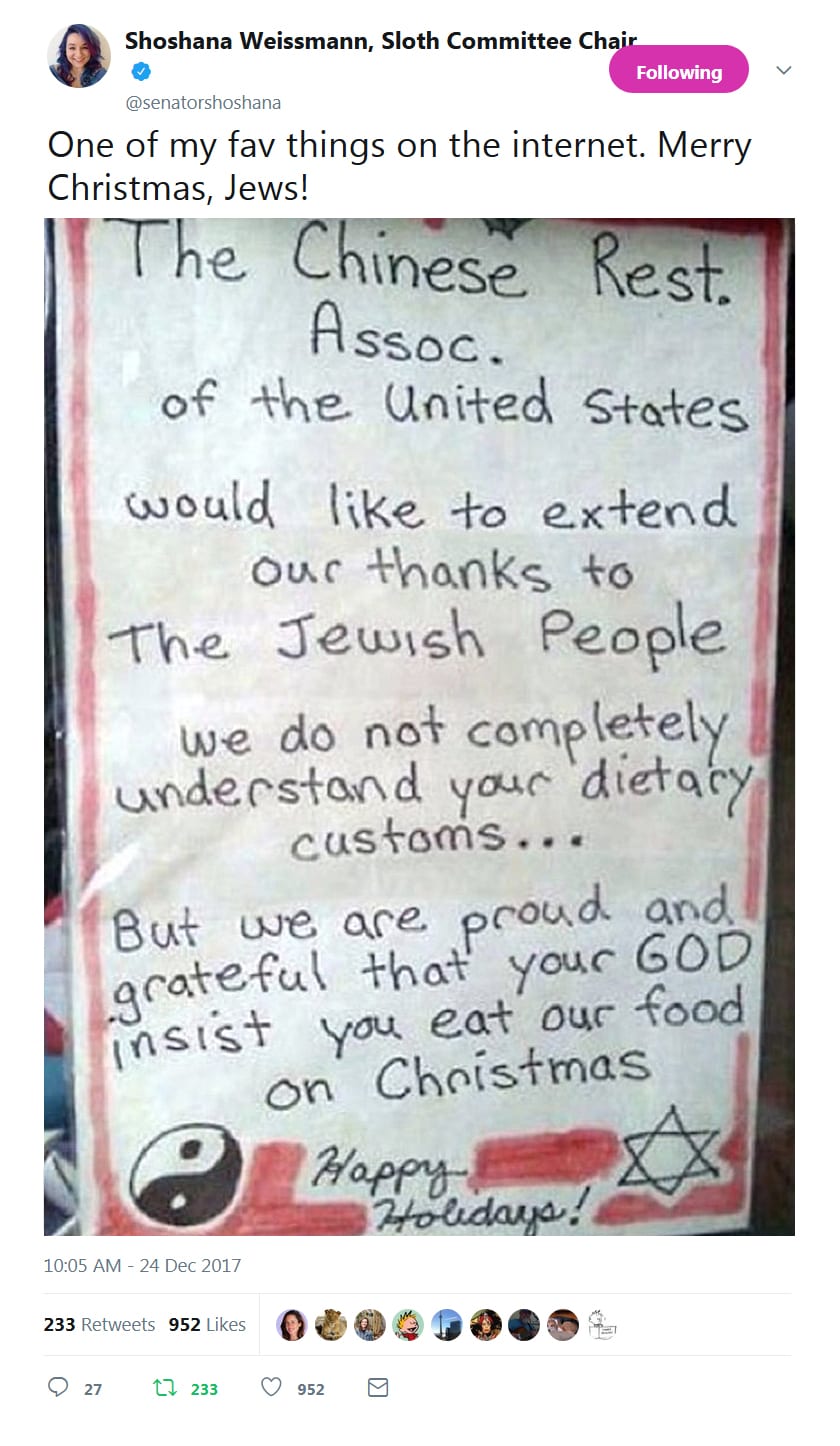
ONE OF SATURDAY NIGHT LIVE’S FUNNIER 21st CENTURY SEGMENTS: 2005’s Christmastime For The Jews.  “Just watch it. And you don’t have to be Jewish. My WASP husband gets almost every joke.”

Related:

ROUGH CHRISTMAS? PLEASE READ THIS: PJ Media editor Paula Bolyard is a gifted writer who is blessed with a powerfully candid self-awareness and a courageous heart for sharing her faith.

In the following column she wrote several years ago in the midst of an especially difficult Christmas season, Paula shares her heart about the real struggles we all face from time to time, not just in this season, and how the grace and love of Jesus Christ alone provides the true path forward, no matter the challenge.

And if you missed it Friday on HillFaith, the latest edition of “What Would You Say” from the Colson Center demonstrates that Christmas is not merely a pagan celebration “stolen” by Christians. As Reagan said, “Well, the trouble with our liberal friends is not that they’re ignorant; it’s just that they know so much that isn’t so.”

Merry Christmas to all Instapunditeers, and, as Tiny Tim said, “God bless us, everyone.” If you’ve never watched George C. Scott as Scrooge, it’s a wonderful performance of the classic Dickens tale. (UPDATE: And let’s not forget “Christmas Vacation.”!

MERRY CHRISTMAS!

ASKING THE IMPORTANT QUESTIONS: Is Christmas really a pagan festival?

The celebration of Christmas is suffused with probable pre-Christian elements, from the Yule Log to the Lord of Misrule (an official appointed to oversee the festivities) but this should hardly surprise us. After all, the priority of early missionaries was to ensure that people came to believe in the Christian God. Customs with no direct bearing on the basics of belief were often left alone; for example, it was several centuries before Anglo-Saxon missionaries to Germany began to interfere in pre-Christian funeral rites or betrothal customs. The medieval church did not, as some think, demand control of every aspect of people’s lives. However, whether surviving pre-Christian customs should be called pagan is debateable, since ‘paganism’ seems to imply something to do with the cult of pagan deities. It is pretty clear that such cults disappeared fairly quickly, within a few decades of the Christianisation of most European nations, even if many other traces of pre-Christian culture remained.

So, is Christmas pagan? In the sense that Christmas is a festival that retains, in most cultures, elements of pre-Christian midwinter festivities, the answer can be yes – provided we’re prepared to use the word ‘pagan’ in quite a loose way.

I blame Saturnalia:

MERRY CHRISTMAS!

MERRY CHRISTMAS!