
CRISIS BY DESIGN: Biden Exempts Some Crimes by Illegal Immigrants as Basis for Deportation. “Critics of President Joe Biden’s new policy as stated by Homeland Security Secretary Alejandro Mayorkas note that it will allow those who commit domestic violence, drunk drivers, and others convicted of crimes to stay in America—amid an ongoing border crisis.”
Archive for 2021
October 11, 2021
FOREIGN COLLUSION: University suspends TPUSA club for criticizing Chinese Communist Party. “Emerson College’s Turning Point USA chapter could be banned from campus after students reported them for handing out stickers critical of the Chinese Communist Party. . . . William P. Gilligan, Emerson’s Interim President, called the stickers ‘disturbing’ and claimed that they featured ‘anti-Chinese messaging inconsistent with the College’s values.’ Per an email the president sent to Emerson’s student body September 30, an official investigation into the incident has been launched.”
Well, I guess Emerson’s “values” involve sucking up to commie dictators who spread disease worldwide and killed over a million people. Nice job, Gilligan!
Also the notion, prevalent among higher-ed administrators, that you can punish students for not sharing your “values” is totalitarian and monstrous. To be fair, many higher-ed administrators are also totalitarian and monstrous.
HOSTILE WORK ENVIRONMENT ON ACCOUNT OF RACE: High school begins all staff meetings with ‘commitment to dismantling whiteness.’
SHUT UP, THEY EXPLAINED: There will soon be no more ads denying climate change on Google.
FIRST A BUMPER STICKER, NOW A T-SHIRT: Let’s Go Brandon T-Shirt. (Bumped)
SO I’M TOLD THAT THE LAWSUIT REGARDING REINSTATING A MASK MANDATE IN KNOX COUNTY SCHOOLS, which I wrote about in this column, was pushed by a national Democratic activist group called “Democracy Forward,” whose board includes none other than John Podesta.
HAPPY COLUMBUS DAY: Many in the West will demonstrate their fierce originality and intellectual independence today by condemning Christopher Columbus using the same shopworn cliches they used last year. For those of a different bent, I recommend Samuel Eliot Morison’s Admiral of the Ocean Sea: A Life of Christopher Columbus which takes a somewhat different position. Here’s an excerpt:
At the end of 1492 most men in Western Europe felt exceedingly gloomy about the future. Christian civilization appeared to be shrinking in area and dividing into hostile units as its sphere contracted. For over a century there had been no important advance in natural science and registration in the universities dwindled as the instruction they offered became increasingly jejune and lifeless. Institutions were decaying, well-meaning people were growing cynical or desperate, and many intelligent men, for want of something better to do, were endeavoring to escape the present through studying the pagan past. . . .
Yet, even as the chroniclers of Nuremberg were correcting their proofs from Koberger’s press, a Spanish caravel named Nina scudded before a winter gale into Lisbon with news of a discovery that was to give old Europe another chance. In a few years we find the mental picture completely changed. Strong monarchs are stamping out privy conspiracy and rebellion; the Church, purged and chastened by the Protestant Reformation, puts her house in order; new ideas flare up throughout Italy, France, Germany and the northern nations; faith in God revives and the human spirit is renewed. The change is complete and startling: “A new envisagement of the world has begun, and men are no longer sighing after the imaginary golden age that lay in the distant past, but speculating as to the golden age that might possibly lie in the oncoming future.”
Christopher Columbus belonged to an age that was past, yet he became the sign and symbol of this new age of hope, glory and accomplishment. His medieval faith impelled him to a modern solution: Expansion.
Morison’s book is superb, and I recommend it highly as an antidote to the simplistic anti-occidental prejudice of today — which, as Jim Bennett has noted, has roots that might surprise its proponents:
This is primarily an effect of the Calvinist Puritan roots of American progressivism. Just as Calvinists believed in the centrality of the depravity of man, with the exception of a minuscule contingent of the Elect of God, their secularized descendants believe in the depravity and cursedness of Western civilization, with their own enlightened selves in the role of the Elect.
Indeed. Nonetheless, Bennett thinks that a different Italian deserves the real credit. (Reposted from 2005, but it still fits.) [Doesn’t this leave you vulnerable to charges of recycling too? –ed. I prefer to think of it as “They came at us in the same old way, and, you know, we beat them in the same old way.”]
I post this every year, as it’s evergreen. The original link to Bennett’s column seems to have succumbed to link-rot, but I believe this is it.
#RESISTANCE: Southwest cancels more than 1,000 flights, Cruz says it’s Biden’s ‘illegal vaccine mandate at work.’ “The airline announced last week that—due to the new rules from the Biden administration—its workers must be vaccinated against COVID-19 and have until Dec. 8 to be fully vaccinated.”
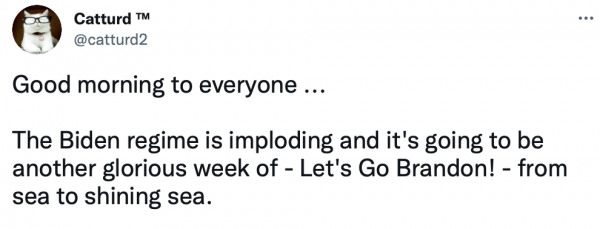
REPUBLICANS POUNCE! McConnell seizes on debt standoff to undermine Biden agenda.
That Biden doesn’t have enough muscle on Capitol Hill to wrangle his own caucus is McConnell’s fault, apparently.
AND IT SHOULD BE: Salena Zito: School board meetings show only that freedom is messy.
Twenty years ago, Paul Carson said he never would have hesitated speaking out at a school board meeting about any issue affecting his children’s education.
But one day, that changed. “I just don’t do it,” Carson told me. A physician who practices medicine in an urban Pittsburgh hospital, Carson said it has nothing to do with his being 20 years older. “It has everything to do with the culture we are navigating.” . . .
School board meetings have been around forever, and they have always had the potential to become raucous. I remember attending them with my mother as a teenager, then as a mother myself when my children were young. I also had to attend a few as a reporter for the local newspaper I worked for at the time. Emotions often ran high, as they should when children’s welfare is involved. Good parents never lose sight that the people who educate their children spend more day time with them in a classroom setting than parents themselves do. Emotions also ran high when new buildings were proposed, which always eventually meant higher taxes.
I have often told young reporters that if they want to see firsthand the most important political process in the U.S. system, turn off cable news, get off the iPhone, turn their eyes away from Washington, and cover a local school board meeting.
No one should accept threats or physical violence at a school board meeting or anywhere else. But such conduct is fortunately rare. The problem today is, can we trust our government to distinguish between the actual threat of violence and the passionate expression of viewpoints by parents?
No, we can’t. Which is why Merrick Garland should resign. Plus:
Eighty years ago, dairy farmer Jim Edgerton stood up at a town hall meeting in his hometown of Arlington, Vermont, to voice his disagreement with the town councilors’ decision to build a new school. Edgerton was the only person at the meeting or in town who objected to the proposed building.
His opposition was mostly unremarkable, but he held his ground nonetheless. No one would have known about it had not Norman Rockwell, a newcomer in town, been there.
As he watched Edgerton exercise his freedom of speech, the famous illustrator of Americana could not stop thinking about the State of the Union address President Franklin D. Roosevelt had delivered on Jan. 6, 1941, in which he warned that the values and liberties the public took for granted were under attack. Rockwell would go on to illustrate that moment, making Roosevelt’s words relatable by depicting them in use in small-town America.
It is inconceivable that the federal government today wants to squash that freedom through vague rules and intimidation. Garland seems to be making the calculation that the Jim Edgertons of this world will cower under the concern the government is watching them.
He hopes for that. I expect he’ll be disappointed.
YES, BUT MAKING EVERYONE ELSE PAY FOR STUDENTS’ BAD DECISIONS ISN’T THE ANSWER: George Leef reviews “The Debt Trap.”
FRANCIS COLLINS IS NO HERO: Departing NIH chief Francis Collins has been something of a rock star among secularists and evangelical Christians alike, but Dr. John G. West of the Discovery Institute presents a comprehensive case for a profoundly different assessment.
WHY IS THE LEFT SUCH A CESSPIT OF BIGOTRY? MSNBC’s Tiffany Cross Slams ESPN’s Sage Steele as a ‘Stepin Fetchit Minstrel Show.
KRUISER’S MORNING BRIEF: Can America Survive the Addled Lunatic Biden? “Near the end of this section in last Friday’s Briefing, I said ‘I have enough life experience and perspective to know that everything isn’t an existential crisis. Joe Biden’s Reign of Error is starting to make it feel as if the country is in the throes of one though.’ That got me pondering things I would generally prefer to not ponder but, circumstances being what they are, I pondered.”
WELL, SURE: FACT CHECK: McAuliffe Spreads COVID Misinformation at Candidate Forum.
Democratic gubernatorial candidate Terry McAuliffe incorrectly stated on Thursday night that there were 1,142 children in Virginia’s intensive care unit beds, a gross overestimation of the virus’s current impact in the state.
“We in Virginia today, 1,142 children are in ICU beds,” McAuliffe stated during a roundtable discussion with local reporters. The statistic is a massive overestimation. Virginia Department of Health statistics show that there are a total of 443 people of all ages currently in ICU beds, a fraction of the figure McAuliffe put forth for children.
The state database shows the number of Virginians in ICU beds infected with COVID-19 has never come close to 1,142 since the first hospitalizations in March 2020—the peak of individuals hospitalized in the ICU with COVID-19 was on Jan. 13, when there were 587 cases. State records show that just 1,094 individuals younger than 19 years old have been hospitalized with COVID-19 since the beginning of the pandemic. Children, who rarely get seriously ill from the virus, have never made up a significant chunk of hospitalized individuals.
McAuliffe also said during the roundtable Virginia had “8,000 cases on Monday,” another exaggerated statistic. On Monday, Oct. 4, Virginia saw 1,220 “confirmed” cases and 864 “probable” cases, according to the Virginia Department of Health.
The state has never seen 8,000 confirmed cases in a day.
To be fair, McAuliffe lies a lot. He knows the press won’t call him on it.
THE PEOPLE RUNNING OUR GOVERNMENT REQUIRE A STIFF DOSE OF CORRECTION: Why Are Moms Like Me Being Called Domestic Terrorists? Showing up to dress down school boards over their dereliction of duty isn’t a crime. It’s good parenting and good citizenship.
One of the key outcomes of the pandemic response and the Biden election is an overweeningly arrogant refusal to listen to the common people. If it ends with politicians and bureaucrats being whipped naked through the streets, tarred, and feathered, well, they will have brought it upon themselves. If speaking at a school board makes you a domestic terrorist, some may figure, then well, why not go whole hog?
And, frankly, it’ll be deserved. All the people running this country had to do was be normal for the last 5 years, and they couldnt’ — or wouldn’t — do it. It will not end well, and we — and they — will be lucky if it doesn’t end violently.
WHAT COULD GO WRONG? Executive Order Bombshell: Bitcoin, Ethereum, Cardano, BNB, XRP, Solana And Dogecoin Are Braced For A Massive Earthquake Amid Huge Price Pump. “The executive order, which is still under consideration, would see federal agencies charged with making recommendations on bitcoin and crypto and would touch on “financial regulation, economic innovation and national security,” Bloomberg was told by White House insiders who added a ‘crypto czar’ could be appointed to ‘coordinate agencies’ work on digital currencies.'”
SALENA ZITO: Stop griping and give Breezewood a second look.
Breezewood’s story is more than a town filled with cement, neon, cars and trucks and all the necessities they require; in truth, it is the story of how a small town survived when most other small towns along the turnpikes and interstates withered away when those superhighways passed them by.
There are hundreds of towns that once flourished — along the Lincoln Highway in this state alone — that have now faded into obscurity, thanks to either the turnpike or bypasses. Each new generation finds it harder and harder to keep their town alive when potential visitors find traveling fast more important than stopping and sitting a spell.
If anything, Breezewood is a story of American exceptionalism, of finding the tenacity to be both small and still matter in a society that often looks past small-town America.
Judy Felton-Carlin has lived here all of her life. She and her husband, John Carlin, run the Quality Inn Breeze Manor motel. Her grandparents started the motel when the turnpike divided their farm into three pieces, making actual farming a real challenge.
“The farm was crimped by the turnpike,” Ms. Felton-Carlin said. “To make ends meet they sold homemade ice cream and chocolate milk on the roadside. As they noticed more cars started to come into town, my father and uncles bought the land off of my grandfather and built 12 rooms on the farmland for people to stay — and called it the Breeze Manor Motel,” she said pointing to the original, impeccably kept motel rooms 101 through 112, still in service.
Two years later, they added eight more rooms and bought a Quality Inn franchise; 68 years later, Judy and her husband John are running this completely intact, perfectly maintained, mid-century marvel.
In between, John and Yoko Lennon and Muhammad Ali all tried to stay here, explained Ms. Felton-Carlin, “Unfortunately we were booked both times.”
The view of Breezewood from the vantage point of the motel rooms would rival any you would find in the Shenandoah Valley or the foothills of the Rockies — quite different from the meme of this town that keeps getting passed around on social media.
Social media can be misleading.
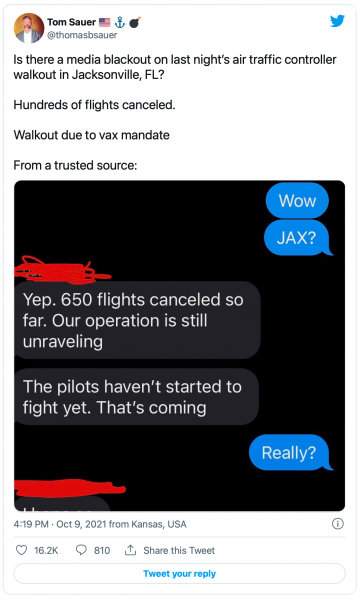
#RESIST: Southwest Cancels 1,800 Flights. Is There a ‘Sickout’ Over the Vaccine Mandate?
Let’s go, Brandon!
JOEL KOTKIN: The New Face of Autocracy.
former Facebook employee hailed by the media as a whistleblower testified this week on Capitol Hill about the social media giant’s algorithm, and how it harms children and democracy. Frances Haugen told the the Senate Commerce, Science and Transportation Subcommittee on Consumer Protection, Product Safety and Data Security that Facebook routinely chooses profit over safety, creating an addictive product that puts children—and American democracy—at risk by failing to adequately police its product.
But though Facebook founder Mark Zuckerberg is no doubt embarrassed by the brouhaha, he and his fellow big tech founders ultimately may have very little to worry about. At the end of the day, Haugen’s testimony was less an exposé and more a distraction from the far more urgent issue of big tech’s expanding monopolistic reach, and its growing political and cultural power. The real question when it comes to big tech is not the one posed by Haugen’s testimony—whether Facebook and the other tech platforms allow “misinformation” or “hate speech” on their platforms; her testimony instead conveniently missed the real problem: that a handful of mega-firms are now controlling content for much of the population.
Nearly two-thirds of U.S. adults now get their news through social media sites like Facebook or from Google.This is even more true among millennials, soon to be the nation’s largest voting bloc. And tech oligarchs have further expanded their domain by purchasing much of what is left of the mainstream media, including the New Republic, the Washington Post, the Atlantic, and the long-distressed Time Magazine .
And contrary to what Haugen and the Senate seem to believe, the biggest problem with having the flow of information so tightly concentrated in the hands of so few is not that it allows posts from hate groups or divisive political operatives or skinny teenagers. It’s that a tiny handful of oligarchs are dictating what is knowable, or what views are valid.
Yes. And the distraction is intentional.