AT AMAZON, Treat Your Own Back.

Plus, fresh Gold Box and Lightning Deals.

AT AMAZON, Treat Your Own Back.
Plus, fresh Gold Box and Lightning Deals.
ROGER SIMON SPOTS THE TELL: Peter Strzok’s Smirk Said He Was Lying.
Read the whole thing.
MAKE ‘EM TAKE A STAND: House GOP to Bring Democratic ‘Abolish ICE’ Bill to the Floor.
HOPE AND CHANGE: Political shift: Nation wants ‘to move away from’ Obama policies.
The latest McLaughlin & Associates poll suggests that Trump has support for distancing himself and policies from Obama.
As recently as January, the country was split on pulling away from or continuing with Obama’s policies.
Now, however, the gap has widened. Some 47 percent want to “move away from the policies of President Obama.” And 41 percent want to continue those policies.
Well, good.
CHANGE: Tesla Hits Delivery Threshold for Juicy Federal Tax Credit.
Tesla Motors announced Thursday that it officially reached 200,000 deliveries this month, which is good news in terms of overall sales. But the figure also means the company has surpassed the threshold requiring that federal tax credits be phased out, which is bad news.
Some speculate that, without government incentives, fewer people will be willing to buy Tesla-branded vehicles. While that’s a possibility, the brand offers unique, trendy models not readily available elsewhere. We’d presume a discount on an iPhone would probably help sales as well, but affordability it isn’t the main reason people purchase them.
We’ll see what kind of impact it has on the automaker as the $7,500 federal electric vehicle tax credit for new owners is gradually phased out. It will also be telling for the electric vehicle market as a whole, as Tesla is the first EV producer to reach the limit.
Every time I see an electric vehicle on the road, I wonder how much of it I paid for.
OVERSIGHT: Congress Demands State Department Release Secret Report Busting Myth of Palestinian Refugees.
The State Department has, since the Obama administration was in office, been hiding a key report believed to expose the number of Palestinian refugees as far smaller than the U.N. and other have claimed for decades. The public release of this information could alter how the United States provides funding for Palestinian refugees.
The Washington Free Beacon first disclosed the existence of the refugee report in January, when the Trump administration decided to significantly cut funding to the U.N. Relief and Works Agency, or UNRWA, an organization long accused of harboring anti-Israel bias and of aiding Hamas terrorists in the Palestinian territories.
Though the State Department is legally required to publish an unclassified version of the report, it has repeatedly ignored demands by Congress that the report be released.
The State Department, when asked by the Free Beacon, could not provide any information or timeframe on the report’s possible release.
“The State Department is committed to taking all appropriate measures to provide information in response to requests from Congress,” a State Department official said.
Uh-huh.
HIGHER EDUCATION BUBBLE UPDATE: Feminist scholar slams hot-wing-eating show for ‘inequitable gender hierarchies.’ Remember, when taxpayers tire of funding this sort of thing, we’ll be told it’s because of “anti-intellectualism.”
LIZ SHELD’S MORNING BRIEF: Strzok Testimony Delivers and Much, Much More. “The Democrats played defense for the disgraced FBI agent, interrupting with parliamentary distractions to keep Strzok safe from answering questions or accidently lying under oath. It was quite a spectacle to watch the left defend a law enforcement agency while simultaneously demanding another be abolished.”
SWEDEN PREPARES FOR RUSSIAN AGGRESSION: In case you missed it –my latest Creators Syndicate column.
KREMLIN BLUES: Russia admits defeat on its ‘stealth’ F-35 killer by canceling mass production of the Su-57 fighter jet.
“The plane has proven to be very good, including in Syria, where it confirmed its performance and combat capabilities,” Russian Deputy Defense Minister Yuri Borisov said on Russian TV on July 2, as reported by The Diplomat.
But despite Russia’s nonstop praise for the plane and dubious claims about its abilities, Borisov said, per The Diplomat: “The Su-57 is considered to be one of the best aircrafts produced in the world. Consequently, it does not make sense to speed up work on mass-producing the fifth-generation aircraft.”
Justin Bronk, a combat-aviation expert at the Royal United Services Institute, told Business Insider that Borisov’s comments “could be charitably described as an unreasonably optimistic reason why they stopped production.”
Ya think?
MICHAEL BARONE: The Kavanaugh confirmation Kabuki.
Theater, much like Japan’s Kabuki. That’s all the Supreme Court confirmation process is. President Trump’s presentations of his two nominees, Judge Neil Gorsuch last year and Judge Brett Kavanaugh on Monday, were uncharacteristically graceful — a worthy theatrical innovation, in the view of even some Trump critics.
Now, we get to watch television clips of Kavanaugh’s visits to senators’ offices — where he’ll likely never return to after the play-acting is over — with cordial words from Republicans who are certain to vote for him, and maybe even from Democrats certain to vote against.
Then, there will be hearings before the Judiciary Committee, presided over by the folksy but canny Chairman Chuck Grassley. The ranking Democrat, Dianne Feinstein, may be a bit restrained by her earlier imposition of what sounded like a constitutionally prohibited religious test for office on another judge on Trump’s Supreme Court shortlist.
This process is ostensibly to enable senators to make informed decisions. But Kavanaugh is certain to invoke the 1993 precedent set by his D.C. Circuit predecessor Ruth Bader Ginsburg in refusing to say how she’d vote in any case.
Sure, everybody knows judges shouldn’t make decisions off the tops of their heads. But everyone also knows that they have to deny ammunition to the other side. Judge Robert Bork in 1987 did the opposite, unfortunately for his nomination. Supreme Court nominees for years have been very smart people, able to deftly avoid this mistake.
Of course, everyone knows the outcome of the play, as they do when they go see “Hamlet.” Praise from liberal legal scholars Akhil Reed Amar and Benjamin Wittes won’t make any difference in the outcome. Judge Kavanaugh will be confirmed, with all Republican and perhaps a few Democratic votes.
Well, let’s hope. And in the meantime, think of all the fundraising opportunities!
BECAUSE SOCIALISM: Why Higher Oil Prices Won’t Save Venezuela.
Now that crude prices are rising again, the political and economic pressures are easing on oil exporters as revenues, in most cases, begin to surge. But there is one glaring exception, one country that relies on oil exports for essentially all its export revenue and whose economy is continuing its downward spiral despite the sharp rise in oil prices: Venezuela.
The simplest way to gauge the impact of oil price fluctuations on the economy and the potential effect on policy is to look at an exporter’s fiscal break-even price. The break-even price is the level at which oil prices need to sell in order to allow an exporter to meet government spending and produce a balanced budget. When crude prices fall below break-even, budget deficits start to balloon, eroding reserves and threatening economic stability. Depending on the availability of other exports and the size of reserves, large gaps between break-even and market prices can force a government to cut spending, raise taxes and borrow heavily. It can squeeze an economy well beyond the oil industry.
The most dramatic response to the drop in global oil prices came in Saudi Arabia, where an ambitious and daring crown prince, Mohammed bin Salman, launched revolutionary reforms with an eye toward, among other things, reducing the country’s overreliance on oil. While the success of many of his reform plans remains unclear, the crown prince’s efforts to lower Saudi Arabia’s break-even price has been little short of spectacular. Before prices fell, Saudi Arabia’s break-even price was $105.70 per barrel. The government has since slashed expenditures by about one-fifth, cutting subsidies and other expenses, and raising taxes. The break-even level now stands at $74.40, and a recent study by a Japanese bank predicts it will reach $55 a barrel by 2021, giving the kingdom ample room to finance Crown Prince Mohammed’s goal of diversifying the economy.
Other Gulf states have also moved to narrow the gap, introducing a value-added tax, lowering subsidy payments and promoting new industries. Now, with oil prices climbing, these petroleum producers are set to reap a sharp rise in revenues against a lowered level of national expenditures.
The contrast with Venezuela could not be starker. Despite the rise in prices, Venezuela, holder of the world’s largest known oil reserves, is seeing its oil income continue to plummet, along with the rest of its economy.
Venezuela was one of the richest countries in Latin America when Hugo Chavez began imposing Bolivarian Socialism — and oil was only about $18.
The price of oil isn’t what’s wrong with Venezuela.
RICHARD FERNANDEZ ON WHAT’S AT STAKE:
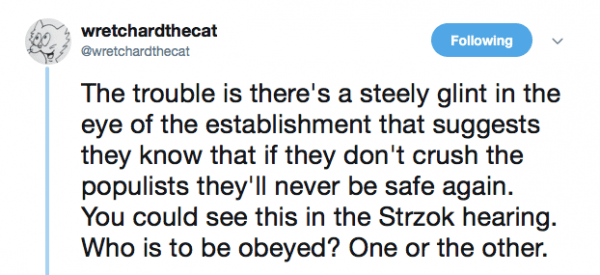

Thought to be fair, I’m not sure I’d call this a “steely glint” exactly.
I foresee this being used as a meme or gif. #Creepy #Strzok #FoxNews pic.twitter.com/uUHC7wv7EP
— Holly Bowie (@Hollybowie) July 12, 2018
This is so over the top, I thought it was fake at first.
UPDATE: Roger Simon: Peter Strzok’s Smirk Said He Was Lying. And that he expected to get away with it. “The shrinks call that ‘inappropriate affect’ and it sure was. What the hell was this guy smirking about?”
IS THIS UNPRECEDENTED POLITICKING BY AN EX-PRESIDENT? Obama Returns to Boost Eric Holder-Led Group Targeting Republicans in 12 States. By . . . “redistricting.”
SEA STORY: China’s Expanding Navy.
In 2018, the PLA-N is at the point of commissioning a 10,000-ton air defence cruiser every year. It already commissions four guided missile destroyers, two guided missile frigates, and nine guided missile corvettes annually. These ships are fitted with advanced computers, data links, and long-range weaponry, as well as sensors with capabilities inconceivable to earlier generations.
But each advance in capability means additional complexity. Solid state equipment may be much more reliable than the valves of the past, but setting up complicated software-controlled systems and managing networks are highly demanding activities. Over-the-horizon tactics require greater precision and awareness of orders of magnitude than the old systems.
The PLA-N is clearly doing its best to advance its star performers. The commanding officers of the early anti-piracy deployments to the Indian Ocean are now admirals. But the great majority of the senior leadership and middle management of the PLA-N can have only a theoretical understanding of the capabilities of the force that is now being deployed.
Furthermore, the expansion has been so rapid that there must be very little chance to winnow out the inferior and mediocre – any personnel with operational experience with the new technology will have to be promoted and assigned to new construction. In the First World War, Britain’s Royal Navy struggled with the consequences of large-scale promotion past competence in a massively expanded fleet. Its operational performance reflected this, a lesson the PLA-N cannot ignore.
Naval traditions are expensive to come by — in treasure and blood. But once earned, those traditions can last centuries.
TRUMP’S REFORM OF THE ALJ HIRING PROCESS, discussed at the Yale Journal on Regulation blog here and here. “The changes to the hiring process are unsurprising. This term, in Lucia v. SEC, the Court held that ALJs are inferior officers, not employees, of the United States and accordingly must be appointed through the procedures listed in Article II of the Constitution—that is, they must be appointed by the President (with or without Senate approval), by heads of departments, or by the courts. The natural way to implement that holding is to exempt ALJs from the competitive selection process and leave the appointment of ALJs to the discretion of agency heads.”
SETH LIPSKY: Losing the Supreme Court can teach Democrats same valuable lessons.
This line of thinking was nicely articulated the other day by The New York Times’ David Leonhardt in a column urging liberals not to despair. Leonhardt didn’t go so far as to suggest that a right-wing court would be the “best” thing in years. He did, though, urge a course of realism and a new strategy for pursuing liberal policies.
Like, say, winning elections.
“Over the last half-century, conservatives have put more energy into building a movement,” Leonhardt wrote. Above all, he added, “winning local, state and congressional elections.”
Democrats, meanwhile, “have emphasized higher-profile politics, like the presidency and landmark court cases.” Leonhardt suggested Democrats “can’t afford to do so anymore.”
Those strike me as wise words as we stand at the brink of what might yet come to be called the Trump court. And they are words to mark for the conservative caucus, too.
After all, we were there once.
And they will learn, once they’ve hit bottom and the old leadership dies off or is forced out.
BECAUSE IT’S NO FUN GETTING THERE WITHOUT GIVING THE GOVERNMENT MORE POWER: U.S. CO2 Levels Drop Again — So Why Aren’t Green Groups Rejoicing?
The new report, based on U.S. data, shows clearly the U.S. continuing downward trend.
“The U.S. emitted 15.6 metric tons of CO2 per person in 1950,” wrote the Daily Caller. “After rising for decades, it’s declined in recent years to 15.8 metric tons per person in 2017, the lowest measured levels in 67 years.”
That’s right. 67 years. Green groups and leftist climate extremists should be exulting. The U.S. has found a way to produce more GDP — making all of us better off — with less energy.
Meanwhile, Europe has imposed massive economy-deadening regulations on its economies in order to reduce CO2 output. How has that worked?
Last year, European output of CO2 rose 1.5%, while U.S. output fell 0.5%. For the record, the disaster predicted when President Trump left the Paris climate agreement and rejected draconian EPA restrictions on power plants hasn’t materialized. On the contrary, the U.S. model has been shown to be superior.
This isn’t the first time we’ve reported the ongoing decline in U.S. CO2. And if current trends hold, it won’t be the last. And, to be sure, it is a long-term trend. . . .
Question: Over the same period, how did the rest of the world do? Emissions rose by 21% to 6.04 billion metric tons over the 12 years, mostly due to booming economic growth in India and China, where coal-fired energy output continues to expand.
The truth, and it’s proven by the hard data, is that CO2 made in the USA will not choke the world to death or cause it to massively overheat. And you can thank capitalism for that.
Well, they’re not going to do that. The thing to remember is, environmentalism is the excuse for the policies they champion, not the reason.
DEBRA HEINE: Republicans Forced to Call U.S. Marshals to Serve Subpoena on Lisa Page. “They had to go back three times before they were finally able to reach her.”
WHEN YOU CAN’T TRUST ASSOCIATE DEANS, WHO CAN YOU TRUST? After Temple Admitted That Its Business School Misreported Data To Goose Its Ranking, U.S. News Demands Certification Of Other Schools’ Data (Including Law Schools).
InstaPundit is a participant in the Amazon Services LLC Associates Program, an affiliate advertising program designed to provide a means for sites to earn advertising fees by advertising and linking to Amazon.com.


