
WELL, THIS IS THE 21ST CENTURY, YOU KNOW: Crash-Proof: ‘Indestructible’ Drone Springs Back To Shape.
Archive for 2017
April 4, 2017
HEY. WE’VE SEEN THIS MOVIE BEFORE, HAVEN’T WE? Why Is CNN Refuting The Susan Rice Story It Refuses To Cover?
2017: The Rice-Free Zone.
2008: The Wright-Free Zone:
Just think of the MSM as Democrat activists with bylines (and vice-versa) and it all makes sense.
IN RANGE OF NORTH KOREAN NUKES: NBC talks to American ex-pats in South Korea. I’ve read similar stories over the years.
Of course, there was this earlier NBC report, quoting a North Korean defector.
A senior North Korean defector has told NBC News that the country’s “desperate” dictator is prepared to use nuclear weapons to strike the United States and its allies.
Thae Yong Ho is the most high profile North Korean defector in two decades, meaning he is able to give a rare insight into the secretive, authoritarian regime.
Reuters reports on China-North Korea relations.
China has taken steps to increase economic pressure on Pyongyang but has long been unwilling to do anything that may destabilize the North and send millions of refugees across their border.
Here’s what I wrote two weeks ago regarding the end of “strategic patience.” The essay provides a lot of context.
STUFF JUST GOT REAL: Susan Rice isn’t a ‘smoking gun,’ but she does have some explaining to do.
That’s WaPo’s Aaron Blake, and if The Fix is willing to even breathe the words “smoking gun,” then you can bet there’s “a fish, a barrel, and a smoking gun.”
“THE MONEY AND TIME PUBLIC CAMPUSES WASTE DEFENDING THESE MANIFESTLY UNCONSTITUTIONAL CODES IN COURT IS A NATIONAL SCANDAL. CAMPUSES SHOULD NOT HAVE TO BE FORCED TO RESPECT STUDENTS’ FIRST AMENDMENT RIGHTS.” – This morning I testified before the House Judiciary Committee’s Subcommittee on the Constitution and Civil Justice on the topic of First Amendment Protections on Public College and University Campuses. As of this posting, the hearing is still in progress— you can watch it here, or read my oral testimony over at The Huffington Post.
QUESTION ASKED: The Beginning of the End of Putinism?
Putin may have cause for concern. The recent protests, complaining about corruption, are materially different in substance than the 2011 and 2012 protests that focused on election fraud, although the issues are related. The latest round of protests has taken place in a worse economic and political environment.
Moreover, the luster of the nationalism aroused by Putin’s geopolitical adventures in Ukraine, Syria and elsewhere may have begun to fade as the conflicts in those regions continue and as their economic cost rises. Russia’s increased negative image in the world, and in the West in particular, may be taking its toll on the Russian polity as the effects of the corruption exposed in the Panama Papers and by the impressive investigative activity of opposition leader Alexei Navalny starts to have an impact. This is in addition to the impact of the massive Russian sports cheating scandal exposed by the WADA investigations.
Western sanctions have been meaningful but not for the purpose for which they were implemented, i.e., to reverse the annexation of Crimea. The sanctions may have helped foster the economic conditions which might over time bring about political change in Russia. Real incomes in Russia have been steadily falling for several years despite relatively stable energy prices. The number of Russians living below the poverty line has increased by 15 percent in the past two years. The number of billionaires and millionaires has increased, and evidence of their extravagant lifestyles has become increasingly available on the internet.
A corrupt and heavily centralized state has always been good for the 1%.
IN THE MAIL: From Mark Rubinstein, Beyond Bedlam’s Door: True Tales from the Couch and Courtroom.

Plus, today only at Amazon: Blendtec Designer Series Blender, WildSide Jar, $199.99 (57% off).
And, also today only: Up to 60% Off Casio Protrek Watches.
Also, Simmons 801600 Volt 600 Laser Rangefinder, $59.99 (49% off).
And, don’t forget, brand new Lightning Deals, updated every hour.
BEN CARSON ON TRUMP H.U.D. BUDGET: ‘Nobody’s Going to be Thrown Out on the Street’
It’s a symptom of our poisoned political atmosphere that Carson feels the need to say that.
TIME FLIES ON STRATEGYPAGE, SO TO SPEAK: I’m behind –again. Time to catch up with StrategyPage.com’s WW2 bomber series.
From late last week: the A-20 Havoc. Note the six .50 caliber machine guns in the nose.
This week: the B-34 Lexington, with U.S. markings.
Earlier this week: the Avenger. An outstanding Navy plane. The caption mentions President George H. W. Bush and Paul Newman.
BILL GERTZ: U.S. Ill-Prepared to Stop Widespread Russian Information Warfare.
In addition to the hacking and leaking campaign during the election, Russian intelligence agencies engaged in covert influence operations that falsely reported terrorist attacks in the United States and against the key U.S. military base in Incirlik, Turkey.
The Russian government also backed the Occupy Wall Street protest movement and trumpeted racially charged news to sow social unrest.
The federal government has been unable to stop Moscow’s propaganda and influence operations. Likewise, it has failed to counter cyber attacks aimed at stealing data or sabotaging critical networks.
“Americans should be concerned because right now a foreign country, whether they realize it or not, is pitting them against their neighbor, other political parties, ramping up divisions based on things that aren’t true,” said Clint Watts, a cyber security expert and former FBI special agent.
Russian information warfare operations seek to erode Americans’ trust in the government.
“If they can do that, if Americans don’t believe that their vote counts, they’re not going to show up to participate in democracy,” said Watts, a senior fellow at the Foreign Policy Research Institute.
There’s still no evidence that Russia “hacked” the election in any way, although high-level Clinton hand John Podesta was apparently gullible enough to fall for a phishing attack — which revealed embarrassing, but true, details about Hillary’s campaign.
As for the rest, given how much more fragile Russia’s institutions are than ours, a little tit might prevent a whole lot of future tat.
HIGHER EDUCATION BUBBLE UPDATE: The Political Economy Of Administrative Bloat in American Higher Education.
REMEMBER OBAMA’S CHEMICAL WEAPON RED LINE IN SYRIA?: Stephen’s posted on this. I’ve been following the chemical attack in Syria story since early this morning. The BBC article Stephen linked to and the AP both report the suspected the chemical agent used in the attack is sarin (GB), a nerve agent. The description of the symptoms experienced by victims is consistent with a nerve agent.
Note this from the BBC report:
The Syrian Observatory for Human Rights reported that strikes on Khan Sheikhoun by Syrian government or Russian jets had caused many people to choke.
We don’t know who delivered the bombs– not yet.
Now, recall Obama worked out a deal with Russia (via Vladimir Putin). Russia would take control of the Assad regime’s chemical weapons arsenal. The Kremlin would then move the weapons out of Syria and destroy them.
Apparently the BBC didn’t remember that history, even though it is very relevant context. Well, Business Insider remembers.
The Obama administration’s failure to enforce the “red line” it drew for intervention in Syria against Assad in 2012 has become arguably the biggest stain on the former president’s foreign-policy legacy. Kerry acknowledged in December that the failure to follow through on the threat to retaliate against Assad for his use of chemical weapons to kill 1,500 people in August of 2013 damaged the US’s reputation in the region.
Obama opted instead for a deal brokered by Russia to ship Assad’s chemical weapons stockpile out of Syria and destroy them. The US hailed the deal as a success, but Assad has evidently retained some of the weapons he promised to destroy. Syrian activists have reported three separate chemical attacks in the last week alone, according to the Associated Press, including the attack Tuesday.
Stay tuned.
THEY’D RATHER PEDDLE FAKE NEWS: Attention NYT: This Is What Journalism Looks Like.
It’s worth noting here that one of biggest scandals in American journalism is the longtime failure of the New York Times to cover the corrupt nature of city politics in New York. The readers of the NYT don’t know very much about political power in America’s largest city because the Times is too grand for such base concerns—and because, frankly, Democratic politicians are often subjected to less scrutiny by the mainstream media. If the NYT had been doing its job, very little in this Daily News piece would be news to New Yorkers.
Shoe-leather journalism is too hard.
I NOTICE THAT EVEN THE MAINSTREAM PRESS IS MAKING THIS POINT NOW:
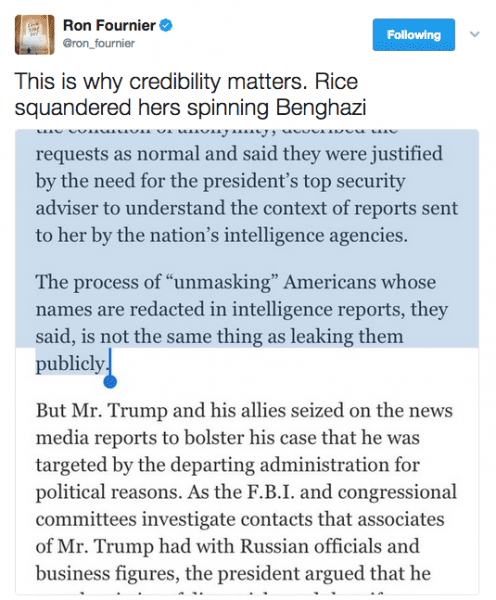
CHANGE? Trump Administration Floats Compromise on Health Care.
Rep. Mark Meadows, R-N.C. and head of the conservative Freedom Caucus, called the administration’s new measure for compromise “a solid idea.”
“We remain open minded and willing to look at details for the plan, so we’re hopeful,” Meadows said after emerging from his group’s meeting with Pence Monday night. “We are encouraged by at least the idea — intrigued by the idea — but would certainly need a whole lot more information before we take action in support or opposition.”
The compromise Pence and the moderate members of the House discussed — and that Pence has taken to the conservative members on the Hill — would give states the opportunity to issue a waiver so they don’t have to impose those requirements on the condition that states show that getting rid of the insurance regulations, such as essential health benefits, will lower the cost of premiums, according to a Republican aide.
The compromise would not allow states to waive those requirements for dependents under 26 or allow an opt-out for pre-existing conditions or impose lifetime spending caps.
Most any negotiations might be an improvement over last month’s failed attempt at a fait accompli.
SYRIA: ‘Chemical attack’ in Idlib kills 58.
If you have the stomach for it, Australian reporter Sophie McNeil’s Twitter feed is filled with photos from the attack — and it certainly does look like chemical weapons were used.