Archive for 2015

HIGHER EDUCATION BUBBLE UPDATE, LEGAL EDUCATION EDITION: Creighton Joins Rankings Hall Of Shame; Graduation Rate Was 43%, Not 91%.

Related: Bar Exam Carnage Continued: 10 Of 15 New York Law Schools Suffer Bar Pass Rate Declines.

And, inevitably: Deans Of Some California Law Schools Say Low LSAT Scores Do Not Predict Bar Exam Failure. Color me skeptical. At Tennessee, we did a study on our own graduates back in the 1990s and found that LSAT scores were the single best predictor of bar passage, which isn’t surprising when you consider that both are big, stressful exams about legal reasoning.

IS IT TIME TO END PEER REVIEW?

The peer review process – long considered the gold standard of quality scientific research – is a “sacred cow” that should be slaughtered, the former editor of one of the country’s leading medical journals has said.

Richard Smith, who edited the British Medical Journal for more than a decade, said there was no evidence that peer review was a good method of detecting errors and claimed that “most of what is published in journals is just plain wrong or nonsense”.

Research papers considered for scientific and medical journals undergo a process of scrutiny by experts before they can be published. Hundreds of thousands of new studies are published around the world every year, and the peer review process exists to ensure that readers can have confidence that published findings are scientifically sound.

But Dr Smith said pre-publication peer review was slow, expensive and, perhaps ironically, lacking in evidence that it actually works in its chief goal of spotting errors.

Has anyone done a peer-reviewed study on this?

OBAMA: “WHAT I’M NOT INTERESTED IN DOING IS POSING OR PURSUING SOME NOTION OF AMERICAN LEADERSHIP OR AMERICA WINNING:”

Obama’s tone during Monday’s press conference alternated between defensive and disinterested. The two-term Democratic president repeatedly insisted that his strategy was working and scoffed at demands to change his plan to confront and defeat ISIS.

“What I’m not interested in doing is posing or pursuing some notion of American leadership or America winning or whatever other slogans they come up with that has no relationship to what is actually going to work to protect the American people and to protect the people in the region who are getting killed and to protect our allies and people like France,” Obama said. “I’m too busy for that.”

There’s video of Obama’s chilling words in a C-SPAN clip at the Federalist. They’re the president’s equivalent of Carter’s malaise speech, only this time concerning real war, not its moral equivalent, which he and most Democrats view global warming. (And which Carter similarly viewed what in the 1970s was dubbed “the energy crisis.”)

Contrast this with a very different geopolitical strategy against totalitarianism. As Power Line’s Steve Hayward wrote in The Age of Reagan Volume II: The Conservative Counterrevolution: 1980-1989, published in 1989:

Reagan wanted to do much more than simply return to a robust anti-Communist foreign policy; he had spoken openly to his aides of wanting to win the Cold War, a hitherto unthinkable notion. Most notably, he told his future national security adviser, Richard Allen, sometime in 1979 that his view of the Cold War was simple: “We win, they lose. What do you think of that?” Reagan rejected coexistence and agreed with the orthodox conservative view that containment was a losing strategy in the face of determined revolutionists. Following Lincoln’s policy on slavery, Reagan wanted to place Communism on the course of ultimate extinction.

I know which strategy I prefer. How about you? (And hey, remember when Time magazine told us that Reagan would approve of Obama?)

Related: “If he hated terrorists half as much as he hates Republicans then maybe ISIS wouldn’t control half the middle east.”

THIS MAY EXPLAIN MORE THAN WE REALIZE: Huma Abedin told State Department colleague that Hillary Clinton was “often confused.”

HIGHER EDUCATION BUBBLE UPDATE: So You’re Getting a Ph.D.: Welcome to the worst job market in America.

As late as 1970, more than two-thirds of faculty positions at U.S. colleges and universities were tenure-line, but now the percentages are reversed, with 1 million out of the estimated 1.5 million Americans teaching college these days classified as “contingent” faculty, the overwhelming majority of them working part-time. Parents who have shelled out or borrowed the more than $60,000 per year that it can now cost to attend an elite private college may be shocked to learn that their young Jayden or Sophia isn’t actually being taught by the Nobel Prize-winners advertised on the faculty but by shabbily attired nomads with ancient clattering cars who are wondering how to get the phone bill paid. Some adjuncts have successfully unionized. In 2013 adjuncts at the University of Oregon won the right to a boost in base pay, regular raises, health insurance, and the ability to qualify for multiyear contracts. That still didn’t erase—and perhaps set in stone—their second-class faculty status, and they still would earn tens of thousands of dollars less than the greenest assistant professor.

Explanations for this two-tier phenomenon abound. Marc Bousquet, now an associate professor of film and media at Emory University, contended, in his 2008 book, How the University Works: Higher Education and the Low-Wage Nation, that the problem was the “corporatization” of the university. Bousquet argued that formerly high-minded academia figured out that it was actually a business. Like the rest of American businesses during the 1980s and 1990s, Bousquet argued, universities adopted outsourcing as their most profitable economic model, transforming their historic teaching mission into a form of low-wage, gig-economy service employment in which the majority of the instructors, like Uber drivers, are responsible for their own overhead.

An alternative and less class-warfare-driven theory came from Benjamin Ginsberg, a political science professor at Johns Hopkins University. In his 2011 book, The Fall of the Faculty: The Rise of the All-Administrative University and Why It Matters, Ginsberg targeted administrative bloat as the culprit for the massive shrinkage in tenure-line faculty from the 1970s onward, even as college tuition costs were rising exponentially. He pointed out, for example, that between 1998 and 2008, America’s colleges increased their spending on administration by 36 percent while boosting their spending on instruction by only 22 percent. In an adaptation of his book for the Washington Monthly Ginsberg wrote: “As a result, universities are now filled with armies of functionaries—vice presidents, associate vice presidents, assistant vice presidents, provosts, associate provosts, vice provosts, assistant provosts, deans, deanlets, and deanlings, all of whom command staffers and assistants—who, more and more, direct the operations of every school.”

To conservative critics of academia, the shrinkage of tenure-line faculty may seem to be a good thing: fewer “tenured radicals” shoving their Marxist-derived ideologies down the throats of hapless undergraduates. After all, some 63 percent of college professors define themselves as either “liberal” or “far left,” compared with only 12 percent who place themselves on the right, according to a 2012 survey by UCLA’s Higher Education Research Institute. . . .

As Kelsky—but almost nobody who is actually still inside academia—points out, there’s an elephant in this clamorous room of underemployed scholars. It’s the fact that from a supply-and-demand standpoint, graduate schools are simply turning out way too many Ph.D.s for the academic market to bear, depressing their wages accordingly. It’s a similar crisis to the glut of new attorneys that law schools were churning out in recent years even as law jobs paying enough to cover sky-high law school debt were disappearing. The law market seems to have corrected itself, with law school enrollments steadily plunging since 2011. That collapse hasn’t happened with graduate schools. Indeed, throughout the 2000s and beyond, new enrollments in master’s and doctoral programs of every kind continued to climb, even in the arts and humanities, where the job pickings are slimmest.

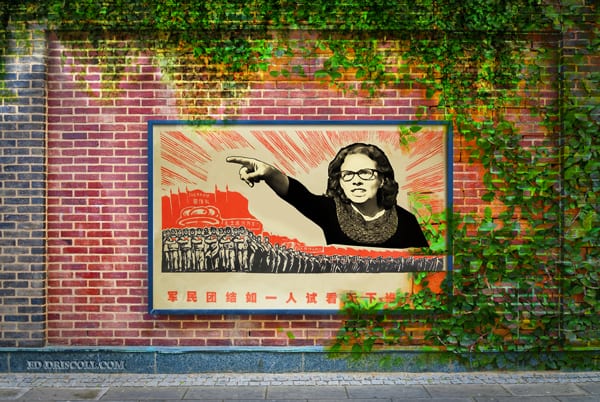
If only someone had warned them.

GEORGE WILL: AMERICAN COLLEGES ARE REAPING THE PROGRESSIVE WHIRLWIND:

If you believe, as progressives do, that human nature is not fixed, and hence is not a basis for understanding natural rights. And if you believe, as progressives do, that human beings are soft wax who receive their shape from the society that government shapes. And if you believe, as progressives do, that people receive their rights from the shaping government. And if you believe, as progressives do, that people are the sum of the social promptings they experience. Then it will seem sensible for government, including a university’s administration, to guarantee not freedom of speech but freedom from speech. From, that is, speech that might prompt its hearers to develop ideas inimical to progress, and might violate the universal entitlement to perpetual serenity.

On campuses so saturated with progressivism that they celebrate diversity in everything but thought, every day is a snow day: There are perishable snowflakes everywhere. The institutions have brought this on themselves. So, regarding the campuses’ current agonies, schadenfreude is not a guilty pleasure, it is obligatory.

Or as Jonah Goldberg put it, in somewhat earthier terms, via a callback to the Al Pacino in Scarface, “You Stupid Schmucks, Look at You Now.”

Related: In Liberals v. Maoists,” Matthew Hennessey of City Journal writes that “The turmoil on campus is the Left’s problem to solve:”

We hear a lot about the Republicans’ Tea Party problem but almost nothing about the Democrats’ Maoist problem. What’s Bernie Sanders’s take on the goings-on at Missouri? What’s Hillary Clinton’s?

“We’ll soon learn whether the old-fashioned liberals have what it takes to stand up to the Maoists,” Hennessey concludes. “So far, it’s not looking good.” The previous iteration of this story, when the young Turks of the New Left attacked the staid New Deal-era Democrats in the 1960s didn’t end very well, either.

CONOR FRIEDERSDORF: Paris and the Lessons of 9/11: The U.S. should treat France as France treated the U.S. 14 years ago—by helping the other wage prudent fights and warning its leaders against the rash decisions that trauma can lead to. Hmm.

I was actually thinking that if the French were to nuke ISIS, it would send a powerful message about the likely future of aggressive Islamic terrorism, while not creating the kind of superpower dynamic that would occur if the US did so. Won’t happen, I guess, but I wonder if there’s someone in France thinking the same thing. If not, there will be after the next attack.

Related: The Jihadis’ Master Plan To Break Us.