
 TEST-DRIVING THE NISSAN LEAF. So as I mentioned the other day, the Nissan folks arranged for me to drive a Leaf for a couple of days to see how I liked it. The answer is that I did. It’s zippy, quiet, and fun to drive, and it’s well-suited as a commuter car, though it only a few urbanites would want it as their sole vehicle. Here are the details.
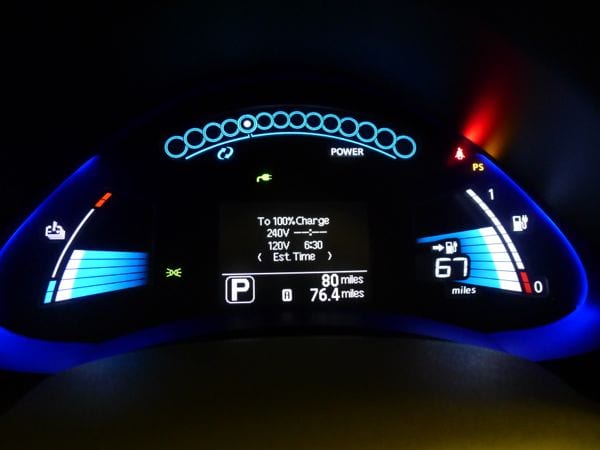
First, what about range anxiety? I can attest that it’s a real phenomenon. Part of that is the “miles remaining” display on the dash. When I picked the car up it wasn’t fully charged. The range display showed 83 miles, and the time-to-full-charge, even on the dealership’s 240v charger (which takes 6-8 hours for a full charge from empty) was about an hour. I didn’t have time to hang around that long, so I drove it to the Law School on Alcoa Highway, going about 55 mph. The distance is about 9 miles, and the display — which is based on a moving average of consumption — only dropped to 77. Driving home on back roads took it down to a further 67, but then driving around later, with headlights and climate control on, quickly dropped it to about 44. Because the display keeps changing, it’s better to look at the bar-display to its right, which shows the percentage charge of the battery. I’m sure Leaf owners quickly get used to this, but the way the display is configured probably produces excessive worry in newbies. Here’s a picture. The mileage display is on the right; the bar display on the left is battery temperature, which can matter a lot but usually doesn’t.
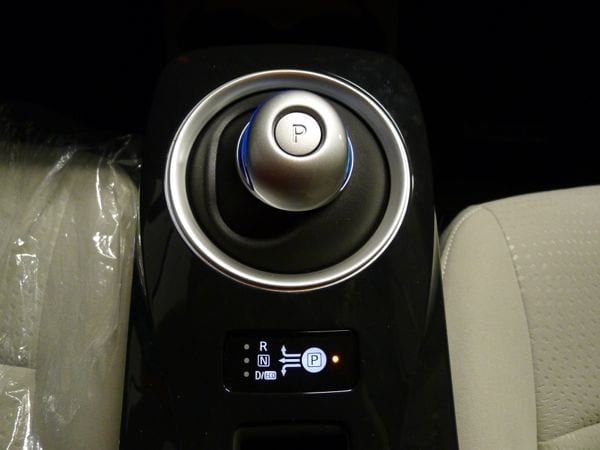
Instead of a gearshift, the Leaf has a simple forward/backward stick which, counterintuitively, goes forward for reverse, and reverse for forward. The button on the top sets the parking brake. Kind of an odd configuration, but easy enough to figure out and get used to.
The Leaf has lots of torque, as electric vehicles tend to, and merging into traffic is a snap. The smooth and near-silent acceleration is very cool. Cruising in the Leaf is also near-silent, with very little wind noise and only a modicum of tire noise from the low-rolling-resistance tires. Nissan clearly did a serious job of tightening up the interior, which is entirely free of squeaks and rattles. That must have been a chore, as there’s not the engine noise that would ordinarily mask them. The interior is nice, and an upgrade from the Versa whose chassis the Leaf uses. It’s not Infiniti-level, but it’s not econobox-level either. There’s plenty of room for the driver, even if, like me, you’re 6’3″ and over 200 pounds. Cornering is adequate, though the car feels a bit heavy, probably because of the battery weight.
There are some nice touches. The backup camera has a distance overlay, which is useful; if you’re turning while backing, the distance overlay curves to indicate your path. The car emits a low-level whine while driving at slow speeds, to warn pedestrians; I would prefer the Jetsons spaceship bleeble, but it’s not bad. The beeping sound it emits while backing up, however, is mildly annoying. The buttons for turning off the audio and climate control systems are a bit small and dark — again, not a problem when you’re used to the car, but not good design.
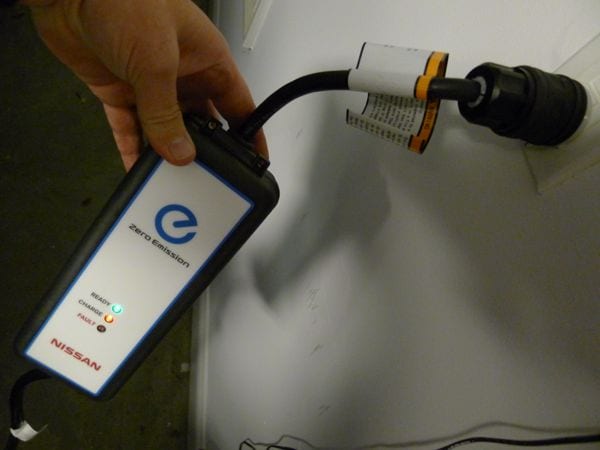
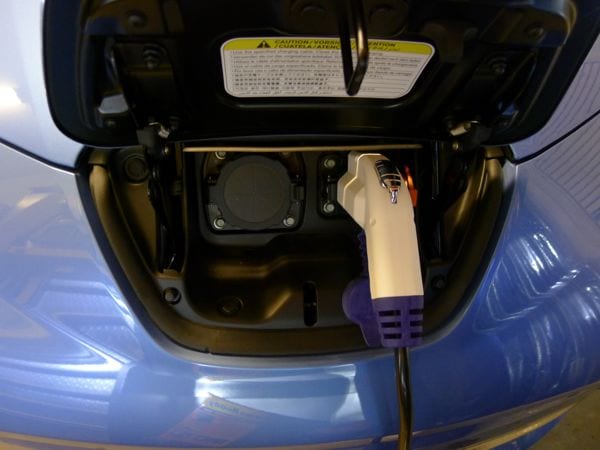
Once you get used to the idea of driving an electric car, it’s pretty uneventful. The range is such that it’s really only a commuter car, but it would easily accommodate 90% of my driving. When I got home I plugged it into the included 110v charger and by morning it was topped up to 100% and showed an indicated range of 111 miles. The charger inlet is in the front of the car and accommodates both 110v and 240v chargers in the right socket, and the still-scarce Level 3 chargers (which can charge the battery in half an hour) in the socket on the left.
Of course, the weather was perfect for maximum range as I didn’t have to make much use of the air conditioner or heat, both of which are (naturally) electric. Just turning on the A/C immediately drops the indicated range by over ten miles.
So is the Leaf worth it? The price is a bit steep — the car I drove, which had Nav, XM/Sirius, and assorted other bells and whistles, was priced at over $37K, which means that you’d be spending about $30,000 even after the $7500 federal tax credit. Is that worth it for a commuter car that never needs gas? Only if gas prices skyrocket — or if you follow the early adopter’s manifesto. But a lot of people do, and I can attest that the Leaf, which is surprisingly cute, did draw a lot of favorable attention as I drove it around. If you’re looking for a car that’s different, and plenty of people are willing to spend money for one of those, then this certainly fills the bill. It’s also pleasant to drive, and surprisingly comfortable.
(All photos taken with the Panasonic Lumix LX-5. Which did a nice job.)