Author Archive: Stephen Green

WELL, GOOD: Trump to greet Netanyahu by abandoning ‘2-state’ doctrine.

If we assume that the two-state solution was ever viable, it lost even our ability to assume when Arafat rejected a deal giving the Palestinians 93% of what they wanted, in favor of waging a renewed terror war against Israel.

CHATTER: Harward emerges as front-runner to replace Flynn following talks.

Vice Adm. Robert Harward, a former deputy commander of the U.S. Central Command, became the front-runner late Monday to replace Michael Flynn as the White House national security adviser, following lengthy discussions among top advisers to President Trump and several Cabinet members after Flynn resigned.

Harward’s rapid ascension to the top of Trump’s three-person shortlist for the position was confirmed by two White House officials who were not authorized to speak publicly.

Vice President Pence has been leading the discussions and working closely with Defense Secretary Jim Mattis, Homeland Security Security John F. Kelly, CIA director Mike Pompeo, White House senior adviser Jared Kushner, chief strategist Stephen K. Bannon and Chief of Staff Reince Priebus, the officials said.

Harward served under Mattis while he was at U.S. Central Command and remains an ally and friend of the defense secretary.

The Mattis-Harward connection would smooth out what looked like was going to be a dangerously rocky relationship between Defense and D.I.A.

ANALYSIS: SAD BUT PROBABLY TRUE. South Korea Needs to Realize That North Korea Isn’t Going to Collapse.

Even if it violates much of what we “know” in political science and economics, it has some source of strength—extreme nationalism, a genuine belief in the Kim cult, the regime’s willingness to do anything to survive—that helps it through crises which would bring down similar nation states. North Korea has survived the end of the Cold War; the cutoff of Soviet aid; the death of founder-turned-godhead Kim Il-sung; the famine of the late 1990s; the death of the founder’s heir, Kim Jong-il; and ever-tightening United Nations sanctions. If the North has survived all this, then none of the various ideas out there for change—chasing North Korean money in Chinese banks, inward information flows, airstrikes on missile sites, more sanctions—are a likely to be a magic bullet. All are worth discussion, of course, but given what the regime has survived to date, we must admit that it will be with us for a long time. This will be a long, grinding stalemate—as it has been to date—in which the side that “hangs tough” will triumph.

Predicting the end of the Kim regime is like economists predicting the next recession: They have called seven out of the last zero times.

THE 1980S CALLED, YADDA, YADDA, YADDA: Russian Spy Ship Spotted Off Delaware Coast.

The ship is equipped with technology that can intercept nearby communications and measure U.S. navy sonar capability, officials told FoxNews. “It’s not a huge concern, but we are keeping our eyes on it,” an official elaborated.

The same ship, theSSV-175 Viktor Leonov, has been repeatedly deployed to the U.S. coast and harangued U.S. naval operations. The ship spent nearly a month in the Gulf of Mexico in April 2014 intercepting U.S. communications, after making a brief pit stop in Havana in February. At the time, Pentagon officials suspected the ship of lingering in international waters to monitor U.S. nuclear submarines in Georiga, and other naval installations.

Later that year, the Leonov made its way to the pacific ocean where it clung to U.S. military exercises off the coast of Hawaii. In each case the Russian ship stayed in international waters, which begin 12 nautical miles off the coast of the U.S.

Getting spied on in this way is a small price to pay for enjoying all the benefits freedom of the seas provides.

TAKING RENT-SEEKING TO THE NEXT LEVEL: Cosmetology Board Investigates Student for Giving Free Haircuts to Homeless People.

The Arizona State Board of Cosmetology is investigating Juan Carlos Montesdeoca after receiving complaints that he was cutting hair without a license, Tucson News Now reported Monday. According to the complaint, which Montesdeoca shared with the TV station, the board received an anonymous complaint alleging that Montesdeoca was “requesting local businesses and local stylists to help out with free haircuts (unlicensed individuals) to the homeless.”

Montesdeoca gave the free haircuts on January 28 at the library in downtown Tucson. He organized the event through a Facebook group and solicited help from volunteers. He did it “out of the kindness of my heart,” and in memory of his mother, who loved her hair, he told Tucson News Now.

But he forgot to get permission from the state—or, rather, from the cosmetologists who apparently view his act of charity as a form of unwanted competition.

I was about to write “unbelievable,” but this kind of thing has become commonplace.

TRAFFICKING IN LOVE: Colombia Keeps Cocaine From Spoiling Valentine’s Day Flowers.

As much as 330,000 pounds (150 metric tons) of flowers leave Colombia on 30-plus jumbo cargo planes daily starting in late January, presenting an opportunity for the country’s ingenious drug cartels to penetrate the frenzied, overworked chain of suppliers and stash drugs amid the roses.

“Without a doubt we’re a target,” said Augusto Solano, president of the Colombian flower exporters’ association.

Security protocols that the flower industry developed with police begin the moment that refrigerated trucks carrying rose buds depart dozens of flower farms dotting the waterlogged savannah surrounding Colombia’s capital. Once the flowers are inside the airport, 100 police offices equipped with 15 drug-sniffing dogs and electronic scanners inspect each shipment.

Last year, police said they found almost 200 pounds (90 kilograms) of cocaine hidden in flower boxes.

Just last month it was 3,000 pounds of marijuana badly-disguised as watermelons.

ANDREW MALCOLM: Russia trains Iran as dominant military force as the U.S., well, warns again.

This all presents a growing threat to American allies and influence as Trump builds and gets his new administration up to speed in both foreign and domestic policies. But the president already faces a de facto axis of opposition power with Russia and Iran controlling Syria as a de facto client state.

Trump’s continuation of Obama’s drift there needs to change. The president meets this week with Israeli Prime Minister Benjamin Netanyahu and already conferred with Jordan’s King Abdullah on Feb. 2, in addition to numerous telephone consultations with other leaders.

Now would not be a good time to press Israel on some grand new Palestinian peace deal, and especially not to be seen doing so.

BYRON YORK: Time for Trump to hit campaign trail.

At the moment Trump is in what might be called the executive-action phase of his presidency. Beyond fighting for his Cabinet appointments on Capitol Hill, everything Trump has done has relied solely on his executive power as president. At some point he’ll have to move into a legislative phase, with the introduction of bills dealing with health care, taxes, immigration, and more.

But for now, Trump has a number of executive actions to point to: orders to 1) reduce the regulatory burdens of Obamacare; 2) freeze federal hiring; 3) pull the United States out of the Trans-Pacific Partnership; 4) approve the Keystone XL and Dakota Access pipelines; 5) strengthen enforcement of the nation’s immigration laws; 6) authorize planning for a U.S.-Mexico border wall; 7) tighten White House ethics rules; 8) reduce the number of federal regulations; 9) weaken Dodd-Frank financial regulations; and 10) temporarily suspend immigration from some terrorism-plagued nations.

It’s a pretty solid list. The last, called a “Muslim ban” by detractors, has attracted the most attention — and litigation. But each item on Trump’s list would be worth a White House rollout and promotion campaign.

Instead, Trump threw them out in a firehose of appearances, tweets, and controversy. And Trump regularly distracted from his own message by doing something to set off what might be called the Daily Agitation — the frenzy of media and opposition politicians reacting to whatever the president has said most recently.

The “frenzy” had the advantage of keeping his opponents one step behind, at least initially. But opposition has been solidifying, particularly the town hall protests against ObamaCare repeal. Yes, they’re largely astroturf, but Congress does appear to be going all wobbly.

A counter-“resistance” will be most effective if it includes a grassroots, Tea Party-type element to stand in contrast to Soros-funded street thugs. But the counter-resistance can’t be effective at all without Trump making good use of the bully pulpit, too. That’s going to require the White House to run more smoothly than we’ve seen so far, and for Trump to adopt more consistent messaging, but it’s also the fun part of being president — and would take good advantage of Trump’s campaign-trail flair.

Trump won in large part because he was the fun candidate, opposed to Hillary Clinton’s dour sense of entitlement. He can still use the Fun Element to his advantage now that he’s the President.

OUT LIKE FLYNN: The Political Assassination of Michael Flynn.

Eli Lake:

Representative Devin Nunes, the Republican chairman of the House Permanent Select Committee on Intelligence, told me Monday that he saw the leaks about Flynn’s conversations with Kislyak as part of a pattern. “There does appear to be a well orchestrated effort to attack Flynn and others in the administration,” he said. “From the leaking of phone calls between the president and foreign leaders to what appears to be high-level FISA Court information, to the leaking of American citizens being denied security clearances, it looks like a pattern.”

Nunes said he was going to bring this up with the FBI, and ask the agency to investigate the leak and find out whether Flynn himself is a target of a law enforcement investigation. The Washington Post reported last month that Flynn was not the target of an FBI probe.

The background here is important. Three people once affiliated with Trump’s presidential campaign — Carter Page, Paul Manafort and Roger Stone — are being investigated by the FBI and the intelligence community for their contacts with the Russian government. This is part of a wider inquiry into Russia’s role in hacking and distributing emails of leading Democrats before the election.

Flynn himself traveled in 2015 to Russia to attend a conference put on by the country’s propaganda network, RT. He has acknowledged he was paid through his speaker’s bureau for his appearance. That doesn’t look good, but it’s also not illegal in and of itself. All of this is to say there are many unanswered questions about Trump’s and his administration’s ties to Russia.

But that’s all these allegations are at this point: unanswered questions. It’s possible that Flynn has more ties to Russia that he had kept from the public and his colleagues. It’s also possible that a group of national security bureaucrats and former Obama officials are selectively leaking highly sensitive law enforcement information to undermine the elected government.

The chatter against Flynn — and it has come from Democrats, Republicans, and the intelligence community — has been longstanding, intense, and in the end, effective. The motives for it also seem to come from across the spectrum: Partisanship, #NeverTrump, and for those concerned about his Russian ties, honest patriotism. It would also be too kind to say that Flynn is unloved by the I.C. following his troubled tenure as head of D.I.A.

But what really happened? It’s impossible to say, but if the intelligence community is still at war with the Trump Administration even after collecting Flynn’s scalp, then we we’ll know at least part of the answer.

ALSO:
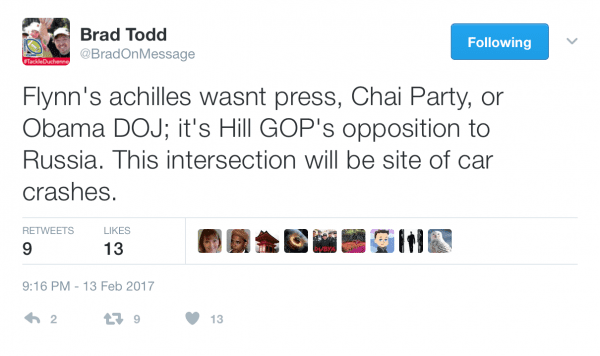
Russia isn’t the only busy intersection between the White House and Congress, either.

I NEVER THOUGHT THIS: Think Asia Will Dominate the 21st Century? Think Again.

Chinese economic statistics, never fully reliable, continue to be adjusted downward. Wages have risen sharply over the past decade; indeed, for several years, the minimum wage was growing at double digits—as high as 18 percent. The Chinese banking system remains opaque, and bank balance sheets are unreliable, as they continue to overstate the value of their assets, notably state-owned enterprises (SOEs). Moreover, obtaining financing in China often requires connections in Beijing, further undermining the efficiency of the banking system. Finally, local and provincial regulations often impede business growth, while corruption, particularly at those levels, remains rampant, despite President Xi Jinping’s ongoing efforts to clean house. Lastly, Auslin rightly identifies yet another scourge that China—and other Asian economies—suffer from: Mafia-like intimidation, or worse, of foreign investors. Not surprisingly, companies that are contemplating investment in East Asia are looking more and more at Vietnam, Malaysia or Indonesia, or even the Philippines, rather than risk shrinking margins in China.

The SOEs are an albatross around China’s economic neck, yet even the increasingly powerful Xi, recently crowned China’s “core leader,” has been unable to shut most of them down. The management, ownership and finances of many private businesses also are opaque. Often, businesses that are nominally private are actually owned by the government through a complex chain of holding companies. This is particularly the case with respect to firms in the high-tech and aerospace sectors.

The era of untrammeled Chinese economic growth appears to be over—and that development naturally does not account for whatever actions a new Trump administration will take to even the playing field of Chinese-American trade.

Almost 30 years ago, I found Joel Kotkin and Yoriko Kishimoto’s The Third Century to be a powerful corrective against then-dominant fears of Japan, Inc taking over the world. And I’ve kept it in mind these last 20 years while watching China’s rise. What Dov S. Zakheim has written here for The National Interest is almost a 21st Century companion piece to that book, and well worth your time.

ARRIVING IN STYLE: B-21 Nuclear Bomber Recommended as New Air Force One by US Consulting Firm.

WWK said the arguments in favor of the B-21 include unsurpassed survivability because of the plane’s stealth, and protection against conventional and electronic attacks because of its advanced electronic systems.

The firm feels the B-21 can better deal with sophisticated surface-to-air missiles (SAMs) that might one day become available to radical Islamic terrorists. The bottom line is the survivability of Air Force One trumps all other considerations, including comfort.

Aviation experts say WWK’s recommendations won’t fly in the face of realities of the ground, the chief of which is the B-21 is optimized as a stealth bomber designed to destroy people and not transport people. Having the B-21 become a people carrier will require extensive refitting that will add enormously to the plane’s overall cost.

It’s difficult to imagine any White House, Congress, or Pentagon staff ever taking this proposal seriously. But there would be a certain appeal to seeing a 21st Century stealth bomber done up in presidential blue and arriving at certain foreign capitals.

JAYVEE: Execution Leaflets Bring New ISIS Terror Fear to Pakistan.

The sheets feature the black flag of ISIS, alongside pictures of an execution and armed militants waving automatic rifles as they parade through streets, thought to be in Iraq or Syria.

It’s not clear who distributed the leaflets in the Kurram tribal area, and their origin cannot be independently verified by NBC News.

Pakistan’s government says ISIS has no real organizational presence in the country, and the papers may have been produced by lone sympathizers rather than the group’s more central elements.

However, American officials warned last year that ISIS is attempting to establish a foothold across the border with Afghanistan, and the group has claimed responsibility for several deadly attacks.

The leaflets’ appearance has worried recipients that the influence of the militant group is spreading into new areas.

I’m old enough to remember when Presidents complained that “I inherited this mess” before leaving an even bigger one for the next guy.

HMM: Brother Of North Korea’s Kim Jong Un Assassinated In Malaysia.

Who is behind the murder? As BBG adds, Kim has carried out a series of executions since taking power in 2011, the most high profile of which was the 2013 killing of his uncle and one-time deputy Jang Song Thaek. If Kim Jong Nam was killed by a North Korean spy, it indicates that Kim Jong Un felt a sense of paranoia about his own future and wanted to remove any potential successors, according to Namkoong Young, who has been teaching inter-Korean politics at Hankuk University of Foreign Studies for more than 25 years.

“Jong Nam has been in exile for years away from North’s politics for a long time but he is still the eldest son of Kim Jong Il,” Namkoong said. “And if there was any move or plan by some elite there to have him replace Jong Un, he probably should be removed.”

Of course, it is just as likely that a certain spy agency could have staged the murder, making it seem like it was preemptive retaliation by Un. For now there are no further details.

Kim Jong-un brooks no… well, he brooks nothing, really.

THE NEW SPACE RACE: First Chinese Cargo Spacecraft Launch Planned For April.

Citing sources in the China Manned Space Agency, a Xinhua report said the Tianzhou-1 cargo spacecraft arrived Monday at the Wenchang Space Launch Center in Hainan Province in south China. The first cargo vessel built independently by China, Tianzhou-1 consists of a capsule each for cargo and propellant, and can carry a payload of up to six tons.

Itself weighing about 13 tons at liftoff, it is designed to stay in space for up to three months at a stretch. It is also capable of docking with Tiangong-2, a space laboratory China launched mid-September 2015, which it can refuel as well.

It will be launched aboard a Long March 7-Y2 carrier rocket, which will arrive at the launch center some time in March, the space agency sources told Xinhua.

We could use the competition.