Author Archive: Stephen Green

AVIK ROY: House GOP’s Obamacare Replacement Will Make Coverage Unaffordable For Millions — Otherwise, It’s Great.

Unfortunately, the AHCA’s efforts at replacing Obamacare’s health insurance exchanges are problematic. A key limitation is that Republicans have decided to repeal and replace Obamacare on a party-line vote using the Senate’s reconciliation process. But reconciliation can only repeal Obamacare’s taxes and spending; it can’t replace most of the law’s premium-hiking insurance regulations.

The AHCA does make an effort to repeal Obamacare’s two costliest regulations: its requirement that plans charge similar premiums to the young and the old (age-based community rating); and its requirement that plans contain generous financial payouts (high actuarial value). So far, so good.

But the plan, due to the reconciliation process, appears to leave the vast majority of Obamacare’s regulations in place. The February 10 leaked draft contained language that would have returned control of essential health benefits to the states. That language appears to have been deleted.

Worse still, the bill contains an arbitrary “continuous coverage” provision, in which those who sign up for coverage outside of the normal open enrollment period would pay a 30 percent surcharge to the normal insurance premium. This surcharge is an arbitrary price control. While 30 percent represents an approximate average of the additional health risk of late enrollees, the 30 percent provision incentivizes those who face much higher costs to sign up, forcing insurers to cover them at a loss. This seems like a recipe for adverse selection death spirals.

The critical mistake of the AHCA is its insistence on flat, non-means-tested tax credits. The flat credit will price many poor and vulnerable people out of the health insurance market.

As I wrote last month, the AHCA creates a steep benefit cliff between those on Medicaid (subsidizing approximately $6,000 per patient per year), and those just above the poverty line who will get tax credits of about $3,000. People just below poverty will be strongly disincentivized to make more money, effectively trapping them in poverty.

You want to lose your majority? Because this is how you lose your majority.

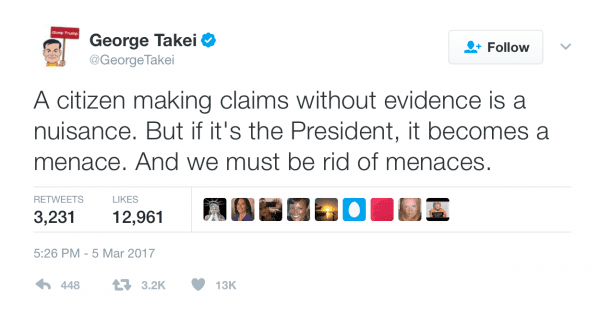
But here’s what Trump said this morning:

This is more cause for hope than Philip Klein’s take earlier today, but remain wary of Congress ever getting to Phase Two after they can safely claim to have “done something” about ObamaCare.
WIKILEAKS: U.S. Consulate in Frankfurt is a covert CIA hacker base.

Does Wikileaks expect us to be outraged that we have a forward intelligence base, using the time-honored tradition of diplomatic cover, located in the heart of troubled a Europe?

PHILIP KLEIN: Republican Obamacare plan signals that liberalism has already won.

I’ve already shared my skepticism that the bill, which doesn’t actually start repealing the major spending provisions of Obamacare until the 2020 presidential election, would actually end up repealing much in practice. But for the sake of argument, let’s just assume the plan gets implemented exactly as written.

Supporters of the bill could argue that it does make changes to Obamacare – repealing taxes, reducing spending, and scaling back some mandates and regulations. There are even a few areas in which one could argue the bill moves health policy in a more conservative direction relative to the pre-Obamacare status quo. It provides for expanded health savings accounts and, though it would spend more money than otherwise would have been the case before Obamacare, it would overhaul Medicaid into a program in which states are given a per capita grant and provided the flexibility to run their own programs.

But at the same time, the GOP bill preserves much of the regulatory structure of Obamacare; leaves the bias in favor of employer healthcare largely intact; replaces Obamacare’s subsidies with a different subsidy scheme; and still supports higher spending for Medicaid relative to what was the case before Obamacare.

What we have here is the GOP negotiating with itself over the terms of its surrender.

DEMOCRAT PROFESSOR INTIMIDATED BY LEFTWING MOB, BLAMES TRUMP. By Roger Kimball’s telling of the Middlebury Meltdown, Middlebury Professor Allison Stanger acted with all the courage one could possibly hope for during the violent protest. And this from Stanger’s Facebook account of what happened:

I want you to know what it feels like to look out at a sea of students yelling obscenities at other members of my beloved community. There were students and faculty who wanted to hear the exchange, but were unable to do so, either because of the screaming and chanting and chair-pounding in the room, or because their seats were occupied by those who refused to listen, and they were stranded outside the doors. I saw some of my faculty colleagues who had publicly acknowledged that they had not read anything Dr. Murray had written join the effort to shut down the lecture. All of this was deeply unsettling to me. What alarmed me most, however, was what I saw in student eyes from up on that stage. Those who wanted the event to take place made eye contact with me. Those intent on disrupting it steadfastly refused to do so. It was clear to me that they had effectively dehumanized me. They couldn’t look me in the eye, because if they had, they would have seen another human being. There is a lot to be angry about in America today, but nothing good ever comes from demonizing our brothers and sisters.

Things deteriorated from there as we went to another location in an attempt to salvage the event via live-stream for those who were still interested in engaging. I want you to know how hard it was for us to continue with fire alarms going off and enraged students and outside agitators banging on the windows. I thought they were going to break through, and I then wondered what would happen next. It is hard to think and listen in such an environment. I am proud that we somehow continued the conversation. Listen to the video and judge for yourself whether this was an event that should take place on a college campus.

When the event ended, and it was time to leave the building, I breathed a sigh of relief. We had made it. I was ready for dinner and conversation with faculty and students in a tranquil setting. What transpired instead felt like a scene from Homeland rather than an evening at an institution of higher learning. We confronted an angry mob as we tried to exit the building. Most of the hatred was focused on Dr. Murray, but when I took his right arm both to shield him from attack and to make sure we stayed together so I could reach the car too, that’s when the hatred turned on me. One thug grabbed me by the hair and another shoved me in a different direction. I noticed signs with expletives and my name on them. There was also an angry human on crutches, and I remember thinking to myself, “What are you doing? That’s so dangerous!” For those of you who marched in Washington the day after the inauguration, imagine being in a crowd like that, only being surrounded by hatred rather than love. I feared for my life.

The attack eventually sent Stanger to the E.R., where she ended up on painkillers and wearing a neck brace. She paid for her defense of free speech in a way few of us ever have to.

But then this, from the end of her report:

To people who wish to spin this story as one about what’s wrong with elite colleges and universities, you are mistaken. Please instead consider this as a metaphor for what is wrong with our country, and on that, Charles Murray and I would agree. This was the saddest day of my life. We have got to do better by those who feel and are marginalized. Our 230-year constitutional democracy depends on it, especially when our current President is blind to the evils he has unleashed.

The left attacks its own… because Trump.

HERE IT IS: House GOP Releases Plan to Repeal, Replace Obamacare.

The legislation would provide tax credits to people who don’t get coverage through their job, replacing the subsidies the ACA gave to a narrower set of lower-income people to help them afford insurance policies.

The proposal wouldn’t kill the ACA’s exchanges where people can obtain insurance, but far fewer people are expected to use them because the subsidies that reduce premium costs would no longer exist. Those subsidies are only available now to people who obtain coverage through the state and federal ACA exchanges.

The refundable tax credits have been a thorny issue for Republicans. Conservative Republicans vowed not to support an earlier draft that would have provided the tax credits regardless of income.

Under the House GOP proposal released Monday, the refundable tax credits would be tied to age, with people under 30 eligible for a credit of $2,000 per year, increasing steadily to $4,000 for those over 60. The size of a tax credit would grow with the size of a family, but would be capped at $14,000.

To assuage the concern among conservative lawmakers that the credits would be available to wealthy Americans, the tax credits would start to shrink for individuals making more than $75,000 or households making more than $150,000. For every $1,000 in income over $75,000, the tax credit would be reduced by $100.

What the legislation doesn’t appear to do is create a national market for health insurance, and instead keeps in place our current system of having 50 little state-based insurance fiefdoms — which limits risk pools and, more critically, competition between insurers.

Another complaint against ObamaCare is that it hugely increased the regulatory burden on doctors, clinics, and hospitals, but it’s impossible to tell from this story if the GOP legislation repeals any of that.

Rand Paul calls it “ObamaCare Lite” and says he won’t vote for it.

HEALTH: Why this Brazilian city uses tilapia fish skin to treat burn victims.

The three functional skin banks in Brazil can meet only 1 percent of the national demand, said Dr. Edmar Maciel, a plastic surgeon and burn specialist leading the clinical trials with tilapia skin.

As a result, public health patients in Brazil are normally bandaged with gauze and silver sulfadiazine cream.

“It’s a burn cream because there’s silver in it, so it prevents the burns from being infected,” said Dr. Jeanne Lee, interim burn director at the the regional burn center at the University of California at San Diego. “But it doesn’t help in terms of debriding a burn or necessarily helping it heal.”

The gauze-and-cream dressing must be changed every day, a painful process. In the burn unit at Fortaleza’s José Frota Institute, patients contort as their wounds are unwrapped and washed.

Enter the humble tilapia, a fish that’s widely farmed in Brazil and whose skin, until now, was considered trash. Unlike the gauze bandages, the sterilized tilapia skin goes on and stays on.

Finally, a reason not to hate tilapia.

MARK MECKLER: Senator Chuck Schumer says Jewish cemetery vandalized by anti-Semites, but the NYPD discovered who was really responsible.

Turns out, the Brooklyn cemetery that serves a large Jewish community wasn’t vandalized at all. After the NYPD hate crimes unit went out there to investigate — no doubt spurred on by the above social media posts — they discovered that these gravestones had not been turned over by hateful bigots. Instead, they were simply ignored for years… perhaps even decades.

That is actually really, really horrible. If loved ones place their family members in a cemetery, they do so with the expectation that the owners of the plots will not let that happen.

Neglect does seem somehow worse than vandalism.

NO LASER BEAMS? Marine Corps to Arm Osprey With New Weapons and build a new variant for the 2030s.

“Currently, NSWC (Naval Surface Warfare Center) Dahlgren explored the use of forward firing rockets, missiles, fixed guns, a chin mounted gun, and also looked at the use of a 30MM gun along with gravity drop rockets and guided bombs deployed from the back of the V-22. The study that is being conducted will help define the requirements and ultimately inform a Marine Corps decision with regards to armament of the MV-22B Osprey,” Marine Corps spokeswoman Capt. Sarah Burns told Scout Warrior in a written statement.

Adding weapons to the Opsrey would naturally allow the aircraft to better defend itself should it come under attack from small arms fire, missiles or surface rockets while conducting transport missions; in addition, precision fire will enable the Osprey to support amphibious operations with suppressive or offensive fire as Marines approach enemy territory.

Maybe the 2030s variant will finally get laser beams.