BRIDGET JOHNSON: Spending Deal Stipulates Border Security Funding Can’t Build Concrete Wall. “Ryan pitches plan personally at White House to secure Trump’s support as Schumer declares ‘at the end of the day we Democrats feel very good’.”
I bet.

BRIDGET JOHNSON: Spending Deal Stipulates Border Security Funding Can’t Build Concrete Wall. “Ryan pitches plan personally at White House to secure Trump’s support as Schumer declares ‘at the end of the day we Democrats feel very good’.”
I bet.
HEALTH: Passive Detection of Atrial Fibrillation Using a Commercially Available Smartwatch. “This proof-of-concept study found that smartwatch photoplethysmography coupled with a deep neural network can passively detect AF [atrial fibrillation] but with some loss of sensitivity and specificity against a criterion-standard ECG. Further studies will help identify the optimal role for smartwatch-guided rhythm assessment.”
BEN SHAPIRO: Stop Making Children Into Moral Authorities.
On March 14, high school students from Parkland, Florida, led a school walkout in favor of gun control. The media have already appointed student witnesses of the horror at Marjory Stoneman Douglas High School untouchable moral authorities; their opinions are not to be questioned.
But now, the left has found even more sympathetic faces for its agenda: kindergarteners. According to The Wall Street Journal, “Schools are grappling with how to address the event with children as young as 5 years old and with finding ways for children who are too little to be told about school shootings to take part.” Children in pre-K at Manhattan Country School will sing, “If I Had a Hammer” and “Paz y Libertad.” Public schools like PS 321 in Brooklyn allowed children to do activities linked with the protests.
There is something deeply perverse about using children to promote a political agenda.
Yes, but they don’t care.
HE’S SCARED: Zuckerberg Says He’s Open to Government Regulating Facebook. “‘I’m actually am not sure we shouldn’t be regulated,’ the Facebook CEO told CNN.”
GOOD LORD: Police shot at a man 20 times in his own yard, thinking he had a gun. It was an iPhone.
Video released by the Sacramento Police Department depicts a frantic foot pursuit through darkened streets pierced by white slivers of police flashlight.
The officers spot Clark approaching a house and shout: “Show me your hands! Stop! Stop!”
Clark is seen running, and the two officers round the corner of the house and find him under a covered patio.
An infrared camera on an overhead helicopter briefly loses sight of Clark at this moment.
“Show me your hands! Gun!” an officer shouts and ducks behind the wall in a fraction of a second.
The helicopter footage shows one of the officers appearing to grab his partner to pull him to cover.
Clark steps toward the officers. Behind the wall, one of the officers issues another command. “Show me your hands!” And then: “Gun, gun, gun!”
Both officers open fire. Sparks from the bullets light up the helicopter’s infrared camera in sharp white pops.
The sequence, from the first glimpse of Clark on the patio to the first gunshot, unfolds in about six seconds.
The officers are never heard identifying themselves as police before fatally shooting Clark.
What a mess.
LEAVING FACEBOOK — IT’S GONE VIRAL! Facebook Advertisers Start Pulling Out.
LIZ SHELD’S MORNING BRIEF: McCabe, Tariffs, Omnibus Hot Mess and Much, Much More. “”Sources tell ABC News that fired deputy ‘Andy’s office’ McCabe had opened a secret investigation against Attorney General Jeff Sessions.”
GET WOKE, GO BROKE: Survey Says Politicized Sports, Entertainment Driving Viewers Away.
DEPLATFORMED: Reddit announces new addition to site-wide rules regarding the use of Reddit to conduct transactions.
Hello All—
We want to let you know that we have made a new addition to our content policy forbidding transactions for certain goods and services. As of today, users may not use Reddit to solicit or facilitate any transaction or gift involving certain goods and services, including:
Firearms, ammunition, or explosives.
Good catch from “Sam” on Twitter who explains that “the subreddit r/GunDeals [was] merely posts and links to gun retail websites that are fully FFL compliant.”
SMART MOVE: Russia reportedly helped Venezuela launch its petro cryptocurrency to skirt US sanctions.
An executive at a Russian state bank told Time that senior advisers in the Kremlin oversaw the development of the petro and that Russian president Vladimir Putin signed off on the project in 2017. “People close to Putin, they told him this is how to avoid the sanctions,” the executive told Time. “This is how the whole thing started.”
Earlier this week, the Trump administration issued an executive order prohibiting US citizens from purchasing the petro, which Maduro hopes will raise $6 billion and help shore up the country’s failing economy. Venezuela’s currency, the bolívar, has suffered from hyperinflation as a result of government mismanagement and US sanctions. The US has also frozen assets of four current and former officials of the Venezuelan government.
Cryptocurrencies could be an effective form of skirting sanctions. Time reports that Russia floated the idea of creating a digital version of the ruble, but Russia’s central bank said it would risk destabilizing the ruble itself.
“So Russia made its stronghold here in Venezuela,” Armando Armas, an opposition member of Venezuela’s parliament, the National Assembly told Time. “Now they are using Venezuela as a guinea pig for their experiment.”
All that might be true, and yet still not the whole story. If I were Putin, I’d want to help keep Maduro in power for as long as possible by almost any means available. So long as Venezuela remains socialist, the Venezuelan oil industry will continue to underperform — which means higher prices and less competition for Russian oil.
BILL ROGGIO: US military will not pursue Taliban into Pakistan.
“We have no authority to go into Pakistan,” Pentagon spokesman Lieutenant Colonel Mike Andrews told Pajhwok Afghan News. US forces could ask for authority to chase Taliban fighters as they cross the border into Pakistan, but approval for such action “would certainly be the exception and not the norm,” he continued.
“Say, for example, we have troops in contact and then the Taliban forces go across the border,” Andrews told Pajhwok. “They are clearly inside Pakistan then. There’s no change with regards to respecting the territorial sovereignty of Pakistan.”
In the past the US military has defended its right to pursue Taliban forces retreating into Pakistan under its “inherent right of self defense.”
The US military has in rare cases pursued Taliban fighters as they crossed the border into Pakistan after battling US forces in Afghanistan. Pakistan has responded furiously to such incursions.
I wonder if there’s been a genuine policy change, or if we’re just keeping up appearances with Islamabad.
MARK ZUCKERBERG: “We have a responsibility to protect your data, and if we can’t then we don’t deserve to serve you.”
Here’s a timeline of the events:
In 2007, we launched the Facebook Platform with the vision that more apps should be social. Your calendar should be able to show your friends’ birthdays, your maps should show where your friends live, and your address book should show their pictures. To do this, we enabled people to log into apps and share who their friends were and some information about them.
In 2013, a Cambridge University researcher named Aleksandr Kogan created a personality quiz app. It was installed by around 300,000 people who shared their data as well as some of their friends’ data. Given the way our platform worked at the time this meant Kogan was able to access tens of millions of their friends’ data.
In 2014, to prevent abusive apps, we announced that we were changing the entire platform to dramatically limit the data apps could access. Most importantly, apps like Kogan’s could no longer ask for data about a person’s friends unless their friends had also authorized the app. We also required developers to get approval from us before they could request any sensitive data from people. These actions would prevent any app like Kogan’s from being able to access so much data today.
In 2015, we learned from journalists at The Guardian that Kogan had shared data from his app with Cambridge Analytica. It is against our policies for developers to share data without people’s consent, so we immediately banned Kogan’s app from our platform, and demanded that Kogan and Cambridge Analytica formally certify that they had deleted all improperly acquired data. They provided these certifications.
Whether or not you trust CA’s certification or Zuckerberg’s explanation, Stephen Miller notes a curious omission:
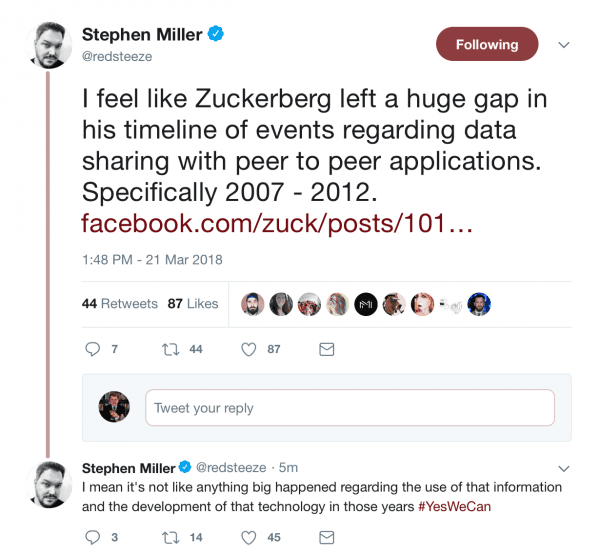
Indeed.
Update: Sorry — had attached the wrong tweet to this post. Fixed now.
ZIMBABWE REDUX: A White Farmer Is Killed Every Five Days in South Africa and Authorities Do Nothing About It, Activists Say.
If the numbers are accurate, then South Africa’s ethnic cleansing is just getting started — wait until the locals grasp just how much they can get away with.
In the meantime, I’m sure we can soon expect a few popular protest songs, along with calls for divestiture and sanctions on South Africa’s racist regime.
FASTER? PLEASE! Cadillac debuts CT6 V-Sport with new twin-turbo V8.
The CT6 is a good-looking sedan and has been earning some solid reviews since it debuted two years ago, even with the smaller V6 engines.
I just wish they’d give it a proper Cadillac name.
PRIVACY: How I went dark in Australia’s surveillance state for 2 years.
In 2015, during the transition from paper to Opal [contactless public transit cards], Australia passed sweeping new data retention laws. These laws required all Australian internet service providers and telecommunications carriers to retain customers’ phone and internet metadata for two years — details like the phone number a person calls, the timestamps on text messages or the cell tower a phone pings when it makes a call.
Suddenly, Australians were fighting for the right to stay anonymous in a digital world.
On one side of the fence: safety-conscious civilians. They argued that this metadata was a powerful tool and that the ability to track a person’s movements through phone pings or call times was vital for law enforcement.
On the other side of the fence: digital civil libertarians. They argued that the data retention scheme was invasive and that this metadata could be used to build up an incredibly detailed picture of someone’s life.
And sitting in a barn two paddocks away from that fence: me, switching out burner phones and researching VPNs.
When it emerged that police had the power to search Opal card data, track people’s movements and match this to individual users, it was the last straw. August 2016 rolled around, paperless tickets were phased out and I hatched my plan.
It’s a fascinating story.
IF IT MOVES, TAX IT: EU proposes online turnover tax for big tech firms.
Under the Commission’s plan, companies with significant digital revenues in Europe will pay a 3 percent tax on their turnover on various online services in the European Union, bringing in an estimated 5 billion euros ($6.1 billion).
EU Economics Commissioner Pierre Moscovici brushed off accusations that he was going after rich American tech companies to enrich EU coffers at a time when the bloc is at odds with the Trump administration over trade and taxation issues.
“This is neither a GAFA (Google, Apple, Facebook and Amazon) attack nor an anti-U.S. attack proposal that will target any company or any country,” he told a news conference.
The tax would apply to large firms with annual worldwide revenue above 750 million euros ($920 million) and annual “taxable” EU revenues above 50 million euros.
I was frankly surprised to read that there are enough EU leaders opposed to make approval uncertain.
MISS LIBERTY: Social Justice Mocked: Eight Short Films.
Seven more at the link.
ANTI-ANTI-SOCIAL MEDIA: WhatsApp Co-Founder Joins #DeleteFacebook Movement.
The #DeleteFacebook movement just gained a notable supporter: Brian Acton, co-founder of Facebook-owned WhatsApp.
Acton and fellow WhatsApp Co-Founder Jan Koum sold their messaging app to Facebook in 2014 for $16 billion, becoming very rich in the process. After leaving Facebook last year to start his own nonprofit, Acton is now speaking out against the social media behemoth in the wake of the Cambridge Analytica scandal.
“It is time. #deletefacebook,” Acton wrote on Twitter Tuesday. “Delete and forget. It’s time to care about privacy.”
Leaving Facebook — it’s gone viral!
BRIDGET JOHNSON: Bipartisan Effort Fails to Rein in U.S. Military Involvement in Yemen. “Senate tables War Powers Resolution as Trump meets with Saudi crown prince and touts sales of ‘the missiles and the planes and all of the military equipment’.”
InstaPundit is a participant in the Amazon Services LLC Associates Program, an affiliate advertising program designed to provide a means for sites to earn advertising fees by advertising and linking to Amazon.com.