
Author Archive: Stephen Green
December 12, 2018
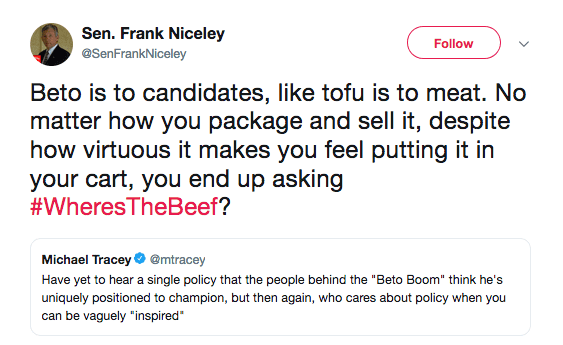
HE’S NO TED KENNEDY — BUT HE’S WORKING ON IT: Beto O’Rourke Overtakes Biden As Dem’s Top 2020 Candidate In New Poll. “You can be a failed Senate candidate with not much in the way of accomplishments except a bad rap for stealing land from the poor and trying to flee a drunk driving incident, and STILL be the number one choice for Democrats in 2020.”
UPDATE (FROM GLENN): Harsh but fair:
CYBERSECURITY: Sen. Warner Warns China, Russia are Accelerating Cyber, Disinformation Capabilities.
Sen. Mark Warner (D-Va.) said the General Accountability Office “found almost all our new weapons systems are vulnerable” to cyber attacks, he said in a Friday speech at the Center for a New American Security.
“If at the seams we don’t have protections, you have vulnerabilities,” he said. The GAO said even inside the Pentagon’s newest systems, ”DoD’s weapons are more computerized and networked than ever before, so it’s no surprise that there are more opportunities for attacks.”
Outside the Pentagon, the so-called internet-of-things is a growing vulnerability for all sectors of government, he added. Vulnerabilities are multiplying, Warner said, and there is no penalty for not closing gaps or failing to tighten security.
Always left out of these stories is whatever our own cyberoffensive capabilities might be.
THE NEW CHINA SYNDROME: Japan’s military sees record spending.
Japan’s military looks to raise spending over the next five years in response to security challenges and to narrow Japan’s trade surplus with the United States by buying U.S. equipment, the Nikkei business daily reported on Saturday.
The Ministry of Defense looks to spend at least 27 trillion yen ($240 billion) between April 2019 and March 2024, with the spending rising an average 1.1 percent per year, exceeding the 0.8 percent average during the five years ending next March, the report said without identifying its sources.
Currently, payments on equipment and personnel expenses account for 80 percent of defense spending, Nikkei said. Under the plan, funds for new equipment purchases will be separated from these expenses, making it easier to buy equipment from the United States, it added.
Japan aims to have cabinet approval for the spending in mid-December, it said. The Ministry of Defence could not be reached immediately for comment.
Purchases of American-made equipment could help Tokyo ease trade friction with Washington as U.S. President Donald Trump pushes Japan to buy more American goods, including military gear, while threatening to impose tariffs on Japanese auto imports to cut a trade deficit with Tokyo.
If Beijing would rein in Pyongyang and stop with the aggressive moves in the South China Sea, Japanese rearmament wouldn’t be an issue. But having stronger allies and more robust defense sales isn’t a bad second option.
CHAD FELIX GREENE: The Stigma Against My Conservative Politics Is Worse Than The Stigma Of Being Gay. “Everything I was told to fear about being openly gay has become a reality in being openly conservative.”
Today I look out across the turbulent sea of political discourse and ask, “Why would anyone choose to be a conservative?” To be a conservative means to openly invite others’ hatred into your life and to lose your humanity in the eyes of strangers who view you exclusively through stereotypes and prejudices.
To be a conservative means to be forced to choose when to speak and when to remain silent, since offending someone on the left, even mildly or by accident, is a social battle you may not be able to win. To be a conservative means carefully regulating your speech and constructing opinions in such a way as to avoid being banned from the public square. To be a conservative means to be a marginalized voice, suppressed and dehumanized; bullied into hesitating to speak out.
You might not be interested in the Gleichschaltung, but the Gleichschaltung is interested in you — and conservatives are by and large uninterested in the Gleichschaltung.
ROBERT SPENCER: Huffington Post Enraged: UN Pick Heather Nauert Has ‘Relationship’ With Me? “HuffPo offers its usual distortions and hysteria against a Trump nominee.”
December 11, 2018
VIDEO: Google CEO Squirms as Jim Jordan Grills Him Over 2016 Latino Turnout Efforts. “Did Google push the Latino vote in Florida and Nevada to help Hillary Clinton?”
BREAKING: Fatal Shooting Near Christmas Market in Strasbourg, Suspect on the Run.
UPDATE (From Ed): As always with shooting incidents, early reports can be chaotic and contradictory. However, Andrew Neil of the London Spectator tweets that “This is becoming a scandal. French media reporting gunman escaped this morning from a search carried out at his home in the district of Neudorf south of Strasbourg by gendarmes. Grenades were found on site by the gendarmes.”
The London Telegraph is currently reporting that “at least four people” have been killed, and that the gunman is still at large. “The authorities are treating the attack as a terrorist act. Anti-terrorist prosecutors have opened an investigation.”
LATE UPDATE (From Ed): The Telegraph have since stealth edited their article, and currently state that “A suspected terrorist is on the run after killing at least three people and injuring 11 more in the eastern French city of Strasbourg near its Christmas market.”
(Bumped.)
A MINOR FISKING: Little Caracas on the Prairie.
NEWS I HOPE YOU CAN’T USE: The 21 biggest data breaches of 2018.
SUSTAINABILITY: Budget deficit soars in first two months of fiscal year.
The country’s budget deficit in the first two months of fiscal 2019, which began Oct. 1, was 50 percent higher than in the same period the previous year, according to the Congressional Budget Office (CBO), though the figure was inflated by timing.
In October and November, the federal government spent $303 billion more than it took in, compared to $202 billion in the same period of fiscal 2018, according to the CBO.
Tax revenues were just 3 percentage points higher than the previous year, largely because of the GOP tax law, while spending surged 18 percent.
Revenues, in other words, still grew faster than inflation — but spending grew six times fast than even that.
We have a spending problem, not a revenue problem.
NICHOLAS BALLASY: Rolling Stones’ Chuck Leavell Says Longer Summers in South Prove Climate Change Is ‘Undeniable.’
Science!
UPDATE (From Ed): Get back to me when Leavell convinces Mick and Keith to stop touring with 130 trucks for their stage, lights, amps, speakers, instruments, and equipment, and a private Boeing 767.
RICH LOWRY: May’s Brexit is becoming increasingly haphazard and provisional.
May has just pulled her Brexit deal from a parliamentary vote that she was going to lose in an embarrassing drubbing that might have loosed her increasingly precarious grip on power.
She has negotiated abysmally, giving away leverage right at the start when she prematurely invoked Article 50, beginning the process of Britain’s departure with no realistic fallback plan if talks with the EU failed. She ended up with an agreement that would effectively leave Britain within most EU rules, with no means of influencing them anymore. The London Spectator calls the deal “Remain-minus.”
There’s a reason that resignations of her Brexit negotiators have become a semiregular event.
Now, humiliated and her credibility in shreds, May says that she is going to go back to the EU to get more reassurances, when the EU has said that it is not conceding anything else of consequence. And why should it? There’s no guarantee that May can get any tweaked deal through Parliament, regardless.
And she’s already tried to sell so many meaningless gestures from the EU as concessions that Brexit supporters won’t be inclined to take her seriously, either.
The larger question is whether once the EU has its hooks in a nation-state, will it ever relinquish it?
Not willingly, no.
THE DARK NIGHT OF FASCISM IS ALWAYS DESCENDING IN THE UNITED STATES AND YET LANDS ONLY IN EUROPE: Anti-Semitism in EU worse over past 5 years. “Almost a third of European Jews avoid attending events or visiting Jewish sites because they do not feel safe.”
Europe has imported an awful lot of anti-Semites in recent years, and yet the words “Muslim” and “migrant” or “immigrant” are missing from Florian Eder’s Politico report.
FINANCIAL TIMES: Protests Show Leading France Is an Impossible Job.
As Glenn has noted before, big government types only complain that this or that country has become “ungovernable” when the people resist big government schemes the people never wanted.
YOU’RE GONNA NEED A BIGGER BLOG: 4 Reasons Deplatforming Controversial Figures Is a Terrible Idea.
MORE LIKE CUBA EVERY DAY: Russia sends 2 nuclear-capable bombers to Venezuela.
PRIVACY: Australia passes new law to thwart strong encryption.
The new law, which has been pushed for since at least 2017, requires that companies provide a way to get at encrypted communications and data via a warrant process. It also imposes fines of up to A$10 million for companies that do not comply and A$50,000 for individuals who do not comply. In short, the law thwarts (or at least tries to thwart) strong encryption.
Companies who receive one of these warrants have the option of either complying with the government or waiting for a court order. However, by default, the orders are secret, so companies would not be able to tell the public that they had received one.
“It’s a big deal,” Adam Molnar, a lecturer in criminology at Deakin University in Australia, told Ars.
However, the law as currently written seems to contain what some view as a loophole. The statute says that companies cannot be compelled to introduce a “systemic weakness” or a “systemic vulnerability” into their software or hardware to satisfy government demands.
In other words, the new law is just as confused as the notion of having a “safe” backdoor past encryption.
LIZ SHELD’S MORNING BRIEF: Google on the Hill Today and Much, Much More. “It’s time for these tech companies to be treated like a utility or a publishing venue since they are making decisions and curating their content, picking and choosing who can use their services. You don’t see the power company debating whether or not to provide electricity to the Breitbart offices or other perceived political adversaries do you?”
CHANGE MORE OF THE SAME: Brexit in turmoil as May pulls vote to seek changes to EU divorce. “British Prime Minister Theresa May on Monday postponed a parliamentary vote on her Brexit deal to seek more concessions but the European Union refused to renegotiate and lawmakers doubted her chances of winning big changes.”
YESTERDAY: European Court of Justice rules UK can unilaterally revoke Article 50 and halt Brexit.
Glenn called it “shenanigans,” but the EU is playing hardball. On the one hand they’re making it impossible for May to get a deal she can sell to Parliament, and on the other they’re giving her an easy way to kill Brexit. I think they’re afraid for the world to see how fragile the EU really is.
NO. NEXT QUESTION? Does the US want a war with Iran over Syria?
MERCY, MERCI: To quell unrest, France’s Macron speeds up tax cuts but vows no U-turn.
In his first national address following two weekends of France’s worst unrest for years, Macron sought to restore calm and struck a humble tone after accusations that his governing style and economic policies were fracturing the country.
But he refused to reinstate a wealth tax and to back down on his reform agenda, which he said would proceed in 2019 with overhauls of pensions, unemployment benefits and public expenditures.
“We will respond to the economic and social urgency with strong measures, by cutting taxes more rapidly, by keeping our spending under control, but not with U-turns,” Macron said in the 13-minute TV address from the Elysee Palace.
Getting no relief is the French middle class, which will have to continue paying for Macron’s schemes and these new benefits.