
“ENOUGH IS ENOUGH”: Keystone Rebellion. Six counties in Pennsylvania rebel against the governor’s lockdown policies.
Author Archive: John Tierney
May 13, 2020
RED TAPE AND LAWYERS: Covid-19: Regulatory Obstacles to U.S. Recovery. How the FDA prevented Covid victims from making vital health measurements on their smartphones, and how to stop legal vultures from feasting off the pandemic.
May 12, 2020
NOBODY KNOWS ANYTHING: “Social Distancing” Is Snake Oil, Not Science. There was never good evidence to support its efficacy.
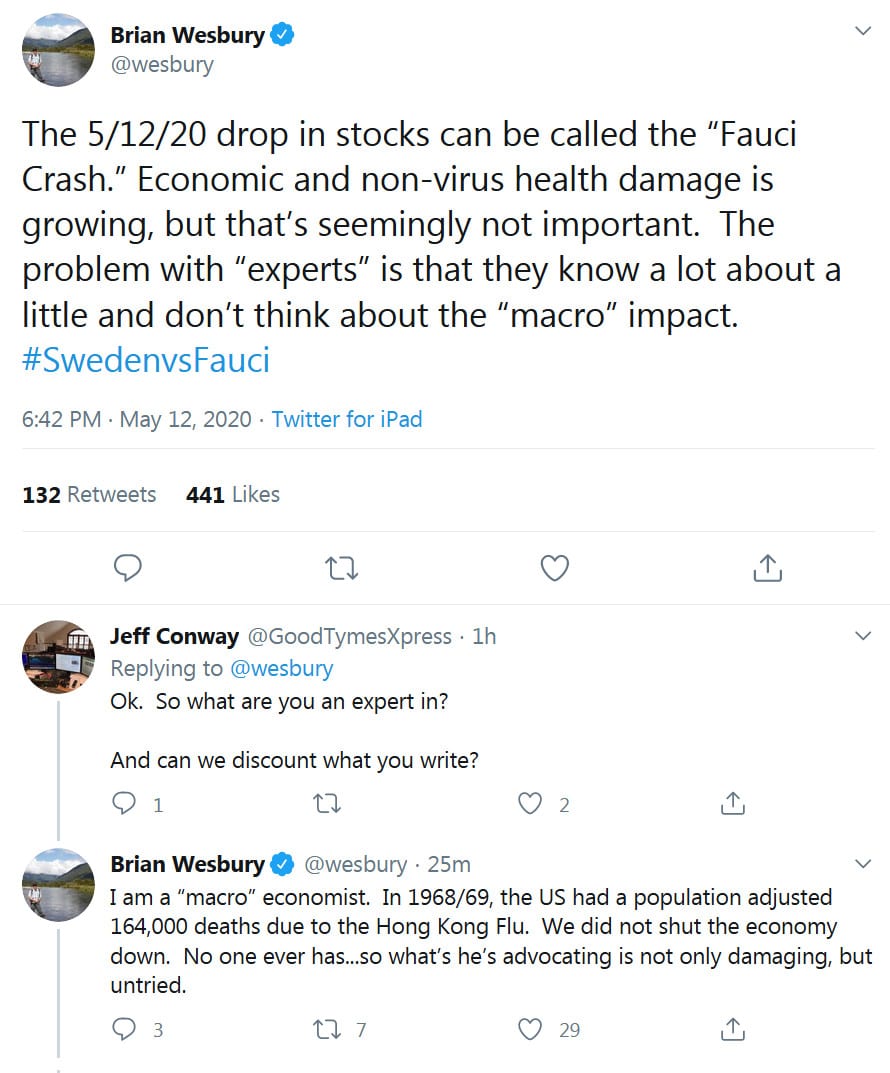
UPDATE (FROM GLENN): One of the things I find most annoying about Dr. Fauci is his scientific version of Jon Stewart’s clown-nose-on-clown-nose-off routine. Sometimes he demands double-blind studies, other times — as with lockdowns and social distancing — he goes with his gut. It’s not that that’s necessarily wrong, but he’s very shifty in not explaining why he’s changing his standards.
Earlier: Woodstock Occurred in the Middle of a Pandemic.
(Updated and bumped.)
WHY WE FOOLISHLY BELIEVED THE COVID MODELERS: A Scheme of Heaven: The History of Astrology and the Search for Our Destiny in Data. In the Middle Ages, the physicians of Paris “forecast” the ebb and flow of the Black Death using the conjunctions of Jupiter, Saturn, and Mars. The way we’re seduced by complex mathematical models today isn’t all that different from how we were seduced by astrology for millennia, as the physicist and data scientist Alexander Boxer explains in his entertaining history of this obsession.
Astrology was the ancient world’s most ambitious applied mathematics problem, a grand data-analysis enterprise sustained for centuries by some of history’s most brilliant minds, from Ptolemy to al-Kindi to Kepler. Just consider that for much of the last two thousand years, the word “mathematician” (mathematicus) simply meant an astrologer; there was no distinction. . . . Astrologers were the quants and data scientists of their day, and those of us who are enthusiastic about the promise of numerical data to unlock the secrets of ourselves and our world would do well simply to acknowledge that others have come this way before.
And learn from their mistakes as we look for an escape from lockdown.
THE SEEN AND THE UNSEEN: Economic Well-Being Matters, Too. The poorest counties are suffering the most from lockdowns.
DECAY ON THE BAY: I Left My Home in San Francisco. The exodus from a beautiful city going to seed.
May 11, 2020
MATT RIDLEY: We know everything–and nothing–about Covid. The lockdowns were imposed in a state of ignorance. It now looks as if many of the early cases were caught in hospitals and doctors’ offices and nursing homes.
If Covid-19 is at least partly a ‘nosocomial’ (hospital-acquired) disease, then the pandemic might burn itself out quicker than expected. The death rate here [in the U.K.] peaked on 8 April, just two weeks after lockdown began, which is surprisingly early given that it is usually at least four weeks after infection that people die if they die. But it makes sense if this was the fading of the initial, hospital–acquired wave. If you look at the per capita numbers for different countries in Europe, they all show a dampening of the rate of growth earlier than you would expect from the lockdowns.
So if it wasn’t the lockdowns that slowed infection . . . .
It is possible that washing your hands, not shaking hands with others, not gathering in large crowds, and wearing a face mask in public, but no more than this, might have been enough, as Sweden seems to suggest. Forcibly shutting schools and shops and aggressively policing sunbathers in parks may have added little in terms of reducing the rate of spread.
But it did give politicians a chance to order everyone around, so there’s that.
LOCAL MILITIAS ARE BETTER THAN A D-DAY STRATEGY: Herd Immunity Is Misleading. We should aim for augmented immunity instead — and fight a guerilla war against Covid-19 instead of a centrally commanded confrontation.
THIS WOULD BE VERY GOOD NEWS: Have Stockholm and Other Places Already Reached Herd Immunity? Nicholas Lewis argues that the Covid modelers’ doomsday predictions were off because they wrongly assumed that the “herd immunity threshold” is 50 to 60 percent of the population, whereas there is reason to believe that it’s actually much lower and has already been reached in Stockholm and probably in some other places. This paper and other encouraging developments — like the downward trend for infections in Germany despite the easing of the lockdown — are discussed in Toby Young’s daily roundup at Lockdown Skeptics.
WHERE A LOCKDOWN MAKES SENSE: The Real Center of the Pandemic. How to protect people in nursing homes from Covid-19 (and how it wasn’t done in New York and other states).
May 10, 2020
NO, BLUE STATES DON’T DESERVE EXTRA AID: Givers and Takers. Democratic governors’ arguments that their states are “donors” doesn’t hold water.
FAKE HISTORY: Ms. Judging Mrs. America. A compelling new series on Phyllis Schlafly’s battles against leading feminists makes some legitimate criticisms—while also distorting facts and indulging in plenty of blue-state condescension.
GET WOKE, GET SICK: The Glory–and Risk–of Cities. From the beginning, urban density has yielded opportunity while also posing the danger of contagion. “Sewer socialists” and other leftists used to focus on public hygiene, but today’s urban progressives tolerate homeless encampments that are breeding grounds for diseases more dangerous than coronavirus.
May 8, 2020
NO, ONE LIFE IS NOT “PRICELESS”: Andrew Cuomo’s Morally Grotesque Rationale for Maintaining Covid-19 Lockdowns. Even the president is a better moral philosopher than New York’s governor.
KC JOHNSON: When Rules Don’t Apply. Joe Biden wants to deny accused college students the procedural protections that he demands for himself.
NO THANKS TO THE NET-NEUTRALITY NITWITS: The Pandemic That Didn’t Break the Internet. Market-friendly policies let Americans stream to their hearts’ content, while regulation-heavy Europe has been forced to impose speed limits on streaming services due to high demand during the pandemic.
May 7, 2020
YES, THERE REALLY ARE SOME: Reasons to be Cheerful. On Freakonomics Radio, Stephen Dubner discusses how to deal with the negativity bias in our news and in our brains. He interviews David Byrne of Talking Heads fame about Byrne’s good-news magazine and talks to a researcher who has developed software for filtering out depressing stories. And he chats with Roy Baumeister and me about our book, The Power of Bad: How the Negativity Effect Rules Us and How We Can Rule It. Bonus feature: I confess how I learned to create fake bad news early in my journalistic career.
DOUBLING DOWN ON HIS DOUBLE STANDARD: Biden Vows to Destroy Campus Due Process Again If Elected. He shamelessly continues promoting injustice for men accused of sexual assault — except himself, of course. That’s different.
HELEN FISHER: How Coronavirus Is Changing the Dating Game for the Better. With video chats, you don’t have to fret about who picks up the check. And maybe the biggest plus: You’re forced to take things slow.
MESSING WITH THE MARKET: At What Price? The federal government’s monetary remedies for the pandemic could produce a combination of inflation and deflation.
May 6, 2020
IRRATIONAL EXUBERANCE: What Do We Clap for When We Clap for Government? I like joining my Bronx neighbors in the nightly tribute to health-care workers, but I worry about our fondness for “encompassment,” as the economist Daniel Klein terms our yearning for emotional communion with everyone around us. As Hayek warned, it’s this emotional inheritance from our hunter-gatherer ancestors that leads to blather about “social justice” and enthusiam for political collectivism. This primal impulse for solidarity explains why socialism’s appeal endures despite its colossal failures — and why Americans have cheered the unprecedented expansion of government power during the pandemic.
May 5, 2020
A PANDEMIC IS NO TIME TO FOCUS ON SCIENCE: Should Identity Politics Dictate Vaccine Research? Even amid a pandemic, federal science agencies continue to fund anti-scientific diversity initiatives. Besides subsidizing the usual suspects, NIH now wants more scientists who have been homeless.
SAVING OUR BACON: America’s Indispensable Industry. How to keep meatpacking plants open and the food supply chain moving.
PRIVATE V. PUBLIC HEALTH CARE: A Tale of Two Countries. Northern Italy could learn from Switzerland’s Covid-19 experience.
May 1, 2020
THE RATCHET RACKET: Past Crises Have Ratcheted Up Leviathan. The Covid-19 Pandemic Will Too. A too-timely warning from the economists Robert Higgs (author of the classic Crisis and Leviathan) and Donald Boudreaux (proprietor of Cafe Hayek).