
Author Archive: Glenn Reynolds
January 3, 2020
REVIEW: Beretta APX Carry. Made in Tennessee!
VITAMIN D DEFICIENCY AND CHRONIC HEADACHES.
NEWS YOU CAN USE: Why caffeine may limit weight gain. Is there anything it can’t do?
JOE PAPPALARDO: The SpaceX Decade: How One Company Changed Spaceflight Forever.
HEADLINES FROM 1750: Brain response to pleasure, pain may inform new mental health treatments.
CONGRATS TO MY COLLEAGUE MAURICE STUCKE, whose book Competition Overdose (written with Oxford’s Ariel Ezrachi) made a list of must-read business books from Inc. magazine.
DON SURBER: Liberals Mourn Death of Iranian General. “My how things have changed in just a few days. Democrats were gleeful on New Year’s Even when Iranians had attacked our embassy in Baghdad. They labelled it President Donald John Trump’s Benghazi. . . . What did killing the general in charge of Iran’s terrorism network escalate? Is Iran going to call for death to America — as it has for 40 years? Will it attack our embassy in Iraq again?”
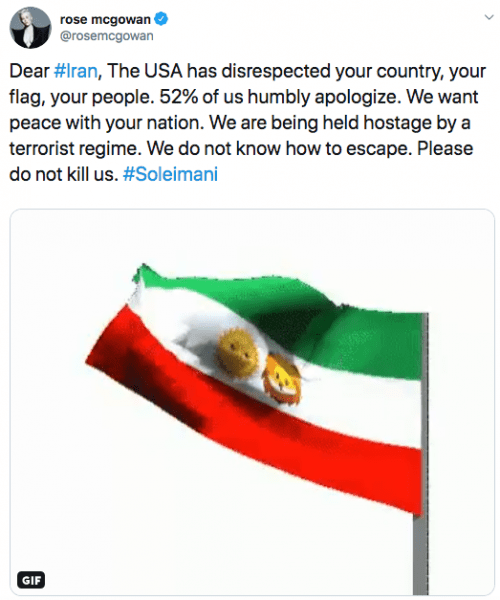
SO LET’S STIPULATE THAT THE DEMOCRATS’ ROSE-MCGOWAN-LIKE REACTION IS STUPID AND ANTI-AMERICAN. That doesn’t mean that there are no possible valid critiques of bombing Soleimani. But honestly, I can’t think of any. Here are the main candidates:
1. It will provoke Iran. Well, maybe. But Iran has been at war with us for 40 years; we’ve mostly chosen to pretend otherwise. Iran’s top priority is wrecking our presence in the mideast, and then eventually destroying America. This doesn’t change that. At most it might make them spring an operation earlier than they had planned, which is as likely to do them harm as it is to do anything.
2. It increases the risk of war. We’re already at war, see above. If anything, it makes Iran look weak, which hurts them in the region and gives domestic rebels heart and momentum. (See: ‘Overthrow is within reach’: Leader of Iranian resistance group hails death of Qassem Soleimani.)
3. It was illegal because there was no congressional authorization. Pretty hard to take that argument seriously in 2019, but at any rate Soleimani orchestrated an attack on the U.S. Embassy in Iraq, which is for these purposes an attack on American soil. (Even the governor of a state is allowed by the Constitution to wage war without Congressional authorization when actually attacked.) Besides which, we have a Congressional authorization for use of military force in Iraq, and this is covered by its exceedingly broad terms. Also, it’s reported that he had a large anti-American operation in the works.
4. We can’t know the ramifications. That’s true. But that’s also true of not acting. Unintended consequences rule in the sphere of government action, but you can’t base your policy choices on not having any.
5. Orange Man Bad. To be honest, this seems to be the real objection. It’s a stupid one.
Related: Trump’s Ground Game Against Iran.
Building up on this successful experience, Mr. Suleimani spent the last decade replicating the Hezbollah model in Iraq, Syria and Yemen, propping up local militias with precision weapons and tactical know-how. In Syria, his forces have allied with Russia to prop up the regime of Bashar al-Assad, a project that, in practice, has meant driving over 10 million people from their homes and killing well over half a million. In Iraq, as we have seen in recent days, Mr. Suleimani’s militias ride roughshod over the legitimate state institutions. They rose to power, of course, after participating in an insurgency, of which he was the architect, against American and coalition forces. Hundreds of American soldiers lost their lives to the weapons that the Qods Force provided to its Iraqi proxies.
Mr. Suleimani built this empire of militias while betting that America would steer clear of an outright confrontation. This gambit certainly paid off under President Barack Obama, but it even seemed to be a safe bet under President Trump, despite his stated policy of “maximum pressure.” Mr. Trump was putting an economic squeeze on Iran, and popular protests in Iran, Iraq and Lebanon were adding to the pressure, but Mr. Suleimani assumed that, in the end, control of military assets would win the day. Mr. Trump, it seemed, feared getting sucked into a war. Washington, in short, lacked a ground game.
In September, Mr. Suleimani and his colleagues reportedly pressed their advantage by attacking a Saudi Arabian oil field, an act of war that went unanswered. He followed this up by orchestrating attacks by Iranian proxies on Americans. The Trump administration had said clearly that attacking Americans was a red line, but Mr. Suleimani had heard threats in the past from American leaders. He thought he could erase Mr. Trump’s red line.
His departure will make Iran much weaker. It will embolden the country’s regional rivals —primarily Israel and Saudi Arabia— to pursue their strategic interests more resolutely. It will also instill in the protesters in Iran, Lebanon and, especially, Iraq, the hope that they will one day wrest control of their governments from the talons of the Islamic Republic.
In Washington, the decision to kill Mr. Suleimani represents the final demise of Mr. Obama’s Middle East strategy, which sought to realign American interests with those of Iran. Mr. Obama’s search for a modus vivendi with Tehran never comported with the reality of the Islamic Republic’s fundamental character and regional ambitions. President Trump, by contrast, realized that Tehran’s goal was to replace America as the key player in the Middle East.
One mild caveat: The Bush Administration in 2005 seemed to suddenly go soft on Iran. I speculated at the time that Iran was somehow deterring them, but with no obvious mechanism for that wondered about things like bioweapons. Whatever, they don’t seem to have deterred Trump in the same fashion.
UPDATE: Some thoughts on the subject from Spengler.
Without attempting to read the minds of Iran’s leaders, one may conjecture that Iran badly needed a moral victory to show that it was not cowed by massive Israeli airstrikes in Syria, nor, indeed, by a deteriorating economy at home. In November, the Iranian regime ruthlessly suppressed anti-regime protests, killing up to 1,000 demonstrators. After the US struck five bases of Iran-backed militias in Iraq on Dec. 30, Iran decided that its credibility required a demonstration of power, and ordered the attack on the US embassy.
That left Trump with few good choices. After 5,000 dead, 50,000 wounded and trillions of dollars in expenditures in Iraq, the US had succeeded in turning a former counterweight to Iranian ambitions into an Iranian satrapy. The embassy attack was intended by Iran as a public act of ritual humiliation, and the United States had no choice but to respond. Trump chose to respond by subjecting Iran to an even more poignant form of humiliation, by assassinating a national hero, Gen. Qassam Sulemaini. It is easy to criticize the US president, but harder to recommend an alternative course of action. US airpower has limited effectiveness in constraining the diffuse Iranian-backed militias.
Neither Iran nor the US has good choices here. Iran must respond or its credibility will collapse. The question is how. An Iranian attack on an American ally like Israel or Saudi Arabia would not suffice, now that Washington has acted in its own name against a key Iranian leader. The indicated course of action is to attack an American asset. In the extreme case, Iran could use a combination of intermediate-range missiles, cruise missiles and drones to attack the Doha base.
Iran’s problem is that it has the most to lose here, and it’s weak. That suggests that they will do something symbolic but essentially back down, rather than escalate and invite still further escalation in return. But that assumes they will act rationally, which in fact they usually do, but usually isn’t always. And read Spengler’s entire piece.
And lurking behind all of this is a new reality that the Iranians may not have fully absorbed: Thanks to fracking, the United States doesn’t have to keep the straits of Hormuz open anymore. We only have to be able to keep them closed.
HIGHER EDUCATION BUBBLE UPDATE: Appeals court orders Arizona State to reinstate male student expelled for having a threesome.
According to James Rund, ASU senior vice president for educational outreach and student services, a rational woman would not consent to a threesome. You’re a sad little weenie, James, but just because a rational woman wouldn’t consent to a threesome involving you . . . . Or even a twosome, methinks.
IT’S MARQUETTE AGAIN, BECAUSE OF COURSE: Prof threatens to dock students grade for not using ‘gender inclusive’ language.
Cost of Attending Marquette University for one year: $58,057.
FAIL: Democrats Rethink Bail Reform After Hate Crime Spike. “The change eliminates cash bail for those accused of committing a litany of misdemeanors and felonies, including many nonviolent hate crimes.”
WELL, NOT LITERALLY, AT LEAST NOT YET: Virginia governor’s call for 18-person gun ban force comes under fire. But I gotta say, the Northam regime is acting in what seems to be a deliberately provocative fashion. If Bush had acted this way in Iraq, they’d have called cowboy-style bullying of a native population.
MATTHEW CONTINETTI: Trump Calls the Ayatollah’s Bluff: And scores a victory against terrorism.
UPDATE: John Ringo emails:
People keep missing something important about the airstrikes that ‘killed 25 militants’.
The militants were collateral damage. The target was multiple ‘hidden’ missile magazines for rather expensive Iranian SCUDs threatening Israel.
The strike cost the Iranians a shit ton of hard currency. It also pointed out we know where they hide stuff and can take out the “threat” at leisure.
And trying to storm the (fortress) embassy in Iraq was the best they could do.
Yeah, my lefty friends on Facebook seem to think this is Trump wagging the dog because his back is to the wall over impeachment, and that it will provoke Iran to suddenly not like us. In fact this is Trump demonstrating that impeachment is irrelevant, and that Iran, which has always hated us, is weak now.
FLASHBACK: Obama Strikes a Deal–With Qassem Suleimani. “Obama likes Suleimani, and admires his work. As the president reportedly told a group of Arab officials in May, the Arabs ‘need to learn from Iran’s example.'”
THE MENTALLY ILL ON TWITTER:
HONESTLY, IT SEEMS LIKE WHATSAPP DID THE RIGHT THING HERE. NOBODY TOLD THEM THIS WAS A LEGIT SPYING OPERATION. Police Tracked a Terror Suspect—Until His Phone Went Dark After a Facebook Warning.
A team of European law-enforcement officials was hot on the trail of a potential terror plot in October, fearing an attack during Christmas season, when their keyhole into a suspect’s phone went dark.
WhatsApp, Facebook Inc. ’s popular messaging tool, had just notified about 1,400 users—among them the suspected terrorist—that their phones had been hacked by an “advanced cyber actor.” An elite surveillance team was using spyware from NSO Group, an Israeli company, to track the suspect, according to a law-enforcement official overseeing the investigation.
A judge in the Western European country had authorized investigators to deploy all means available to get into the suspect’s phone, for which the team used its government’s existing contract with NSO. The country’s use of NSO’s spyware wasn’t known to Facebook. NSO licenses its spyware to government clients, who use it to hack targets.
On Oct. 29, Facebook filed suit against NSO—which has been enmeshed in controversy after governments used its technology to spy on dissidents—in federal court in California, seeking unspecified financial penalties over NSO’s alleged hacking of WhatsApp software. It also sought an injunction prohibiting NSO from accessing Facebook and WhatsApp’s computer systems.
NSO said it is vigorously defending itself against the lawsuit, without elaborating.
Technology companies such as Facebook and Apple Inc. over recent years have strengthened the security of their systems to the point where even the tech companies themselves can’t provide law-enforcement agencies with messages created on their own systems.
Private companies, meanwhile, have stepped in to fill the gap by devising new ways of extracting data from computers and mobile devices. Facebook said in the lawsuit that spyware was installed by hacking WhatsApp’s video-calling function.
The thwarted terror investigation, as described by the law-enforcement official, spotlights an increasingly common clash of concerns over public security and personal privacy.
Governments want encryption backdoors, but nobody can trust them to use those honestly, or to keep them from being exploited by bad actors. Governments can’t even protect their own networks and data.
WHAT IS BEST IN LIFE, BRETT?
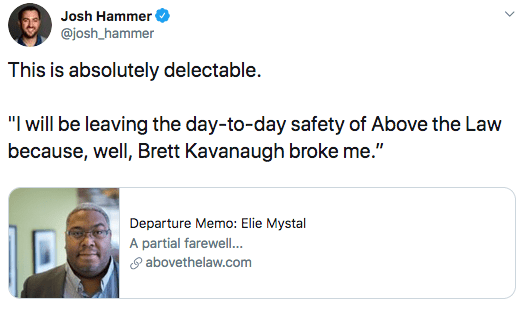
NeverTrumpers are a fringe whose only significance is that they serve as useful idiots for the left and the media.
KC JOHNSON: Cuomo and the Lack of Fairness in New York Title IX Stats. Before it’s over, Andrew Cuomo will be extolling the importance of due process, and its hallowed place in the Constitution — at least as it applies to him.
TO BE FAIR, THAT’S LITERALLY ITS REASON FOR EXISTENCE: How social justice is destroying objectivity, excellence, due process, science — and much more.
JOHN KLEIN: The Creation of a U.S. Space Force: It’s Only the End of the Beginning.
The U.S. Space Force will need to develop a service ethos and distinct operational styles of warfare more suited for considering conflict within the space domain. . . .
Creating a Space Force is a dramatic step for addressing great-power competition in space. But while Space Force discussions commonly focus on the need to address today’s emerging global and counter-space threats, the true value of the Space Force will come later, as the understanding of space’s character and development of distinct culture and operational style unleash the full promise of military innovation.
Future Space Force strategists will need to acknowledge that space warfare has a character differing from conflict on land, at sea, or in the air.
At a high level, the essentials will remain the same, but yes.
January 2, 2020
TRUMP WORKS HIS MAGIC: Congressional Democrats Denounce Killing of Soleimani: Trump is Bringing U.S. to ‘Brink of an Illegal War.’ They didn’t care when Obama droned American teenagers, but this, this, is beyond the pale because reasons.
WELL, GOOD:
