
NEWS I HOPE YOU CAN’T USE: 6 things to know if you’re living with someone who has coronavirus, or think you might be.
Author Archive: Glenn Reynolds
March 24, 2020
A POINT THAT SHOULDN’T HAVE TO BE MADE, BUT YES:
TREATMENTS: These Drugs Are Helping Our Coronavirus Patients:
A flash of potential good news from the front lines of the coronavirus pandemic: A treatment is showing promise. Doctors in France, South Korea and the U.S. are using an antimalarial drug known as hydroxychloroquine with success. We are physicians treating patients with Covid-19, and the therapy appears to be making a difference. It isn’t a silver bullet, but if deployed quickly and strategically the drug could potentially help bend the pandemic’s “hockey stick” curve.
Hydroxychloroquine is a common generic drug used to treat lupus, arthritis and malaria. The medication, whose brand name is Plaquenil, is relatively safe, with the main side effect being stomach irritation, though it can cause echocardiogram and vision changes. In 2005, a Centers for Disease Control and Prevention study showed that chloroquine, an analogue, could block a virus from penetrating a cell if administered before exposure. If tissue had already been infected, the drug inhibited the virus.
On March 9 a team of researchers in China published results showing hydroxychloroquine was effective against the 2019 coronavirus in a test tube. The authors suggested a five-day, 12-pill treatment for Covid-19: two 200-milligram tablets twice a day on the first day followed by one tablet twice a day for four more days.
A more recent French study used the drug in combination with azithromycin. Most Americans know azithromycin as the brand name Zithromax Z-Pak, prescribed for upper respiratory infections. The Z-Pak alone doesn’t appear to help fight Covid-19, and the findings of combination treatment are preliminary.
But researchers in France treated a small number of patients with both hydroxychloroquine and a Z-Pak, and 100% of them were cured by day six of treatment. Compare that with 57.1% of patients treated with hydroxychloroquine alone, and 12.5% of patients who received neither.
What’s more, most patients cleared the virus in three to six days rather than the 20 days observed in China. That reduces the time a patient can spread the virus to others. One lesson that should inform the U.S. approach: Use this treatment cocktail early, and don’t wait until a patient is on a ventilator in the intensive-care unit.
A couple of careful studies of hydroxychloroquine are in progress, but the results may take weeks or longer. Infectious-disease experts are already using hydroxychloroquine clinically with some success. With our colleague Dr. Joe Brewer in Kansas City, Mo., we are using hydroxychloroquine in two ways: to treat patients and as prophylaxis to protect health-care workers from infection. . . . As a matter of clinical practice, hydroxychloroquine should be given early to patients who test positive, and perhaps if Covid-19 is presumed—in the case of ill household contacts, for instance.
Good. Sounds promising.
IT’S A MISTAKE THAT ANY FAN OF 70-YEAR-OLD MUSIC COULD MAKE: Gaffetastic! Joe Biden calls Charlie Baker ‘Charlie Parker.’
Next he’ll call Mike Pence “Bix.”
JOEL KOTKIN: It’s Not Going To Be A Blue Future: Coronavirus and the future of living and working in America. “Ever since classical times, pandemics have tended to be especially tough on large, dense urban areas. A look at a map of COVID-19 infections, reveals that the vast majority of cases have occurred in dense cities, like Wuhan, and later on around Milan, and, to a lesser extent, Seattle, Los Angeles, San Francisco, New York and Boston. In contrast there has been very little incidence in vast middle of country and particularly more rural areas, which benefit from less crowding and unwanted human contact, which now may be even more attractive to urban workers.”
I’ve always thought that one driver for suburbanization after World War Two was the display of photos showing how much of various urban areas would be destroyed by an atomic bomb. Suddenly, it seemed safer to live a ways from town. This may have a similar effect.
ROGER KIMBALL: Cancel culture comstockery.
Fast forward to early March 2020. The Hachette Book Group suddenly announced that its Grand Central Publishing imprint would be bringing out Apropos of Nothing, a memoir by Allen, in early April. In an interview, Michael Pietsch, Hachette’s ceo, noted the controversy surrounding Allen but said that “Grand Central Publishing believes strongly that there’s a large audience that wants to hear the story of Woody Allen’s life as told by Woody Allen himself. That’s what they’ve chosen to publish.”
A few days later, a group of Hachette employees staged a walkout to protest the book’s publication. The next day, Hachette announced that it was hopping onto the cancel culture bandwagon and dropping the book.
“The decision to cancel Mr. Allen’s book was a difficult one,” said a spokesman for the publisher (so difficult it took twenty-four hours to achieve). “At hbg we take our relationships with authors very seriously, and do not cancel books lightly. We have published and will continue to publish many challenging books.”
Translation: Hachette, as Oscar Wilde said in another context, can resist anything except temptation. Just so long as a book does not attract the ire of the politically correct establishment, the firm is all for publishing “challenging” books. (Item: Commandant of Auschwitz, a memoir by Rudolf Hoess, is published by Hachette.) But trespass on that PC orthodoxy and watch the capitulation, leavened by moralistic hand-wringing, begin. As Groucho Marx is supposed to have said, “These are my principles. If you don’t like them, I have others.”
Our interest in Woody Allen is minimal. Yes, his early movies and writings are funny. Then he discovered Ingmar Bergman. The quantum of pretension and narcissistic self-seriousness proceeded to swamp the comedy. For us, the prospect of wading through “a comprehensive account of [Woody Allen’s] life, both personal and professional” (as Hachette put it when the publishing skies were sunny) is queasy-making.
But Hachette had determined that many readers would be interested in Allen’s life story. They simply forgot to check with the feminist commissars to see if Woody Allen passes muster in the age of #MeToo. He doesn’t.
These weren’t even commissars, but Red Guards in the form of their own 20-something editorial staff, who should have been told that there are lots of people who would like to work in publishing, and that some of those people would be taking over their jobs shortly.
March 23, 2020
THOUGH YOU’RE NOT MY ENEMY, I LIKE THINGS LIKE THEY USED TO BE.
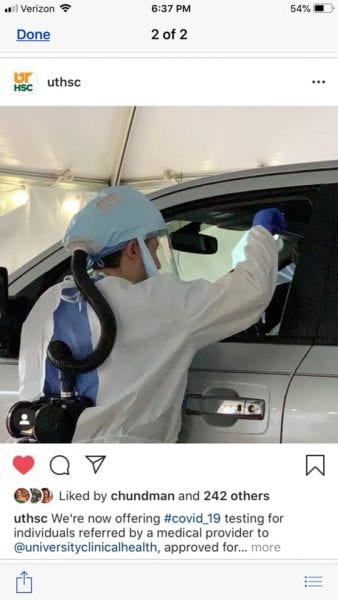
AN OLD FRIEND’S SON APPEARS IN THIS PHOTO:
SEEN ON FACEBOOK:
Yes, the Coronavirus is a killer. No, it’s not “just a flu”.
But:
They did not stop the economy for cancer, which is a bigger killer.
They did not stop the economy for diabetes, which is a bigger killer.
They did not stop the economy for heart disease, which is a bigger killer.
Why stop it for the coronavirus?
Um, maybe because those aren’t contagious diseases that can be stopped or slowed by quarantine? Just spitballing here. . . .
EXPANDED CAPACITY: New York converting Javits Center into 2,000-bed COVID-19 hospital.
REPORT: Airlines Preparing to Shut Down Flights, Voluntarily or by Executive Order. An order might help them by triggering insurance, or letting them invoke various contingency clauses in debt instruments.
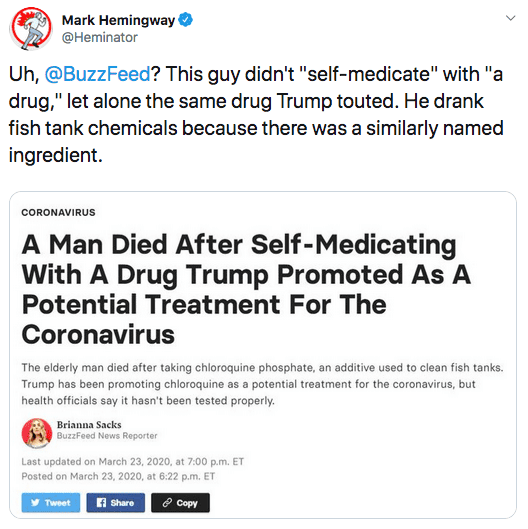
I SEE A LOT OF PEOPLE TRYING TO SPIN THIS STORY AS ZOMG! TRUMP IS PUSHING POISON!!! Man dies after ingesting chloroquine in an attempt to prevent coronavirus.
But: “The toxic ingredient they consumed was not the medication form of chloroquine, used to treat malaria in humans. Instead, it was an ingredient listed on a parasite treatment for fish.”
OPEN THREAD: Explore your thoughts and opinions.
ACTION: New York launches new COVID-19 drug trials; more underway in China. “New York, ‘ground zero’ for the U.S. coronavirus outbreak, is taking the lead on drug testing, with trials beginning this week on three drugs believed to have potential for treatment. Trials to assess the efficacy and safety of the anti-malaria drug chloroquine, its sister agent hydroxychloroquine and the antibiotic azithromycin will join trials of other drugs going on globally, including tests of an HIV drug and an antiviral.”
Related: David Lat Undergoing ‘Experimental’ Drug Therapy, His Husband Says.
Lat, the founder of the legal blog Above the Law and now a widely recognized legal recruiter who still writes columns for Above the Law, has been hospitalized at NYU Langone Hospital since March 16 due to a worsening COVID-19 infection. For more than a week before being admitted to the hospital, Lat, 44, had experienced intermittent fevers, joint aches, chills, fatigue and coughing. Labored breathing set in by March 15, forcing him to go to his nearest emergency room to seek a coronavirus test. . . .
Lat went from receiving oxygen and being in stable condition last week at NYU Langone, as he posted Twitter threads about his coronavirus battle that he titled “Above the Hospital Bed,” to being put on a ventilator and placed in an intensive care unit late Friday night or early Saturday.
In an interview on March 18, Lat said that he’s generally been a very healthy person. He’s run two New York City marathons and until recently did intense interval training each week and walked about 25 miles a week, as well. He did note, though, that he has exercise-induced asthma.
According to Shemtob, 36, the doctors at NYU Langone on Saturday or late Friday prescribed Lat a Z-Pak (azithromycin) and the anti-malarial drug hydroxychloroquine. They also are treating him with an IL 6-inhibitor to fight the inflammation of Lat’s lungs.
Get well, soon, David.
DAN MCLAUGHLIN: The Lockdown Debate Requires Transparent Disagreement. “Aaron Ginn wrote a long, charts-and-statistics-filled blog post at Medium arguing that the available public health data shows that COVID-19 is less easily transmitted, less fatal, and more likely to fade away with the hot weather than the conventional wisdom would have you believe. Medium deleted the post, which is now hosted at ZeroHedge. Deleting arguments like Ginn’s is a bad and dangerous way to handle the still-roiling debate over what governments and society should do in order to react to the disease.”
VICTOR DAVIS HANSON: The Virus is Not Invisible, But It’s Exposing Who’s Irreplaceable.
I think one of the strangest of all sequelae to the virus and the lockdowns might be the millions of high-paid Americans whose absences were hardly missed either by the public or count much in subsequent economic analyses of damage to the economy.
In a sophisticated society under lockdown, is it more existentially valuable to know how to fix a toilet, replace a circuit breaker, or change a tire, or to be a New York fashion designer, a Hollywood actor, or a corporate merger lawyer? At 9 p.m., when you go downtown in need of a critical prescription, are you really all that furious that a law-abiding citizen who has a gun and concealed permit is also in line—or would you be more relieved that gun control laws might ensure that his ilk never enters an all-night pharmacy?
So who is important and who not?
We were often told globalized elites on the coast were the deserved 21st-century winners, while the suckers and rubes in-between had better learn coding or head to the fracking fields.
But who now is more important than the trucker who drives 12-hours straight to deliver toilet paper to Costco? Or the mid-level manager of Target who calibrates supply and demand and is on the phone all day juggling deliveries before his store opens? Or the checker at the local supermarket who knows that the hundreds of customers inches away from her pose risks of infection, and yet she ensures that people walk out with food in their carts? The farmworker who is on the tractor all night to ensure that millions of carrots and lettuce don’t rot? The muddy frackers in West Texas who make it possible that natural gas reaches the home of the quarantined broker in Houston? The ER nurse on her fifth coronavirus of the day who matter-of-factly saves lives?
Do we really need to ask such questions of whether the presence of the czar for diversity and inclusion at Yale is missed as much as the often-caricatured cop on patrol at 2 a.m. in New Haven?
No, no we don’t.
SECURITY: How To Make Your Home A Hard Target.

MY USA TODAY COLUMN THIS WEEK WILL SOUND THIS THEME: Coronavirus outbreak: Supermarket workers among those on the frontline of the crisis. Thank your grocery clerk.