
AS A 14EEEE I’M GOING TO ORDER SOME OF THESE: Extra-Wide Sock Company King Size Men’s Comfort Fit Athletic Crew Socks.
Author Archive: Glenn Reynolds
April 19, 2020
AND NOT A MINUTE TOO SOON, EITHER: Coronavirus brings Europe’s borders back: The coronavirus has not just brought globalization to a standstill. The COVID-19 crisis also shows how fragmented united Europe actually is — not only relations between countries but between generations and classes. The class divide is the topic of my USA Today column tomorrow.
OPEN THREAD: If you’re feeling lucky you best not refuse. It’s your game the rules are your own, win or lose
GOOD: Israel, US law-firms sue China for trillions over coronavirus. Mao wrote about paper tigers, but if he’d ever faced a major discovery operation he’d have had more respect for paper.
YOU’LL GET NOTHING, AND LIKE IT! Illinois Dems’ $41 Billion Demand Includes $10 Billion Pension Bailout That Has Nothing To Do With Coronavirus.
We need a GOP congress and president, and then we need to condition bailouts on splitting Illinois into two states: Chicago and the ring counties, and downstate.
IF YOU WANT TO ENCOURAGE PEOPLE TO START BREAKING QUARANTINE, FLOAT TRIAL BALLOONS LIKE THIS: ‘Experts’ Trial Balloon: Hey, What If We Closed Grocery Stores While We’re At It?
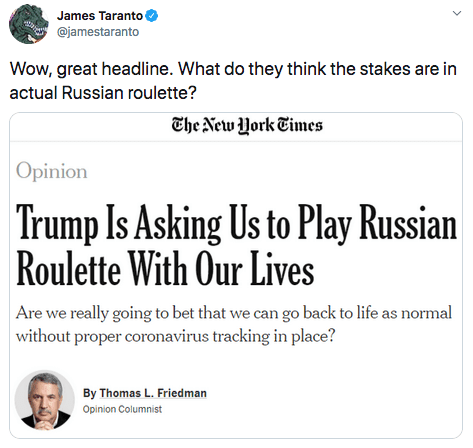
LAYERS OF FACT-CHECKERS AND EDITORS:
“DEATH AMBASSADORS.” THAT’S A TERM THAT WILL STICK: Giuliani: China Sent Death ‘Ambassadors’ Around World.
China not only unleashed the deadly coronavirus pandemic on the world, but they “protected themselves” while doing it, closing down travel in their country from the city of Wuhan but permitting it internationally, according to former New York City Mayor Rudy Giuliani.
“They sent over a million people around the world – 1.5 million – almost like ambassadors carrying the disease,” Giuliani told host John Catsimatidis on Sunday’s “The Cats Roundtable” on 970 AM-N.Y.
“What’s wrong with them, John? They have no conscience. It’s really a tragedy. This is directly caused by the Chinese Communist government, and by the choices they made. Almost all of this could have been avoided, John.
“The whole world is kind of shut down for three weeks because of them,” he added.
Giuliani added a rebuke of the World Health Organization and its Director-General Tedros Adhanom Ghebreyesus.
“He’s in the pocket of China; he did everything China wanted,” Giuliani told Catsimatidis.
Well, that’s certainly true.
CHRISTOPHER DEMUTH: Trump Rewrites the Book on Emergencies: For the first time in U.S. history, an administration is responding to a crisis with deregulation and decentralization.
Washington’s response to the Covid-19 pandemic is upending one of the most durable patterns of American politics. Throughout history, national emergencies have led to a more powerful and centralized federal government and to the transfer of federal power from Congress to the executive branch. This time, the federal response rests largely on state and local government and private enterprise, with a wave of deregulation clearing the way. The Trump administration has seized no new powers, and Congress has stayed energetically in the game.
The historical pattern is powerful and might have seemed inevitable. In times of war, natural disaster and economic upheaval, action is king. The president and his officials and agencies can act with much greater dispatch than Congress can. They may be forgiven for crossing statutory or even constitutional boundaries—in a crisis, the test of legitimacy is perceived effectiveness. But emergency actions often set precedents for normal times.
Moreover, crises generate proposals for preventing their recurrence. These typically take the form of an agency that, with the benefit of hindsight, could have nipped the crisis in the bud. Positing an omnicompetent government authority is political misdirection: It elides the profound problems of uncertainty and conflicting information and interpretation that precede every catastrophe. That is a sure recipe for highly concentrated, discretionary power.
These tendencies were dramatically on display in the first two national emergencies of the 21st century, 9/11 and the 2008 financial collapse. In response to the 9/11 attacks, the Bush administration and Congress created two gigantic agencies with extraordinary powers and insulation from congressional control, the Department of Homeland Security and the Office of the Director of National Intelligence. Intelligence was centralized and bureaucratized; federal police powers were extended down to driver’s licenses and much else; the administration established wide-ranging surveillance programs.
In response to the 2008 crisis, the administration arranged corporate mergers and bailouts with only fig leaves of statutory authority. It spent hundreds of billions of dollars without congressional appropriation. These crisis expedients provided the template for the Obama administration’s unilateral responses to mere political frustrations—congressional inaction on its climate change, immigration and other legislative proposals. At the same time, the Dodd-Frank Act of 2010 commissioned an army of new regulatory authorities with unprecedented discretion and autonomy.
It is not only crises that propel the administrative state. Lesser events of the 2000s—accounting scandals and a spike in energy prices—also led to new layers of freewheeling federal power. But major emergencies have unfailingly been major inflection points.
Until now. In responding to the coronavirus, the Trump administration has confined itself to longstanding statutory authorities that have been invoked routinely in responding to lesser emergencies. President Trump has used the Stafford Act of 1988 to provide states with emergency financial assistance—but has deferred to their decisions regarding social confinement, business closures, testing and treatment. He has employed the Defense Production Act of 1950 to cajole manufactures to prioritize urgently needed medical equipment—but has relied primarily on consultation, coordination and publicity to coach a private-sector-led mobilization. He has declared a national emergency under the National Emergencies Act of 1976, which can potentially trigger extraordinary regulatory powers—but so far he has used it only for deregulatory purposes, waiving Medicare, Medicaid, Children’s Health Insurance and Health Insurance Portability and Accountability Act rules that restrict telemedicine and interstate medical practice.
Mr. Trump has received criticism from all sides for these measured responses. It is said, on the one hand, that he should aggressively commandeer state police powers and industrial resources to mount a uniform national response—and, on the other (sometimes by the same critics), that the crisis will sooner or later unleash the authoritarian ambitions Mr. Trump has supposedly been harboring all along.
His replies have been characteristically adamant. He has extolled his administration’s performance on the measures that are unarguably federal jurisdictions—restricting foreign travel, deploying the military’s medical resources, mobilizing production of materials in short supply and allocating them among states and cities, providing information on the spread of the virus and guidance on mitigation measures. He has been jealous of federal prerogatives and sharply critical of governors and business executives he regarded as uncooperative.
But mainly he has given pride of place to federalism and private enterprise—lauding the patriotism and proficiency of our fantastic governors and mayors, our incredible business leaders and genius companies, our heroic doctors and nurses and orderlies, and our tremendous truckers. By shouting out many of them by name and documenting their deeds on a daily basis, he has vivified the American way in action (once reluctantly aroused). When asked why he has not issued orders for nationwide home and business lockdowns, he has emphasized that the intensity of the epidemic varies widely and is best met by calibrated state and local judgments—and added pointedly that such steps would conflict with the Constitution.
What nonsense. Everyone knows that we have a living, breathing Constitution that adapts and changes to meet the needs of the time, defined as whatever the chattering class wants at the moment.
Plus: “The most striking aspect of the administration’s response has been its waiving or liberalizing of hundreds of regulatory requirements that would otherwise impede efforts to cope with the epidemic and ensuing shutdowns. The Food and Drug Administration has relaxed its extreme restrictions on the development and deployment of medical tests, equipment, drugs and vaccines. The Medicare and Hipaa waivers, along with the suspension by many states of their restrictions on out-of-state medical professionals, are allowing doctors and nurses to go where they are needed and to practice telemedicine. The Education Department is easing its micromanagement of school districts to facilitate online teaching and other initiatives. Teachers I know are enthusiastic about the cancellation of this year’s federal testing requirements—now they can actually teach their students instead of merely preparing them for tests.”
Most of these requirements — possibly all — should be permanently abolished.
“PAY ME.” Cuomo: ‘If You Want States To Reopen, We Need Funding.’
UPDATE: Wrong link before. Fixed now. Sorry!
NEWS FROM MY NECK OF THE WOODS: Protesters rally at Knoxville’s West Town Mall in favor of reopening economy. Judging from the photos they appear to be distancing.
Also: Coronavirus in Tennessee: 32 active Knox County cases, total recovered cases at 156. “The Knox County Health Department is reporting one new case of COVID-19 on Sunday, bringing the total case number to 192. There are now 32 active cases in the county as of April 19, down from 36 on Saturday. The total number of cases grew to 192 from 191. The total number of recovered cases rose to 156. . . . Of the 192 cases, 25 of them have resulted in hospitalization at any point during the illness.”
A FRIEND ON FACEBOOK COMMENTS:
Perhaps regional responses and attitudes about the continuing shelter-in-place can be explained, in part, by some startling numbers. In New York State you have a roughly 1/16,390 chance of dying in a car accident in any given year (using numbers from a few years ago). So far, your chances of dying of Covid-19 in NYS are an arresting 1/1072, or roughly 16X WORSE than dying in a car accident. In Texas, by comparison, your chances of dying in a car accident are much worse at 1/7820, but your chances of dying of Covid-19 (again, so far) are a very remote 1/58,824. Driving a car in Texas, a risk we take every day, is roughly 7X more dangerous than the Covid. Again, so far… None of this is to say that any given policy was the wrong approach (and, in any case, one can never derive “what ought” from “what is,” a basic precept lost in most public commentary just now). It might suggest, however, why civil impatience to loosen some restrictions is growing at different rates in different places.
Good point.
THIS IS JUST THE BEGINNING: Germany sends China £130billion bill for ‘coronavirus damages’ – sparks fury in Beijing.
PANDEMIC WISDOM:

IT’S ASKING A LOT FOR INSTITUTIONS TO BE READY FOR SOMETHING THAT HAPPENS LESS THAN ONCE IN A LIFETIME: “Every Western institution was unprepared for the coronavirus pandemic, despite many prior warnings. This monumental failure of institutional effectiveness will reverberate for the rest of the decade, but it’s not too early to ask why, and what we need to do about it.”
I mean, I’d like us to have been in better shape, and we should have been. But peacetime armies are never really ready for war, and war happens a lot more often than once in a hundred years. Expecting bureaucracies to function smoothly and effectively is expecting a lot; it’s expecting even more when they’ve been on idle for decades.
Which isn’t to say that this piece doesn’t state a problem. “You don’t just see this smug complacency, this satisfaction with the status quo and the unwillingness to build, in the pandemic, or in healthcare generally. You see it throughout Western life, and specifically throughout American life.”
IT’S PAYWALLED, BUT I’VE GOT A PIECE IN THE WSJ WITH TAYLOR DINERMAN ON THE TRUMP SPACE PUSH: Trump Opens Outer Space for Business: An executive order and a prospective treaty aim to make celestial mining an attractive investment.
President Trump acted two weeks ago to bring about the kind of 21st century that we expected in the 20th. If all goes well, it will open the way for mankind to become a true “multiplanet species,” as Elon Musk puts it.
An April 6 executive order, “Encouraging International Support for the Recovery and Use of Space Resources,” is meant to spur a new industry: the extraction and processing of resources from the moon and asteroids to facilitate settlement of the solar system. With this order, Mr. Trump ended an era of legal uncertainty in outer space and laid the foundation for international cooperation on American terms.
The National Aeronautics and Space Administration plans a manned moon mission in 2024, followed by a “sustained lunar presence.” The U.S. National Space Council, led by Vice President Mike Pence, has been quietly working on an international agreement known as the Artemis Accords, which would clarify the 1967 Outer Space Treaty and provide a solid basis for private enterprise to operate on the moon, Mars and beyond.
The Outer Space Treaty, to which the U.S. and all other major countries are parties, bars “national appropriation” and sovereignty over the moon and other so-called celestial bodies, declaring that they “shall be the province of all mankind.” Some have read into that provision a prohibition on the private appropriation of resources. The executive order rejects that position: “Outer space is a legally and physically unique domain of human activity, and the United States does not view it as a global commons.” . . .
The Trump order also rejects the 1979 Moon Treaty, which was intended to supplant the Outer Space Treaty. The Moon Treaty purports to ban private exploitation of space resources and mandate that any such activity take place under the supervision of an international authority with a rake-off going to Third World governments. President Carter initially supported the pact, but facing popular opposition, the Senate never took up ratification. Mr. Trump’s statement specifically notes that only 17 of the 95 members of the United Nations Committee on the Peaceful Uses of Outer Space have ratified the Moon Treaty. None have a major space program.
As a follow up to the executive order, the administration has been quietly preparing the Artemis Accords, which it plans to present first to America’s partners on the International Space Station—Canada, Europe, Japan and Russia—and later to other nations. Parties would “affirm that the extraction and utilization of space resources does not constitute national appropriation under Article 2 of the Outer Space Treaty.” . . .
There’s a lot of wealth in space. A 79-foot-wide asteroid could hold 33.000 tons of extractable material, including $50 million worth of platinum. The 2-mile-wide asteroid 1986 DA could be worth $7 trillion. But that will require massive investment in new technology, and investors need assurance that they won’t pour billions into capturing an asteroid or mining the moon only to be told the resulting product isn’t theirs.
In some ways the administration’s policy is a logical continuation of the Obama-era drive for space commercialization. In 2015 President Obama signed the U.S. Commercial Space Launch Competitiveness Act, which provides that “a U.S. citizen engaged in the commercial recovery of an asteroid or space resource . . . shall be entitled to . . . possess, own, transport, use, and sell the asteroid resource or space resource obtained in accordance with applicable law, including the international obligations of the United States.” Mr. Trump’s order ensures that international obligations will be supportive and not destructive of such efforts.
Sorry I can’t give you the whole thing, but there’s the gist.
TEACH WOMEN NOT TO LIE ABOUT MEN: “Police: Woman Filed False Report on Drug-Spiked Drink at UNH Frat.”
SEEN ON FACEBOOK:

ANALYSIS: TRUE.

FROM THE COMMENTS TO THIS POST:
Top Ten Surprising Consequences of Covid-19 Hysteria:
1: Democrat governors rediscover federalism.
2: Wanna-be totalitarians can’t help but unmask themselves.
3: Trump gets a daily platform to smack the media around (watched by millions).
4: The CDC is exposed as just another dysfunctional gov. agency.
5: FDA, same as above.
6: WHO, same as FDA, CDC.
7: The US media is in China’s pocket.
8: “Models” completely useless except to frighten citizens.
9: We now know Nancy Pelosi has a $24,000.00 fridge.And the 10th most surprising consequence of the Covid-19 hysteria? Donald Trump was right about China the whole time, and everybody who didn’t know it before knows it now.
Yeah, pretty much. To be honest, I’m kinda jealous of the fridge.
WHY IS ACADEMIA SUCH A CESSPIT OF RACIST HATE? University lecturer: White men are COVID-19’s ‘ally’ in helping the virus spread.
Remember, when taxpayers tire of funding this sort of thing, we’ll be told it’s because of anti-intellectualism.
INTERESTING: With broad, random tests for antibodies, Germany seeks path out of lockdown. I should note, though, that if you don’t count the NYC area, the US is doing as well as Germany.
Our antibody tests have been smaller, but suggest more antibodies out there than we had expected. More here.