
THE MODELS AND THE MODELERS HAVE NOT EXACTLY DISTINGUISHED THEMSELVES IN THIS PANDEMIC: Vanderbilt reduces coronavirus hospitalization estimates from thousands to 300.
Author Archive: Glenn Reynolds
May 13, 2020
YOU CAN DO WHAT YOU WANT BABS, BUT, NEXT TIME YOU SEE ME COMING, DON’T ASK FOR A BAILOUT: Los Angeles County announces new ‘Safer-at-Home’ order with no end date.


NOT A CONSPIRACY THEORY, BUT A CONSPIRACY: ‘Obamagate’ Isn’t A Conspiracy Theory, It’s The Biggest Political Scandal Of Our Time: And the media know it.
They know it, but they’re going to do their best to make sure as few other people as possible understand it.
Remember:

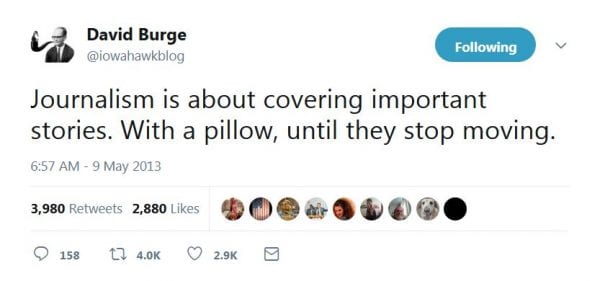

THE PRESS, BY NATURE, IS LAZY, CONDESCENDING, AND AUTHORITARIAN:
Go to the link to see the county-by-county map — “Where people started leaving home again/Percentage point change in the share of people staying home.” How does the NYT know this? It uses data from Cuebiq, which takes “a representative sample of about 15 million smartphone users nationwide who have agreed to share their location data with certain apps.” It’s not snooping on you. You agreed! With certain apps.
Quite aside from that invasion of our privacy — by our lax acceptance of the demands of apps — there’s the insinuation that we’re violating our state governments’ orders if we do not stay home. But where are we required to stay home? Not here in Wisconsin. We’re free to leave the house. It really irritates me to hear mainstream news and commentary speaking of a requirement to stay home. The requirement is social distancing! Maybe in New York City, you need to stay home to avoid violating the strictures of social distancing, but that’s not true in most of the country. If people are leaving home to take walks or go food shopping, they’re not disregarding orders.
Whether people are thinking for themselves and following their own ideas about how much social distancing they want or need instead of following orders — that’s another matter entirely. And I don’t think the certain apps are measuring that.
And it’s gotten worse — and dumber — in recent years.
FLASHBACK: States are cutting university budgets. Taxpayers aren’t interested in funding campus kooks. “Whom the gods would destroy, they first make crazy. And higher education has become objectively crazy.”
WELL, GOOD: U.S. to Get Sanofi Covid Vaccine First If It Succeeds, CEO Says.
That’s because the U.S. was first in line to fund Sanofi’s vaccine research, Chief Executive Officer Paul Hudson said in an interview with Bloomberg News. He warned that Europe risks falling behind unless it steps up efforts to seek protection against a pandemic that’s killed more than 290,000 people worldwide.
“The U.S. government has the right to the largest pre-order because it’s invested in taking the risk,” Hudson said. The U.S., which expanded a vaccine partnership with the company in February, expects “that if we’ve helped you manufacture the doses at risk, we expect to get the doses first.”
Huh. All the best people told me Trump just wants people to die.
NEWS YOU CAN USE: The Importance of Situational Awareness.
THEY’LL ALSO START LEAVING HOME BEFORE THE GOVERNMENT TELLS THEM TO: Most Americans stayed home before government COVID-19 mandates. “Most Americans voluntarily stayed at home during the early days of the COVID-19 tsunami, before states began issuing official ‘shelter-in-place’ orders, new research indicates. Why? Because statewide emergency declarations coupled with news — of first infections, first fatalities and school closures — were motivation enough to get folks to stay home. This was more motivating than quarantine mandates imposed weeks later, say investigators.”
People are thinking for themselves, which is problematic.
HUH, THIS USED TO BE “ALTERNATIVE HEALTH” STUFF: A combo of fasting plus vitamin C is effective for hard-to-treat cancers, study shows.
CHANGE: Manhattan Faces a Reckoning if Working From Home Becomes the Norm. “Even after the crisis eases, companies may let workers stay home. That would affect an entire ecosystem, from transit to restaurants to shops. Not to mention the tax base.”
#JOURNALISM: Beyond parody: CNN taps Greta Thunberg for expert coronavirus panel.
In case you didn’t realize how hard the writers at the Babylon Bee have to work to surpass reality.
UPDATE: Yep.

MICE GET ALL THE BEST TREATMENTS FIRST: Experimental gene therapy prevents obesity, builds muscle, without exercise or dieting. Of course they also get the worst ones first.
NEITHER THE MODELS OR THE MODELERS HAVE COVERED THEMSELVES WITH GLORY, BUT THE EXPERT CLASS AS A WHOLE HAS BEEN A PANTLOAD OF FAIL UNDER COVID-19: Can we trust Covid modelling? More evidence from Sweden.
When people finally got to look under the hood of the famous Imperial College study, they found twisted and tangled code. And most of the model’s predictions bear little resemblance to what is actually happening. Some defend the models by saying that their predictions turned out to be wrong only because governments imposed harsher restrictions than the coders expected.
If so, we have a perfect experiment. Sweden did not close borders, shut down schools, businesses, restaurants, gyms or shopping centres and did not issue stay at home orders. So it should be the one country where the models fit. Let’s see. . . . At this moment, when the models suggested that Sweden would have 30 to 40 patients fighting over every available ICU bed, there is spare capacity in beds, equipment and personnel of around 30 percent.
Pantload.
I’M SENDING COVID-19 PATIENTS TO NURSING HOMES, BUT ALSO I’M PULLING MY MOM OUT:
This month a consortium of Mid-Atlantic newspapers under the USA Today Network detailed the policy in Pennsylvania and other states that’s ordering nursing homes to admit medically stable residents infected with the coronavirus.
Spotlight PA, a partnership between the Philadelphia Inquirer, the Pittsburgh Post-Gazette, and Harrisburg’s PennLive, also found evidence the Pennsylvania Department of Health drafted a quick strike plan to protect nursing homes in March, but never fully implemented it.
In the meantime, some facilities have become death traps. . . .
Levine was asked by a reporter Tuesday about her mother being moved out of a long-term care facility, Levine said she was allowing the wishes of her 95-year-old mother to move from a personal care home to a hotel.
Death is for the little people, and their parents.
FLASHBACK: Look Outside Of Politics For Heroes.
NOTHING TO SEE HERE, MOVE ALONG: GOP sweeps congressional special elections.
THEY HAVE SOMETHING TO HIDE, AND WE ALL HAVE A GOOD IDEA OF WHAT THEY’RE HIDING: WSJ: China is stalling global investigations into origin of the coronavirus.
FASTER, PLEASE: Unleash the entrepreneurs America needs to build a post-coronavirus economy. Perhaps we need some sort of across-the-board regulatory suspension, like in postwar Germany under (and even before) the Marshall Plan. Here’s more on the German plan:
On July 7, 1948, the German government approved a law giving the economic authorities the right to “take all necessary measures in the field of control and to determine in detail which goods and production should be freed from price controls.”
The ensuing deregulation was dramatic and shocking to occupation forces. As Erhard notes, “It was strictly laid down by the British and American control authorities that permission had to be obtained before any definite price changes could be made. The Allies never seemed to have thought it possible that someone could have the idea, not to alter price controls, but simply to remove them.” With determined action and the strong support of one American, a Gen. Lucius Clay, the German free market exponents were able to blast through the inertia of Allied supervision.
The sweeping success of the currency reform is of little doubt. As Prof. Henry Wallich put it, “The spirit of the country changed overnight.” Two observers not native to Germany, Jacques Rueff and Andre Piettre, had the following report: “Only an eye-witness can give an account of the sudden effect which currency reform had on the size of stocks and the wealth of goods on display. Shops filled up with goods from one day to the next; the factories began to work. On the eve of currency reform the Germans were aimlessly wandering about their towns in search of a few additional items of food. A day later they thought of nothing but producing them. One day apathy was mirrored on their faces while on the next a whole nation looked hopefully into the future.”
I’m just sayin’. Plus:
Almost all consumer goods were immediately deregulated (excepting agricultural commodities); wages were set free three months after the currency reform; and industrial commodities (steel, iron, coal, oil, etc.) were gradually deregulated over the next few years; while foreign trade, which was under technical restrictions in law, was turned to free competition in practice in a very short time. The one area where price control would remain in effect throughout the 1950’s was the special case of rents.
The result of this substantial deregulation was to let the Germans take full advantage of the powerful incentives set before them. The gravity of the German postwar condition provided strong motivation for productive effort, yet economic restriction had prohibited the enterprise and imagination of the populace. In a system where supply and demand cannot coincide, the result is economic chaos. In the German instance, the price regulation had legislated massive shortages, for the surest way to curtail supply is to make it impossible to reap the rewards of production. Additionally, the heavy reliance on black markets created vast senseless gyrations and economic waste. Commenting bn the explosion of effort in the post-reform era, Gordon Hallet has noted how “the startling change between the period before and after July 1948 indicates the extent to which an economic system can either frustrate individual efforts or give them the opportunity to be effective.”
Contemporary analysts might paint the German policy as harsh in that it left few rewards for those who did not seek to take care of themselves. While government expenditures on social welfare through transfer payments were comparable with those of other European nations, the State abstained from further economic intrusions via “full employment” policies, subsidies, and income redistribution. In fact the tax policy was shifted to reduce the burden on upper-income brackets. The tight money policies pursued by Erhard created buyers’—rather than sellers’—markets.
If the harshness of the policy was great, so was the positive record of accomplishment. Industrial production and national income skyrocketed. Industrial output increased 50 percent within the year, and national income (in constant prices) was restored to the 1936 level in just over a year (it had fallen 20 percent below this figure). Economic recovery was complete except for one plaguing phenomenon—the emergence of unemployment, which steadily rose to a peak of 10.2 percent in 1950. The instantaneous response of the British and Americans was to explain the dilemma in Keynesian terms and diagnose the problem as “insufficient effective demand.” The prescription; immediate government and monetary expansion, along with reintroduction of economic controls.
The German response, in the light of the Keynesian revolution, was terribly naive. The Germans theorized that an increased money supply would simply cause inflation and that the employment problem was frictional, fueled basically by the stream (still flowing) of millions of refugees. The resultant policy was a strict balanced-budget fiscal framework and a conservative monetary course by the Deutsche Bundesbank. Unemployment dropped steadily—to six percent in 1952, three percent in 1956, and one percent by 1960.
Again.
HIGHER EDUCATION BUBBLE UPDATE, COLLUSION EDITION: University of Arkansas professor arrested for hiding ties to China.
According to a Justice Department press release (via the Arkansas Times), Professor Simon Ang, head of the UA High Density Electronics Center, did not reveal his connections to China when he applied for grants from NASA.
“These materially false representations to NASA and the University of Arkansas resulted in numerous wires to be sent and received that facilitated Ang’s scheme to defraud,” the release said.
Ang has worked at UA since 1988 and is a 1980 graduate of the school. He faces up to 20 years in prison if convicted.
40/29 News reports the investigation began when a UA employee discovered a hard drive in the school library’s lost-and-found. On it were emails allegedly from Ang which stated “there are things that are becoming very difficult for me recently because of the political climate” and “I have to be very careful or else I may be out of my job from this university.”
In another, Ang wrote “You can search the Chinese website regarding what the US will do to Thousand Talent Scholars. Not many people here know I am one of them but if this leaks out, my job here will be in deep troubles.”
Full criminal complaint at the link.
PUNCH BACK TWICE AS HARD: Anti-male bias lawsuit drags college to court. “The lawsuit against Colgate University on the basis of male gender bias is the first of its kind to move to trial. The judge found that an anonymous male student received a harsher punishment than his female counterpart.”