Author Archive: Glenn Reynolds

JOEL KOTKIN: The new geography of America, post-coronavirus.

For a generation, a procession of pundits, public relations aces and speculators have promoted the notion that our future lay in dense — and politically deep-blue — urban centers, largely on the coasts. Just a decade ago, in the midst of the financial crisis, suburbia’s future seemed perilous, with experts claiming that many suburban tracks were about to become “the next slums.” The head of President Obama’s Department of Housing and Urban Development proclaimed that “sprawl” was now doomed and people were “moving back into central cities.”

That idea was always overwrought with enthusiasm, but, with the COVID-19 pandemic heavily concentrated in these urban centers, the case for forced densification promoted by “urban supremacists” seems increasing dubious. By some estimates, the death rate in large urban counties has been well over twice those of high-density suburbs, nearly four times higher than lower-density ones, with even larger gaps with smaller metros and rural areas.

The pandemic has been toughest on those areas that suffer what demographer Wendell Cox called “exposure density.” In the worst case, which is in New York’s outer boroughs, this pattern is exacerbated by living in crowded apartments, walking packed streets, traveling cheek to jowl in the subway and then forced into a crowded workplace. This could explain why sprawling, large and relatively less-dense urban areas in Texas, California and Florida — each with their own pockets of poverty — have also experienced far lower infection and fatality rates than New York.

Indeed. Related: Coronavirus lessons on density, mass transit, bureaucracy and censorship: They kill.
RICHARD FERNANDEZ:

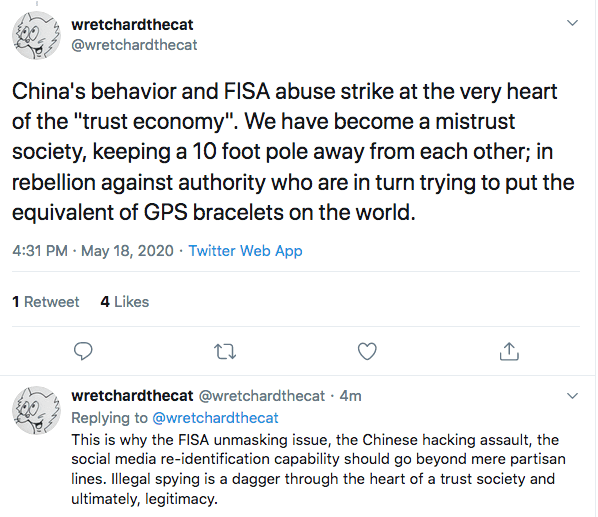
A high trust society is much better than a low trust society. But a high trust society requires people — especially among its leadership classes — willing to be trustworthy even when doing so is a short-term disadvantage. That requires civic-mindedness and self-discipline, two things that our leadership classes have not demonstrated of late.

OPEN THREAD: Nighttime you’re too tired to drive your change across the floor.

THIS IS WHY THE CHINESE WANTED HIM, I GUESS: NYT 2017: Candidate to Lead the W.H.O. Accused of Covering Up Epidemics. “A leading candidate to head the World Health Organization was accused this week of covering up three cholera epidemics in his home country, Ethiopia, when he was health minister — a charge that could seriously undermine his campaign to run the agency. The accusation against Tedros Adhanom Ghebreyesus was made by a prominent global health expert who is also an informal adviser to Dr. David Nabarro, a rival candidate in the race for W.H.O. director general.”

NOW IN SPACE: A microwave power-beaming experiment.

A secretive military space plane will soon test the idea of using microwave beams to send solar power to Earth from space. The U.S. Air Force’s X-37B space plane is expected to launch into orbit Saturday (May 16) with an experiment onboard that tests the possibility.

The Photovoltaic Radiofrequency Antenna Module Flight Experiment (PRAM-FX) represents the first orbital test of such a sci-fi technology since the 19th century — solar satellite power. Build a big solar array in orbit, the idea goes, and it could collect enough sunlight (unfiltered by atmospheric effects or clouds,) to generate a powerful beam of microwaves. A collection station on Earth would then convert that beam into useful power. Launch any satellite into a high enough orbit and it will receive a near-constant stream of sunlight, with only brief passes through the Earth’s shadow. A whole constellation of solar arrays might offer uninterrupted 24/7 power.

I like orbital solar. The power-beaming idea isn’t new — they did a proof-of-concept experiment at JPL Goldstone 50 years ago (with, if I recall correctly, around 50% efficiency), but now they’re doing actual engineering.

ANDREW CUOMO’S reckless choices. “Bill de Blasio made terrible decisions as mayor of New York City. But as more reporting emerges about the catastrophic decisions made by New York’s governor, it’s possible Andrew Cuomo deserves even more blame than de Blasio for what the coronavirus has done to the tri-state area and consequently the nation. New York and New Jersey combined have suffered more COVID-19 deaths than any other country being tracked by researchers who run the Johns Hopkins crisis dashboard. Cuomo made three breathtakingly bad moves in March that in retrospect amounted to catastrophe. First, Cuomo failed to call for, and even actively discouraged, informal social-distancing measures in early March. Next was the delay in mid-March in ordering formal closures when the virus started rampaging through his state. Third was his March 25 edict to long-term care facilities that they must accept infected patients, which caused a mass deadly outbreak among helpless, trapped, elderly New Yorkers. Only in the last few days have some corners of the media begun to call attention to just how badly Cuomo has failed us.”

Related: NYC vs. San Francisco: the stark failure of Andrew Cuomo and Bill de Blasio.

UPDATE: Cuomo refuses accountability in nursing home scandal, says vulnerable people were going to die anyway. Quoth Cuomo: “Older people, vulnerable people are going to die from this virus. That is going to happen despite whatever you do. Because with all our progress as a society, we can’t keep everyone alive. Despite what everything you do and older people are more vulnerable. And that is a fact. And that is not going to change.”

Maybe, but they die faster when you send infectious people into nursing homes full of older and vulnerable people.

IRISH DEMOCRACY: Lockdown Is Ending, Whether Governments Approve or Not: Executive orders may have encouraged the lockdowns, but they always depended on voluntary behavior. “The data also show something about the nature of the shutdowns. They might have been encouraged by executive orders, but they were always ultimately driven by voluntary behavior. Well before states started issuing stay-at-home orders in the final week of March, many Americans were voluntarily self-quarantining. Since officials had only limited influence over the beginning of the lockdown, they were always going to have limited influence over its ending. This was always unsustainable over the long term, and coronavirus policies need to be reconsidered in light of that. On the other hand, declaring states to be ‘open’ will be meaningless unless residents feel it is safe to venture out again.”

MY COLLEAGUE ALEX LONG TALKS ABOUT REOPENING AND RISK MANAGEMENT. I will note that while there is a duty to provide a safe working environment, the Supreme Court has made clear that “safe” doesn’t mean “free of risk.” I also think that predictions that things will “never be the same” in the workplace are unlikely to pan out.

I STILL REALLY DON’T MISS TWITTER.

LETTER: Pacific Legal Foundation sides with Cordair Fine Art Gallery on Reopening.

While the government may adopt laws to protect public health, its power is not unlimited. Even during a pandemic, the State and County must abide by constitutional limits. As one federal court has ruled, the government may legislate to prevent the spread of infectious diseases, but “it does not at all follow that every statute enacted ostensibly for the promotion of these ends is to be accepted as a legitimate exertion of the police powers of the state.” And the United States Supreme Court has held that a community’s power to “protect itself against an epidemic” might be exercised “in such an arbitrary, unreasonable manner, or might go so far beyond what was reasonably required for the safety of the public, as to authorize or compel the courts to interfere for the protection of such persons.”

Entire letter at the link.

CHANGE: Judge tosses out Gov. Kate Brown’s coronavirus restrictions in Oregon. “Emergency powers” have to be approved by the legislature after 28 days.

But: “Brown said she would immediately appeal the ruling to the state Supreme Court to try to keep the emergency orders in effect.”

I guess asking the legislature for approval is expecting too much.

HMM: Japan’s economy slips into recession amid pandemic. “Japan recorded slides across all sectors except for government consumption, which grew by 0.1 percent. Leading the declines, exports of goods and services contracted 6 percent followed by imports at 4.9 percent and private residential investment at 4.5 percent.”