
THE ENEMY WITHIN: Motion backing Hong Kong blocked after campaign by Chinese students at Warwick. The Chinese Government takes it for granted that Chinese students studying abroad will do its bidding. You should assume it knows what it’s doing.
Author Archive: Glenn Reynolds
May 28, 2020
SOME SPACE DEEP BACKGROUND: Op-ed: Unleashing the Dragon – the NASA bargain behind this week’s SpaceX launch.
YOU CAN GET A HINT BY WATCHING HOW THE CHINESE REACTED: NIH director: ‘No way of knowing’ if coronavirus escaped from Wuhan lab.
HERE’S A COPY OF PRESIDENT TRUMP’S Draft Executive Order on Preventing Online Censorship.
And here are some comments by Eugene Volokh on what Section 230 does and doesn’t do.
SHOCKING NEWS: Use of high-THC cannabis doubles risk for anxiety disorders.
AND WE’RE LUCKY THAT THAT’S THE CASE: American Spaceflight Is Now In Elon Musk’s Hands.
JOEL KOTKIN: THE CORONAVIRUS IS ALSO SPREADING A DARK NEW ERA OF NEO-FEUDALISM.
The COVID-19 pandemic is accelerating the global shift already underway towards a neo-feudal society. With the middle-class economy largely shut down and, in the best-case scenario, in for a long and painful recovery, the population that is barely hanging on is expanding rapidly in America and around the world. In the U.S. alone, the ranks of the poor are projected to increase by as much as 50 percent, to levels not seen in at least a half century.
Neo-feudalism is reprising the kind of society that existed in Medieval times, characterized by declining social mobility and greater concentrations of power. In the neo-Feudal world, as in the original, the middle class loses its primacy, as small businesses fail and even affluent families face the prospect of joining the ranks of ever expanding class of property-less serfs.
Yet not all will be losers—the tech oligarchs, whose net worths have surged during the pandemic, are now positioned to pick up the pieces of a devastated analog economy. But the class that may benefit most may be the Clerisy, encompassing professions such as teachers, consultants, lawyers, top level government officials and medical specialists. Their share of the labor market has grown while those of the traditional middle class — small business owners, workers in basic industries and construction — have shrunk.
Many in the Clerisy has barely been discomfited by the pandemic as they continue to have checks deposited while working largely from home. Some members of the “expert” class — medical professionals in white coats, empowered bureaucrats and the media that interprets their prognostications — have emerged as “the privileged stratum”, in the words of the French leftist Christophe Guilluy, operating from an assumption of “moral superiority” that justifies their right to instruct others.
Just as the tech oligarchs, having conquered and consolidated the digital economy, have assumed the predominant role of the old feudal aristocracy, the Clerisy reprises the role once played by the Catholic clergy. Samuel Coleridge coined the term in the 1830s to define a class of people whose job it was to instruct and direct the masses, as traditional clerics were joined by university professors, scientists, public intellectuals and foundation heads.
Like the elites of Medieval times, today’s clerisy has become increasingly hereditary in part due to the phenomena of well-educated people marrying each other; between 1960 and 2005 the share of men with university degrees who married women with university degrees nearly doubled, from 25% to 48%. “After one generation,” Daniel Bell noted in 1972, “a meritocracy simply becomes an enclaved class.”
And one notably lacking in anything that could be called “merit.”
WELL, MSNBC: ‘Fact-Based Truth’: MSNBC Demonized Ron DeSantis; Where’s the Apology?
So, according to Mike Barnicle, the “experts” were agreed that Florida Gov. Ron DeSantis was doing the exact opposite of what was needed to fight the coronavirus pandemic. Barnicle specifically contrasted Florida’s governor to the governors of Massachusetts, New York, California, Illinois and Michigan, where “fact-based truth” allegedly prevailed.
Well, where are we now, more than two months later? How did Barnicle’s “expert” opinion fare? Here are the per-capita coronavirus death rates (deaths per million residents) for these states:
New York ………………………. 1,519
Massachusetts ………………… 950
Michigan ………………………… 534
Illinois ……………………………. 400
Florida …………………………… 108
California ……………………….. 100So, Florida’s death rate has been 93% lower than New York, 89% lower than Massachusetts, 80% lower than Michigan, 73% lower than Illinois. The only state named by Barnicle that has done better than Florida in terms of its COVID-19 death rate is California. Given that Barnicle is such a proponent of “fact-based truth,” doesn’t it seem to you that the viewers of MSNBC deserve an explanation of why he got this so wrong?
Keep in mind that on March 23, when Barnicle was busy smearing Ron DeSantis and the MSNBC chyron declared that Florida’s coronavirus cases had passed the 1,000 mark, Massachusetts had only 777 known cases. Two weeks later, however, the situation had reversed, with Massachusetts reporting 15,202 cases on April 7, when Florida had 14,707 cases. Now? Massachusetts has 94,220 cases and 6,547 deaths, compared to 52,634 cases and 2,320 deaths in Florida — almost twice as many cases, and nearly three times as many deaths, despite the fact that Florida’s population (21.5 million) is more than three times larger than the population of Massachusetts (6.9 million).
You’re not judged according to results. You’re judged according to where you’re situated in the narrative.
THINK OF HIGHER EDUCATION AS PART OF THE DEMOCRATS’ POLITICAL APPARAT AND YOU WON’T GO FAR WRONG: University of Minnesota unconstitutionally showers student money on left-wing groups: lawsuit.
NEWS YOU CAN USE: Don’t Bother Learning to Code: Ruthless outsourcing will be the death of the American Dream. “The Nobel Prize-winning economist Milton Friedman characterized the H-1B visa as a government subsidy program. . . . Socialism for the rich.”
STANDING UP FOR CIVIL RIGHTS:
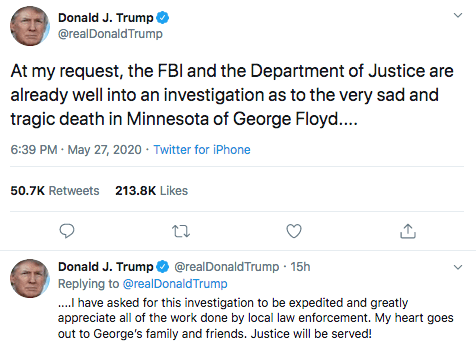
But how long before Trump is accused of playing politics because Minneapolis is a blue city with a lefty Democratic mayor?
HIGHER EDUCATION BUBBLE UPDATE, COLLUSION-COVERUP EDITION: Colleges stonewall feds on China records: The Department of Education says colleges are blocking attempts to obtain documents pertaining to foreign gifts. Among the countries from which the colleges have received money are China, Russia, and Iran.
HIGHER EDUCATION UPDATE: Movement Builds To Suspend U.S. News Rankings During COVID-19 Pandemic.
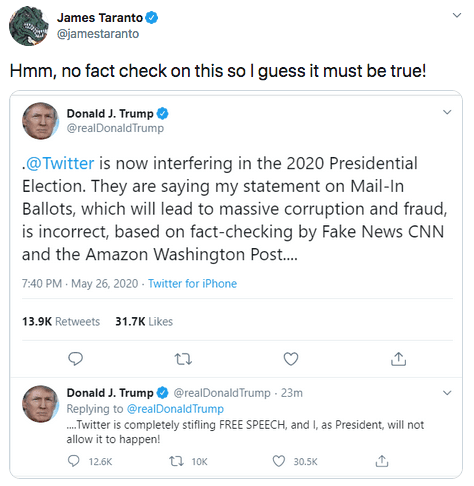
THE NATURAL CONSEQUENCE OF COMMITTING YOURSELF TO DECIDE ON WHAT’S TRUE:
A TREMENDOUS RESPONSE, THAT TURNED OUT TO BE LARGELY UNNECESSARY: Pence: 167,000% surge in tests, 663M masks, and 110,000 ventilators ‘ready this fall.’ The “ventilator gap” turns out to have been about as important as the “missile gap.”
Related: CDC’s Latest ‘Best Estimate’ of COVID Death Rate Is 13 Times Lower Than Initial WHO Claim.
CULTURE OF CORRUPTION: Former Pelosi Aides Cash in as Coronavirus Lobbyists.
IN CASE YOU MISSED IT: New FBI document confirms the Trump campaign was investigated without justification. But we’ll be lucky if they pay any serious price at all.
Early in the response to the pandemic, localities hard-hit by COVID-19 invited medical professionals working in more fortunate places to temporarily relocate and help treat afflicted patients. To make such moves possible, state governments suspended or loosened licensing requirements that would otherwise delay and discourage doctors, nurses, and others hoping to lend a hand. The Centers for Medicare & Medicaid Services similarly eased restrictions on cross-border practice of medicine, telehealth, testing, and other services. The Food and Drug Administration stepped-down regulation of personal protective equipment and medical devices. Local governments cut all sorts of red tape to make life a bit easier.
Many rules that served as tedious bureaucratic obstructionism in good times were quickly revealed as dangerous and potentially deadly during a crisis and tossed aside. And that’s where those rules should remain after the pandemic is gone—on the garbage heap of failed authoritarian policy.
“Sometimes, destruction may create an opportunity for future growth, if the destruction includes the piled-up layers of interest group guano that coats the gears of the system,” writes Michael Munger, a professor of political science, economics, and public policy at Duke University. “Our systems of occupational licensing—always a mook’s game, but now clearly preventing rapid response to emergencies in other states—drug and medical equipment certification, and regulating employment in the ‘gig’ economy, have all been shown to be catastrophic. The economic justification for these grants and set-asides was never persuasive. Let’s get rid of them!”
Get rid of them, indeed! But how much guano are we talking about?
Heaps.