
KIND OF LIKE TECH PROGRESS TODAY: Mergers may have stunted growth of early galaxies.
Author Archive: Glenn Reynolds
January 13, 2021
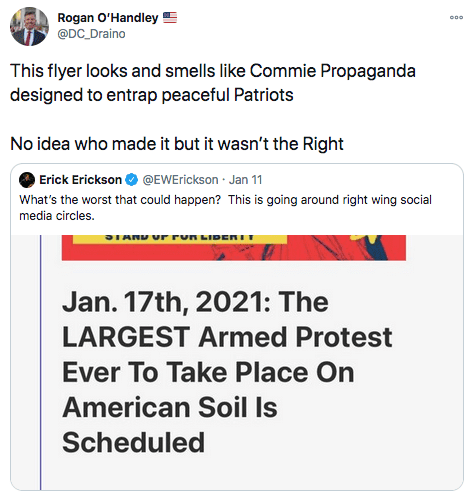
MY STRONG ADVICE, AND ADMIRAL AKBAR’S, IS DON’T ATTEND THESE EVENTS AND DON’T PROMOTE THEM:
MICROBIOME NEWS: Study: Gut microbes could play a role in anorexia.
A TRUMP ACCOMPLISHMENT SO HUGE THAT NO ONE WANTS TO TALK ABOUT IT: The Death of the Arab-Israeli Conflict: A big problem that the Biden administration suddenly won’t have to deal with.
I hope not, but it may come back: As Barack Obama said, never underestimate Joe’s ability to f*ck things up.
WILLIAM VOEGELI IN CITY JOURNAL: About “Whataboutism:” When turnabout is never fair play.
Many things are complicated—but not everything. If you condemned the Antifa/Black Lives Matter violence that took place around the country in 2020, as all conservatives did, then you must condemn the Trumpist riot at the U.S. Capitol in 2021. Period.
Suppose, however, you spent last summer applauding the riots, or dissembling about them, or dismissing them. In that case, to deplore last week’s violence credibly is not so simple. If you demand that your political adversaries adhere to a principle, but exempt people whose cause you endorse from having to comply, then that preference you enjoy boasting about is not really a principle. It is not a standard of conduct applicable to all, in other words, but just another rhetorical device used for political combat.
If you’re Speaker of the House Nancy Pelosi, for example, a question in July about mobs toppling statues in public spaces elicited not a denunciation but a koan: “People will do what they do.” Indeed, people will do what they do. Some people, for example, will break into the Capitol and occupy the Speaker’s office. But limiting oneself to the serene observation that this is what they do would constitute a grave failure to repudiate an offense against law, order, and democracy.
Nikole Hannah-Jones, who won a Pulitzer Prize for creating the New York Times’s “1619 Project,” also expressed equanimity and even pride regarding last year’s unrest. “It would be an honor,” she said, if the burning police stations and looted stores came to be described as the “1619 Riots.” In any case, “Destroying property, which can be replaced, is not violence.” Hannah-Jones went on to explain, “Any reasonable person would say we shouldn’t be destroying other people’s property, but these are not reasonable times.” Reasonable people also say that mobs should not overrun the seat of government or be gratified if someone calls that assault the “1776 Riots.” But if declaring “these are not reasonable times” changes everything, then the loophole devours the rule, or even the idea of having rules.
When protesters surrounded a Seattle police station, forcing officers to evacuate it, and declared the adjacent area an “autonomous zone,” mayor Jenny Durkan was reassuring: “Don’t be so afraid of democracy.” Civic and political leaders in Philadelphia were equally non-judgmental about the shattered glass and boarded stores on their streets. “I don’t think we need to be parsing whether there needs to be looting,” said one city council member. Rioting was “understandable but regrettable,” Jesse Jackson said in June, a quasi-criticism no one would think to apply to the Capitol Hill mob.
In the wake of last week’s riot, formulations like these have become deeply embarrassing. What is to be done? One option would be for the people who put them forward, and their many political allies, to admit the obvious: since riots are bad—utterly, always, and everywhere—justifying them, or praising them with faint damns, is also colossally irresponsible. The people who set last summer’s fires, looted stores, or assaulted motorists and pedestrians should be condemned, and the people who made excuses for their behavior should be ashamed. Reader, you are borne through life with a sunnier view of human nature than I if you are dismayed that no such apologies or retractions have yet been offered.
A different response to conservatives who have started 2021 by rudely calling attention to the riot apologists of 2020 is: Shut Up. A more sophisticated way to say Shut Up is to accuse conservatives whose memories go back more than three months of engaging in “whataboutism.” This is the position of University of Wisconsin political scientist Kenneth R. Mayer, who believes that any public official “who does not immediately and unequivocally condemn [the Capitol riot] without using the words ‘I understand,’ ‘but,’ or any variant suggesting that the rioters had a point but went too far, should forfeit their right to hold public office.” Furthermore, “any elected official who engages in ‘whataboutism,’ or complains that the other side does it too, should leave next.”
Similarly, “Whataboutism is the last refuge for someone who can’t admit they’re wrong,” says journalist Tod Perry, who demands that we “stop equating Trump’s Capitol insurrection to Black Lives Matter protests.”
“Whataboutism” is a deflection-term whose function is to distract from obvious leftist hypocrisy.
SAVE THE CONSTITUTION FROM BIG TECH:
Conventional wisdom holds that technology companies are free to regulate content because they are private, and the First Amendment protects only against government censorship. That view is wrong: Google, Facebook and Twitter should be treated as state actors under existing legal doctrines. Using a combination of statutory inducements and regulatory threats, Congress has co-opted Silicon Valley to do through the back door what government cannot directly accomplish under the Constitution.
It is “axiomatic,” the Supreme Court held in Norwood v. Harrison (1973), that the government “may not induce, encourage or promote private persons to accomplish what it is constitutionally forbidden to accomplish.” That’s what Congress did by enacting Section 230 of the 1996 Communications Decency Act, which not only permits tech companies to censor constitutionally protected speech but immunizes them from liability if they do so.
The justices have long held that the provision of such immunity can turn private action into state action. In Railway Employees’ Department v. Hanson (1956), they found state action in private union-employer closed-shop agreements—which force all employees to join the union—because Congress had passed a statute immunizing such agreements from liability under state law. In Skinner v. Railway Labor Executives Association(1989), the court again found state action in private-party conduct—drug tests for company employees—because federal regulations immunized railroads from liability if they conducted those tests. In both cases, as with Section 230, the federal government didn’t mandate anything; it merely pre-empted state law, protecting certain private parties from lawsuits if they engaged in the conduct Congress was promoting.
Section 230 is the carrot, and there’s also a stick: Congressional Democrats have repeatedly made explicit threats to social-media giants if they failed to censor speech those lawmakers disfavored. In April 2019, Louisiana Rep. Cedric Richmond warned Facebook and Google that they had “better” restrict what he and his colleagues saw as harmful content or face regulation: “We’re going to make it swift, we’re going to make it strong, and we’re going to hold them very accountable.” New York Rep. Jerrold Nadler added: “Let’s see what happens by just pressuring them.”
Such threats have worked. In September 2019, the day before another congressional grilling was to begin, Facebook announced important new restrictions on “hate speech.” It’s no accident that big tech took its most aggressive steps against Mr. Trump just as Democrats were poised to take control of the White House and Senate. Prominent Democrats promptly voiced approval of big tech’s actions, which Connecticut Sen. Richard Blumenthal expressly attributed to “a shift in the political winds.”
For more than half a century courts have held that governmental threats can turn private conduct into state action. In Bantam Books v. Sullivan (1963), the Supreme Court found a First Amendment violation when a private bookseller stopped selling works state officials deemed “objectionable” after they sent him a veiled threat of prosecution. In Carlin Communications v. Mountain States Telephone & Telegraph Co. (1987), the Ninth U.S. Circuit Court of Appeals found state action when an official induced a telephone company to stop carrying offensive content, again by threat of prosecution.
As the Second Circuit held in Hammerhead Enterprises v. Brezenoff (1983), the test is whether “comments of a government official can reasonably be interpreted as intimating that some form of punishment or adverse regulatory action will follow the failure to accede to the official’s request.” Mr. Richmond’s comments, along with many others, easily meet that test. Notably, the Ninth Circuit held it didn’t matter whether the threats were the “real motivating force” behind the private party’s conduct; state action exists even if he “would have acted as he did independently.”
Either Section 230 or congressional pressure alone might be sufficient to create state action. The combination surely is. Suppose a Republican Congress enacted a statute giving legal immunity to any private party that obstructs access to abortion clinics. Suppose further that Republican congressmen explicitly threatened private companies with punitive laws if they fail to act against abortion clinics. If those companies did as Congress demands, then got an attaboy from lawmakers, progressives would see the constitutional problem.
Sure, but that’s different because reasons.
WHY IS HIGHER EDUCATION SUCH A CESSPIT OF RACISM? Broward College promotes ‘teaching Black Lives Matter,’ disparages ‘All Lives Matter.’
SOHRAB AMARI: The GOP-corporate divorce is a blessing for the party’s future.
November’s election revealed that the class realignment of our two parties is solidifying. Democrats have increasingly emerged as the party of upscale suburbs, of Silicon Valley and Hollywood and Wall Street, of the owners of capital and the professionals who service them. The GOP, meanwhile, is trending toward a multiracial working-class party, preferred by those who generally make their living by toil. . . .
The corporate backlash will no doubt scare some Republican faux-populists into dropping even their rhetorical gestures toward the working class. The old guard awaits the wayward prodigal, to return to the comfortable fold of marginal tax cuts and useless foreign wars. Picture Paul Ryan’s wingtips stamped on the face of the American right — forever.
But that would be a monumental mistake, because as 2016 showed and 2020 confirmed, the votes simply aren’t there for that. The old agenda threatened to turn the GOP into a regional rump party (see 2008 and 2012). By contrast, the Trump GOP, warts and all, expanded its appeal to Hispanics and young black men in 2020 while consolidating the white working class.
Today’s Democrats sure don’t represent this multiracial working class. The party and its Big Tech and Big Media allies deliver mostly for the HR department — a k a you’re fired for saying the wrong thing. Mass student-loan forgiveness would end up transferring wealth from everyone else to the cognitive elite. Amazon’s Democratic-approved wokery masks appalling working conditions and union-busting.
Indeed.
NO BAILOUTS FOR THE RICH: Thirty Wealthy Colleges And Universities Are Targeted In Covid Relief Act. “After President Trump and Education Secretary Betsy DeVos criticized giving private colleges and universities with large endowments help in the CARES Act, wealthier institutions like Harvard, Yale and Stanford Universities had their share of the money in the latest coronavirus relief package cut in half. Under a little-noticed provision in the bill passed two weeks ago [The Coronavirus Response and Relief Supplemental Appropriations Act of 2021], private higher education institutions that were required by a 2017 law to pay a 1.4 percent excise tax on net investment income not only had their aid slashed, they were barred from using the money they will get to defray their financial losses from the pandemic. The relief bill allows them only to use the aid on emergency grants to students or to pay for personal protective equipment and other health and safety costs associated with the coronavirus. Higher education received about $23 billion in the legislation.”
FROM THE JOINT CHIEFS OF STAFF: Message to the Joint Force.
Related: QAnon Woke Up The Real Deep State.
PAUL BEDARD: Exclusive: 60% call impeachment a ‘waste of time,’ Big Tech backlash for censoring Trump. “70% believe that technology firms, including Twitter, Facebook, Amazon, Google, and Apple, are too powerful and need to be regulated.”
NOTHING TO SEE HERE, MOVE ALONG: CCP Virus Outbreaks Spread Across North China, as Cities Prepare Emergency Isolation Units. “Despite enacting stringent lockdown measures, Chinese authorities are struggling to contain CCP virus outbreaks throughout northern China. Hebei Province is the hardest-hit, with two cities, Shijiazhuang and Xingtai, seeing the biggest surges in new infections. Authorities have publicized little information despite imposing restrictions on people’s movements and requiring mass testing for COVID-19.”
CULTURE OF CORRUPTION: Before Becoming Boston’s Mayor, Biden’s Labor Pick Was Embroiled in Union Extortion Scandal.
January 12, 2021
LIFE UNDER BIDEN’S SUPPORTERS: Woman describes two years in a Chinese re-education camp. “This is something out of Orwell’s 1984 but it’s happening right now. Perhaps a million people have been through this dehumanizing process and many of them are not just being brainwashed, they are forced to work in prison factories.”
But China supports the “right” party in the United States, so shut up.
SEEN ON FACEBOOK: “Look. The Woolworths lunch counter in Greensboro, North Carolina is a private company. They can do what they want.”
I PREDICT IT WILL: If Global Corporations Walk Away from Republicans the GOP Will Have to Listen to New Voters. “A significant majority of Americans, 73%, have a negative view of China. Continued international integration will hurt working and middle-class Americans the most. If Republicans plan on winning elections, these are the voters they will have to both listen to and appeal to. The party will need to develop a slate of policies that increase these families’ prosperity and security to combat the destruction that Democrats and their allies in big business will do with horrible energy and trade policy.”
PERRY DE HAVILLAND: Take action now… because choices will be made for you if you do not.
If you do not hold the ‘correct views’, the time is rapidly approaching that you need to find alternative venues for expressing those views. So set up your own blog (& do NOT host it with a company owned by Big Tech) and/or set up accounts on alternative platforms that do not depend on the very worst of Big Tech.
It is only a matter of time before Twitter, Google & Amazon makes the decision for you, either kicking you off platforms they own directly or taking down other platforms they disapprove off by denying them hosting. Gab and Parler can be accessed via the web, and the Parler app can still be installed on Android devices. It’s a quick and easy process.
And if you are still using an iPhone and want the app… consider making your current iPhone your final iPhone.
Dissenting views are under attack and the people doing the attacks do not even need to hide the fact anymore.
Indeed.