
BIG WINNER: FORD F-150S WITH GENERATOR OUTPUT. BIG LOSER: GREEN POWER. Did Wind Power Fall Hard During the Great Texas Storm? Yep. Twice. Yeah, it wasn’t just the green power that failed, but it failed bigly.
Author Archive: Glenn Reynolds
February 20, 2021
THAT’S DIFFERENT BECAUSE SHUT UP: China Built Three Times as Much Coal Power in 2020 as the Rest of the World Combined.
CHIEF CLOWN AT THE COVID CLOWN SHOW: We Have Another Fauci Reversal…This Time on the COVID Vaccine. “I gave Dr. Anthony Fauci the benefit of the doubt. I should have known such investments would have incurred massive losses at the close of trading. Fauci is arrogant. He loves to hear himself talk, and that 60 Minutes interview where he lamented about political division was just rich. Look in the mirror, pal. You and your people caused a lot of it with your drivel about COVID. The mask advice was a train wreck and now you’re doing the same with vaccines. What just broke about the vaccine and transmission is exactly the opposite of what Fauci had said previously. It all looks politically motivated and that’s because it is.”
JIGGERY-POKERY: Joe Biden’s $1.9 trillion conjuring trick.
BAEN’S TONI WEISSKOPF: Editor extraordinaire.
HEY, GROVER CLEVELAND DID IT: Ben Carson: ‘Of course’ Trump can come back in 2024.
Yet West added the 2019 study, published in Aggressive Behavior and led by psychologist Qian Zhang of Southwest University of Chongqing, to his meta-analysis after a reviewer asked him to cast a wider net. West didn’t feel his vague misgivings could justify excluding it from the study pool. But after Aggressive Behavior published West’s meta-analysis last year, he was startled to find that the journal was investigating Zhang’s paper while his own was under review.
It is just one of many papers of Zhang’s that have recently been called into question, casting a shadow on research into the controversial question of whether violent entertainment fosters violent behavior. Zhang denies any wrongdoing, but two papers have been retracted. Others live on in journals and meta-analyses—a “major problem” for a field with conflicting results and entrenched camps, says Amy Orben, a cognitive scientist at the University of Cambridge who studies media and behavior. And not just for the ivory tower, she says: The research shapes media warning labels and decisions by parents and health professionals.
The investigations were triggered by Illinois State University psychologist Joe Hilgard, who published a blog post last month cataloging his concerns about Zhang’s work. Hilgard was initially impressed when he came across a 2018 paper of Zhang’s in Youth & Society, another study with 3000 subjects. “I was like, holy smokes!” he says. The study found some teenagers were more aggressive after playing violent video games. Given the huge sample size, it had the potential to be a “powerful chunk of evidence,” Hilgard says.
But he found the paper’s statistics mathematically impossible. Zhang and his co-authors reported high levels of statistical significance for their finding, but the reported differences in the effects of violent games versus nonviolent games were too small for that high statistical significance to be possible. Hilgard alerted Zhang and the journal, and Zhang submitted a correction. Hilgard says that made the statistics seem more plausible, but they were still incorrect.
Hilgard says he found problems in other papers of Zhang’s, such as nearly identical results reported in three different papers. He emailed Zhang and asked to see his data, but he says Zhang refused. Hilgard then contacted Dorothy Espelage, a psychologist at the University of North Carolina, Chapel Hill, and co-author with Zhang on multiple papers. She told Hilgard that Zhang had refused to send her the data, too. It was only after Hilgard asked Southwest University to investigate that Zhang sent Hilgard data for a Youth & Society paper on movie violence.
But the data were odd, Hilgard says, and missing features normally found in similar experiments. He sent his findings to Zhang’s university, which said it found problems, but not fraud, with Zhang’s data, and that Zhang was “deficient in statistical knowledge and research methods.” Dissatisfied with the response, Hilgard sent his observations to all the journals involved.
Modern science has a lot more bad research than it should, because the rewards for research are so high, and not especially dependent on its quality.
EVERYTHING IS GOING SWIMMINGLY: Rasmussen: 54% of Voters Say Biden Is a ‘Puppet’ of the Left. Only 40% disagree. The statement they were asked to agree/disagree with was this: “Joe Biden’s not the moderate nice guy that they made him out to be. He’s a puppet of the radical left.”
TO SOME, THAT’S NOT A BUG, BUT A FEATURE: Universities’ Insane COVID Rules and Snitch Culture Are Training the Next Generation to Embrace Totalitarianism.
February 19, 2021
HONOR: Florida Gov. Ron DeSantis: Flags to fly at half-staff for Rush Limbaugh. Hey, he was Florida’s most-famous and most-loved citizen.
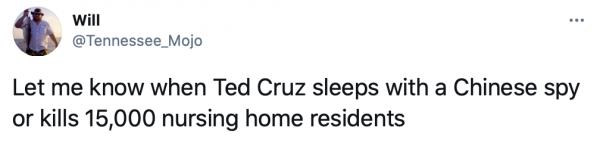
WELL, IT’S NOT LIKE HE’S A DEMOCRAT, SO SURE:
OPEN THREAD: It’s Friday.
FROM POPULIST TO DISSIDENT.
THERE’S NOTHING MORE WOKE THAN ERASING SUCCESSFUL BLACK WOMEN: Aunt Jemima rebranding rankles family of some women who portrayed her, who say they’re being erased.. “Let’s put it in context of what it really actually is, a propaganda campaign.”
Except, maybe, erasing successful black men.
HIGHER EDUCATION BUBBLE UPDATE: Whistleblower at Smith College Resigns Over Racism.
SINGLE-DOSE RESPONSE: Pfizer first dose 85% effective after 2-4 weeks: study.
SO MUCH THAT WE’RE TOLD IS WRONG: Only eat organic? You’re paying too much, and it’s not worth it, author says.
FLIGHT: The Air Force Finally Has Its First New AT-6E Wolverine Light Attack Aircraft. “The most immediately visible difference between the AT-6E, which Beechcraft has marketed in the past as the AT-6B, AT-6C, or simply the AT-6, and standard Texan II trainers are its six underwing pylons. These can accommodate various precision-guided bombs and missiles, as well as rocket and gun pods, among other stores. It has an additional station under the fuselage, which is typically occupied by a sensor turret containing electro-optical and infrared cameras. The Air Force’s model reportedly has a WESCAM MX-15D turret, which also includes a laser designator, from L3Harris.”
FIGHTING “MISINFORMATION.” Facebook will soon add labels, links to posts about climate change. “Facebook announced on Thursday that it will soon begin labeling posts related to climate change and directing users to a central information page, as part of a greater effort to weed out misinformation about the environmental crisis.”
“Misinformation” sounds CCP-ish, and simply refers to things that contradict the preferred official narrative.
Many members of the media, including and especially those who report on tech, fret constantly about the potential for inaccurate speech to appear on social media. Their complaints frequently expose their own biases: Times tech reporter Kevin Roose once tweeted that “Facebook is absolutely teeming with right-wing disinformation right now,” and linked to four news stories that had attracted significant web traffic on the platform. But the headlines of all four were accurate, as Roose later conceded—a particularly powerful example of an emerging phenomenon in which journalists label something as disinformation or misinformation, not because it is false, but because they don’t want the American public to hear or read it.
Yes.
HILLARY LEADS WITH HER CHIN:



THINGS THAT WOULD BE BIGGER NEWS IF TRUMP HAD BEEN RE-ELECTED: Jobless Claims Jump to 861,000, Much Worse Than Expected. We’re back to “unexpectedly!” I guess.