
A FRIEND COMMENTS: Every day they keep making the case to stop listening to them. WHO Urges Fully Vaccinated People To Continue Wearing Masks As Delta Variant Spreads.
Author Archive: Glenn Reynolds
June 27, 2021
OOPS: Police hunt for female Tour de France spectator, who is on the run and faces up to a year in PRISON after causing a massive crash with her placard… and organisers want to sue her after 21 riders were injured. I caught a clip of the crash on TV yesterday, but the overhead shot is awe-inspiring.
THE SHELDON WHITEHOUSE RACISM SCANDAL CONTINUES: Photos Show Whitehouse Attending Social Event at All-White Beach Club: R.I. senator denied he’s a member of the club earlier this week.
THE PUBLIC DOES NOT SHARE THE VIEWS OF THE POLITICAL CLASS: Harvard poll: 80% see border disaster, want Trump closure restored, reject teaching critical race theory.
The political class knows this, and is doing its best to ensure that what the public wants doesn’t matter.
THE NEW SPACE RACE: Chinese Space Station a Looming Threat to US, Experts Say.
COLLUSION? COLLABORATION? DEFINITELY EVIL. Nike CEO says sports giant is ‘a brand of China and for China’ in earnings call amid concerns corporate America is too close to Beijing.
THE LOVELY PEOPLE WANT TO FIT IN, AND SINCE OUR GENTRY CLASS BELIEVES A LOT OF STUPID AND EVIL THINGS, SO DO THEY: All The Lovely People.
June 26, 2021
OPEN THREAD: Here, for your delectation.
A NEW SPACEFARING NATION: Papua New Guinea?
International space law and the treaty regime have remained largely theoretical constructs for most of the Space Age. While great for moot-court exercises or the occasional congressional hearing on treaty obligations, their real-world applications were scarce. Yet those of us who have practiced commercial space law have long warned that a time would come when “Space Law 101” would play an important part in opening the high frontier.
That time is now. The FCC faces a decision that goes beyond whether to grant AST & Science a “market access” request for a new constellation of non-geostationary spacecraft in the crowded 700-kilometer orbit. Far more important is whether the FCC will require companies seeking authority to operate in the United States to be licensed by countries which agree to be bound by the norms of international space law.
The AST & Science application itself is problematic enough, with its 243 gigantic satellites each with a cross-section of 450 square meters. NASA initially filed a report raising significant concerns with this application, arguing that the number and size of the satellites in the AST constellation posed a significant risk and would cause NASA to “experience a very large number of satellite conjunctions, certainly with debris objects and potentially with A-Train satellites themselves, both as part of the AST satellites’ ascent/descent to on-orbit locations and during regular operations.”
TechFreedom filed comments raising similar concerns, adding that AST & Science has zero experience building large structures in space.
But the greater problem is that rather than seek a license directly from the FCC for their enormous satellites, AST & Science got a license for its system from Papua New Guinea (PNG). This is more than a “flag of convenience” situation, however, as PNG has signed neither the 1971 Liability Convention nor the 1974 Registration Convention. While PNG has signed the 1967 Outer Space Treaty (OST), those latter two treaties are what put actual “meat on the bone” of the OST. Choosing not to sign these leaves PNG outside of the sphere of countries which have agreed to both norms of governance and resolution procedures for outer space disputes.
In short, PNG has not stepped up to accept specific international responsibility or liability for the activities of commercial entities it has licensed.
Well, under the Outer Space Treaty, the launching state retains responsibility for those things, and they’re not going to be launching from Papua New Guinea any time soon.
WHY NAME A LAW SCHOOL CHAIR AFTER SOMEONE WHO WAS DISBARRED FOR OBSTRUCTION OF JUSTICE? Flap over ‘Clinton’ change.
In 1999 the University of Arkansas at Little Rock’s Bowen Law School established an endowed professorship called the “Distinguished Professor of Law and Public Policy.” It’s since been available for a five-year term to UALR faculty members who apply, though held solely since inception by soon-to-retire Professor John DiPippa.
I’m told DiPippa and the dean of the law school several months ago began calling this appointed position the “William J. Clinton Professor of Constitutional Law and Public Service.” It appears the decision to rename (and seemingly refocus) the professorship after Clinton was made without the current faculty’s involvement.
Normally when you rename a chair, there’s a big donation involved. Rather doubt Bill has ponied up anything.
UPDATE: A friend emails: “Will it have interns?”
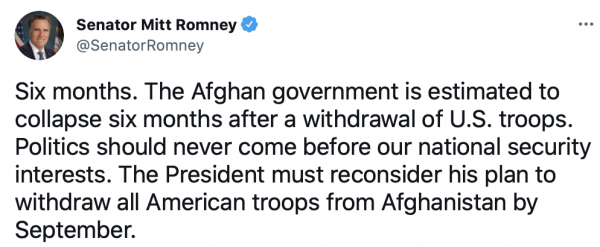
WELL, MITTENS, YOU OPPOSED A PRESIDENT WHO WAS WORKING AGAINST THE CHINESE COMMUNIST PARTY, IN FAVOR OF ONE OWNED BY IT:

SCIENCE: Massive human head in Chinese well forces scientists to rethink evolution.
Analysis of the remains has revealed a new branch of the human family tree that points to a previously unknown sister group more closely related to modern humans than the Neanderthals.
The extraordinary fossil has been named a new human species, Homo longi or “Dragon man”, by Chinese researchers, although other experts are more cautious about the designation.
“I think this is one of the most important finds of the past 50 years,” said Prof Chris Stringer, research leader at the Natural History Museum in London, who worked on the project. “It’s a wonderfully preserved fossil.”
The skull appears to have a remarkable backstory. According to the researchers, it was originally found in 1933 by Chinese labourers building a bridge over the Songhua River in Harbin, in China’s northernmost province, Heilongjiang, during the Japanese occupation. To keep the skull from falling into Japanese hands it was wrapped and hidden in an abandoned well, resurfacing only in 2018 after the man who hid it told his grandson about it shortly before he died. . . .
Mark Maslin, a professor of earth system science at UCL and the author of The Cradle of Humanity, said: “The beautifully preserved Chinese Harbin archaic human skull adds even more evidence that human evolution was not a simple evolutionary tree but a dense intertwined bush. We now know that there were as many as 10 different species of hominins at the same time as our own species emerged.
“Genetic analysis shows that these species interacted and interbred – our own genetics contain the legacy of many of these ghost species. But what is a sobering thought, is that despite all this diversity, a new version of Homo sapiens emerged from Africa about 60,000 years ago which clearly out-competed, out-bred, and even out-fought these other closely related species, causing their extinction. It is only by painstaking searching and analysis of their fossils, such as the Harbin skull, do we know of their existence.”
That’s less surprising if you think about how people are today.
IT’S COME TO THIS: Biden Administration Imposes Cruel Border Restriction Barring Mexicans from Crossing to the US to Sell Blood Plasma. “By exacerbating an already severe blood plasma shortage, the new policy will cost lives – and also deprive poor Mexicans of much-needed income.”
NEWS YOU CAN USE: Why You Should Carry a Handgun Every Day.
BUT WITH THE WORLD’S MEDIA AND ELITES BOUGHT OFF, WHO WILL DO ANYTHING? New Research Shows Extent of China’s Cover-Up of COVID-19’s Origins.
OUT: PUFFY SHIRTS. IN: PUFFY SAILS. Michelin Puts Puffy Sails on Cargo Ships.
SHALLOWNESS ON PARADE: “Sometimes one just slams right up against the horrific shallowness of legal scholarship, and you can only hope to have kept enough of your wits about you to feel a slight pain. And so I twinge as I read Isaac Chotiner in The New Yorker.”
THIS SEEMS TO BE THE EMERGING CONSENSUS: Lockdowns were not effective in slowing COVID spread, engineering professor concludes.
HOSTILE EDUCATIONAL ENVIRONMENT: Stanford U prof, Antifa leader plans ‘broad, visible and loud network’ against campus conservatives.